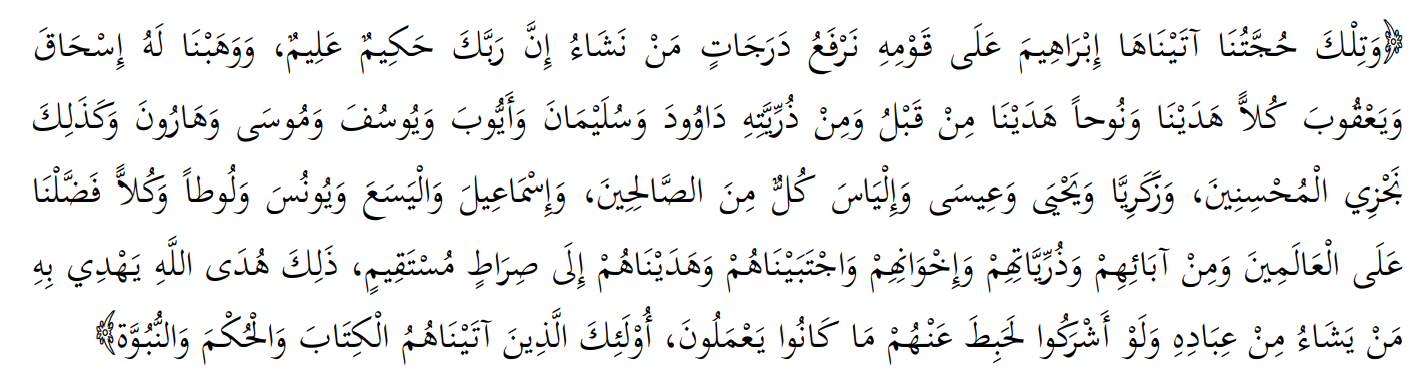
2.13 The Prophets And Messengers
‘Prophet’ (nabi) and ‘Messenger’ (rasul) are two contrastive terms but they share in the respect that a shari’a is revelaed to both of them. The difference between the Messenger and the prophet is that the former is inspired with a Sharī’ah which he is commanded to propagate, whereas the latter, i.e. the prophet is also inspired, but commanded to propagate the Sharī’ah of the messengers. In other words, the messenger is commanded to propagate the Sharī’ah himself, whilst the prophet propagates the Sharī’ah of the messengers.
Qadi al-Baydawi in commentary of the saying of Allah ,
"Never did we send an apostle or a prophet before thee, but, when he framed a desire" [TMQ Hajj: 52];
Says, ‘The messenger is sent by Allah with a revived or new Sharī’ah which he calls people to, whereas the prophet is sent by Allah to affirm the former Sharī’ah.’ Thus, Musa was a prophet because he was inspired with a Sharī’ah and a messenger because this Sharī’ah was for his mission. On the other hand, although Aaron was also a prophet because he was inspired with a Sharī’ah, he was not a messenger because the Sharī’ah, which was revealed to him was not for his mission, rather it was for the mission of Musa . By the same token, Muhammad was a prophet and a messenger because he was inspired with a Sharī’ah, which was for his mission.
The message is the mediation between Allah and the slaves in order to explain and clarify the method of satisfying the needs of this world and the hereafter. Wisdom necessitates the sending of messengers as they bring laws and benefits for people.