2.2 Seine Schlichtheit und Demut
2.2 His Simplicity and Humility
Die einfache, bescheidene Lebensweise des Propheten ﷺ ist ein deutlicher Hinweis darauf, dass seine Sendung nicht eigennützig sein konnte, besonders im Vergleich mit den dekadenten, verschwenderischen Lebensweisen so vieler falscher Propheten in der Weltgeschichte. Schließlich war dies ein Mann, der am Ende seines Lebens ganz Arabien beherrschte. Schon davor hatte er Tausende von Anhängern in Madinah, Anhänger, die ihm verfallen waren und für ihn alles auf der Welt getan hätten. Dennoch finden wir in keinem Bereich seines Lebens Anzeichen von Luxus.
The simple, austere lifestyle of the Prophet صلى الله عليه وسلم is a major indication that his mission could not have been self-serving, especially when contrasted with the decadent, extravagant lifestyles of so many false prophets in world history. After all, this was a man who controlled all of Arabia by the end of his life. Even before that, he had thousands of followers in Madinah, followers who obsessed over him and would have done anything in the world for him. Yet, we see no signs of luxury in any sphere of his life.
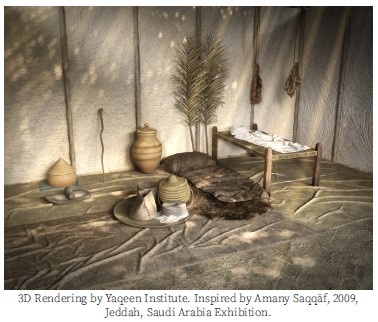
Seine Wohnräume waren so eng, dass er, wenn er beten wollte, ʿĀ’ischa antippte, damit sie ihre Beine anzog und ihm Platz zum Niederwerfen machte. Zum Trinken oder Waschen griff er nach dem kleinen Lederwasserschlauch, der in seinem Zimmer hing. Monatelang wurde in seinem Haus kein Feuer zum Kochen entzündet, und seine Familie war mit Datteln und Wasser zufrieden, sofern nicht jemand ihnen Milch schenkte.58 ʿUmar ibn al-Chattāb berichtet, dass er einmal in das Zimmer des Gesandten Allahs ﷺ trat und ihn liegend antraf. Dabei bemerkte er, dass die raue Strohmatte unter ihm Spuren an seiner Seite hinterlassen hatte. Als er dies sah, dazu die kargen Rationen aus Gerste und Blättern und den Lederbeutel, der in der Ecke hing, traten ihm Tränen in die Augen. Der Prophet ﷺ sagte: „Was lässt dich weinen, Sohn des al-Chaṭṭāb?“ Er sagte: „O Prophet Allahs, wie könnte ich nicht weinen, wenn ich sehe, wie die Matte diese Spuren an deiner Seite hinterlassen hat und wie wenig du in deinem Vorratsschrank hast? Cäsar und Chosroes leben inmitten von Früchten und Wasserquellen, während du der Gesandte Gottes und Sein Erwählter bist und dennoch in diesem Zustand lebst.“ Der Prophet ﷺ sagte: „Sohn des al-Chaṭṭāb, freut es dich nicht, dass diese [Annehmlichkeiten] für uns im Jenseits und für sie in dieser Welt bestimmt sind?“ Ich sagte: „Gewiss.“59 In einer anderen Überlieferung begann er seine Antwort mit: „Zweifelst du, Sohn des al-Chaṭṭāb? Das sind Menschen, deren Genüsse im Leben dieser Welt vorweggenommen wurden.“60
His living quarters were so tight that when he صلى الله عليه وسلم wished to pray, he would tap ‘Āishah to bend her legs to make room for him to prostrate. To drink or bathe, he would reach for the small leather water skin that hung in his room. For months on end, no fire would be kindled for cooking in his home, and his family was content with dates and water unless someone gifted them some milk.58 ‘Umar ibn al-Khattāb reports that he once entered the room of the Messenger of Allah صلى الله عليه وسلم to find him lying down and noticed that the coarseness of the straw mat under him had left marks on his side. Upon noticing that, and the meager rations of barley and leaves, and the leather bag hanging in the corner, his eyes welled with tears. The Prophet صلى الله عليه وسلم said, “What makes you weep, O son of al-Khaṭṭāb?” He said, “O Prophet of Allah, how can I not cry after seeing how the mat has left these marks on your side, and how little you have in your food cupboard? Caesar and Chosroes live surrounded by fruits and springs of water, while you are the Messenger of God and His chosen one, and yet this is your condition.” The Prophet صلى الله عليه وسلم said, “O son of al-Khaṭṭāb, does it not please you that these [luxuries] are for us in the Hereafter and for them in this world?” I said, “Of course.”59 In another narration, he began his response with, “Are you in doubt, O son of al-Khaṭṭāb? These are a people whose pleasures have been expedited in the life of this world.”60
58 al-Bukhārī, Ṣaḥīḥ al-Bukhārī, 8:97 #6459.
58 al-Bukhārī, Ṣaḥīḥ al-Bukhārī, 8:97 #6459.
59 Muslim, Ṣaḥīḥ Muslim, 2:1105 #1479.
59 Muslim, Ṣaḥīḥ Muslim, 2:1105 #1479.
60 al-Bukhārī, Ṣaḥīḥ al-Bukhārī, 3:133 #2468.
60 al-Bukhārī, Ṣaḥīḥ al-Bukhārī, 3:133 #2468.
61 Edward Gibbon, Decline and Fall of the Roman Empire: Volume the Fifth (London:
61 Edward Gibbon, Decline and Fall of the Roman Empire: Volume the Fifth (London:
Electric Book Co, 2001), Kapitel L, 252.
Electric Book Co, 2001), chapter L, 252.
62 Ebd., 251-252.
62 Ibid., 251-252.
63 Washington Irving und Bertram R. Davis, The Life of Mahomet (London: G.
63 Washington Irving and Bertram R. Davis, The Life of Mahomet (London: G.
Routledge & Co, 1850), 186-187.
Routledge & Co, 1850), 186-187.
64 Ebd., 203.
64 Ibid., 203.
65 al-Tirmidhī, Sunan al-Tirmidhī, 5:90 #2754; von al-Tirmidhī in den Anmerkungen als authentisch (ṣaḥīḥ) bewertet.
65 al-Tirmidhī, Sunan al-Tirmidhī, 5:90 #2754; authenticated by al-Tirmidhī in the comments.
66 Bosworth Smith, Mohammed and Mohammedanism (London: Smith, Elder, and Co., 1874), 235.
66 Bosworth Smith, Mohammed and Mohammedanism (London: Smith, Elder, and Co., 1874), 235.
Muslim, Ṣaḥīḥ Muslim, 1:1 #8.
67 Muslim, Ṣaḥīḥ Muslim, 1:1 #8.