2.7 Al-Qadā’ Wa‘l-Qadar
2.7 Al-qadā’ Wa‘l-qadar
Al-qadā' wa'l-qadar, mit diesem Namen, das heißt durch die Verbindung zweier Wörter zu einer Bedeutung, hat einen bestimmten Bezugspunkt; das heißt, al-qadā' verbunden mit al-qadar, indem sie zwei einander begleitende Sachverhalte bilden, bei denen das eine vom anderen nicht trennbar ist, und sie haben eine Bedeutung, die ausschließlich ihnen zukommt. Es ist nicht richtig, darin etwas anderes als diese Bedeutung einzubeziehen, die weder von den Sahabah noch von den Tabi'een verwendet wurde. Bei der Untersuchung der schariatischen und sprachlichen Texte sowie der Aussprüche der Sahabah, der Tabi'een und derjenigen, die nach ihnen kamen, von den Gelehrten, zeigt sich, dass die Begriffe al-qadā' wa'l-qadar zusammen von keinem der Sahabah oder Tabi'een mit einer bestimmten fachlichen [istilāhī] Bedeutung gebraucht wurden, und sie sind auch im Qur'ān oder im Hadīth nicht zusammen mit einer bestimmten fachlichen Bedeutung vorgekommen; wohl aber sind sie zusammen in ihrer sprachlichen Bedeutung in dem vorgekommen, was al-Bazzār mit einer hasan-Kette von Jābir auf die Autorität des Propheten ﷺ überliefert hat, dass er sagte:
Al-qadā’ wa‘l-qadar, with this name, that is, by connecting two words together for one meaning, has a specific referent; that is, al-qadā’ linked to al-qadar, by making them two concomitant matters whereby one is not separable from the other, and they have a meaning that is exclusive to them. It is not correct to include in it other than this meaning which has not been used by the Sahabah or the Tabi’een. By studying the shar’i and linguistic texts and studying the sayings of the Sahabah, Tabi’een and those who came after them from the Ulama’, it is apparent that the terms al qadā’ wa‘l-qadar together, have not been used with a specific technical [istilāhī] meaning by any of the Sahabah or Tabi’een, nor have they come together with a specific technical meaning in the Qur’ān or the Hadīth; though they have come together in their linguistic meaning in what al Bazzār reported from the hadīth of Jabir with a hasan chain on the authority of the Prophet (PBUH) that he said:
„Die meisten meiner Umma sterben nach dem qadā’ Allahs und seinem qadar mit ihren Seelen [anfūs].“
“Most of my Ummah die after the qadā’ of Allaah and his qadar with the souls [anfūs].”
Daher ist diese terminologische Bedeutung, die auf diesen Begriff anspielt, nur bei den Mutakallimūn zu finden, nachdem das erste Jahrhundert vergangen war und nachdem die griechische Philosophie übersetzt worden war. Sie existierte nicht zur Zeit der Sahabah, und es gab auch keinen Streit oder keine Diskussion über diese beiden Begriffe als einen Namen für eine bestimmte fachliche Bedeutung. In der gesamten Epoche der Sahabah kannten die Muslime den Ausdruck ‚al-qadā’ wa‘l-qadar‘ nicht, obwohl das Wort qadā’ für sich allein vorkam und das Wort qadar für sich allein in den Ahadith vorkam, ebenso wie beide zusammen im bereits erwähnten Hadith von Jabir vorkamen. In all diesen Fällen wurden sie jedoch in ihrer sprachlichen Bedeutung verwendet, nicht in ihrer fachlichen Bedeutung. Das Wort qadā’ kommt im Hadith über das Qunut vor. Al-Hasan sagte: Der Gesandte Allahs ﷺ lehrte mich Worte, die ich im Qunut des Witr spreche, dann erwähnte er das Bittgebet des Qunut, dessen Wortlaut lautet:
Therefore this terminological meaning which alludes to this name is not found except from the Mutakallimūn, after the first century had passed and after the translation of the Greek philosophy. It did not exist in the time of the Sahabah nor was there any dispute or discussion of those two terms as one name for a specific technical meaning. Throughout the era of the Sahabah the Muslims did not know of ‘al-qadā’ wa‘l-qadar’ though the word qadā’ had come on its own and the word qadar had come on its own in the ahadīth just as the two had come together in the aforementioned hadīth of Jabir, but in all of these cases they had come in the linguistic meaning. They have not come in the technical meaning. The word qadā’ has come in the hadīth of al-qunut. Al-Hasan said, the Messenger of Allah (PBUH) taught me words I say in the qunut of the witr, then he mentioned the du’a of qunut, of which is,
„...und bewahre mich vor dem, was Du bestimmt hast, denn Du bist derjenige, der bestimmt, und über Dich wird nicht bestimmt." [Reported by al-Darimi , Narrated by al-Hasan ibn Ali]
“...and save me from what You have decreed, for You are the one Who Decrees and you are not decreed upon,” [Reported by al-Darimi , Narrated by al-Hasan ibn Ali]
Seine Bedeutung lautet: Bewahre mich vor dem Übel dessen, was Du bestimmt hast, denn Du bestimmst, was Du willst, und niemand bestimmt über Dich. Das Wort qadar ist im Hadith von Jibrīl in einigen seiner Überlieferungen vorgekommen. Er sagte:
Its meaning is, protect me from the evil of what you have judged, for you judge what you wish and no one judges over you. The word qadar has come in the hadīth of Jibrīl in some of its narrations: He said,
„Und an die Vorherbestimmung (al-qadar) zu glauben, sowohl an ihr Gutes als auch an ihr Schlechtes.“ [Reported by Muslim, Narrated by Umar ibn al-Khattab]
“And to believe in al-qadar, the good and the bad thereof”, [Reported by Muslim, Narrated by Umar ibn al-Khattab]
Und in seinem Ausspruch
And in his saying
„…Wenn dir etwas widerfährt, sag nicht: ‚Hätte ich das getan, wäre es so und so gekommen‘, sondern sag: ‚Allah hat es bestimmt [qaddara], und Er hat getan, was Er wollte.‘“ [Reported by Muslim, Narrated by Abu Hurairah]
“…If anything befalls you do not say, ‘had I done (this), it would have been such-and-such, but rather say, ‘Allah determined [qaddara] and He did what He willed,’”[Reported by Muslim, Narrated by Abu Hurairah]
Die Bedeutung des Wortes qadar in diesen beiden Ahādīth ist die Bestimmung [taqdīr] und das Wissen Allahs, das heißt, dass du glauben sollst, dass die Dinge von Allah im Lawḥ al-Maḥfūẓ niedergeschrieben wurden und Er sie kennt, bevor sie entstehen, seien sie gut oder schlecht; und zu sagen: Allah hat dies im Lawḥ al-Maḥfūẓ niedergeschrieben, und Er wusste es, bevor es entstand, und Er tat, was Er wollte. Das Wort al-qadā’ in der Bedeutung, in der es in diesem Ḥadīth oder überall sonst vorkam, war unter den Muslimen nicht umstritten; sie führten keine Diskussionen hinsichtlich seines Wortlauts oder seiner Aussage.
The meaning of the word qadar in these two ahadīth is the Determination [taqdīr] and Knowledge of Allah , that is, that you should believe that the things have been written by Allah in the Lawh al-Mahfūdh and He knows of them before they come into existence, whether they be good or bad; and say Allah has written this in the Lawh al-Mahfūdh and he knew it before it came into being and he did what he wished. The word al-qadā’ in the meaning which it came in this hadīth or anywhere else it came was not disputed by the Muslims; they did not have discussions with regards to its wording or its import.
Was das Wort qadar in der Bedeutung betrifft, die in jenen beiden Ahadith genannt wird, so waren sich die Muslime vor dem Aufkommen der griechischen Philosophie darüber nicht uneins und führten keine Diskussionen über seine Formulierung oder Aussage. Nach dem Aufkommen der griechischen Philosophie unter den Muslimen entstand jedoch eine Gruppe aus Kufa, die sagte: Es gibt kein qadar, das heißt, es gibt niemanden, der vorherbestimmt, und alles geschieht ohne jede vorherige Bestimmung. Sie wurden die Qadariyyah genannt, und sie sind diejenigen, die das qadar leugnen und sagen, Allah habe die Grundlagen der Dinge erschaffen und sie dann sich selbst überlassen, sodass Er die Einzelheiten [juz'iyāt] nicht kenne. Dies widerspricht dem, was im eindeutigen Wortlaut des Qur'ān gekommen ist, der besagt, dass Allah der Schöpfer aller Dinge ist, kleiner wie großer, grundlegender wie nebensächlicher, und dass Er alles vor seinem Dasein bestimmt hat, das heißt, Er hat es in der Lawh al-Mahfūdh niedergeschrieben, das heißt, Er wusste es, bevor es entstand. Er sagte:
As for the word qadar in the meaning mentioned in those two ahadīth, the Muslims, before the presence of Greek philosophy, did not disagree about it or have discussions with regards to its wording or import. But after the presence of the Greek philosophy amongst the Muslims, a group from Kufa arose and said: there is no qadar, that is, there is no one who (pre)determines and everything occurs without any previous determination; they were called the Qadariyyah and they are the ones who deny the qadar and say that Allah created the fundamentals of things and then left them, so He does not have knowledge of their particulars [juz'iyāt]. This is contrary to what has come in the clear text of the Qur’ān which states that Allah is the Creator of all things, small or big, fundamental or branchial, and that He determined everything before its existence, that is, He wrote it in the Lawh al-Mahfūdh, that is, He knew it before it came to be. He said:
„Er hat alle Dinge erschaffen, und Er ist der Allwissende über alles.“ [TMQ-An’ām: 101]
“He created all things and He is the All-Knower of everything” [TMQ-An’ām: 101]
Und
And
„Und Er weiß, was auf dem Land und im Meer ist. Kein Blatt fällt, ohne dass Er es weiß. Es gibt kein Korn in der Finsternis der Erde, nichts Frisches und nichts Trockenes, das nicht in einem deutlichen Buch verzeichnet wäre.“ [TMQ-An’ām: 59]
“And He knows whatever there is in the Earth and in the sea: not a leaf falls, but He knows it. There is not a grain in the darkness of the Earth nor anything fresh or dry, but is written in a Clear Record.” [TMQ-An’ām: 59]
Dieser Meinungsunterschied und diese Diskussion betreffen jedoch nur das „Qadar Allahs“ im Sinne Seines Wissens. Die Qadariyyah behaupteten also, Allah wisse die Grundlagen der Dinge, nicht aber deren Einzelheiten, während der Islam lehrt, dass Allah sowohl die Grundlagen der Dinge als auch deren Einzelheiten kennt. Die Diskussion über das Qadar Allahs, also Sein Wissen, betrifft somit den Gegenstand des göttlichen Wissens. Dieser Gegenstand unterscheidet sich von dem des al-qadā’ wa‘l-qadar. Es handelt sich um eine andere Diskussion, getrennt von der Diskussion über al-qadā’ wa‘l-qadar. Ihrer tatsächlichen Wirklichkeit nach ist es ebenso ein anderes Thema als das des al-qadā’ wa‘l-qadar.
However, this disagreement and discussion is only with respect to the ‘qadar of Allah’ in terms of His Knowledge. So the Qadariyyah claimed that Allah knows the fundamentals of things but not their partial aspects, whilst Islam states that Allah knows the fundamentals of things as well as their partial aspects. Thus, the discussion with respect to the qadar of Allah , that is, His Knowledge, is about the subject of Allah's Knowledge. It is a subject different to that of al-qadā’ wa‘l-qadar. It is a different discussion, separate from the discussion of al-qadā’ wa‘l-qadar. Its reality that took place is the same, that is, it is a different subject to that of al-qadā’ wa‘l-qadar.
Somit ist offensichtlich, dass die Wörter al-qadā’ und al-qadar jeweils für sich mit einer eigenen, bestimmten Bedeutung vorkommen. Sie haben keinerlei Bezug zur Lehre von al-qadā’ wa’l-qadar. Mit anderen Worten: Das Wort al-qadā’ in all seinen sprachlichen und scharʿî-Bedeutungen, die vom Gesetzgeber überliefert sind, und das Wort al-qadar in all seinen sprachlichen und scharʿî-Bedeutungen, die vom Gesetzgeber überliefert sind, haben keinen Bezug zu diesen Begriffen, ob sie allein oder zusammen erwähnt werden, wenn es um die Erörterung von al-qadā’ wa’l-qadar geht. Ihre Bedeutung ist auf das beschränkt, was sie an sprachlichen und scharʿî-Bedeutungen mit sich bringen.
Thus, it is plainly apparent that the words al-qadā’ and al-qadar have each come on their own with each having a specific meaning. They do not have any relation with the study of al-qadā’ wa‘l qadar. In other words, the word al-qadā’ in all its linguistic and shar’i meanings that have come from the Legislator, and the word al-qadar in all its linguistic and shar’i meanings that have come from the Legislator, have no relation to any of these terms, whether mentioned alone or together, in the discussion of al-qadā’ wa‘l-qadar. They are confined with regards to their meaning, to that what they come with from the linguistic and shar'i meanings.
Die Verse, die auf die Kenntnis Allahs hinweisen, sind jene, die zeigen, dass das Wissen Allahs alle Dinge umfasst, wie Sein Wort:
„Kein Unheil trifft auf der Erde oder an euch selbst ein, ohne dass es in einem Buch verzeichnet ist, bevor Wir es ins Dasein bringen. Gewiss, das ist für Allah ein Leichtes." [TMQ-Hadīd: 22]
“No calamity befalls on the Earth or in yourselves but is inscribed in a Book, before We bring it into existence. Indeed, that, upon Allah, is easy” [TMQ-Hadīd: 22]
Und Sein Wort,
And His saying,
„Sprich: ‚Nichts wird uns treffen, außer dem, was Allah für uns bestimmt hat. Er ist unser Beschützer.‘ Und auf Allah sollen die Gläubigen dann ihr Vertrauen setzen.“ [TMQ Tawba: 51]
“Say: ‘Nothing shall ever happen to us except what Allah has ordained for us. He is our Mawla.’ Then in Allah let the believers put their trust” [TMQ Tawba: 51]
Und Sein Wort,
And His saying,
Nicht entgeht Seinem Wissen auch nur das Gewicht eines Atoms in den Himmeln oder auf der Erde, noch etwas, das kleiner oder größer ist als dies, sondern es steht alles in einem deutlichen Buch. [TMQ Saba: 3]
“Escapes not from His Knowledge even the weight of an atom, in the Heavens or in the Earth, or less than that, or greater, but it is in a Clear Book” [TMQ Saba: 3]
Und Sein Wort,
And His saying,
Er ist es, Der eure Seelen des Nachts nimmt und Der weiß, was ihr am Tage getan habt. Dann erweckt Er euch wieder, damit eine festgesetzte Frist erfüllt werde. Dann wird eure Rückkehr zu Ihm sein. Dann wird Er euch darüber unterrichten, was ihr zu tun pflegtet. [TMQ An’ām: 60]
“It is He, Who takes your souls by night, and (Who) has knowledge of all that you have done by day, then He raises (wakes) you up again that a term appointed be fulfilled, then unto Him will be your return. Then He will inform you what you used to do” [TMQ An’ām: 60]
Diese Verse wurden dem Gesandten Allahs ﷺ offenbart, und die Gefährten haben sie auswendig gelernt und verstanden; es kam ihnen nicht in den Sinn, über al-qadā’ wa‘l-qadar zu diskutieren. Ferner besagen Wortlaut, Verständnis und Hinweis dieser Verse, dass sie eine Klarstellung über das Wissen Allahs sind und keinerlei Bezug zur Erforschung von al-qadā’ wa‘l-qadar haben. Ebenso der Vers:
These verses were revealed to the Messenger (PBUH) and they were memorised and understood by the Sahabah, it did not occur to them to discuss al-qadā’ wa‘l-qadar. Furthermore, the wording, understanding and indication of these verses states that they are a clarification about the Knowledge of Allah and have no relation to the study of al-qadā’ wa‘l-qadar. Similarly the ayah,
„Und wenn ihnen etwas Gutes widerfährt, sagen sie: ‚Das kommt von Allah‘; widerfährt ihnen aber etwas Böses, sagen sie: ‚Das kommt von dir‘. Sag: ‚Alles kommt von Allah‘. Was ist denn mit diesen Leuten los, dass sie kaum eine Aussage verstehen?“ [TMQ-Nisā’: 78]
“And if some good reaches them, they say, ‘This is from Allah’, but if some evil befalls them, they say, ‘This is from you’. Say: ‘All things are from Allah’; so what is wrong with these people that they fail to understand any word?’ [TMQ-Nisā’: 78]
Es hat nichts mit der Diskussion über al-qadā’ wa’l-qadar zu tun, denn es ist eine Widerlegung der Kuffār, die zwischen Schlechtem und Gutem unterschieden. So ließen sie das Schlechte vom Gesandten ﷺ kommen und das Gute von Allah . Daher widerlegte Allah sie, indem Er erklärte, dass alles von Allah kommt. Die Diskussion handelt nicht von dem Guten, das ein Mensch tut, und dem Bösen, dem er nachgeht; vielmehr handelt sie vom Kampf und vom Tod. Der Vers selbst und das, was ihm vorausgeht, macht dies deutlich:
It has nothing to do with the discussion of al-qadā’ wa‘l-qadar because it is a refutation of the kuffār who differentiated between bad and good. Thus, they made bad to come from the Messenger and good from Allah . So Allah refuted them by declaring that everything is from Allah . The discussion is not about the good that a human being does and the evil that he pursues; rather the discussion is about fighting and death. The ayah itself and that what precedes it clarifies this:
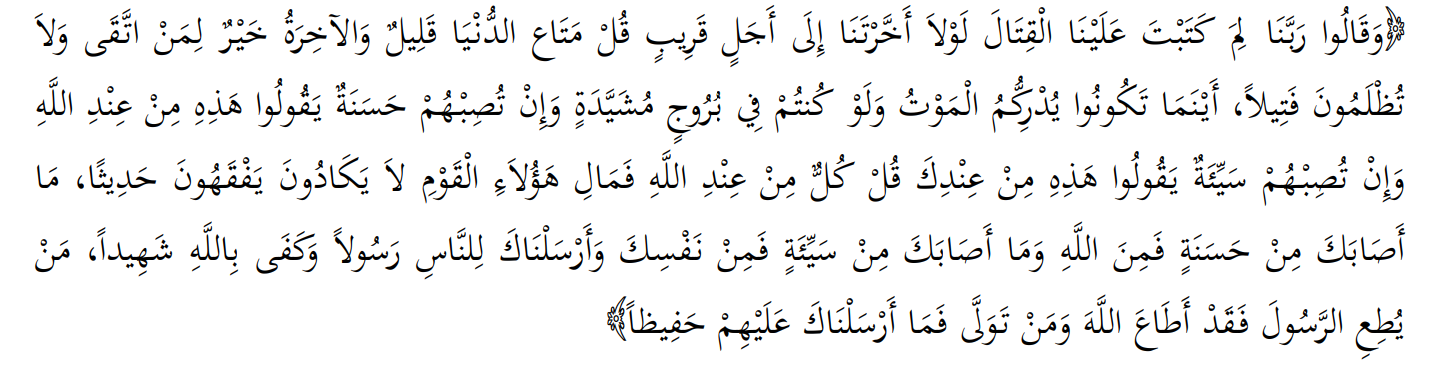
„Sie sagen: ‚Unser Herr! Warum hast Du uns das Kämpfen vorgeschrieben? Hättest Du uns doch nur eine kurze Frist gewährt!‘ Sprich: ‚Kurz ist der Genuss dieser Welt. Das Jenseits ist besser für denjenigen, der Allah fürchtet, und ihr werdet auch nicht im Geringsten ungerecht behandelt werden.‘ Wo immer ihr auch seid, der Tod wird euch ereilen, selbst wenn ihr in festen, hoch gebauten Burgen seid! Und wenn ihnen etwas Gutes widerfährt, sagen sie: ‚Das kommt von Allah.‘ Wenn ihnen aber etwas Böses widerfährt, sagen sie: ‚Das kommt von dir.‘ Sprich: ‚Alles kommt von Allah.‘ Was ist mit diesen Leuten los, dass sie kein Wort zu verstehen scheinen? Was dir an Gutem widerfährt, kommt von Allah, und was dir an Bösem widerfährt, kommt von dir selbst. Und Wir haben dich (o Muhammad ﷺ) als Gesandten für die Menschheit gesandt, und Allah genügt als Zeuge. Wer dem Gesandten gehorcht, hat tatsächlich Allah gehorcht; wer sich jedoch abwendet, dem haben Wir dich nicht als Wächter über sie gesandt.“ [TMQ-Nisā’: 77-80]
“They say: Our Lord! Why have you ordained for us fighting? Would that you have granted us respite for a short period?’ Say: ‘Short is the enjoyment of this world. The Hereafter is (far) better for him who fears Allah, and you shall not be dealt with unjustly in the least. Wheresoever you may be, death will overtake you even if you are in fortresses built up strong and high! And if some good reaches them, they say, ‘This is from Allah,’ but if some evil befalls them, they say, ’This is from you.’ Say: ‘All things are from Allah’, so what is wrong with these people that they fail to understand any word? Whatever of good reaches you, is from Allah, but whatever of evil befalls you, is from yourself. And We have sent you (O Muhammad) as a Messenger to mankind, and Allah is sufficient as Witness. He who obeys the Messenger, has indeed obeyed Allah, but he who turns away, then we have not sent you as a watcher over them.” [TMQ-Nisā’: 77-80]
Das Subjekt ist also das, was ihnen widerfährt, und nicht das, was sie tun. Somit hat es nichts mit dem Studium von al-qadā’ wa‘l-qadar zu tun.
So the subject is what befalls them and not what they are doing. Thus it has nothing to do with the study of al-qadā’ wa‘l-qadar.
Daher hat alles, was oben erwähnt wurde, nichts mit dem Studium von al-qadā’ wa‘l-qadar zu tun; es fällt nicht unter dessen Bedeutung und steht in keinerlei Zusammenhang mit dem zuvor Genannten. Vielmehr ist al-qadā’ wa‘l-qadar als Begriff aus der griechischen Philosophie hervorgegangen, die von den Mu'taziliten übernommen wurde, die dazu eine Meinung vertraten. Ahl as-Sunna und die Jabriyya widerlegten sie, und Ahl as-Sunna widerlegte außerdem die Jabriyya. Die Diskussion beschränkte sich auf dieselbe Bedeutung und beruhte auf denselben Prämissen. Somit ist die Frage ein Begriffsinhalt, der aus der griechischen Philosophie stammt und in der Auseinandersetzung zutage trat, die zwischen den Muslimen und den Ungläubigen geführt wurde, die mit der griechischen Philosophie ausgerüstet waren. Es ist ein Begriff, der für die ‘Aqīda (Glaubenslehre) relevant ist, weshalb es darum geht, die Position des Islam zu diesem Begriff darzulegen. Die Mu'taziliten vertraten eine Meinung, die Jabriyya widerlegte sie und vertrat eine andere Meinung. Ahl as-Sunna widerlegte alle beide und vertrat eine eigene Meinung, und sie sagte darüber, es sei eine dritte Meinung, die aus den beiden anderen hervorgegangen sei, und beschrieb sie als „die reine Milch, süß zu trinken, die zwischen Kot und Blut hervortritt“.
Therefore, all that has been mentioned above has nothing to do with the study of al-qadā’ wa‘l qadar; they do not come under its meaning and have no relation whatsoever with what has been mentioned above. Rather, al-qadā’ wa‘l-qadar as a meaning has come from Greek philosophy which was transmitted by the Mu'tazilah who gave an opinion with regards to it. Ahl al-Sunnah and the Jabriyyah refuted them and Ahl al-Sunnah (also) made a refutation of the Jabriyyah. The discussion was confined to the same meaning and preceded upon the same premise. Thus the issue is a meaning/sense that came from Greek philosophy and it came to the fore in the debate which used to take place between the Muslims and the kuffar who used to be armed with the Greek philosophy. It is a meaning which has a relevance to the ‘aqīdah (creed), thus what is desired is to give Islam's opinion regarding this meaning. The Mu'tazilah gave an opinion and the Jabriyyah refuted them and gave another opinion. Ahl al-Sunnah refuted all of them and gave an opinion, and said about it that it is a third opinion which has come out from the two opinions and they described it as ‘the pure milk, sweet to drink, that comes out from between excrement and blood’.
Daher wurde der Gegenstand der Diskussion, der aus der griechischen Philosophie stammte, bekannt, und da er mit der ‘Aqīdah (Glaubenslehre) zusammenhängt, muss der Muslim klar darüber sein, was sein Glaube in dieser Sache ist. Die Muslime haben tatsächlich ihre Meinung geäußert, und es entstanden drei Denkschulen. Somit ist es nicht erlaubt, die Frage von al-qadā’ wa-l-qadar auf das zurückzuführen, was sich an Bedeutung von al-qadā’ oder al-qadar sprachlich und in der Scharī‘ah ergeben hat. Ebenso ist es nicht erlaubt, sich für al-qadā’ oder al-qadar eine Bedeutung aus bloßer Vermutung, Vorstellung oder Einbildung auszudenken und zu behaupten, al-qadā’ sei zum Beispiel das allgemeine Urteil nur über die Allgemeinheiten und al-qadar sei das allgemeine Urteil über die Einzelaspekte und deren Details, oder zu sagen, al-qadar sei der ewige Plan für die Dinge und al-qadā’ sei deren Vollzug und Erschaffung gemäß dieser Vorherbestimmung und diesem Plan. Dies ist in der Tat nicht erlaubt, denn es ist bloße Einbildung, Annahme und ein gescheiterter Versuch, bestimmte sprachliche und scharʻī-Ausdrücke anzuwenden, die darauf nicht zutreffen, sondern vielmehr allgemeine Bedeutungen anzeigen. Es wäre dann ein willkürliches Vorgehen, die beiden Begriffe ohne Beleg auf diese besonderen Bedeutungen zu beschränken.
„Jede Seele ist ein Pfand für das, was sie erwirbt,“ [TMQ Muddathir: 38]
“Every soul is a pledge for what it earns,” [TMQ Muddathir: 38]