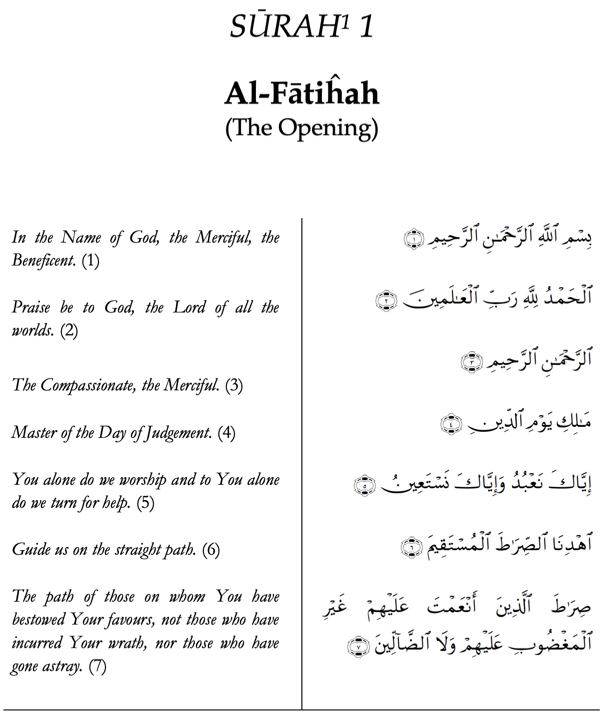
Todo musulmán recita esta breve sūrah de siete versículos al menos diecisiete veces al día. Un ḥadīz auténtico del Profeta Muḥammad ﷺ dice: «La oración de quien no recita la Fātiḥah es inválida». Esta breve sūrah contiene gran parte de las ideas básicas y centrales del Islam, sus creencias y conceptos. Expone muchas de sus percepciones y actitudes esenciales. Todo ello explica claramente por qué se elige para la recitación frecuente y por qué es indispensable para la validez de la oración.
Every Muslim recites this short sūrah of seven verses at least seventeen times a day. An authentic ĥadīth of the Prophet Muĥammad (peace be upon him), says: “A prayer by one who does not read the Fātiĥah is invalid.” This short sūrah contains a great deal of the central basic ideas of Islam, its beliefs and concepts. It outlines many of its essential perceptions and attitudes. All this makes it clear why it is chosen for frequent recitation and why it is essential for the validity of prayer.
La sura comienza con la frase:
The sūrah opens with the phrase:
En el nombre de Dios, el Compasivo, el Misericordioso. (Versículo 1)
In the name of God, the Compassionate, the Merciful. (Verse 1)
Esta aleya es reconocida por la mayoría de los eruditos como un versículo de la sura en sí misma, completando así sus versículos hasta siete. Sin embargo, existe una diferencia de opinión sobre si esto también ocurre con respecto a todas las demás suras del Corán en las que aparecen las mismas palabras como frase de apertura. Algunos eruditos sostienen que la siguiente afirmación coránica se refiere a la Fātiĥah: «Te hemos dado siete aleyas que se repiten y este sublime Corán». (15: 87)
This is recognized by the majority of scholars as a verse of the sūrah, in its own right, completing its verses into seven. There is, however, a difference of opinion over whether this is so with respect to all other sūrahs of the Qur’ān in which the same words appear as the opening phrase. Some scholars maintain that it is to the Fātiĥah that the following Qur’ānic statement refers: “We have given you seven oft- repeated verses and this sublime Qur’ān.” (15: 87)
Los primeros versículos del Corán revelados al Profeta Muĥammad ﷺ, que comienzan con: «Lee en nombre de tu Señor...» (96: 1), establecen la etiqueta islámica de invocar el nombre de Dios al comienzo de toda acción. Esto también concuerda con el principio islámico fundamental de que Dios es «el Primero y el Último, el Manifiesto y el Oculto». (57: 3) En efecto, Él es el Ser real, el origen y la razón de ser de todo lo que existe. En Su nombre, por tanto, se hace todo movimiento y toda acción, y en Su nombre todo comienza.
The very first verses of the Qur’ān revealed to Prophet Muĥammad, which begin with: “Read in the name of your Lord...” (96: 1) establish the Islamic etiquette of invoking the name of God at the beginning of every action. This is also in line with the fundamental Islamic principle that God is “the first and the last, the outward and the inward.” (57: 3) He is indeed the real being, the origin and the raison d’être of all that exists. In His name, therefore, every movement and action is made, and in His name everything begins.
Los atributos divinos del Misericordioso, al-Raḥmān, y del Compasivo, al-Raḥīm, abarcan todos los aspectos y el significado de la misericordia, y solo pueden emplearse conjuntamente con respecto a Dios Todopoderoso. Sería apropiado usar el atributo de al-Raḥīm en referencia a un ser humano, pero la fe islámica exige que el uso de al-Raḥmān sea exclusivo de Dios. En cuanto al debate sobre cuál de los dos adjetivos denota el significado más amplio de la misericordia y la compasión, no nos concierne aquí. Sin embargo, podemos concluir que, cuando se combinan, abarcan todos los aspectos y dimensiones de la misericordia.
The divine attributes of the Compassionate, al-Raĥmān, and the Merciful, al-Raĥīm, encompass all aspects and meaning of mercy, and can only be used together with respect to God Almighty. It would be appropriate to use the attribute of al-Raĥīm in reference to a human being, but the Islamic faith requires that use of al-Raĥmān is exclusive to God. As for the debate over which of the two adjectives denotes the wider meaning of mercy and compassion, it does not concern us here. We can conclude, however, that when combined, they encompass all aspects and dimensions of mercy.
Como la invocación del nombre de Dios al inicio de toda acción constituye el primer principio fundamental de la fe musulmana, la restricción del uso de al-Raḥmān y al-Raḥīm a Dios únicamente constituye el segundo principio y define la relación entre Dios y el hombre. Tras invocar el nombre de Dios y reconocer Su infinita misericordia, se es dirigido a alabar a Dios y a reconocer Su soberanía absoluta sobre todos los seres:
As the invocation of God’s name at the beginning of every action constitutes the first fundamental principle of the Muslim faith, the restriction of the use of al-Raĥmān and al-Raĥīm to God alone constitutes the second principle and defines the relationship between God and man. Having invoked God’s name and acknowledged His infinite mercy, one is directed to praise God and recognize His absolute sovereignty over all beings:
Alabado sea Dios, Señor de los mundos. (Versículo 2)
Praise be to God, the Lord of all the worlds. (Verse 2)
La alabanza a Dios es el primer sentimiento que surge en el corazón del creyente al mencionar a Dios. Pues la propia existencia del hombre es un aspecto de la gracia infinita de Dios, que engendra gratitud y reverencia hacia Dios. Las manifestaciones de la munificencia y generosidad de Dios hacia el hombre y las demás criaturas abundan por doquier y pueden observarse en cada momento. Alabar a Dios al comienzo y al final de cada acción es otro principio fundamental de la fe islámica. El Corán dice: «Él es Dios; no hay más divinidad que Él. Suya es la alabanza en la primera y en la última [vida]...» (28: 70)
Praise of God is the first feeling aroused in a believer’s heart at the mention of God. For man’s own existence is an aspect of God’s infinite grace, which engenders gratitude and reverence towards God. The manifestations of God’s munificence and generosity to man and other creatures abound everywhere and can be seen at every moment. To praise God at the beginning and at the end of every action is another fundamental principle of the Islamic faith. The Qur’ān says: “He is God; there is no deity but He. To Him belongs praise in the first and in the last...” (28: 70)
Sin embargo, la gracia de Dios es tal que cuando un creyente dice «alabado sea Dios», ello le es registrado como una buena acción que supera a todas las demás. `Umar ibn al-Jattāb, compañero del Profeta ﷺ, relata que el Profeta ﷺ contó cómo un hombre dijo una vez: «Señor, Te alabo como corresponde a la majestad de Tu rostro y a la grandeza de Tu poder». Los dos ángeles que acompañaban a aquel hombre no pudieron valorar la expresión y acudieron a Dios Todopoderoso, quien les ordenó: «Regístrala en su expediente tal como él la dijo, y Yo lo recompensaré como merece cuando regrese a Mí».
La última parte de este versículo, «Señor de los mundos», expresa la creencia en una divinidad absoluta y universal, que está en el núcleo mismo del concepto islámico de Dios. Dios es el único, absoluto y último propietario, con plena autoridad independiente para actuar en todo el cosmos. Él es el soberano supremo que ha creado el mundo y sigue velando por él, cuidándolo y asegurando su estabilidad y bienestar. Esta relación viva y dinámica entre el Creador y lo creado es la fuente perpetua de vida para toda la creación. Dios no creó el mundo para abandonarlo a su suerte; sigue siendo una autoridad activa y viva sobre Su creación, proporcionándole lo que necesita para su existencia continua y significativa. Esto se aplica a toda la creación de Dios.
Nevertheless, God’s grace is such that when a believer says, ‘praise be to God,’ it is recorded for him as a good deed outweighing everything. `Umar ibn al-Khaţţāb, the Prophet’s Companion, relates that the Prophet (peace be upon him) told how a man once said, “Lord, I praise You as befits the majesty of Your face and the greatness of Your power.” The two angels accompanying that man could not evaluate the remark and referred to God Almighty, who commanded them: “Register it in his record as he said it, and I shall reward him as he deserves when he returns to Me.” The last part of this verse, “Lord of all the worlds”, expresses the belief in absolute universal Godhead which is at the very core of the Islamic concept of God. God is the sole, absolute and ultimate owner with full independent authority to act in the whole cosmos. He is the overall supreme master who has created the world and continues to watch over it, take care of it, and ensure its stability and well-being. This living and dynamic relationship between the Creator and the created is the perpetual fountain of life for all creation. God has not created the world and abandoned it to its own devices. He continues to be an active living authority over His creation, giving it what it needs for its continued and meaningful life. This applies to all God’s creation.
Reconocer el señorío absoluto de Dios marca toda la diferencia entre la claridad y la confusión en lo que respecta a la unicidad absoluta de Dios. Con frecuencia, las personas combinaban su reconocimiento de Dios como único creador con la creencia en múltiples deidades que ejercían autoridad en su vida. Puede parecer absurdo que alguien llegue a sostener tal creencia, pero así fue en el pasado y sigue siéndolo hoy. El Corán habla de quienes afirman que solo "los adoran [a dioses menores] para que nos acerquen a Dios" (39: 3). También menciona que algunos grupos judíos y cristianos "han tomado a sus rabinos y sacerdotes como dioses junto a Dios" (9: 31). El politeísmo, es decir, la adoración de varias deidades o semidioses además del supuesto "Gran Dios", estaba muy extendido cuando surgió el islam en Arabia, en el siglo VII.
Acknowledging God’s absolute Lordship makes all the difference between clarity and confusion with regard to God’s absolute oneness. People often combined their acknowledgement of God as the sole creator with belief in multiple deities having authority in their life. It may seem absurd that people should ever hold such a belief, but this was true in the past and is still true today. The Qur’ān speaks of those who claim that they “only worship them [minor gods] so that they may bring us nearer to God.“ (39: 3) It also mentions that some Jewish and Christian groups who “have taken their rabbis and priests as gods alongside God.” (9: 31) Polytheism, or the worship of several deities or demigods besides the perceived ‘Grand Deity’, was widespread when Islam emerged in the 7th century in Arabia.
La afirmación de la soberanía absoluta y de la autoridad activa del Dios único.
The affirmation of the absolute sovereignty and active authority of the One God.
sobre toda la creación era necesario para garantizar la racionalidad y la tranquilidad de espíritu del hombre, y para liberarlo de la cruel confusión del politeísmo. El hombre debe tener la seguridad de que un Dios vigilante y misericordioso está a cargo de este mundo y nunca lo abandonará ni lo desamparará.
over all creation was necessary to ensure man’s rationality and peace of mind, and to relieve him from the cruel bewilderment of polytheism. Man must be reassured that a vigilant and caring God is in charge of this world and will never abandon or forsake it.
Con la llegada del Islam, el mundo estaba lleno de creencias y filosofías erróneas, y de religiones falsas basadas en la superstición, la leyenda y la mitología. Muy poco de ello era verdadero o siquiera racional. En lo que respecta al concepto de Dios y a Su relación con el hombre y con el mundo, reinaba una lamentable confusión. A su vez, esto llevaba a confusión en la comprensión que el hombre tenía del mundo y de su propia posición y papel dentro de él.
At the advent of Islam, the world was full of erroneous beliefs and philosophies, and of false religions based on superstition, legend and mythology. Very little of it was true or even rational. As far as the concept of God and His relationship with man and the world was concerned, there was plenty of miserable confusion. This in turn led to confusion in man’s understanding of the world and of his own position and role within it.
La necesidad de un sistema de creencias racional, claro y coherente solo se hace evidente cuando estudiamos aquellos periodos oscuros de la historia humana en los que no existía tal sistema. Entonces nos damos cuenta del enorme peso que tales mitos y creencias falsas ejercían sobre el ser humano. Habrá más sobre esto cuando lleguemos a estudiar casos concretos en el Corán.
The need for a rational, clear and consistent system of beliefs only becomes apparent when we study those dark periods of human history when there was no such system. We then realize how heavily such great myth and false beliefs weigh on man. There will be more on this when we come to study specific instances in the Qur’ān.
Es a la luz de esta necesidad que el Islam ha puesto gran cuidado en corregir las creencias del ser humano y en definir con gran claridad el concepto y la naturaleza de Dios y de Sus atributos, así como la relación entre el Creador y la creación.
It is in the light of such need that Islam has taken great care to correct man’s beliefs and define very clearly the concept and nature of God and His attributes, and the relationship between Creator and creation.
Esto se expresa en el concepto islámico de la unicidad de Dios, la esencia y el principio más fundamental del Islam. Se ha dedicado mucho cuidado a establecer y dilucidar la afirmación de que Dios es el Uno, el Señor y Amo absoluto y trascendente de todo lo que existe. El otro aspecto de este concepto al que el Islam ha prestado mayor atención es la definición de los atributos de Dios, que ha sido causa de mucha confusión, oscurecimiento y un pensamiento religioso y filosófico confuso a lo largo de los siglos.
This is embodied in the Islamic concept of God’s oneness, the essence and most fundamental principle of Islam. Much care has been devoted to establishing and elucidating the affirmation that God is the One, absolute and transcendent Lord and Master of all that exists. The other aspect of this concept to which Islam has given its greatest attention is the definition of God’s attributes, which has been the cause of much confusion, obfuscation and muddled religious and philosophical thinking through the ages.
La intensidad, el énfasis y el detalle con que el Islam ha tratado el concepto de la unicidad de Dios, y todos los temas relacionados con ella, solo pueden apreciarse sobre el trasfondo de la gran masa de creencias erróneas y teologías confusas que se habían acumulado a lo largo de la historia. Desde esta perspectiva, el Islam puede considerarse fácilmente como un acto profundo y oportuno de misericordia divina otorgado a la humanidad: una misericordia que se da con belleza, sencillez, claridad, armonía y plena concordancia con la naturaleza humana.
The intensity, emphasis and detail with which Islam has dealt with the concept of God’s oneness, and all subjects related to it, can only be appreciated against the background of the great mass of erroneous beliefs and confused theologies that had accumulated in the course of history. From this perspective, Islam can readily be seen as a profound and timely act of divine mercy bestowed on humanity — mercy that is given with beauty, simplicity, clarity, harmony and full accordance with human nature.
El Compasivo, el Misericordioso. (Versículo 3)
The Compassionate, the Merciful. (Verse 3)
Estos son dos atributos que engloban todos los significados y aspectos de la misericordia y la compasión, y que personifican la misericordia como propiedad de Dios Todopoderoso. Estos dos atributos definen el vínculo entre el Señor como Creador y Sus criaturas. Es un vínculo basado enteramente en el amor, la paz, la tranquilidad y el cuidado, y que despierta en el ser humano un sentimiento espontáneo de gratitud y alabanza hacia Dios.
These are two attributes that encompass all meanings and aspects of mercy and compassion, and epitomize mercy as a property of God Almighty. These two attributes define the link between the Lord as Creator and His creation. It is a link based entirely on love, peace, reassurance and care, and which inspires within man a spontaneous feeling of gratitude and praise towards God.
A diferencia de la mitología griega o del Antiguo Testamento (Génesis, 4: 11-12), el islam no presenta a Dios como un enemigo que persigue al hombre con venganza implacable, ni que conspira contra Su creación con rencor y afán de castigo.
Unlike Greek mythology or the Old Testament (Genesis, 4: 1112), Islam does not depict God as an enemy who pursues man with relentless vengeance, or plots and schemes against His creation with spite and vindictiveness.
Dueño del Día del Juicio. (Versículo 4)
Master of the Day of Judgement. (Verse 4)
Este versículo establece un principio fundamental del Islam que tiene una influencia profundísima en la vida humana: la creencia en el más allá. El Corán comenta el curioso hecho de que las personas han creído a menudo en Dios como Creador, pero no han creído en un Día del Juicio, en una vida venidera, en la que se otorgan recompensa y castigo para restablecer el equilibrio de la justicia. Refiriéndose a ellas, el Corán dice: «Si les preguntas: "¿Quién creó los cielos y la tierra?", responderán ciertamente: "Dios"» (31:25). En otro lugar, el Corán dice de tales personas: «Les extraña que un amonestador haya venido a ellos de entre ellos mismos. Por eso dicen los incrédulos: "¡Esto es algo extraño! [¿Vamos a ser resucitados] después de morir y convertirnos en simple polvo? ¡Tal retorno parece en verdad muy improbable!"» (50:2-3).
This verse states a fundamental Islamic principle that has a most profound influence on human life: belief in the hereafter. The Qur’ān comments on the curious fact that people have often believed in God as Creator but have failed to believe in a Day of Judgement, in a life to come, when reward and punishment are meted out to restore the balance of justice. It is in reference to these that the Qur’ān says: “If you ask them, ‘Who is it that created the heavens and the earth?’ they will surely answer, ‘God’” (31: 25) Elsewhere the Qur’ān says of such people: “They deem it strange that a warner should have come to them from their own midst. Thus, the unbelievers say, A strange thing is this! [Are we to be resurrected] after we have died and become mere dust? Such a return seems far-fetched indeed!’“ (50: 2-3)
La fe en el más allá es esencial porque ocupa el alma y la mente del ser humano y concentra la atención del hombre en una existencia futura. Esto, a su vez, ayuda a frenar su obsesión por la vida presente y a trascender sus deseos terrenales inmediatos. Ya no tiene prisa por cosechar todas sus recompensas aquí y ahora; puede vencer su egoísmo y desarrollar sentimientos e intereses altruistas. El hombre es capaz de atravesar la vida como un ser motivado, tolerante, confiado y optimista.
Belief in the hereafter is essential because it engages the human soul and mind and concentrates man’s attention on a future existence. This in turn helps to rein in man’s obsession with the present life, and to transcend his immediate earthly desires. He is no longer anxious to reap all his rewards here and now; he can conquer his selfishness and develop altruistic feelings and interests. Man is able to go through life as a motivated, tolerant, confident and optimistic being.
Esta creencia islámica central distingue claramente entre aspirar a alcanzar la libertad moral e intelectual que el ser humano necesita y merece, y la sumisión a los deseos y placeres mundanos y egoístas. Marca la diferencia entre una humanidad equilibrada y consciente, y una humanidad egocéntrica y centrada en sí misma.
This central Islamic belief distinguishes clearly between aspiring to gain the moral and intellectual freedom that man needs and deserves, and capitulation to worldly and selfish desires and pleasures. It marks the difference between a well-balanced and conscientious humanity and an egotistic, self-seeking one.
La vida humana nunca podrá ser equilibrada ni equitativa mientras las personas no crean que lo que ganan en esta vida transitoria no lo es todo ni el fin último. El ser humano necesita el incentivo de una creencia firme en que le aguarda otra vida, una vida que merece la pena el esfuerzo, los sacrificios y las dificultades que pueda tener que afrontar en esta otra, tan breve. Esta creencia produce una diferencia fundamental en los sentimientos, las actitudes y el comportamiento de quienes la sostienen.
Human life can never be balanced and equitable until people believe that what they earn in this transient life is not the be-all and the end- all. Man needs to have the incentive of a confident belief that another life awaits him, which is worth the struggle and the sacrifices and the effort he may have to make here in this short one. This belief brings a fundamental difference in the feelings, attitudes and behaviour of those who uphold it.
Solo a Ti adoramos y solo a Ti pedimos ayuda. (Versículo 5)
You alone do we worship and to You alone do we turn for help. (Verse 5)
Este versículo expresa otro principio fundamental que se deduce lógicamente de los anteriores. Es también un principio decisivo y crucial que traza una línea entre la libertad que el hombre alcanza al someterse a Dios y el abuso y la degradación implícitos en la servidumbre del hombre hacia el hombre.
This verse expresses another fundamental principle that follows logically from the preceding ones. It is also a decisive and crucial principle that draws a line between the freedom man gains in submitting to God and the abuse and debasement implicit in man’s servitude to man.
Una vez que el ser humano se ha sometido a Dios y ha buscado ayuda y guía únicamente en Él, ha alcanzado la liberación total de la tiranía de todos los poderes religiosos, intelectuales, morales y políticos.
Once man has submitted himself to God and sought help and guidance from Him alone, he has achieved total liberation from the tyranny of all religious, intellectual, moral and political powers.
Para el creyente en el Islam, el poder humano se divide en dos categorías: un poder bien guiado, que reconoce a Dios y se somete a Sus directrices, y un poder arrogante y rebelde, que no admite la soberanía y la autoridad de Dios. Un musulmán está obligado a apoyar y respaldar el primero, sin importar cuán débil o desfavorecido sea, y a rechazar y oponerse al segundo, sin importar cuán fuerte o dominante sea. El Corán dice: «¡Cuántas veces una pequeña hueste ha vencido a una grande con el permiso de Dios!» (2: 249). Semejante victoria de la hueste aparentemente más débil solo puede lograrse cuando confía en Dios, la fuente de todo poder.
To the believer in Islam, human power falls into two categories: a rightly-guided power that recognizes God and abides by His directions, and an arrogant, rebellious one that does not admit to God’s sovereignty and authority. A Muslim is required to support and endorse the former, no matter how weak or disadvantaged it may be, and to reject and oppose the latter, regardless of its strength or dominance. The Qur’ān says: “Many a small band, by the grace of God, has vanquished a large one.” (2: 249) Such victory of the apparently weaker host could only be achieved when it relies on God, the source of all power.
Hacia las fuerzas naturales, la actitud de un musulmán es de curiosidad y cordialidad, en lugar de temor u hostilidad. Los poderes del hombre y los poderes de la naturaleza son percibidos como subproductos del propio poder de Dios, y sujetos a Su voluntad. Por lo tanto, son perfectamente complementarios e interdependientes.
Towards natural forces, a Muslim’s attitude is one of curiosity and friendliness rather than fear or hostility. The powers of man and the powers of nature are perceived as by-products of God’s own power, and subject to His will. They are, therefore, perfectly complementary and interdependent.
El Islam enseña que Dios ha creado el mundo físico y todas sus fuerzas para el propio uso y beneficio del ser humano. Al hombre se le enseña y se le dirige específicamente a estudiar el mundo que le rodea, descubrir su potencial y aprovechar todo su entorno para su propio bien y para el bien de sus semejantes. Cualquier daño que el hombre sufre a manos de la naturaleza es únicamente el resultado de su ignorancia o de su falta de comprensión de ella y de las leyes que la rigen. Cuanto más aprende el hombre sobre la naturaleza, más pacífica y armoniosa es su relación con ella y con el medio ambiente.
Islam teaches that God has created the physical world and all its forces for man’s own use and benefit. Man is specifically taught and directed to study the world around him, discover its potential and utilize all his environment for his own good and the good of his fellow humans. Any harm that man suffers at the hands of nature is a result only of his ignorance or lack of understanding of it and of the laws governing it. The more man learns about nature, the more peaceful and harmonious his relationship with nature and the environment.
Por ello, la noción de «conquistar la naturaleza» puede considerarse fácilmente cínica y negativa. Es ajena a las percepciones islámicas y revela una vergonzosa ignorancia del espíritu con que el mundo ha sido creado y de la sabiduría divina que lo sustenta.
Hence the notion of “conquering nature” can readily be seen as cynical and negative. It is alien to Islamic perceptions and betrays a shameless ignorance of the spirit in which the world has been created and the divine wisdom that underlies it.
Siendo siempre conscientes de la mano y del papel de Dios en la configuración y el funcionamiento del mundo, los musulmanes tienen una visión positiva, amistosa y constructiva de la relación del hombre con la naturaleza. En pocas palabras, esta visión reconoce a Dios como el origen y el Creador de todas estas fuerzas, sobre la base del mismo conjunto de axiomas y leyes. Están diseñadas para funcionar juntas, con un propósito común, en armonía, compatibilidad y apoyo mutuo. Las fuerzas de la naturaleza están esencialmente sometidas al hombre, que está mental y físicamente capacitado para discernirlas, desentrañar sus secretos, comprender las leyes que las rigen y, posteriormente, aprovecharlas para mejorar la calidad de vida en la tierra. El Corán afirma: “Ha puesto a vuestro servicio todo cuanto hay en la tierra.” (45: 13)
Being always aware of God’s hand and role in shaping and running the world, Muslims have a positive, friendly and constructive outlook on man’s relationship with nature. Simply stated, it acknowledges God as the origin and Creator of all these forces, on the basis of the same set of axioms and laws. They are designed to function together, for a common purpose, in harmony, compatibility and mutual support. The forces of nature are essentially subservient to man, who is mentally and physically equipped to discern them, unravel their secrets, comprehend the laws governing them and, subsequently, to harness them to improve the quality of life on earth. The Qur’ān asserts: “He has all that is on the earth subservient to you.” (45: 13)
Una visión así elimina todo rastro de temor o aislamiento y permite, en cambio, un profundo sentido de pertenencia en el que el ser humano es visto no solo como parte integral del diseño general del mundo, sino también como un ser esencialmente eficaz e influyente. Así, su mundo se convierte en un mundo amigable. Esto lo expresa mejor el Profeta ﷺ cuando, en una ocasión, se encontró frente al monte Uḥud, escenario de una amarga derrota para los musulmanes, y dijo: «¡Cuánto amamos a este monte, y cuánto nos ama!». Esto expresa en pocas palabras la afinidad que el Profeta ﷺ sentía hacia la naturaleza, incluso en sus formas más escarpadas.
Such an outlook eliminates all traces of fear or isolation and allows, instead, a profound sense of belonging in which man is seen not only as an integral part of the overall design of the world, but also an essentially effective and influential one. Thus, his world becomes a friendly one. This is best expressed by the Prophet when he once faced Mount Uĥud, the scene of a bitter defeat for Muslims, and said, “How we love this mountain, and how it loves us!” This expresses in a nutshell the affinity the Prophet felt towards nature even in its most rugged forms.
Habiendo establecido estos principios fundamentales, la sūrah señala ciertos medios prácticos para responder a ellos, entre los cuales el primero es la oración:
Having established these fundamental principles, the sūrah points the way to certain practical means of responding to them, foremost among which is prayer:
Guíanos por el camino recto, el camino de quienes Tú has agraciado, no el de quienes han incurrido en Tu ira, ni el de quienes se han extraviado. (Versículos 6-7)
Guide us on the straight path; the path of those on whom You have bestowed Your favours, not those who have incurred Your wrath, nor those who have gone astray. (Verses 6-7)
Con estas palabras, el creyente suplica que se le muestre el Camino Recto y que se le ayude a seguirlo, lo cual no puede lograrse sin la guía, el cuidado y la misericordia de Dios. Reconocer esto es, en sí mismo, un reconocimiento de la soberanía y el dominio de Dios sobre todas las cosas y todos los acontecimientos.
With these words a believer pleads to be shown the Right Way and to be helped along it, which cannot be achieved without God’s guidance, care and mercy. To acknowledge that is in itself a recognition of God’s sovereignty and dominance over all things and events.
La guía hacia el camino recto garantiza la felicidad del hombre en este mundo y en el más allá. En efecto, se logra al orientar la naturaleza humana y los instintos, deseos e inspiraciones del hombre hacia el reconocimiento y la comprensión de la voluntad divina, armonizando así la actividad humana con el orden natural y el mundo físico.
Guidance to the right way of life guarantees man’s happiness in this world and in the hereafter. It comes about, in effect, by guiding human nature and man’s instincts, desires and inspirations towards the recognition and comprehension of the divine will, so bringing human activity into rhythm with the natural order and the physical world.
La sūrah revela que la naturaleza del "camino recto" es el de aquellos a quienes Dios ha favorecido, no el de quienes han incurrido en Su desagrado por su desviación de la Verdad, ni el de los descuidados que no tienen conocimiento de la verdad. Es el camino de la felicidad y la salvación.
The sūrah reveals the nature of the “straight path” as being one taken by those whom God has favoured, not the way of those who have earned His displeasure by their deviation from the Truth, nor that of the heedless who have no knowledge of the truth. It is the path of happiness and salvation.
Esta es, pues, al-Fātiĥah, la sūrah escogida para la recitación diaria frecuente, sin la cual las oraciones islámicas no son válidas. A pesar de su brevedad, contiene algunos de los principios más fundamentales de la fe islámica y ciertas reflexiones que se derivan de ellos.
This, then, is al-Fātiĥah, the sūrah selected for frequent daily recitation, without which Islamic prayers are invalid. Despite its brevity, it contains some of the most fundamental principles of the Islamic faith and certain insights that arise from them.
El Profeta Muhammad ﷺ relató, según se informa con certeza, que Dios dijo: los frutos de la oración se reparten por igual entre Yo y Mi siervo, y Mi siervo obtendrá lo que pida. Cuando el adorador recita [en la oración]: «Alabado sea Dios, Señor de los mundos», Dios dirá: «Mi siervo Me ha alabado». Cuando recita: «El Misericordioso, el Compasivo», Dios dirá: «Mi siervo Me ha agradecido». Cuando recita: «Dueño del Día del Juicio», Dios dirá: «Mi siervo Me ha glorificado». Cuando dice: «A Ti solo adoramos, y a Ti solo pedimos ayuda», Dios dirá: «Esto es entre Yo y Mi siervo, y Mi siervo recibirá lo que pida». Y cuando dice: «Guíanos por el camino recto, el camino de quienes Tú has agraciado, no el de quienes han incurrido en Tu ira, ni el de los extraviados», Dios dirá: «Esto es para Mi siervo, y se le concederá lo que desea».
Este ḥadīth explora algunos de los significados de al-Fātiḥah. Quizás el lector encuentre útil para comprender por qué Dios ha elegido esta sura para que los musulmanes la reciten al menos diecisiete veces al día, al ponerse de pie para sus oraciones obligatorias repartidas a lo largo de la noche y del día, y aún más a menudo, cada vez que realizan oraciones voluntarias.
The Prophet Muĥammad is reliably reported to have quoted God as saying that the fruits of prayer are shared equally between Me and My servant, and My servant will be granted what he asks for. As the worshipper recites [in Prayer]: “Praise be to God, the Lord of all the worlds,” God will say: ‘My servant has praised Me.’ As he recites: “The Compassionate, the Merciful,” God will say: ‘My servant has thanked Me.’ As he recites: “Master of the Day of Judgement,” God will say: “My servant has glorified Me.” As he says: “You alone do we worship, and to You alone do we turn for help,” God will say: ‘This is between Me and My servant, and My servant will receive what he asks for.’ And, as he says: “Guide us on the straight path, the path of those on whom You have bestowed Your favours, not those who have incurred Your wrath, nor those who have gone astray,” God will say: ‘This is for My servant, and he will be granted his wish.’“ This ĥadīth explores some of the meanings of al-Fātiĥah. The reader will perhaps find it helpful in understanding why God has chosen this sūrah for recitation by Muslims at least seventeen times a day, as they stand up for their obligatory prayers, spread over the night and day, and even more frequently, whenever they offer voluntary prayers.