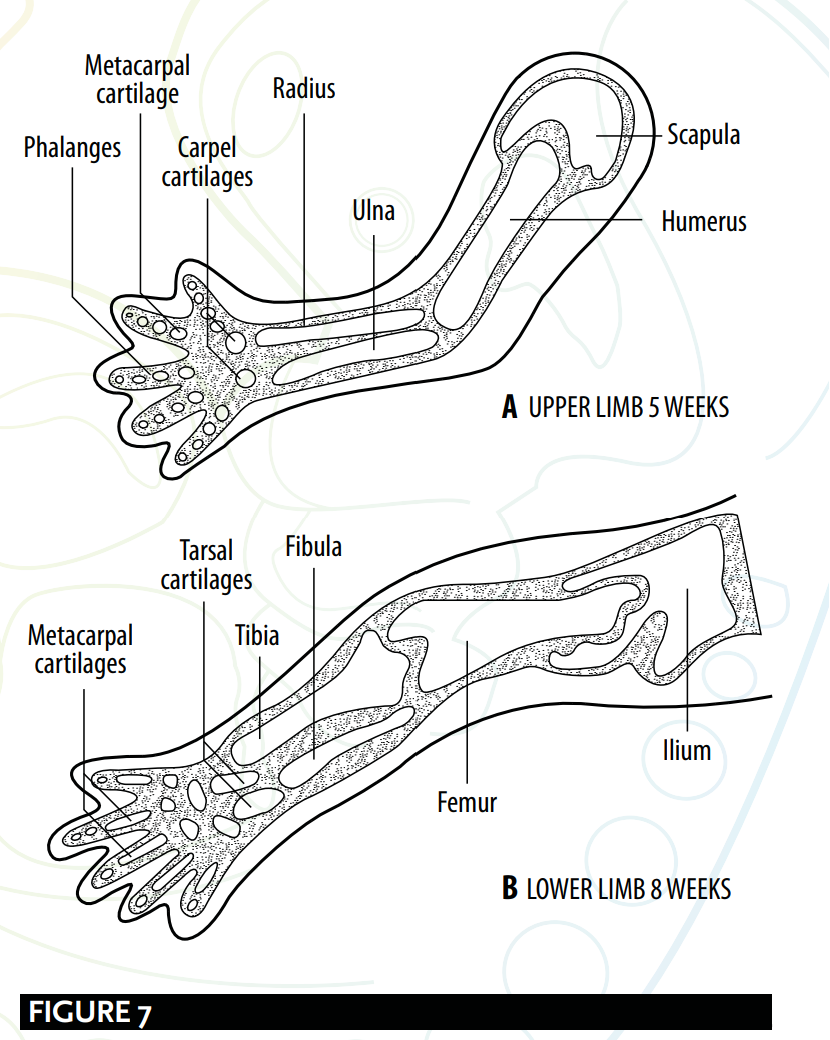
Une autre proposition de la part des commentateurs est qu'à ce stade, il n'y a pas de véritables os. Il est soutenu que les os apparents ne sont que du cartilage car l'ossification est incomplète et que, par conséquent, le Coran doit être inexact. Bien qu'il s'agisse d'une argumentation valable, elle est mal placée. `idhaam englobe la forme cartilagineuse des os au moment où la structure squelettique est mise en place. De plus, le processus d'ossification commence dès la 8ème semaine,76 se poursuivant après la naissance, avec l'achèvement final du processus d'ossification vers la puberté. Barry Mitchell et Ram Sharma expliquent :
Another proposition from commentators is that at this stage there are no real bones. It is argued that the apparent bones are mere cartilage as ossification is incomplete and, as such, the Qur’an must therefore be inaccurate. Although a valid contention, it is misplaced. `idhaam encompasses the cartilaginous form of the bones as the skeletal framework is put in place. Additionally, the process of ossification begins by the 8th week,76 continuing on after birth, with the eventual completion of the ossification process at around puberty. Barry Mitchell and Ram Sharma explain:
Les centres d'ossification apparaissent pour la première fois dans les os des membres durant la huitième semaine. À la douzième semaine, les corps des os des membres sont ossifiés, bien que les os du carpe du poignet restent cartilagineux jusqu'après la naissance. L'ossification des trois plus grands os du tarse de la cheville commence vers la 16ème semaine, mais certains des plus petits os du tarse ne s'ossifient pas avant l'âge de 3 ans après la naissance.77.
The centres of ossification first appear in the limb bones during the eighth week. By the twelfth week, the shafts of the limb bones are ossified, though the carpal bones of the wrist remain cartilaginous until after birth. The ossification of the three largest tarsal bones of the ankle begins about 16 weeks, but some of the smaller tarsal bones do not ossify until 3 years after birth.77.
De ce point de vue, il serait médicalement absurde de supposer que les nouveau-nés ou les jeunes adolescents n'ont pas d'os simplement parce qu'ils nécessitent une ossification, d'autant plus que l'ossification s'achève à la fin de la poussée de croissance de la puberté. Néanmoins, si tel était le cas, et si nous devions considérer cette étape comme étant « sans os », pour ainsi dire, les dérision du mot `idhaam permettent une interprétation globale car les « modèles cartilagineux des divers os »⁷⁸ sont inclus dans son sens.
From this perspective, it would be a medical absurdity to assume newborns or young teenagers do not have bones simply because they require ossification, especially since ossification completes at the end of the growth-spurt of puberty. Nevertheless if this were the case, and we are to take this stage as being ‘boneless’, as it were, the derisions of the word `idhaam allow for an all encompassing interpretation because the “cartilaginous models of the various bones”78 is included in its meaning.