Palestinawa suna raba abubuwan da suka faru gare su da sauran al'ummomin asali waɗanda aka hana su 'yancin kai da labarinsu, aka lalata al'adunsu na zahiri, aka share tarihinsu, aka sake ba da labari a kansa, aka sake ƙirƙira shi ko kuma aka murguɗe shi, ta hannun mazauna da masu mulkin mallaka farar fata na Turai. A cikin *The Invasion of America* (1975), Francis Jennings ya nuna irin labaran da suka mamaye ra'ayi na mazauna farar fata na Turai, inda ya nuna cewa tsawon zamani masana tarihi sun rubuta game da al'ummomin asali na Amurka daga matsayin ɗaukakar al'adu, wanda hakan ya share ko ya murguɗe ainihin tarihin al'ummomin asali da dangantakarsu da mazauna Turai. A cikin *Decolonizing Methodologies*:
The Palestinians share common experiences with other indigenous peoples who had their self-determination and narrative denied, their material culture destroyed and their histories erased, retold, reinvented or distorted by European white settlers and colonisers. In The Invasion of America (1975), Francis Jennings highlighted the hegemonic narratives of the European white settlers by pointing out that for generations historians wrote about the indigenous peoples of America from an attitude of cultural superiority that erased or distorted the actual history of the indigenous peoples and their relations with the European settlers. In Decolonizing Methodologies:
Bincike da Mutanen Asali, Malamar Maori Linda Tuhiwai Smith ta yi jayayya cewa tasirin mulkin mallaka na mazauna Turai yana ci gaba da cutar da lalata mutanen asali; cewa ƙin ra'ayoyin asali game da tarihi ya taka muhimmiyar rawa wajen tabbatar da akidar mulkin mallaka, a wani ɓangare saboda an ɗauki ra'ayoyin asali a matsayin kuskure ko na zamani, amma musamman saboda "sun ƙalubalanci tare da adawa da manufar mulkin mallaka" (Smith, L. 1999: 29). Ta bayyana cewa:
Research and Indigenous Peoples, Maori scholar Linda Tuhiwai Smith argues that the impact of European settler-colonisation is continuing to hurt and destroy indigenous peoples; that the negation of indigenous views of history played a crucial role in asserting colonial ideology, partly because indigenous views were regarded as incorrect or primitive, but primarily because ‘they challenged and resisted the mission of colonisation’ (Smith, L. 1999: 29). She states:
Ƙarƙashin mulkin mallaka, mutanen asali sun yi gwagwarmaya da kallon tarihi na Yammacin Duniya, duk da haka sun kasance masu haɗin kai da wannan kallo. Sau da yawa mun bar "tarihinmu" a ba da labarinsa ga wasu, sa'an nan mu zama baƙi a cikinsa yayin da muke jin ana sake ba da labarin a hanyar da ba tamu ba. Taswirorin duniya sun ƙarfafa matsayinmu a gefen duniya, ko da yake har yanzu ana ɗaukar mu a matsayin wani ɓangare na Daular. Wannan ya haɗa da tilasta mana koyon sababbin sunayen ƙasashenmu. Sauran alamomin biyayyarmu, kamar tuta, su ma sun kasance wani muhimmin sashe na tsarin karatun daular. Yadda muke kallon duniya ya riga ya fara sake fasali yayin da aka kore mu sannu a hankali daga rubuta tarihin ƙasashenmu.
Under colonialism indigenous peoples have struggled against a Western view of history and yet been complicit with the view. We have often allowed our ‘histories’ to be told and have then become outsiders as we heard them being retold ... Maps of the world reinforced our place on the periphery of the world, although we were still considered part of the Empire. This included having to learn new names for our lands. Other symbols of our loyalty, such as the flag, were also an integral part of the imperial curriculum. Our orientation to the world was already being redefined as we were being excluded systematically from the writing of the history of our own lands.
(Smith, L. 1999: 33)
(Smith, L. 1999: 33)
Duk da cewa sun ci gaba da wasu tsare-tsaren da aka yi amfani da su kafin Nakba, dabarun sunayen wurare na Zionist bayan Nakba sun bi hanyar goge tarihi mai tsanani da kuma raba Falasdinawa da tarihinsu. Tare da lalata jiki na ɗaruruwan ƙauyuka da garuruwan Falasdinawa a lokacin da bayan 1948, gwamnatin Isra'ila ta mayar da hankali kan goge tunanin sunayen wurare na asali na Falasdinawa daga tarihi da kuma yanayin ƙasa.
Although continuing some of the pre-Nakba patterns, Zionist toponymic strategies in the post-Nakba period pursued more drastic memoricide and erasure and the detachment of the Palestinians from their history. With the physical destruction of hundreds of Palestinian villages and towns during and after 1948, the Israeli state now focused on the erasure of indigenous Palestinian toponymic memory from history and geography.
Ɓacewar Falasɗin a shekarar 1948 a zahiri, da goge alƙaluma da ainihin al'amuran siyasa na Falasɗinu ta tarihi, da shafe Falasɗinawa daga tarihi, sun ta'allaka ne a kan wasu muhimman batutuwa, mafi muhimmanci daga cikinsu shi ne gwabzawa tsakanin 'musantawa' da 'tabbatarwa' (Said 1980; Abu-Lughod et al. 1991). Goge Falasɗinu ta tarihi daga taswirori da ilimin taswira ba wai kawai an yi shi ne don ƙarfafa sabuwar ƙasar da aka kafa ba, har ma don ƙarfafa tatsuniyar 'haɗin da ba a yanke ba' tsakanin zamanin 'Isra'ilawan Littafi Mai Tsarki' da ƙasar Isra'ila ta zamani. Yayin da yake tsokaci kan shiru da aka yi wa tarihin Falasɗinu da gangan, masanin tarihi Ilan Pappe, a cikin littafinsa The Ethnic Cleaning of Palestine, ya yi amfani da ka'idar kisan tarihin al'adu (cultural memoricide), inda ya nuna yadda aka yi ƙoƙari na ilimi, siyasa da soja bayan 1948 a Isra'ila don cire kamannin Larabci daga ƙasar Falasɗinu, sunayenta, wuraren da ke ciki, wuraren ibada, ƙauyuka, garuruwa da yanayin birane, da makabartu, gonaki, gonakin zaitun da lemu, da 'ya'yan itacen da ake kira Saber (cactus), wato 'ya'yan itacen prickly pear waɗanda aka shahara da noma a cikin ƙauyukan Larabawa da kuma lambunan Larabawa a Falasɗinu. Pappe yana tunanin wani palimpsest na misali da ke aiki a nan, wato goge tarihin mutane ɗaya don rubuta na wasu mutane a kansa; rage yadudduka da yawa zuwa yadudduka ɗaya kacal (Pappe 2006: 225–234).
The physical disappearance of Palestine in 1948, the deletion of the demographic and political realities of historic Palestine and the erasure of Palestinians from history centred on certain key issues, the most important of which is the contest between a ‘denial’ and an ‘affirmation’ (Said 1980; Abu-Lughod et al. 1991). The deletion of historic Palestine from maps and cartography was not only designed to strengthen the newly created state but also to consolidate the myth of the ‘unbroken link’ between the days of the ‘biblical Israelites’ and the modern Israeli state. Commenting on the systematic silencing of the Palestinian past, historian Ilan Pappe, in The Ethnic Cleaning of Palestine, deploys the doctrine of cultural memoricide, where he highlights the systematic scholarly, political and military attempt in post-1948 Israel to de-Arabise the Palestinian terrain, its names, spaces, religious sites, its villages, towns and cityscapes, and its cemeteries, fields, and olive and orange groves, and the fruit called Saber (cactus), the prickly pears famously grown in and around Arab villages and cultivated in Arab gardens in Palestine. Pappe conceives of a metaphorical palimpsest at work here, the erasure of the history of one people in order to write that of another people over it; the reduction of many layers to a single layer (Pappe 2006: 225–234).
A cikin lokacin bayan Nakba, wasu daga cikin halayen dabarar sake sunan Isra'ila sun yi koyi sosai da hanyoyin kafin 1948 na kwace sunayen wurare na Larabci na Falasdinawa da kwaikwayo. An maye gurbin sunayen Larabci na tarihi na wuraren yanayin ƙasa da sunayen Littafi Mai Tsarki ko na Talmud da aka tuna da su, da kuma sabbin sunayen Ibrananci da aka ƙirƙira, wasu daga cikinsu suna kama da sunayen Littafi Mai Tsarki kaɗan.
In the post-Nakba period, some of the features of the Israeli renaming strategy closely followed pre-1948 practices of appropriation of Palestinian Arabic toponyms and mimicry. The historic Arabic names of geographical sites were replaced by evoked biblical or Talmudic names and newly coined Hebrew names, some of which vaguely resembled biblical names.
An an nuna cewa sauya sunayen wuraren Larabci da sake sunan wuraren ƙasar Falasɗinu sun bi, cikin tsari, shawarwarin da Edward Robinson ya bayar a ƙarni na sha tara (1841; Robinson et al.
It has already been shown that the replacement of Arabic places and the renaming of Palestine’s geographical sites followed roughly the guidelines suggested in the 19th century by Edward Robinson (1841; Robinson et al.
1860). Wannan sha’awar binciken kayan tarihi na Littafi Mai Tsarki da ilimin wurare na Nassi ta canza sunayen wuraren Larabci na Falasdinu, wuraren yankin Falasdinu da kuma filin Falasdinu zuwa abubuwan da Zionist ke kwaikwaya da boye su (Yacobi 2009: 115). Tun daga karni na 19 har zuwa rabin farko na karni na 20, tunanin mulkin mallaka na Yammaci, zanen shimfidar wuri na Littafi Mai Tsarki, labaran tatsuniya da tafiye-tafiye na baki, ilimin Littafi Mai Tsarki na masu nazarin Gabas, binciken kayan tarihi na Kasar Alkawari, taswirori da ilimin wurare na Nassi sun taka muhimmiyar rawa wajen nasarar aikin mulkin mallaka na Yammaci a Gabas ta Tsakiya, ta hanyar sake gina “Kasashen Littafi Mai Tsarki”, da sake kirkirar kabilar Ibrananci ta asali wacce ba ta da alaka da tarihi, yayin da a lokaci guda ake boye tarihin Falasdinawa da cire Larabci daga sunayen wuraren Falasdinu (Masalha 2007; Whitelam 1996; Long 1997, 2003).
1860). The obsession with biblical archaeology and scriptural geography transformed Palestinian Arabic place names, Palestinian geographical sites and the Palestinian landscape into subjects of Zionist mimicry and camouflaging (Yacobi 2009: 115). From the 19th century and throughout the first half of the 20th century Western colonialist imagination, biblical landscape painting, fantasy and exotic travel accounts, Orientalist biblical scholarship, Holy Land archaeology, cartography and scriptural geography have been critical to the success of the Western colonial enterprise in the Middle East, recreating the ‘Biblelands’, reinventing ahistorical-primordial Hebrew ethnicity, while at the same time silencing Palestinian history and de-Arabising Palestinian toponomy (Masalha 2007; Whitelam 1996; Long 1997, 2003).
Masana'antar Isra'ila ta Littafi Mai Tsarki, tare da ayyukanta na sake sanya sunaye da Ibrananci, tana cikin wannan al'adar mulkin mallaka mai arziki da kuɗaɗe masu yawa.
Israel’s biblical industry, with its Hebrew renaming projects, was embedded in this richly endowed and massively financed colonial tradition.
Masanin tarihi dan Isra'ila, Ilan Pappe, ya yi tsokaci cewa:
Israeli historian Ilan Pappe remarks:
[A cikin 1948–1949 ƙasar] ta canza fiye da yadda za a iya gane ta. Karkara, zuciyar Falasdinu ta ƙauye, tare da ƙauyukanta masu launi da kyan gani, ta lalace. Rabin ƙauyuka an rushe su, an daidaita su da bulldozers na Isra'ila waɗanda suka fara aiki tun watan Agusta 1948 lokacin da gwamnati ta yanke shawarar ko dai a mayar da su ƙasar noma ko kuma a gina sababbin matsugunan Yahudawa a kan ragowarsu.
[In 1948–1949 the land] changed beyond recognition. The countryside, the rural heart of Palestine, with its colourful and picturesque villages, was ruined. Half the villages had been destroyed, flattened by Israeli bulldozers which had been at work since August 1948 when the government had decided to either turn them into cultivated land or to build new Jewish settlements on their remains.
Wani kwamitin suna ya ba sababbin matsugunai sigar Ibrananci ta sunayen Larabci na asali: Lubya ya zama Lavi, Safuria [Saffuriyah] kuma ya zama Zipori [Tzipori] … David Ben-Gurion ya bayyana cewa an yi haka ne a matsayin wani yunkuri na hana a gaba a yi da'awar mallakar wadannan kauyuka.
A naming committee granted the new settlements Hebraized [sic] versions of the original Arab names: Lubya became Lavi, and Safuria [Saffuriyah] Zipori [Tzipori] … David Ben-Gurion explained that this was done as part of an attempt to prevent future claim to the villages.
Hakazalika masana ilimin kayan tarihi na Isra'ila sun goyi bayan wannan, waɗanda suka amince da sunayen a matsayin hanyar mayar da taswirar zuwa wani abu mai kama da 'Isra'ilar dā'. (Pappe 2004: 138–139)
It was also supported by the Israeli archaeologists, who had authorized the names as returning the map to something resembling ‘ancient Israel’. (Pappe 2004: 138–139)
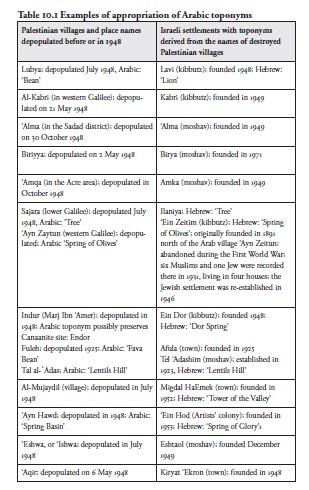
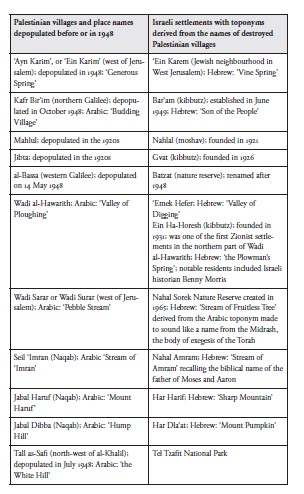
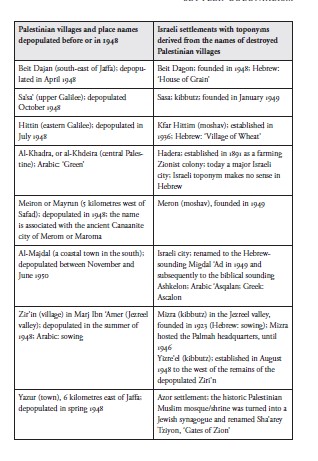
An waɗannan matsugunan Yahudawa an kafa su ne a kan filayen ƙauyukan Falasɗinawa waɗanda aka kwashe mutanensu aka kuma lalata su. A mafi yawan lokuta, waɗannan matsugunan sun ɗauki sunayen ƙauyukan Falasɗinawa na asali, amma aka karkatar da su zuwa sunayen da suke kama da na Ibrananci. Wannan kwace mai yawa na gādon Falasɗinawa ya taimaka wa ƙoƙarin Yahudawan Turai masu mulkin mallaka na cewa su ne wakilan mutanen ƙasar da suke komawa ƙasarsu bayan shekara 2000 na gudun hijira. Misali, matsugunin Yahudawa da ya maye gurbin babban ƙauyen Beit Dajan mai arziki (sunan Filistiyawa "Gidan Dagon"; yana da mazauna 5000 a 1948) an sa masa suna Beit Dagon; an kafa shi a 1948. An gina Kibbutz Sa'sa' a kan ƙauyen Sa'sa'; an kafa ƙungiyar haɗin gwiwa ta moshav ta 'Amka a kan filin ƙauyen 'Amqa (Wakim 2001a, 2001b; Boqa'i 2005: 73). An sauya sunan al-Kabri a Galilee zuwa Kabri; an sauya sunan ƙauyen al-Bassa zuwa Batzat; an sauya sunan ƙauyen al-Mujaydil (kusa da Nazareth) zuwa Migdal Haemek (Hasumiyar Kwari). A yankin Tiberias kaɗai akwai ƙauyukan Larabawa ashirin da bakwai kafin 1948; Isra'ila ta lalata ashirin da biyar daga cikinsu, ciki har da Dalhamiya, Abu Shusha, Kafr Sabt, Lubya, al-Shajara, al-Majdal da Hittin. An canza sunan Hittin – inda Saladin (a Larabci: Salah al-Din) ya ci Crusaders na Latin a Yaƙin Hattin a 1187, wanda ya kai ga kewaye da kayar da Crusaders waɗanda suke iko da Urushalima – zuwa Kfar Hittim mai kama da Ibrananci (Ƙauyen Alkama). A 2008 Hukumar Filayen Isra'ila, wadda ke iko da dukiyar 'yan gudun hijirar Falasɗinawa, ta ba da wani ɓangare na filin ƙauyen ga wani sabon aikin raya ƙasa: wurin wasan golf na kamfani mai zaman kansa na dala miliyan 150, wanda zai kasance da filin golf mai ramuka goma sha takwas, wanda Ba'amurke Robert Trent Jones Jr ya tsara. A kusa da nan, an sa wa hanyar zuwa Tiberias suna Menachem Begin Boulevard; an sanya manyan sandunan ƙarfe a ƙofar masallacin Hittin da ya lalace, kuma an toshe matakalar da ke kai wa ga minaretinsa (Levy 2004).
Jewish settlements were established on the land of the depopulated and destroyed Palestinian villages. In many cases these settlements took the names of the original Palestinian villages and distorted them into Hebrewsounding names. This massive appropriation of Palestinian heritage provided support for the European Jewish colonisers’ claim to represent an indigenous people returning to its homeland after 2000 years of exile. For instance, the Jewish settlement that replaced the large and wealthy village of Beit Dajan (the Philistine ‘House of Dagon’; with 5000 inhabitants in 1948) was named Beit Dagon; founded in 1948; Kibbutz Sa’sa’ was built on Sa’sa’ village; the cooperative moshav of ‘Amka on the land of ‘Amqa village (Wakim 2001a, 2001b; Boqa’i 2005: 73). Al-Kabri in the Galilee was renamed Kabri; al-Bassa village was renamed Batzat; al-Mujaydil village (near Nazareth) was renamed Migdal Haemek (Tower of the Valley). In the region of Tiberias alone there were twenty-seven Arab villages in the pre-1948 period; twenty-five of them, including Dalhamiya, Abu Shusha, Kafr Sabt, Lubya, al-Shajara, al-Majdal and Hittin, were destroyed by Israel. The name Hittin – where Saladin (in Arabic: Salah al-Din) famously defeated the Latin Crusaders in the Battle of Hattin in 1187, leading to the siege and defeat of the Crusaders who controlled Jerusalem – was changed to the Hebrew-sounding Kfar Hittim (Village of Wheat). In 2008 the Israel Land Authority, which controls Palestinian refugee property, gave some of the village’s land to a new development project: a $150 million private golf resort, which was to have an eighteen-hole championship golf course, designed by the American Robert Trent Jones Jr. Nearby, the road to Tiberias was named the Menachem Begin Boulevard; heavy iron bars were placed over the entrance to Hittin’s ruined mosque, and the staircase leading to its minaret was blocked (Levy 2004).
A cikin Marj Ibn ‘Amer (Kwarin Jezreel) Kibbutz Ein Dor (Maɓuɓɓugar Dor)
In Marj Ibn ‘Amer (the Jezreel Valley) Kibbutz Ein Dor (Dor Spring)
Wannan an kafa shi a 1948 ta mambobin ƙungiyar matasa ta gurguzanci-Zionist ta Hashomer Hatza'ir (daga baya Mapam) da ƴan mazauna daga Hungary da Amurka. An kafa shi a kan ƙasar ƙauyen Indur da aka kwashe mutanensa aka lalata, wanda ke da nisan kilomita 10 zuwa kudu maso gabas da Nazareth.
was founded in 1948 by members of the socialist Zionist Hashomer Hatza’ir (later Mapam) youth movement and settlers from Hungary and the United States. It was founded on the land of the depopulated and destroyed village of Indur, located 10 kilometres south-east of Nazareth.
ربما اسم العربية الذي حُفظ يعود إلى مدينة كنعانية قديمة اسمها إندور، لكن ذلك غير واضح. وبعد عام 1948 أصبح كثير من سكانها لاجئين داخليين في إسرائيل (وهم «الغائبون الحاضرون» بحسب القانون الإسرائيلي)، ونالوا الجنسية الإسرائيلية، لكنهم لم يُسمح لهم بالعودة إلى إندور. وتماشياً مع الممارسة الصهيونية الشائعة في إطلاق أسماء توراتية على المواقع والمجتمعات الحديثة، استولى مستوطنو «هشومير هتسعير» الملحدون على الاسم العربي، زاعمين أن عين دور سُميت على اسم قرية ورد ذكرها في صموئيل (28:3‒19). غير أنه ليس من المؤكد بأي حال أن موقع الكيبوتس قريب من المكان الذي كانت فيه «القرية التوراتية». ويحتوي متحف الآثار في الكيبوتس على لقى من عصور ما قبل التاريخ عُثر عليها في المنطقة.
Whether or not the Arabic name preserved the ancient Indur, a Canaanite city, is not clear. After 1948 many of the inhabitants became internal refugees in Israel (‘present absentees’, according to Israeli law) and acquired Israeli citizenship, but were not allowed to return to Indur. In accordance with the common Zionist practice of bestowing biblical names on modern sites and communities, the atheist settlers of Hashomer Hatza’ir appropriated the Arabic name, claiming that Ein Dor was named after a village mentioned in Samuel (28:3‒19). However, it is by no means certain that the kibbutz’s location is anywhere near to where the ‘biblical village’ stood. An archaeological museum at the kibbutz contains prehistoric findings from the area.
Ví a tsakiyar ƙasar, garin Falasɗinawa na zamani Beit Jibrin, mai nisan kilomita 20 arewa maso yamma da birnin al-Khalil, ya taɓa bunƙasa sosai, amma sojojin Isra'ila sun lalata shi a shekarar 1948. Sunan birnin a harshen Aramaic shi ne Beth Gabra, wanda ke nufin 'gidan [ƙarfafan] maza'; a harshen Larabci ma Beir Jibrin na nufin 'gidan masu ƙarfi', wataƙila yana nuna asalin sunansa na Aramaic; an kafa gonar kibbutz mai sunan Ibrananci Beit Guvrin (Gidan Maza), wadda aka sanya wa suna bisa wata al'adar Talmud, a kan filayen Beit Jibrin a shekarar 1949, ta hannun sojojin da suka bar Palmah da sojojin Isra'ila. A yau, ragowar gine-ginen zamanin Byzantine da na Crusader sun tsira, kuma ana kare su a matsayin wurin binciken kayan tarihi a ƙarƙashin sunan Ibrananci Beit Guvrin; gadon tarihin Larabawa da Musulunci na wurin kuwa an yi watsi da shi gaba ɗaya.
In the centre of the country the once thriving ancient Palestinian town of Beit Jibrin, 20 kilometres north-west of the city of al-Khalil, was destroyed by the Israeli army in 1948. The city’s Aramaic name was Beth Gabra, which translates as the ‘house of [strong] men’; in Arabic Beir Jibrin also means ‘house of the powerful’, possibly reflecting its original Aramaic name; the Hebrew-sounding kibbutz of Beit Guvrin (House of Men), named after a Talmudic tradition, was established on Beit Jibrin’s lands in 1949, by soldiers who left the Palmah and Israeli army. Today Byzantine and Crusader remains survive and are protected as an archaeological site under the Hebrew name of Beit Guvrin; the Arab Islamic heritage of the site is completely ignored.