4.1 पाठ के विभाग
4.1 Divisions Of The Text
आयत और सूरत
Aya And Sura
"आयत" (बहुवचन: आयात) का शाब्दिक अर्थ 'निशानी' है। तकनीकी भाषा में यह क़ुरआनी पाठ का सबसे छोटा विभाजन है, यानी एक वाक्यांश या वाक्य। क़ुरआन ईश्वर की ओर से मानवजाति के लिए मार्गदर्शन है, इसलिए यह देखना कुछ आश्चर्यजनक नहीं कि इसके सबसे छोटे विभाजनों को (मार्गदर्शन करने वाली) 'निशानियाँ' कहा गया है। 'verse' शब्द का प्रयोग उचित नहीं है, क्योंकि क़ुरआन कविता नहीं है।
Aya (pl. ayat) actually means 'sign'. In technical language it is the shortest division of the Qur'anic text, i.e. a phrase or sentence. The revelation is guidance from God to mankind and it is therefore not at all surprising to find that its smallest divisions are called (guiding) 'signs'. The term 'verse' is not appropriate since the Qur'an is not poetry.
सूरा (बहुवचन: सुवर) का शाब्दिक अर्थ है 'पंक्ति' या 'बाड़'। पारिभाषिक भाषा में, यह क़ुरआन के पाठ का अध्याय-वार विभाजन है, यानी एक ऐसा भाग या अध्याय, जो अपने से पहले और बाद के पाठ से अलग किया गया हो।
Sura (pl. Suwar) means literally 'row' or 'fence'. In technical language, it is the passage-wise division of the Qur'anic text,i.e. a chapter or part, set apart from the preceding and following text.
कुरआन में 114 सूरतें हैं, जिनकी लंबाई अलग-अलग है; सबसे छोटी सूरह में चार आयतें हैं और सबसे लंबी में 286 आयतें।
The Qur'an has 114 suras of unequal length, the shortest consisting of four and the longest of 286 ayat.
कुरआन की सभी सूरतें (सूरह 9 को छोड़कर) "बिस्मिल्लाहिर रहमानिर रहीम" शब्दों से शुरू होती हैं। यह पाठ में बाद में जोड़ा गया कोई अंश नहीं है, बल्कि यह पैग़ंबर मुहम्मद ﷺ के नबी बनाए जाने से पहले भी प्रयोग में था। [देखें सूरह 27: 30।] कुरआन की सभी 114 सूरतों के नाम हैं, जो एक प्रकार के शीर्षक का काम करते हैं। ये नाम अक्सर स्वयं पाठ के किसी महत्वपूर्ण या विशिष्ट शब्द से लिए जाते हैं, जैसे अल-अनफ़ाल (8) या अल-बक़रह (2)। कुछ अन्य मामलों में यह उन शुरुआती कुछ शब्दों में से एक होता है जिनसे सूरह शुरू होती है, जैसे ता-हा (20) या अल-फ़ुरक़ान (25)।
All suras (with the exception of Sura 9) begin with the words bismillahir rahmanir rahim. This is not a later addition to the text, but was already used, even before Muhammad's call to prophethood. ' [See Sura 27: 30.] All 114 suras in the Qur'an have names, which serve as a sort of heading. The names are often derived from an important or distinguishing word in the text itself, such as e.g. al-anfal (8) or al-baqara (2). In other cases it is one of the first few words with which the sSra begins e.g. ta-ha (20) or al-furqan (25).
क्रम और व्यवस्था
Order And Arrangement
सूरों के भीतर आयतों का क्रम और सूरों की व्यवस्था, दोनों को अंततः पैगंबर ﷺ ने उनकी मृत्यु के वर्ष में फ़रिश्ते जिब्राईल की मार्गदर्शन में तय किया था, जब जिब्राईल दो बार आए और पैगंबर ﷺ के साथ पाठ का पुनरीक्षण किया। [देखें ऊपर, कुरआनी रहस्योद्घाटन के संचरण पर, पृ. 31।] विद्वानों ने सूरों को चार प्रकारों में भी बाँटा है:
Both the order of the ayat within each sura and the arrangement of the suras were finally determined by the Prophet under guidance from the Angel Gabriel in the year of his death, when Gabriel twice came to revise the text with him. [See above. transmission of the Qur'anic revelation, p. 31.] Scholars have also grouped the suras into four kinds:
अल-तिवाल (लंबी सूरतें): 2-10.
al-tiwal (long ones): 2-10.
अल-मा'ऊन: लगभग 100 आयतों वाली सूरें: 10-35।
al-mi'un: suras with approximately 100 ayat: 10-35.
अल-मथानी: वे सूरतें जिनमें सौ से कम आयतें हैं: 36-49।
al-mathani: suras with less than 100 ayat: 36-49.
अल-मुफ़स्सल: क़ुरआन का आख़िरी भाग, जो सूरह क़ाफ़ (50) से शुरू होकर सूरह अन-नास (114) तक है।
al-mufassal: the last section of the Qur'an beginning with Sura qaf: 50-114.
अन्य विभाजन ऑफ़ द टेक्स्ट
Other Divisions Of The Text
जुज़ʼ (बहुवचन: अजज़ा) का शाब्दिक अर्थ है भाग, हिस्सा। क़ुरआन को 30 लगभग बराबर लंबाई वाले भागों में बाँटा गया है, ताकि इसे एक महीने की रातों में, विशेषकर रमज़ान के महीने की तीस रातों में, आसानी से पढ़ा जा सके। आम तौर पर इन्हें "जुज़ʼ" शब्द और उसके साथ लिखी गई संख्या से दर्शाया जाता है (जैसे, जुज़ʼ 30, जो सूरा 78 से शुरू होता है)।
Juz' (pl. ajza') literally means part, portion. The Qur'an is divided into 30 portions of approximately equal length for easy recitation during the thirty nights of a month, especially of the month of Ramadan. Usually they are indicated by the word and the number of it given alongside, (e.g. juz' 30 beginning with Sura 78).
कुरआन की कुछ प्रतियों में सूरतें रुकू' नामक अनुच्छेदों में बँटी होती हैं। इन्हें एक चिह्न द्वारा दर्शाया जाता है, और हर चिह्न के साथ लिखे अरबी अंकों का स्पष्टीकरण इस प्रकार है, जैसे 2:20:
Some copies of the Qur'an have the suras divided into paragraphs called ruku'. They are indicated by the symbol and the explanation of the Arabic numerals written with each is as follows, e.g. 2:20:
यह ऊपर का आंकड़ा (2) दर्शाता है कि यह संबंधित सूरा (यहाँ सूरा अल-बक़रा) में दूसरा पूरा हुआ रुकू‘ है।
The top figure (2) indicates that this is the second completed ruku ' in the respective sura (here Sura albaqara)
.
.
मध्य की आकृति (13) दर्शाती है कि यह पूर्ण हुआ रुकू' 13 आयतों पर आधारित है।
The middle figure (13) indicates that this completed ruku' contains 13 ayat.
निचला अंक (2) यह दर्शाता है कि यह संबंधित जुज़ (यहाँ पहला जुज़) में दूसरा रुकू' है।
The lower figure (2) indicates that this is the second ruku' in the respective juz' (here first juz').
कुरआन की वे प्रतियाँ जो विशेष रूप से मध्य पूर्व में छापी जाती हैं, उनमें हर जुज़ (पारा) को चार हिज़्ब में बाँटा जाता है, जिन्हें एक विशेष चिह्न से दर्शाया जाता है। उदाहरण के लिए, 2:74 कुरआन के दूसरे हिज़्ब की शुरुआत है, जिसे अंक 2 से दर्शाया गया है।
Copies of the Qur'an printed in the Middle East in particular have each juz' subdivided into four hizb indicated by the sign e.g. 2:74 is the beginning of the second hizb of the Qur'an, indicated by the figure 2:
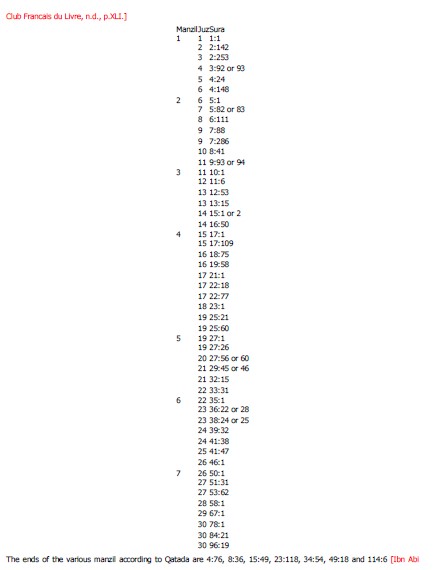
प्रत्येक हिज़्ब को आगे चार भागों (रुबा') में बाँटा जाता है। क़ुरआन के पाठ को भी लगभग बराबर लंबाई के सात भागों में बाँटा गया है, जिन्हें मंज़िल कहा जाता है, ताकि इसे सात दिनों में पढ़ा जा सके। कुछ प्रतियों में हाशिये में शब्द मंज़िल और उसके संबंधित क्रमांक द्वारा इसे दर्शाया जाता है। निम्नलिखित तालिका पाठ के जुज़ और मंज़िल में विभाजन को दर्शाती है: [हमीदुल्लाह, मुहम्मद: Le Saint Coran. Traduction integrale et notes. Paris: