5. 一片の肉塊
5. A Lump Of Flesh
そして、その形を肉塊へと変えました。
and then We made that form into a lump of flesh
人間の発達において、クルアーンで定義されている次の段階は「ムドガ」です。この語は「噛む」「咀嚼」「噛むこと」「噛まれること」「一片の肉」を意味します。61 62 また、胎児が次の段階へと移り、肉となった後の状態も指します。63 その他の意味として、歯で噛まれ、噛んだ跡が見える状態のもの、そして繰り返し噛むことによって噛む過程で変化する跡も含まれます。64 ムドガの段階は、クルアーンの別の箇所でさらに詳しく説明されています。
The next stage of human development defined in the Qur’an is mudghah. This term means to chew, mastication, chewing, to be chewed, and a small piece of meat.61 62 It also describes the embryo after it passes to another stage and becomes flesh.63 Other meanings include something that teeth have chewed and left visible marks on; and marks that change in the process of chewing due to the repetitive act.64 The mudghah stage is elaborated on further, elsewhere in the Qur'an:
そして肉塊(ムドガ)から、形づくられたものと、形づくられていないものへと。65
then from a fleshy lump (mudghah), formed and unformed. 65
アラビア語でここに使われている「formed」にあたる語は mukhallqah であり、「shaped」や「moulded」の意味にもなり得ます。66
The Arabic word used here for ‘formed’ is mukhallqah which can also mean ‘shaped’ or ‘moulded’.66
科学的解釈
SCIENTIFIC INTERPRETATION
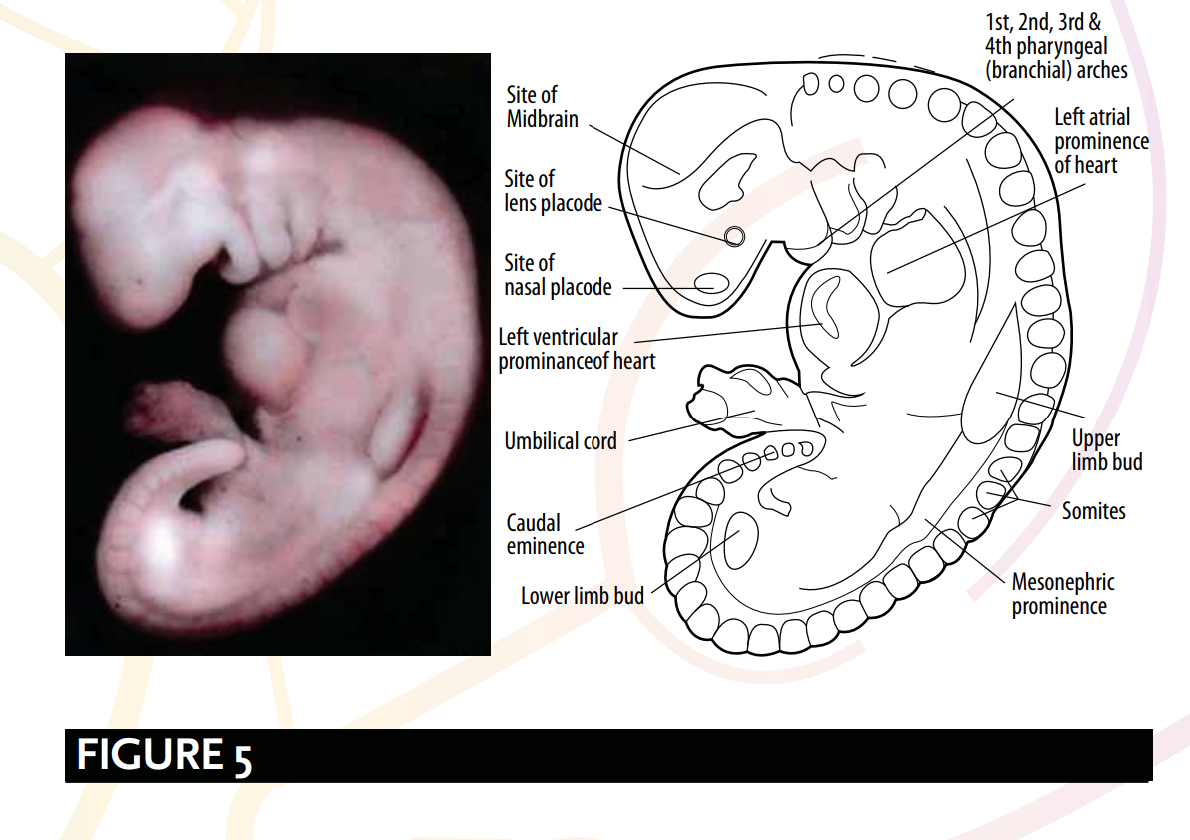
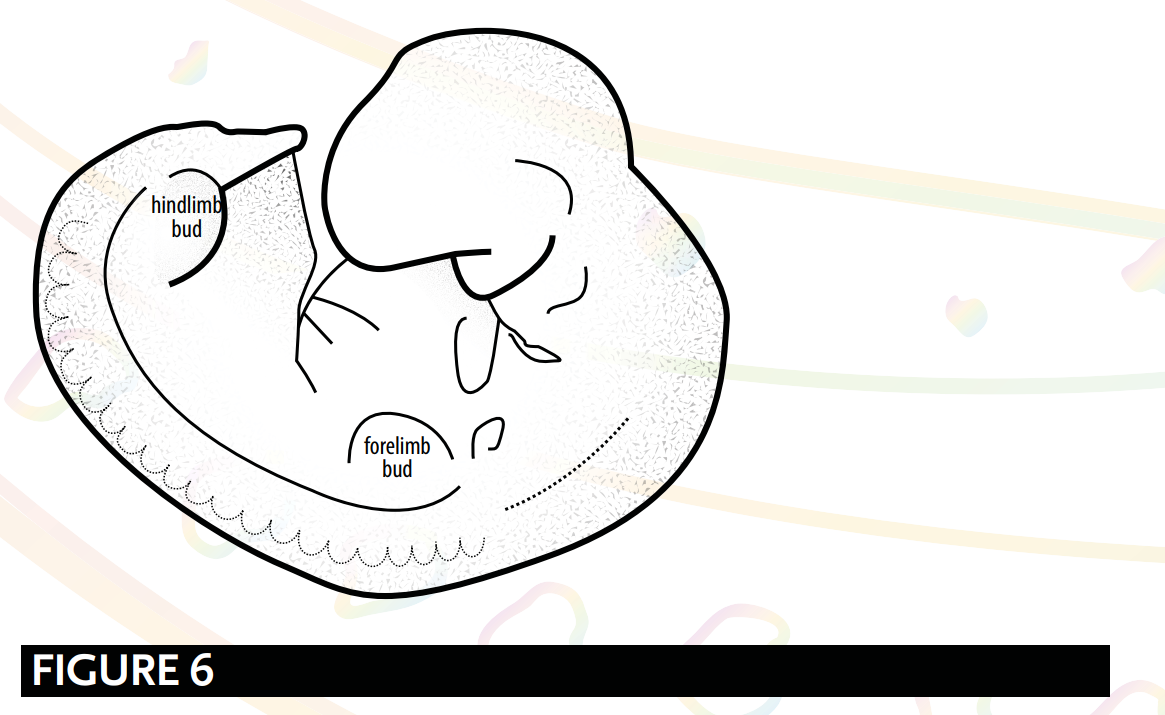
語彙的な解釈のアプローチを取ると、この段階は第4週に当たり、この時期には歯形に似た体節(somite)が形成され始める([図5および図6を参照])。この段階の胚の外観は、体節の発達により、「噛まれたもの」および「歯が噛んで目に見える跡を残したもの」という意味に一致する。体節の発達について、バリー・ミッチェルとラム・シャルマは次のように書いている。
Taking a lexical approach to the interpretation of the word, this stage deals with the 4th week, when somites, which resemble tooth-marks [see Figures 5 and 6], begin to develop. The appearance of the embryo at this stage, due to somite development, corresponds with the meanings: ‘to be chewed’ and ‘something that teeth have chewed and left visible marks on’. Concerning somite development, Barry Mitchell and Ram Sharma write:
第4週には、体節の内側寄りにある間葉細胞が脊索へ向かって移動し、硬節(スクレロトーム)を形成します[間葉は胚の中でゆるやかに配列した胎生期の結合組織です]。67
In the fourth week, the medially placed mesenchymal cells of the somites migrate towards the notochord to form scelerotomes [mesenchyme is the loosely arranged embryonic connective tissue in the embryo].67
「mudghah」の別の意味には、肉片のように見えるものも含まれます。これもまた、この段階における胎児の外見を正確に表した描写です。興味深いことに、クルアーンにおける「mudghah」の説明、すなわち「形作られたものと形作られていないもの」は、主要な器官がすべて発達し始めているものの、まだ完全には形成されていない器官形成期を指す可能性があります。68 この時期は、およそ妊娠4週目頃にも当たります。
Another meaning for the word mudghah includes something looking like a morsel of flesh. This too is an accurate description of the embryo's appearance at this stage. Interestingly, the qur’anic explanation of mudghah as being “formed and unformed”, can refer to the organogenetic period, during which all the main organs have begun to develop, but are not yet fully formed.68 This period also occurs at around the 4th week
噛まれた物質
A CHEWED SUBSTANCE
批評者が提起する論点の一つに、ムドガ(mudghah)の段階について、噛まれた肉片や肉塊は近代発生学が記述するどの段階の胚にも似ていない、というものがあります。これに答えるためには、「噛まれた肉片」とは何を指すのかを明確にする必要があります。それには、噛むこと(咀嚼)だけでなく、一度だけ噛まれたものも含まれます。こうすることで、mudghahという語の意味が保たれます。というのも、噛み跡は一度噛まれた肉片によく似ているからです。このことは、この語のもう一つの意味、すなわち「歯で噛まれ、その跡が目に見えて残っているもの」によっても裏付けられます。
An argument raised by critics concerning the mudghah stage is that a chewed piece of meat or a lump of flesh does not resemble the embryo at any stage described by modern embryology. In responding to this, it is necessary to clarify what constitutes a ‘chewed piece of flesh’. It includes, not just mastication, but also something being chewed just the once. This maintains the meaning of the word mudghah as the bite marks do resemble a piece of meat chewed once. This is highlighted by its other meaning: ‘something that teeth have chewed and left visible marks on’.
概要
SUMMARY
「ムドガ」段階(mudghah)
The `mudghah stage:
体節が発達し、胚が噛まれた物質のような外観を呈すること。肉片のように見えるもの、これはこの段階における胚の外観の正確な描写である。
The development of somites giving the embryo the appearance of a chewed substance. What looks like a morsel of flesh - an accurate description of embryo's appearance at this stage.
それは器官形成期(器官がまだ完全には形成されていない、器官の発達の時期)についても述べています。
It also describes the organogenetic period (the development of organs, not yet fully formed).
このように、クルアーンの用語「ムドガ」をガレノスの著作と比較し、預言者ムハンマド ﷺ がギリシャの人間の発生に関する著作から盗用したという見解を裏付けようとする試みは、これまでにも繰り返されてきた。しかし、ガレノスの著作を分析し、それをムドガという語の多様で広範な意味と対比させると、両者の明確な相違が浮かび上がる。ガレノスは次のように述べている。
As ever, there have been attempts to compare the qur’anic term mudghah with Galen’s work to substantiate the view that the Prophet Muhammad ﷺ plagiarised from Greek writings on human development. However, upon analysing Galen’s writings, bringing it in contrast to the various and extensive meanings of the word mudghah, a pointed difference is made distinct. Galen states:
第三の時期はこれに続きます。前述のとおり、この時期には三つの支配的な部分がはっきりと見え、他のすべての部分の、いわば輪郭や影のようなものが見えてきます。三つの支配的な部分の形態はより明確に見え、胃の各部分の形態はより薄ぼんやりと見え、さらに四肢の形態はそれよりもずっと不明瞭に見えます。その後、それらはヒポクラテスが表現したように「小枝」を形成します。この言葉は、枝に似ていることを示しています。69
The third period follows on this, when, as was said, it is possible to see the three ruling parts clearly and a kind of outline, a silhouette, as it were, of all the other parts. You will see the conformation of the three ruling parts more clearly, that of the parts of the stomach more dimly, and much more still, that of the limbs. Later on they form ‘twigs’, as Hippocrates expressed it, indicating by the term their similarity to branches.69
前述のとおり、クルアーンはムドガ(mudghah)を、噛まれたような物質であり小さな肉片であるものとして述べています。これに対してガレノスは、「三つの支配部分」「影(シルエット)」「小枝」の「形成(conformation)」について論じており、これはおそらく四肢の骨の形成を指していると考えられます。彼はこれら三つの支配部分が、胃や四肢よりも明瞭に見えるものとして詳述しています。しかし、クルアーンはこの点については何も述べておらず、四肢の骨の形成についての言及は次の段階で現れます。したがって、預言者ムハンマド ﷺ がガレノスの著作を写したと主張することは、この段階においてクルアーンがガレノスの記述したいかなる内容も含んでいないことから、道理に合わず実際的でもないと言えます。
As explored, the Qur’an mentions mudghah as a chewed-like substance and a small piece of flesh. In contrast, Galen discusses the “conformation” of “the three ruling parts”, “silhouettes” and “twigs”, which is most likely in reference to limb bone formation. He details these three ruling parts as being more visible than the stomach and the limbs. However, the Qur’an makes no mention of this, and its mention of the limb bone formation comes at the next stage. It is both implausible and impractical, therefore, to suggest the Prophet Muhammad ﷺ copied the works of Galen as the Qur’an does not include any of the descriptions provided by Galen at this stage