1.1 Uchambuzi wa Mgogoro
1.1 Anatomy Of A Crisis
Kumekuwa na uhaba wa waandishi wanaotabiri mwisho wa mfumo tunaoujua. Kwa kweli, wakati tunazungumza, waandishi wengi pengine wanatuma hati zao kwa wachapishaji wakijaribu kuwa wa kwanza kutumia jina "The End of Capitalism" ili kushindana na insha maarufu ya Fukuyama ya mwaka 1989 ya "The End of History" (Mwisho wa Historia), ambayo sasa haitumiki tena. Lakini je, tukio hili kweli litakuwa mwisho wa Ubepari? Haiwezekani. Lakini je, hili ni mwanzo wa mwisho wa ubepari? Huenda kabisa, na bila shaka ubepari kwa sasa unahitaji huduma ya wagonjwa mahututi na unakabiliwa na mgogoro wake mkubwa zaidi.
There has been no shortage of writers predicting an end to the system as we know it. Indeed as we speak many authors are probably sending manuscripts to publishers trying to be first with the title “The End of Capitalism” to rival Fukuyama’s infamous (and now defunct) essay on the End of History in 1989. But will this event really be the end for Capitalism? Unlikely. But, is this the beginning of the end of capitalism? Quite probably, and it is without doubt that Capitalism currently needs intensive care and is facing its greatest crisis.
Matukio ya Septemba 2008 yataingia katika historia kama moja ya nyakati za giza zaidi katika historia ya Ubepari. Alan Greenspan, aliyekuwa Mwenyekiti wa Benki Kuu ya Marekani (Federal Reserve), alisema kuwa matukio ya sasa ni nadra, na hutokea mara moja kila miaka hamsini au mia moja. Kwa Marekani, hasa, mgogoro wa sasa ni sawa kiuchumi na shambulio la Pearl Harbour pamoja na tukio la 9/11 kwa pamoja, mshtuko mkubwa kwa mfumo mzima ambao utahisiwa kwa miaka mingi, ikiwa si miongo, ijayo. Hatushuhudii tu mwisho wa mfumo wa benki za uwekezaji zinazojitegemea, ambao ulikuwa msingi wa ubepari wa kifedha wa kisasa, bali pia tumeona fundisho la uchumi wa soko huria lisilo na udhibiti likivunjwa, huku Serikali zikikimbizana kuokoa taasisi nyingine ya kifedha inayofuata.
The events of September 2008 will go down in history as one of the darkest times in the history of Capitalism. Alan Greenspan former Chairman of the US Federal Reserve stated that the current events were rare, once every fifty or hundred years. For the US, in particular the current crisis constitutes the economic equivalent of Pearl Harbour and 9-11 combined a profound shock to the system which will be felt for years if not decades ahead. Not only have we witnessed the end of the stand alone investment banking model which was the cornerstone of modern financial capitalism, we have also seen the dogma of laissez faire free market economics trashed as Governments scramble around to bail out the next financial institution.
Greenspan amekosea kuhusu tukio linalotokea mara moja kila karne; ni miaka minane tu tangu janga la dot com, ambalo lilifuta karibu dola trilioni 7 kutoka thamani ya soko la hisa. Basi tumefikaje katika hali hii? Marekani, nguvu kubwa yenye uchumi wa dola trilioni 14, imewezaje kugeuka kuwa kicheko cha dunia? Benki za uwekezaji ambazo thamani yake hadi hivi karibuni ilikuwa makumi ya mabilioni ya dola, na ambazo zilinusurika vita viwili vya dunia na Mdororo Mkuu wa Uchumi, zimewezaje kufutwa kwa urahisi namna hii? Serikali za nchi za Magharibi, ambazo zamani zilikuwa zikiwahubiria nchi zinazoendelea kwa kujiona sana sanaa ya umahiri wa kiuchumi, zimewezaje kutenda kwa namna isiyo tofauti na nchi za ndizi zilizoendeshwa vibaya?
Greenspan is wrong about a once a century occurrence, it has only been eight years since the dot com fiasco which wiped off almost 7 trillion dollars off stock market valuations. So how did we get into this mess, how could the United States, a superpower with a $14 trillion economy now become a laughing stock. How could investment banks valued only recently at tens of billions of dollars and who were able to survive two world wars and the great depression be wiped out so easily. How could western governments who used to smugly preach to the developing world the art of economic competence act no better than glorified banana republics?.
Matukio ya mwezi uliopita yalianzia katika sekta ya mikopo ya kiwango cha chini (sub prime), pale madalali waliohamasishwa na tume kubwa walipouza rehani kwa wingi kama mizigo ya malori kwa mamilioni ya wakopaji. Sera hii ya kuhimiza umiliki mkubwa wa nyumba ilifuatwa na serikali mfululizo zilizoamini kwamba kumiliki nyumba ni sehemu ya ndoto ya Kimarekani. Kwa wakopaji wengi waliochochewa na faida ya haraka na kusaidiwa na mikopo rahisi, kupata rehani ilikuwa gharama ndogo ya kulipa kwa ajili ya faida kubwa, kwani bei za nyumba zilipanda kwa kasi ya ajabu. Madalali, baada ya kuweka tume zao benki, waliamua kuziuza rehani hizo, na punde zingegawanywa vipande vipande na kuunda dhamana zinazoungwa mkono na rehani (mortgage backed securities, MBS), zikiuzwa na kuuzwa tena na benki kote duniani. Wakati viwango vya riba vilikuwa chini, benki kote duniani, zikichochewa na wanahisa na wachambuzi, wakiwa ndio washangiliaji wa ubepari wa kampuni, zilipewa changamoto ya kutafuta faida zinazozidi kuongezeka. Kwa hiyo MBS zilikuwa kama peponi kutoka mbinguni, na wakati bei za nyumba zikipanda, mahitaji ya vyombo hivyo na vyombo vingine mbadala yalibaki juu.
The events of the past month were rooted in the sub prime sector when brokers incentivised by fat commissions sold mortgages in their truck loads to millions of borrowers. This policy of encouraging widespread home ownership had been followed by successive administrations who believed that owning one’s house was part of the American dream. For many borrowers motivated by a quick buck and cushioned by easy credit, getting a mortgage was a small price to pay in exchange for a huge profit as house prices rose exponentially. Brokers having banked their commissions decided to sell their mortgages on and soon these would be parcelled up and form mortgage backed securities (MBS) sold and resold by banks throughout the world. At a time of low interest rates, banks throughout the world egged on by shareholders and analysts, the cheerleaders of corporate capitalism, were challenged to seek to gain higher and higher returns. MBSs therefore were like nirvana from heaven and while house prices rose, demand for such instruments and other alternative instruments remained high.
Wakati huo, aina hii mpya ya kuuza kupitia vyombo kama hivyo ilionekana kuwa ya kibunifu na wasimamizi pamoja na wachambuzi walikubaliana nayo, kwa kuwa waliamini bidhaa hizi zilieneza hatari na kuhakikisha kwamba hakuna taasisi moja ingeathirika kupita kiasi. Baada ya miaka ya ukuaji wa bei za nyumba, kila mtu alifurahi hadi kulipotokea anguko lisiloepukika. Wakati huo, mbali na faida za kueneza hatari, hofu kubwa ilitawala pale benki zilipogundua kwamba kwa kweli hazikujua hatari hiyo ilipo, jambo lililosababisha kupotea kwa imani kwa kudumu na kusimama kwa mikopo kati ya benki. Benki hazikuaminiana, kwa kuamini kwamba benki nyingine zingeweza kuwa zimebeba hasara kubwa kadiri MBS zilivyopoteza thamani, au kwa kutumia neno la kitaalamu, zilivyokuwa "sumu". Mgandamizo huu ungezifanya benki fulani zishindwe kulipa madeni na nyingine zifilisike kutokana na ukosefu wa fedha taslimu, baada ya kuwekeza kwa kiwango kikubwa katika kamari ya bidhaa za kifedha za derivatives. Pia ungefanya mikopo iwe ghali zaidi, kuleta wasiwasi mkubwa kuhusu akiba za watu, kuongeza bei za bidhaa na kudhoofisha sarafu, hivyo kufanya bei kupanda zaidi. Yafuatayo ni matukio muhimu yaliyoukumba ulimwengu tangu mgogoro huo uanze.
At the time, this new model of selling on such instruments was considered ingenious by regulators and commentators alike as they believed these products diversified risk and ensured that no one entity would be disproportionately exposed. After years of house price growth, everyone was happy until the inevitable crash. At the time, far from the benefits of diversified risk, deep panic set in as banks discovered that they actually didn’t know where the risk was, thereby leading to a chronic loss of confidence and the freezing of inter bank lending. Banks simply didn’t trust each other believing that other banks could be potentially sitting on huge losses as these MBSs lost value or to use the technical term became “toxic”. This freeze would make certain banks insolvent and others would go to the wall due to a lack of liquidity following highly leveraged derivative bets. It would also make credit more expensive, lead to mass insecurity around savings, increase commodity prices and weaken currencies, so making prices higher. The following are the key events that have hit the world since the crisis began.
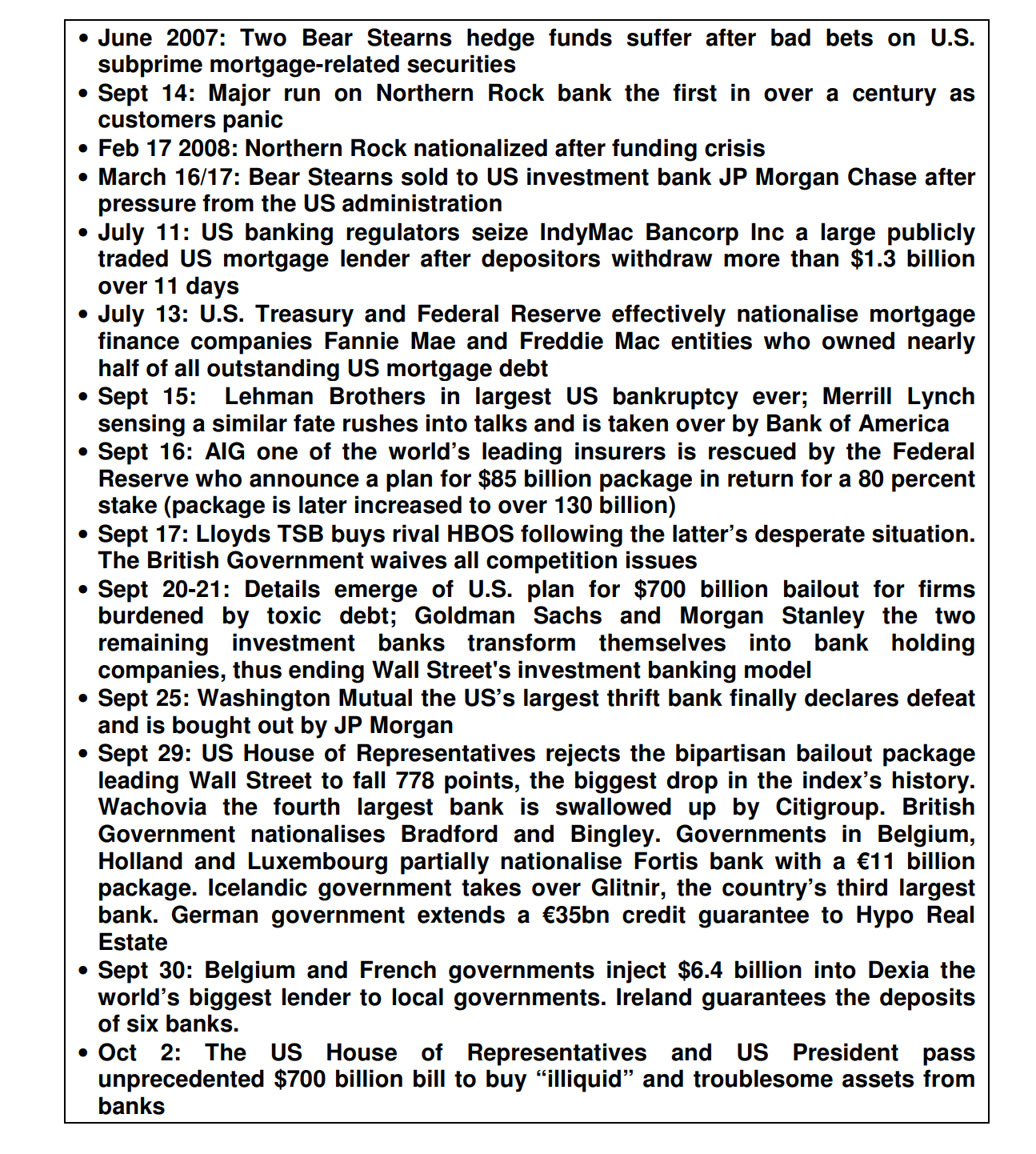

Matukio haya yamekuwa ya msukosuko usiowahi kutokea. Tangu Mdororo Mkuu wa Uchumi hatujashuhudia matukio ya namna hii wala kuona udhaifu mkubwa kiasi hiki katika mfumo wa fedha. Pendekezo la serikali ya Marekani la kununua mali zenye sumu zenye thamani ya hadi dola bilioni 700 kutoka kwenye mfumo wa benki za Marekani lilikataliwa mwanzoni katika Baraza la Wawakilishi kwa kura 228 dhidi ya 205, huku wengi wakitaja jinsi kifurushi hicho kisivyopendwa na wananchi wa Marekani. Watu wamesema kwa haki kwamba Wall Street ilifurahia kuweka faida zake za mabilioni ya dola kuwa za siri wakati wa neema, lakini sasa inataka "kutaifisha" hasara zake, zilipwe na mlipakodi wa Marekani wakati hali ilipokuwa ngumu. Wakati watu wakiendelea kuteseka kutokana na kupanda kwa gharama za chakula, nishati na huduma za afya, malipo ya wafanyakazi wa benki za Wall Street yanaendelea kulipwa, huku wafanyakazi wa zamani wa Lehman wakitarajiwa kupokea bonasi kubwa za mabilioni ya dola kutoka kwa waajiri wao wapya mwaka 2009. Haishangazi kwamba watu wamekata tamaa sana kuhusu Wall Street na washirika wao huko Washington. Zaidi ya hayo, baadhi wanauliza jinsi Marekani, ambayo tayari ina madeni ya matrilioni ya dola, inavyoweza kumudu uokoaji mkubwa kama huu na jinsi inavyoweza kuendelea kutoa mabilioni ya dola za ukwasi kwa soko la Marekani na la dunia. Njoo mbele Ben Bernanke, Mwenyekiti wa sasa wa Hifadhi ya Shirikisho na fimbo yake ya uchawi! Katika hotuba aliyoitoa miaka sita iliyopita, Bernanke alifichua silaha zake za siri alipotamka yafuatayo.
The events have been of unprecedented volatility. Not since the Great Depression have we witnessed such events and seen such fragility in the financial system. The US government’s proposal to buy toxic assets up to $700 billion from the US banking system was initially defeated by 228-205 in the House of Representatives, with many citing the sheer unpopularity of the package with the American people. People have rightly pointed to the fact that Wall Street was more than happy to keep their billion dollar profits private in the good times and yet want to ‘nationalise’ their losses, to be paid for by the American taxpayer when the going got tough. While people continue to suffer from higher food, energy and healthcare costs, Wall Street bankers’ compensation packages continue to be paid with ex Lehman’s staff on course for huge multi billion dollar bonuses from their new employers in 2009. No wonder people are so disillusioned with Wall Street and their cohorts in Washington. In addition some ask how the US, already trillions in debt can afford such huge bailouts and how they can continue to be able to provide hundreds of billions of dollars in liquidity to the US and world markets. Step forward Ben Bernanke the current Chairman of the Federal Reserve and his magic wand! In a speech given six years ago Bernanke revealed his secret weapons when he stated the following.
"Kama dhahabu, dola za Marekani zina thamani tu kwa kiwango ambacho usambazaji wake umewekewa kikomo kikali. Lakini serikali ya Marekani ina teknolojia, inayoitwa mashine ya kuchapisha (au, leo, mfano wake wa kielektroniki), inayoiwezesha kuzalisha dola za Marekani kadiri inavyotaka kwa gharama isiyo na maana."