Hmm, I notice that your message is only a heading and contains no text beyond "4.3 Basic Terms in Hadith." Could you please paste the English passage you'd like me to translate into Swahili?
4.3 Basic Terms in Hadith
• Sanad: ( ع ٕذ ) Mnyororo wa wapokezi unaorudi hadi kwa Mtume ﷺ.
• Sanad: ( ع ٕذ ) A chain of reporters leading back to the Prophet (saw).
• Tabaqah: (غرمس) Tabaka la wasimulizi wa kizazi kimoja, yaani Masahaba na Tabi'een.
• Tabaqah: (غرمس ) A class of reporters in the same generation, i.e. Sahabah, Tabi‟een.
• Marfu‟: ( شِفٛع ) Hadithi ambayo sanad yake inafika kwa Mtume ﷺ.
• Marfu‟: ( شِفٛع ) A Hadith whose Sanad leads to the Prophet (saw).
• Mawquf: (ِٛلٛف ) Hadithi ambayo sanad yake inaishia kwa Sahaba.
• Mawquf: (ِٛلٛف ) A Hadith whose Sanad ends with a Sahabi.
• Mursal: (شِعً ) Hadithi inayoishia kwa Mtume ﷺ lakini ikikosa jina la Sahaba aliyeipokea.
• Mursal: (شِعً ) A Hadith leading to the Prophet (saw) but missing the name of the Sahabi who reported it.
• Qudsi: (لذعٟ ) Hadithi ambayo sanad yake inafika kwa Nabii ﷺ, na Nabii ﷺ ananukuu kutoka kwa Allah (SWT).
• Qudsi: (لذعٟ ) A Hadith whose Sanad leads to Prophet (saw) and the Prophet (saw) is reporting it from Allah (swt).
Hadithi Qudsi inaweza kuanza kusimuliwa kwa njia mbili:
The report of Hadith Qudsi can begin in one of two ways:
a) Mtume ﷺ anasema akimnukuu Allah (SWT).
a) The Prophet (saw) says reporting from Allah (swt).
b) Mwenyezi Mungu (SWT) amesema, kama alivyopokewa na Mjumbe wake ﷺ.
b) Allah (swt) has said as reported by His Messenger (saw).
Aina za Hadithi:
Types of Hadith:
Aina tofauti za Hadith zipo kutokana na njia ya usimulizi, idadi ya wasimulizi katika kila daraja, na usahihi wa Hadith hiyo.
Different types of Ahadith exist due to the method of transmission, number of reporters in each class, and the authenticity of the Hadith.
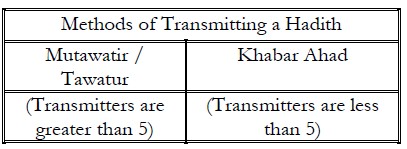
Mutawatir / Tawatur: Dalili iliyopokelewa na idadi isiyojulikana ya watu. Kutokana na wingi wa watu wanaoripoti dalili hiyo na tofauti ya makazi yao, uaminifu wao na imani zao, haiwezekani kufikirika kwamba dalili hii inaweza kuwa imezuliwa.
Mutawatir / Tawatur: a Daleel transmitted by an indefinite number of people. Due to the large number of people reporting the Daleel and their diversity of residence, reliability, and conviction, it is inconceivable that this Daleel could be fabricated.
Idadi ndogo kabisa ya wapokezi wanaohitajika ili hadithi iainishwe kuwa Mutawatir kwa kawaida ni watano. Hata hivyo, baadhi ya wanazuoni wanaweza kuwa na vigezo vikali zaidi. Tabia ya wapokezi wanaosimulia Hadithi Mutawatir lazima iwe tukufu.
The minimum number of transmitters that are required to classify a Daleel as Mutawatir is generally five. However, some scholars may have more stringent criteria. The character of the reporters narrating Mutawatir Ahadith has to be noble.
Ahad: (آقحد) Riwaya Ahad ni idadi ndogo kuliko Mutawatir.
Ahad: (آقحد ) Riwayah Ahad is a number less than the Mutawatir.
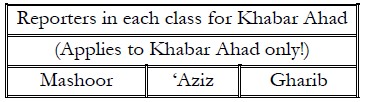
Mashhūr: Hadith iliyopokewa na angalau watu watatu katika kila tabaka (Maswahaba, Tabi'īn, n.k.).
Mashoor: A Hadith reported by at least three individuals in every class (Sahabah, Tabi‟een, etc.).
Aziz: Hadithi iliyopokewa na angalau watu wawili katika kila tabaka.
„Aziz: A Hadith reported by at least two individuals in every class.
Gharibu: Hadithi iliyopokewa na mtu mmoja tu katika tabaka moja au zaidi.
Gharib: A Hadith reported by only one individual in one or more classes.
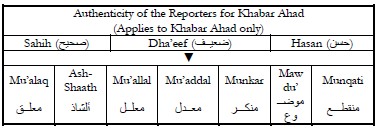
Sahih:
Sahih:
Hadith ni ile iliyosimuliwa na mtu ‘Adl (asiyejulikana kwa utovu wa nidhamu) na Daabit (anayehifadhi usahihi wa simulizi), kutoka kwa mtu mwingine mwenye sifa kama hizo hadi mwisho wa simulizi. Simulizi hiyo pia inapaswa kuondoa Shudhudh (kutofautiana na wasimulizi wengine waaminifu).
A Hadith narrated by an „Adl (not known for misconduct) and Daabit (maintains accuracy of the report) person from another person of similar qualities until the end of the report. The report should also exclude any Shudhudh (disagreement with other credible reporters).
Hasan:
Hasan:
Ina maana mbili.
It has two definitions:
a) Hadithi ambayo inatimiza masharti ya Sahih kwa kiwango cha chini zaidi.
a) A Hadith, which meets the requirements of Sahih to a lesser degree.
b) Hadithi inayokubaliwa na wengi wa Fuqaha.
b) A Hadith, which is acceptable by the majority of the Fuqaha.
Dha‟eef:
Dha‟eef:
Hadith dhaifu ambayo haikidhi sharti la Hadith Sahih wala Hadith Hasan, inaweza kuwa mojawapo ya zifuatazo:
A weak Hadith which does not meet the requirement of either the Sahih or the Hasan Hadith, it can be one of the following:
Mu‘alaq: Hadith ambayo imekosa msimulizi mmoja au zaidi, ama mwanzoni mwa Isnad, katikati yake, au mwishoni mwake.
Mu‟alaq: A Hadith which is missing one or more reporters either at the beginning of the Isnad, in the middle or in the end.
Mu‟addal: Hadith ambayo imekosa wapokezi wawili au zaidi mfululizo.
Mu‟addal: Hadith which is missing two or more consecutive reporters.
Munqati: Hadithi yenye kukatika kwa mnyororo katika daraja.
Munqati: A Hadith which has interruption in the class.
Ash-Shaath: Hadithi ambayo mpokezi mmoja aliyeaminika anapokea jambo linalopingana na wapokezi wengine waliaminika.
Ash-Shaath: A Hadith in which one credible reporter reports something that disagrees with other credible reporters.