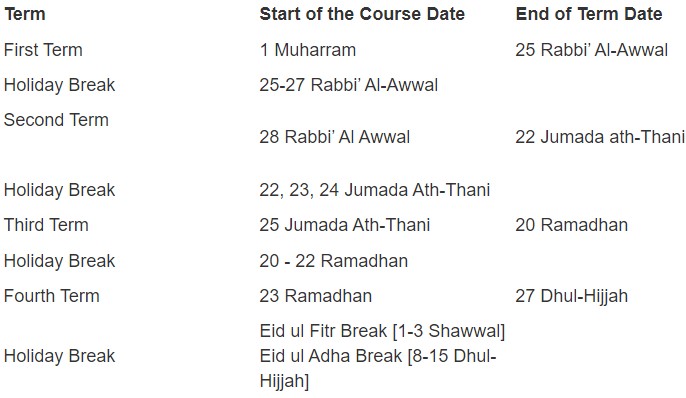
Bola Hijriy taqvim bo‘yicha olti yoshni to‘ldirgan zahoti maktabga kiradi. Shunga ko‘ra, davlat maktablari yilning to‘rt o‘quv choragining har birining boshida, ya’ni taxminan har uch oyda yangi o‘quvchilarni qabul qiladi. Bola yilning mavjud to‘rt choragidan, Hijriy taqvim bo‘yicha olti yoshga to‘lishiga eng yaqin bo‘lgan birinchi choragiga kirishi mumkin.
The child enters school immediately upon completing six years of age according to the Hijri calendar. Accordingly, State schools will accept new students at the beginning of each school term of the four terms of each year i.e. approximately every three months. The child is able to enter the first school term (of the four available in the year) nearest to his attaining six years of age according to the Hijri calendar.
Talaba har uch ketma-ket o‘quv muddatidan keyin, kamida shunday, bir o‘quv muddati dam olishi mumkin, lekin u bunday dam olishsiz ham o‘qishini davom ettirishi mumkin. Shunday qilib, tizim jiddiy talabaga maktab bosqichlarini o‘z tengdoshlaridan qisqaroq vaqtda tugatish imkonini beradi: u o‘quv muddatlari ichida muvaffaqiyatli o‘qishni davom ettiradi, dam olish davrlarini olmaydi yoki ularni qisqartiradi. O‘qish vaqti birligi 83 kundan iborat o‘quv muddati bo‘lib, yillik o‘quv yili emas; har bir muddatning o‘z fan o‘quv dasturi va o‘quvchilari bor.
The student can rest one school term only after every three consecutive terms at the least, but he can also continue his study without any such rest. Thus the system enables the serious student to complete the school stages in a shorter time than his contemporaries by continuing his studies within the school terms successfully without taking the rest periods or reducing them. The study time unit is the school term which is composed of 83 days and not the annual year; each term has its own subject curriculum and students.
Muvaffaqiyatli ravishda, hech qanday ta'tilsiz o'quv choraklarini davom ettirgan talaba o'ttiz oltita choraknı to'qqiz yilda (36/4=9 yil) tugallashi mumkin, shunda u o'n besh yoshga to'lganda maktab bosqichlarini tugallagan bo'ladi. Agar u o'ttiz oltita choraknı yiliga o'rtacha atigi uch o'quv choragi bilan o'qisa, ya'ni odatda har uch ketma-ket choraqdan keyin bir o'quv choragini dam olish bilan, barcha choraklarni muvaffaqiyatli tugallash bilan birga, u maktab bosqichlarini o'n ikki yilda (36/3=12 yil) tugallaydi, shunda u o'n sakkiz yoshga yetganda maktab bosqichlarini tugallagan bo'ladi.
The student who continues his school terms successfully without taking any leave can complete thirty-six terms in nine years (36/4=9 years) whereupon he would have completed the school stages upon completing 15 years of age. If he studies the thirty-six terms at an average of only three school terms every year i.e. by usually resting one school term after every three consecutive terms, together with successfully completing all terms, he would complete the school stages in twelve years (36/3=12 years) whereupon he would complete the school stages upon attaining 18 years of age.
Ba'zi talabalar uchta maktab bosqichini tugatish uchun 18 yoshga to'lgandan keyin yana bir yil yoki ikki yil kerak bo'lishi mumkin. Agar ular 20 yoshga to'lib, maktab bosqichlarining davlat imtihonlarini topshirmagan bo'lsalar, ular muntazam o'qishdan ozod etiladi va kasb-hunar institutlariga qo'shilish yoki imtihonlarni yana bir bor topshirish o'rtasida tanlov qiladilar, agar muvaffaqiyatli topshirsalar, oliy ta'limga o'tish uchun.
Some students may need a year or two after attaining 18 years to complete the three school stages. If they attain 20 years without passing the school stages’ public examinations, they are excused from regular study and choose between joining vocational institutes or retaking the public examinations again so as to join university education if successful.
Maktab o'quv yillarining bu tizimi talabalar o'rtasidagi individual farqlarni hisobga olish bilan birga, vaqtning ahamiyatiga va ularning ilmiy yutuqlariga ham katta e'tibor beradi.
This system of school terms, apart from taking into account individual differences between students, also takes great care over the importance of time and their academic achievement.
Kitobning oxirida keltirilgan jadval 36 ta o‘quv choragining o‘quvchilar yosh guruhlari o‘rtasida taqsimlanishini namoyish etadi. Shuningdek, jadvalda o‘quvchilarning maktab bosqichlarini tugatish va bitirish vaqtidagi eng kichik hamda o‘rtacha yoshi ham ko‘rsatilgan.
The chart attached at the end of this book demonstrates the distribution of the 36 school terms among student age groups. It also demonstrates the lowest as well as the average age of students upon graduation and completion of school stages.
Ushbu muddatli tizimni joriy etish uchun kichik qishloqlar orasida "Kompleks maktab" tashkil etiladi va o'quvchilarning uylaridan maktabga va maktabdan uylariga tashish ta'minlanadi.
A “Comprehensive school” complex is established between small villages to implement this term system, and transportation of students from their homes to and from school will be secured.