2.1 Daleelning tuzilishi
2.1 Structure of Daleel
Yuqorida aytib o'tilganidek, dalil — bu Islomdagi biror fikr, tushuncha, hukm yoki mulohaza uchun isbot bo'lib, u ikki jihatga ega: riwoyat (naql qilish) va dalolat (ma'no).
As mentioned earlier, a Daleel is an evidence for an opinion, concept, ruling, or a thought from Islam. There are two aspects related to any Daleel, Riwayah (reportage) and Dalalah (meaning).
Riyoyat (rivoyat) bizga ma'lumotning qanday yetib kelganiga oid masalalarni, jumladan uni rivoyat qilganlarning soni va ularning odilligi (ishonchliligi)ni qamrab oladi.
The Riwayah covers issues related to how the information was relayed to us, which includes the number and the integrity of its reporters.
Dalolat matnning Dalil ichidagi ma'nosiga taalluqlidir. Dalolat va riwoyat bilan bog'liq holda ishlatiladigan ikki atama ham bor: qat'iy (qat'i') va zanniy (zanni).
The Dalalah is related to the meaning of the text in the Daleel. There are also two terms used in connection with Riwayah and Dalalah; Qata‟i and Dhanni.
Qat'iy – qat'iy (aniq, hal qiluvchi) ma'noda bo'lib, Zanniy esa qat'iyga qarama-qarshi bo'lib, aniq bo'lmagan, taxminiy yoki qat'iy hal qilinmagan ma'noni bildiradi.
Qata‟i is defined as being conclusive or decisive, while Dhanni is the opposite of Qata‟i and means non-definite, speculative or indecisive.
Rivoyat
Riwayah
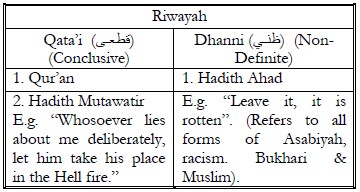
Har qanday oyat yoki hadisi mutavotir Qur'ondan bo'lgan oyat (riwoyat) jihatidan qat'iy (aniq) deb hisoblanadi.
Any Ayah from the Qur‟an or Hadith Mutawatir is considered Qata‟i (conclusive) in its Riwayah (report).
Riwoyatda qat’iy degani, dalilning ishonchli ekanligi shubhasiz deb bildirishdir. Bu ishonchlilik rivoyat usuli asosida belgilanadi.
The Qata‟i in Riwayah implies that the evidence is authentic without any shadow of doubt. This authenticity is established based on the methodology of transmission.
Qur'onning bizgacha yetib kelgan rivoyat usuli uning har qanday soxtalashtirilishi ehtimolini istisno qiladi. Hisobot avlodma-avlod aynan bir xil tarzda naql qilib kelingan. Butun bir avlodning Qur'onga biror narsani qo'shishi, o'chirishi yoki uning mazmunini o'zgartirishi mumkin emas. Shu avlodning har bir fardi yig'ilib, Qur'ondan qismlarni qo'shish yoki olib tashlash to'g'risida kelishib olgan deb o'ylash ham tasavvurga sig'maydi. O'sha avlodning barcha kishilari Qur'onning bir xil mazmunini tilovat qilib yurgan, shu bilan uning matni tasdiqlangan.
The methodology by which the Qur‟an was transmitted to us precludes any possibility of fabrication. The report was transmitted generation by generation in exactly the same manner. It is impossible for an entire generation to fabricate, erase, or add contents to the Qur‟an. It is inconceivable to believe that every single individual in that generation assembled together and agreed to add or delete parts of the Qur‟an. Everyone in that generation was reciting the same contents of the Qur‟an, thus authentifying its contents.
Hadis mutavotir avloddan-avlodga emas, balki juda ko‘p odamlar tomonidan rivoyat qilingan. Dalilni xabar qilgan odamlarning soni juda ko‘pligi, ularning turli joylarda yashashi hamda ularning ishonchliligi va e’tiqodi mustahkamligi tufayli, bu dalilning xato bo‘lishi tasavvur qilib bo‘lmaydigan narsadir. Qur’ondan yoki hadis mutavotirdan boshqa har qanday ma’lumot xabari, masalan hadis ahad, zanniy (aniq emas) deb hisoblanadi, ya’ni dalilda xato bo‘lishi ehtimoli juda oz bo‘lsa ham mavjud. Qisqacha aytganda:
Hadith Mutawatir was not transmitted generation-by-generation, but rather by a large number of people. Due to the large number of people reporting the Daleel, and their diversity of residence, their established reliability and conviction, it is inconceivable that this Daleel could be wrong. Any report of information other than through the Qur‟an or Hadith Mutawatir, such as Hadith Ahad, is considered Dhanni (non-definite), meaning that there is a minute possibility that the Daleel could contain error. To summarise:
Dalolat
Dalalah
Daleelning ikkinchi jihati — dalolat (ma'no) hisoblanadi. Agar Qur'on matni, Hadisi mutavotir yoki Hadisi ahad matni aniq, muayyan bo'lib, faqat bitta ma'noga ega bo'lsa, u qat'iy hisoblanadi. Qat'iy daleelning matni faqat bitta ma'noga ega bo'lishi va boshqa har qanday talqinga ochiq bo'lmasligi kerak. Agar matn bir necha talqinga ochiq bo'lsa, u zanniy hisoblanadi. Talqinlar arab tiliga bog'liq bo'lgani uchun har qanday talqin arab tili orqali asoslanishi lozim. Xulosa qilib aytganda:
The second aspect of the Daleel is the Dalalah (meaning). If the text of Qur‟an, Hadith Mutawatir or Hadith Ahad is clear, specific, and has only one meaning, then it is considered Qata‟i. The text of a Qata‟i Daleel has to have only one meaning and cannot be open to any other interpretation. If the text is open to more than one interpretation, then it is considered Dhanni. Since interpretations are due to the Arabic language, any interpretation has to be justified through the Arabic language. To summarise:
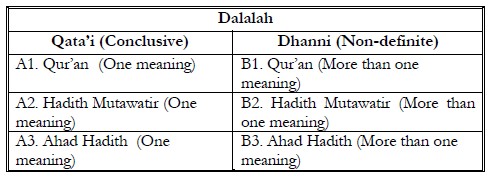
A1. Qur'onning qat'iy (aniq) ma'noga ega bo'lgan misoli:
A1. Example of Qur‟an with a Qata‟i (conclusive) meaning:
“Agar ularning farzandi bo‘lmasa, xotinlaringiz qoldirgan narsaning yarmi sizniki bo‘ladi”. (TMQ An-Niso: 12)
“What your wives leave, your share is a half, if they leave no child”. (TMQ An-Nisa: 12)
"Iffatli ayollarga zino (zinokorlik) tuhmatini qo'yib, so'ngra to'rt guvoh keltira olmaganlarni — ularni sakson qamchi bilan uring." (TMQ An-Nur: 4)
“Those who accuse chaste woman of zina (adultery) and fail to bring four witnesses (to prove it) flog them eighty stripes.” (TMQ An-Nur: 4)
Ushbu hukmlarning miqdoriy jihati, ya'ni yarmi va sakson, aniq bo'lib, shuning uchun boshqa talqinlarga ochiq bo'lishi mumkin emas.
The quantitative aspect of these rulings, namely one half and eighty are clear and therefore cannot be open to any other interpretations.
A2. Mutavotir hadisga misol, qat'iy (aniq) ma'noli:
A2. Example of Hadith Mutawatir with Qata‟i (conclusive) meaning:
“Kim ataylab menga yolg‘on nisbat bersa, u o‘z o‘rnini do‘zaxdan olsin.” (Buxoriy va Muslim)
“Whosoever lies about me (Prophet Muhammad saw) deliberately let him take his place in the hell-fire.” (Bukhari & Muslim)
Ushbu mutavotir hadis mavzusi juda aniq bo'lib, matndan faqat bitta tushuncha chiqadi: kim Payg'ambar ﷺ aytgan narsa haqida ataylab yolg'on gapirsa, u do'zaxga kiradi.
This Mutawatir Hadith is very clear in its subject; thus there is only one understanding from the text that whoever lies about what Prophet (saw) said, intentionally, he will go to hell-fire.
A3. Hadis Ahad bilan qat'iy (aniq) ma'noga ega bo'lgan misol:
A3. Example of Hadith Ahad with Qata‟i (conclusive) meaning:
Ishonchli rivoyatlarga ko'ra, Payg'ambar ﷺ Shavvol oyida 6 kun ro'za tutgan. Ushbu hadisdan quyidagi aniq ma'nolar kelib chiqadi:
It is reported from a non-Mutawatir Hadith that the Prophet (saw) fasted 6 days in Shawwal. The conclusive meanings from this Hadith are the following:
a) Shavvol oyida 6 kun ro'za tutishning ruxsat etilganligi.
a) Permissibility of fasting 6 days in Shawwal.
b) Shavvol oyining birinchi kunidan tashqari, chunki u Ro'za hayit kuni bo'lib, hayit kunida ro'za tutish haromdir.
b) Except on the first day of Shawwal, since it is the day of Eid, and it is Haram to fast on Eid.
B1. Qur'on oyatining zanniy (noaniq) ma'noli misoli:
B1. Example of Quranic Ayah with a Dhanniy (non-definite) meaning:
Alloh (SWT) shunday deydi:
Allah (swt) says:
"Ey iymon keltirganlar! Namozga turmoqchi bo'lganingizda, yuzlaringizni va qo'llaringizni tirsaklargacha yuvinglar, boshlaringizni mash qilinglar (ho'l qo'llaringizni ularning ustidan o'tkazib), oyoqlaringizni esa to'piqlargacha yuvinglar. Agar janoba holatida bo'lsangiz, o'zingizni pok qilinglar (butun tanangizni yuvinglar). Ammo kasal bo'lsangiz yoki safarda bo'lsangiz, yoki biringiz tabiat ehtiyojini qondirgandan keyin kelgan bo'lsangiz, yoki ayollarga tegib bo'lgan bo'lsangiz-u, suv topa olmasangiz, u holda pok tuproq bilan tayammum qilinglar va u bilan yuzlaringizni hamda qo'llaringizni mash qilinglar."
“O you who believe! When you intend to offer As-Salat (the prayer), wash your faces and your hands (forearms) up to the elbows, rub (by passing wet hands over) your heads, and (wash) your feet up to ankles. If you are in a state of Janaba (i.e. had a sexual discharge), purify yourself (bathe your whole body). But if you are ill or on a journey or any of you comes from answering the call of nature, or you have been in contact with women and you find no water, then perform Tayammum with clean earth and rub therewith your faces and hands.” (TMQ Al-Maida: 6)
Oyat "lamastum" so'zi haqida: agar ayollarga "lamastum" (ya'ni tegsangiz) bu vuzuni buzadi deydi. "Lamastum" so'zi ikki ma'noda talqin qilingan:
The verse says if you „lamastum‟ the women, it breaks the Wudhu. The word „lamastum‟ has been interpreted as having two meanings:
a) Qo'l tekkizish b) Jinsiy aloqa Shunday qilib, ushbu oyatning zanniy dalolati bor, ya'ni ayollarga qo'l tekkizish vuzuni buzadi, yoki ayol bilan jinsiy aloqa vuzuni buzadi, degan ma'noni anglatishi mumkin.
a) Touching b) Sexual intercourse Thus the Ayah has a Dhanni Dalalah, i.e. it could mean touching women breaks the Wudhu, or sexual intercourse with a woman breaks the Wudhu.
B2. Hadis mutavotirning zanniy (aniq bo'lmagan) ma'noga ega bo'lgan misoli:
B2. Example of Hadith Mutawatir with a Dhanniy (non-definite) meaning:
Rivoyat qilinishicha, Payg'ambar ﷺ ihromni ma'lum bir tarzda yechar edilar. Biroq, sahobalar (roziyallohu anhum) Payg'ambar ﷺ ga ihromni u zot ﷺ yechgan tarzdan boshqacha tarzda yechganlarini aytganlarida, Payg'ambar ﷺ ularning ishlarini ma'qulladilar. Bu voqea mutavotir bo'lsa-da, ihromni yechish qoidalari ko'pdir.
It was reported that the Prophet (saw) used to take off his Ihram in a specific manner. However, when the Sahabah (ra) told the Prophet (saw) that they took it off in a manner different from the way he (saw) took it off, the Prophet (saw) approved of their actions. Though this incident is Mutawatir, the rules to take off one‟s Ihram are many.
B3. Hadith ahad bo'lgan, ammo zanniy (aniq bo'lmagan) ma'noli hadisga misol:
B3. Example of a Hadith Ahad with a Dhanniy (non-definite) meaning:
Ghayri mutawatir hadisda rivoyat qilinishicha, Payg'ambar ﷺ Shavvol oyida 6 kun ro'za tutganlar. Bu hadisning aniq bo'lmagan ma'nolari quyidagilardir:
It is reported from a non-Mutawatir Hadith that the Prophet (saw) fasted 6 days in Shawwal. The non-definite meanings of this Hadith are:
a) Olti kunlik ro‘zalar ketma-ket tutilishi shartmi yoki yo‘qmi?
a) Whether the six days of fasting are consecutive or not?
b) Shavvol oyining qaysi qismida ro‘za tutiladi?
b) Fasting in which part of Shawwal?
Biz hozirgacha riwoyat va dalolatning qat'iy va zanniy jihatlarini alohida-alohida muhokama qildik. Ammo dalil riwoyat jihatidan ham, dalolat jihatidan ham qat'iy yoki zanniy ekanligini aniqlash uchun quyidagi usul qo'llaniladi.
So far we have discussed the Qata‟i and Dhanni aspects of both Riwayah and Dalalah separately. However, the method to determine whether the Daleel (both in Riwayah and Dalalah) is Qata‟i (conclusive) or Dhanni (non-definite) is the following:
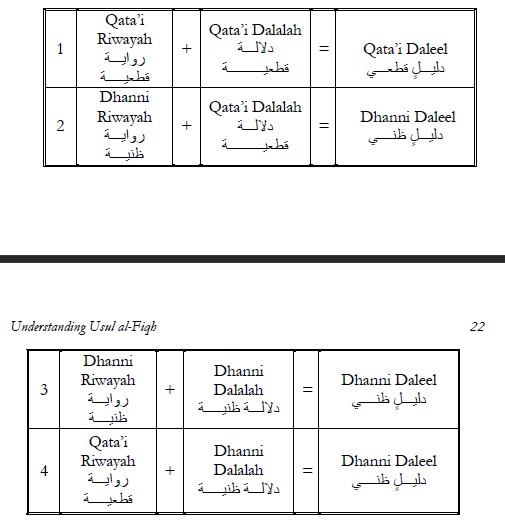
Aqidaga oid har qanday g‘oya, fikr yoki tushuncha qat’iy dalilga asoslanishi kerak. Masalan, farishtalarning mavjudligi tushunchasi zanniy emas, balki qat’iy dalilga asoslangan. Shuningdek, usul al-fiqhda hukmlarni chiqarish uchun manba sifatida qabul qilinadigan narsa, eng kuchli qarashga ko‘ra, qat’iy dalilga asoslangan bo‘lishi lozim.
Any idea, thought, or concept related to the „Aqeedah has to be based upon a Qata‟i Daleel. As an example, the concept that Angels exists is based upon a Qata‟i Daleel not Dhanni. Also, in Usul al-Fiqh, to establish a source for extracting rulings according to the strongest view, the source must base upon a Qata‟i Daleel as well.
Masalan, Ijmoʻ as-sahobani (sahobalar ijmosi) hukmlar manbai sifatida qabul qilinishi uchun, Ijmoʻ as-sahobaning hujjatliligini isbotlovchi dalil ham riwoyat jihatidan, ham dalolat jihatidan qatʼiy bo‘lishi kerak, garchi hukm qatʼiy yoki zanniy dalildan chiqarilishi mumkin bo‘lsa ham.
As an example, to consider Ijma‟ as-Sahabah (consensus of the Companions) as a source of rulings, the Daleel to prove the authority of Ijma‟ as-Sahabah has to be Qata‟i both in Riwayah and Dalalah, though a ruling can be derived from either Qata‟i or Dhanni Daleel.
Bir kishi nega Qur’on va Sunnat matnini tushunish shunchalik murakkab bo‘lib ko‘rinadi, deb so‘rashi mumkin?
One might wonder why understanding the text of Qur‟an and Sunnah is so complicated?
Qur'on va Sunnat matnini tekshirib ko'rsak, ularning hajmi cheklangan ekanini ko'ramiz. Shu cheklangan matn asosida biz qayerda va qachon bo'lishidan qat'i nazar, to Qiyomat kunigacha bizni bezovta qiladigan har qanday muammoga hukm chiqarishimiz mumkin.
By examining the text of Qur‟an and Sunnah one can see that it is limited in its volume. With its limited text one can generate rulings to any problems affecting us anywhere and anytime until the Day of Judgment.
Allohning (SWT) mo''jizasidir, Qur’on va Sunnat matnlari bitta oyat va bitta hadisdan ko‘plab hukmlarni ifodalash qobiliyatiga egadir; holbuki, bitta matndan ko‘p ma’nolarni anglash qobiliyati dunyoning hech bir boshqa huquqiy matnida topilmaydi! Har bir avlod musulmonlari oldidagi vazifa matnni tushunishga harakat qilish va uni o‘z hayotlari bilan bog‘lashdir, chunki Qur’on va Sunnat barcha zamonlar va makonlar uchun dolzarbdir.
It is a miracle from Allah (swt) that the texts of the Qur‟an and Sunnah have the ability to express numerous rulings from a single Ayah and Hadith; whereas, the ability to understand many meanings from a single text cannot be found in any other legal text in the world! The challenge is for Muslims in each generation to try to understand the text and relate it to their lives since the Qur‟an and Sunnah are relevant to all times and places.
Shar'iy hukm manbalari
Sources of Hukm Shar‟i
Yuqorida ta'riflanganidek, Hukm Shar'iy – bu bizning amallarimizga oid Allohning (SWT) hukmlaridir. Bu hukmlar ma'lum manbalardan chiqariladi. Hukmlarni chiqarish uchun foydalaniladigan manbalar Adilla Qat'iya (qat'iy dalillar)ga asoslangan bo'lishi kerak.
As defined earlier, Hukm Shar‟i are the rulings of Allah (swt) addressing our actions. These rulings are derived from certain sources. The sources, which are used to extract rulings, have to be based on Adilla Qata‟iya (Decisive evidences).
Hukmi shar'iy ning to'rtta qat'iy manbai shulardir: Qur'on, Sunnat, Ijmo' as-sahoba va Qiyos. Ular keyingi boblarda muhokama qilinadi. Shundan so'ng olimlar o'rtasida ixtilof bo'lgan bahsli manbalar haqida qisqacha xulosa beriladi.
The four definitive sources of Hukm Shar‟i are; the Qur‟an, Sunnah, Ijma‟ as-Sahabah and Qiyas. These will be discussed in the following chapters. This will be followed by a brief summary of the disputed sources which the scholars disagree on.