6. Mifupa
6. Bones
{Na tukaifanya hiyo tonge kuwa mifupa}
and We made that lump into bones
Kutoka hatua ya mudghah, `idhaam huumbwa. Hii ndiyo hatua inayofuata. Neno `idhaam katika lugha ya Kiarabu lina maana ya mfupa, na hutumika hasa kwa mifupa ya mikono na miguu, au ya mikono na miguu ya mnyama, ambayo juu yake kuna nyama.70
From the mudghah stage, `idhaam are created. This is the next stage. The word `idhaam in the Arabic language means bone, and is specifically applied to the bones of the hands and feet, or of the arms and legs of an animal, upon which is the flesh.70
UFAFANUZI WA KISAYANSI
SCIENTIFIC INTERPRETATION
Hatua ya `idhaam inahusu ukuaji wa mifupa ya mhimili (axial) na mifupa ya viungo, na hutokea takriban wiki ya tano. Barry Mitchell na Ram Sharma wanaeleza:
The `idhaam stage pertains to the development of the axial and limb skeleton, occuring at around the 5th week. Barry Mitchell and Ram Sharma explain:
Asili ya seli za mesenkaimu zinazounda tishu za mifupa hutofautiana katika sehemu mbalimbali za mwili. Seli za mesenkaimu zinazounda mifupa ya axial (mifupa ya kati ya mwili) hutokana na somiti za mesodermu, ilhali mifupa ya appendicular (mifupa ya viungo) inatokana na mesenkaimu ya somatopleuriki ya mesodermu ya sahani ya pembeni. Baada ya kufika mahali pake, seli za mesenkaimu hujikusanya na kuunda vielelezo vya mifupa. Utofautishaji unaofuata wa seli za mesenkaimu kuwa chondroblasti au osteoblasti unadhibitiwa kijenetiki.71.
The origin of mesenchymal cells forming the skeletal tissues varies in different regions of the body. Mesenchymal cells forming the axial skeleton arise from the mesodermal somites, whereas the bones of the appendicular skeleton are derived from the somatopleuric mesenchyme of the lateral plate mesoderm. After reaching their destination the mesenchymal cells condense and form models of bones. The subsequent differentiation of mesenchymal cells into chondroblasts or osteoblasts is genetically controlled.71.
Maana maalum ya neno `idhaam ni ‘mifupa ya viungo’, hivyo linaweza kurejelea ukuaji wa vichipukizi vya viungo ambavyo huzaa ukuaji wa viungo na mifupa ya kiambatisho (appendicular skeleton). Barry Mitchell na Ram Sharma wanafafanua uundaji wa kiungo na mifupa ya kiambatisho:
‘Limb bones’ is the specified meaning of the word `idhaam, and therefore can refer to the development of the limb buds which give rise to the development of the limbs and the appendicular skeleton. Barry Mitchell and Ram Sharma elaborate on the formation of the limb and appendicular skeleton:
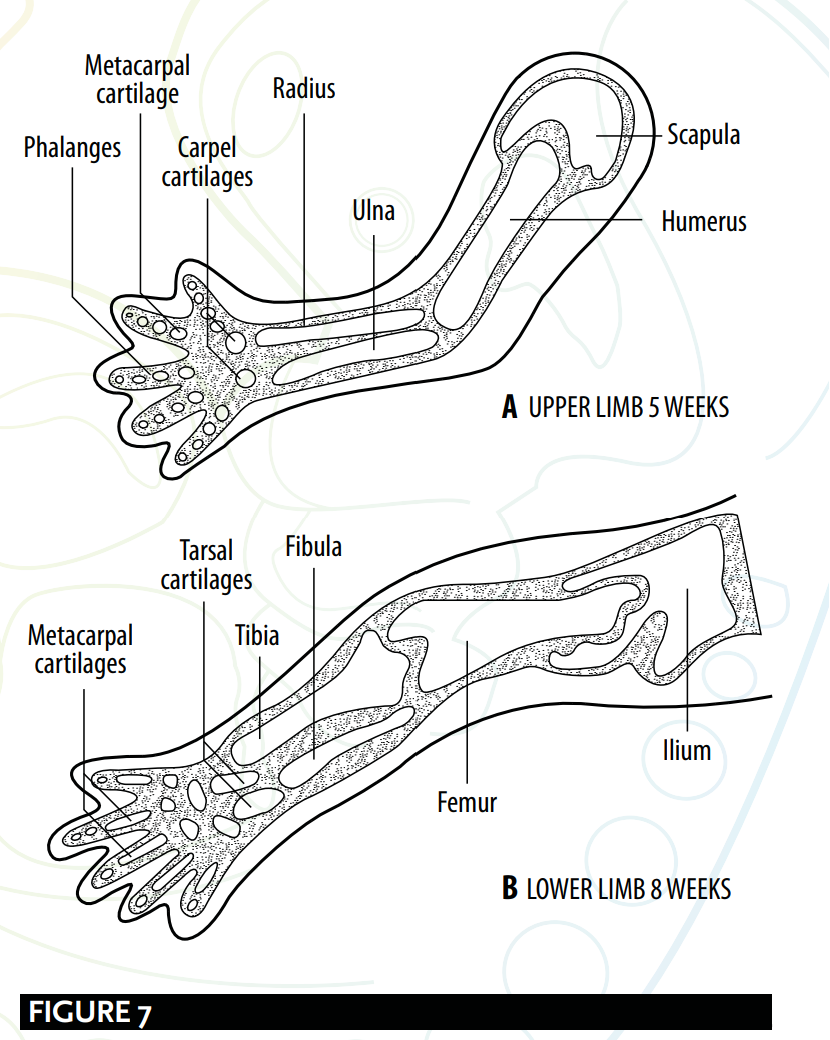
Mifupa ya viungo (appendicular skeleton) inajumuisha mikanda ya viungo (limb girdles) na mifupa ya viungo vyenyewe. Mifupa ya mifumo hii ya viungo hukua kutoka kwenye mikusanyiko ya mesenkaimu (mesenchymal condensations), ambayo baadaye hugeuka kuwa miundo ya gegedu (cartilaginous models).72 [See Figure 7]
The appendicular skeleton consists of limb girdles and the bones of the limbs. The bones of the appendicular skeleton develop from mesenchymal condensations which become cartilaginous models.72 [See Figure 7]
John Allen na Beverley Kramer pia wanatoa maoni kuhusu uundaji wa mifupa ya viungo.
John Allen and Beverley Kramer also comment on limb bone formation.
Mesenchyme ya kiungo mwanzoni ni wingi wa seli zenye umbo moja, lakini punde kwake hujikusanya seli na hizi hubadilika kuwa cartilage, na kutengeneza mifano ya cartilage ya mifupa mbalimbali. Kila mfano wa cartilage huzungukwa na perichondrium, ambayo ni mkusanyiko wa mesenchyme. Kituo cha mifupa (kituo cha kwanza cha ossification) huundwa juu ya kila mfano wa cartilage kwa kuingia kwa osteoblasts (seli zinazotengeneza mfupa) kutoka mesenchyme inayouzunguka. Mesenchyme inayouzunguka sasa inaitwa periosteum (inayozunguka mfupa). Osteoblasts sasa hutengeneza mfupa, ambao huzaa vipengele vya mifupa vya viungo. 73.
The limb mesenchyme is at first a homogenous mass but soon condensations occur in it and these chondrify to form cartilaginous models of the various bones. Each cartilage model is surrounded by perichondrium which is a condensation of mesenchyme. An ossific centre (primary ossification centre) is formed upon each cartilage model by the ingrowth of osteobalsts (bone-forming cells) from the surrounding mesenchyme. The surrounding mesenchyme is now termed periosteum (surrounding the bone). Osteoblasts now produce bone which give rise to the skeletal elements of the limbs. 73.
Kuna mfanano wa wazi kati ya hatua ya idhaam katika Qur'ani na mtazamo ambao elimu ya kisasa ya kiinitete (embryology) inaushikilia, yaani ukuaji wa mifupa ya mhimili wa mwili (axial skeleton), ya viungo (limb) na ya viambatanisho (appendicular skeleton).
There are clear parallels between the qur'anic `idhaam stage and the view modern embryology takes i.e. the development of the axial, limb and appendicular skeleton.
MUHTASARI
SUMMARY
Hatua ya `idhaam: Kuundwa kwa mifupa ya mhimili (axial), ya viungo na ya viambatisho (appendicular).
The `idhaam stage: The formation of the axial, limb and appendicular skeleton.
KUTOKA KWENYE DONGE HADI MIFUPA
FROM A LUMP TO BONES
Dhana ya kawaida, ambayo kwa kawaida hufanywa na wasiokuwa wataalamu wa lugha ya Kiarabu, ni kwamba aya hii inaweza kutafsiriwa kihalisia kama "tukaifanya ile donge kuwa mifupa". Kutokana na hilo, wao hufikia hitimisho kwamba aya hii si ya kisayansi kwa sababu donge la nyama haliwezi kugeuka kuwa mifupa. Hata hivyo, hili linatokana na uelewa mdogo wa sarufi ya Kiarabu na ufasaha wa Qur'an. Aya hii, kwa mtazamo wa kisarufi, ina maana ya: "tukaifanya kutoka katika ile donge mifupa".
A common misconception, usually made by non-Arabists, is that this verse can be literally translated as “and We made that lump into bones”. From this, they conclude that this verse is unscientific because a lump of flesh cannot turn into a mass of bones. However, this is based upon a crude understanding of Arabic grammar and the Qur’an's eloquence. This verse, from a grammatical perspective, has the meanings of: “and We made of/from/out of the lump bones”.
Hii ndiyo sababu Yusuf Ali anatafsiri aya hii kuwa "kisha Tukaifanya ile donge mifupa"74; Shakir anatafsiri kuwa "kisha Tukafanya (ndani ya) donge la nyama mifupa"; na A J Arberry, katika tafsiri yake ya Qur'ani ambayo bado inatumiwa na wasomi hadi leo, anatafsiri aya hii kuwa "kisha Tukaumba ya tishu mifupa".75
This is why Yusuf Ali translates this verse as “then we made out of that lump bones”74; Shakir translates it as “then We made (in) the lump of flesh bones”; and A J Arberry, in his translation of the Qur’an which is still used by academics today, translates this verse as “then We created of the tissue bones”.75
MIFUPA SI HALISI
NOT REAL BONES
Pendekezo jingine kutoka kwa wafafanuzi ni kwamba katika hatua hii hakuna mifupa halisi. Inasemwa kwamba mifupa inayoonekana ni gegedu tu, kwa kuwa mchakato wa kuwa mfupa (ossification) haujakamilika, na kwa hiyo Qur’an lazima iwe si sahihi. Ingawa hoja hii ina msingi, imeelekezwa vibaya. Neno ‘idhaam’ linajumuisha umbo la gegedu la mifupa wakati fremu ya mifupa inapowekwa. Zaidi ya hayo, mchakato wa kuwa mfupa huanza kufikia wiki ya 8,76 na kuendelea baada ya kuzaliwa, huku ukamilifu wake ukifikiwa karibu na balehe. Barry Mitchell na Ram Sharma wanaeleza:
Another proposition from commentators is that at this stage there are no real bones. It is argued that the apparent bones are mere cartilage as ossification is incomplete and, as such, the Qur’an must therefore be inaccurate. Although a valid contention, it is misplaced. `idhaam encompasses the cartilaginous form of the bones as the skeletal framework is put in place. Additionally, the process of ossification begins by the 8th week,76 continuing on after birth, with the eventual completion of the ossification process at around puberty. Barry Mitchell and Ram Sharma explain:
Vituo vya kuanza kugeuka mfupa hujitokeza kwanza katika mifupa ya viungo katika wiki ya nane. Kufikia wiki ya kumi na mbili, miili ya mifupa ya viungo imeshakuwa mifupa, ingawa mifupa ya kifundo cha mkono (carpal) inabaki kuwa gegedu hadi baada ya kuzaliwa. Kugeuka mfupa kwa mifupa mitatu mikubwa zaidi ya kifundo cha mguu (tarsal) huanza takriban wiki ya 16, lakini baadhi ya mifupa midogo ya tarsal haigeuki kuwa mfupa hadi miaka 3 baada ya kuzaliwa.77.
The centres of ossification first appear in the limb bones during the eighth week. By the twelfth week, the shafts of the limb bones are ossified, though the carpal bones of the wrist remain cartilaginous until after birth. The ossification of the three largest tarsal bones of the ankle begins about 16 weeks, but some of the smaller tarsal bones do not ossify until 3 years after birth.77.
Kwa mtazamo huu, itakuwa upuuzi wa kitabibu kudhani kwamba watoto wachanga au vijana wadogo hawana mifupa kwa sababu tu wanahitaji ossification (kugeuka kuwa mfupa), hasa kwa kuwa ossification hukamilika mwishoni mwa kipindi cha kukua kwa kasi wakati wa balehe. Hata hivyo, kama ingekuwa hivyo, na tukichukulia hatua hii kama ya "kutokuwa na mifupa", basi maana ya neno `idhaam` inaruhusu tafsiri pana inayojumuisha, kwa kuwa "mifano ya gegedu ya mifupa mbalimbali"78 imo katika maana yake.
From this perspective, it would be a medical absurdity to assume newborns or young teenagers do not have bones simply because they require ossification, especially since ossification completes at the end of the growth-spurt of puberty. Nevertheless if this were the case, and we are to take this stage as being ‘boneless’, as it were, the derisions of the word `idhaam allow for an all encompassing interpretation because the “cartilaginous models of the various bones”78 is included in its meaning.