17.3 O Juramento de Lealdade (bay‘ah)
17.3 The Pledge (bay’ah)
O bay'ah é uma obrigação para todos os muçulmanos, e é um direito de todo muçulmano, homem ou mulher. A evidência de que é uma obrigação encontra-se em muitos ahadith do Profeta ﷺ, nos quais ele disse:
Bay’ah is an obligation upon all Muslims, and it is a right for every Muslim, man or woman. The evidence for it being an obligation is in many ahadith of the Prophet (saw), in which he said:
“Quem morrer sem ter um juramento de lealdade (bay'ah) sobre o seu pescoço, morre uma morte da jahiliyyah.”
“Whosoever dies without having a bay’ah upon his neck dies a death of jahiliyyah.”
Quanto a ser um direito dos muçulmanos, a própria bay'ah indica isso, pois a bay'ah é oferecida pelos muçulmanos ao Khalifah, e não pelo Khalifah aos muçulmanos. A bay'ah dos muçulmanos ao Profeta ﷺ foi confirmada nos ahadith. Al-Bukhari relatou que 'Ubadah bin as-Samit (ra) disse:
As for being a right for Muslims, the bay’ah itself indicates that, because the bay’ah is offered by the Muslims to the Khalifah, and not by the Khalifah to the Muslims. The bay’ah of the Muslims to the Prophet (saw) was confirmed in the ahadith. Al-Bukhari reported that ‘Ubadah bin as-Samit (ra) said:
“Fizemos o bay'ah ao Profeta ﷺ para ouvir e obedecer tanto no que nos agrada quanto no que nos desagrada, e que não disputaríamos a ordem dos que estão no comando, que diríamos a verdade onde quer que estivéssemos, e que não temeríamos a censura de ninguém ao agir ou falar pela causa de Allah.”
“We made a bay’ah to the Prophet (saw) to hear and to obey in whatever pleases and displeases us, and that we would not dispute the order of those in charge, that we would speak the truth wherever we are, and that we would not fear the blame of anyone when acting or speaking for the sake of Allah.”
Al-Bukhari relatou de Ayyub, de Hafsa, de Umm ‘Atiyyah, que disse:
Al-Bukhari reported from Ayyub from Hafsa from Umm ‘Atiyyah who said:
“Nós fizemos o bay’ah ao Profeta ﷺ, e ele recitou para mim o versículo: {Que não associarão coisa alguma a Allah na adoração} (TMQ 60:12). E ele também nos proibiu de gemer e lamentar sobre os mortos. Uma mulher dentre nós estendeu a mão e disse: ‘Fulana chorou por um morto da minha família, e eu quero compensá-la por aquele choro’. O Profeta ﷺ não lhe respondeu nada, e ela se retirou e voltou.”
“We gave a bay’ah to the Prophet (saw) and he recited to me the verse That they will not associate anything in worship with Allah (TMQ 60.12). And he also prevented us from wailing and lamenting over the dead. A woman from us held her hand out and said, "Such-and-such a woman cried over a dead person belonging to my family and I want to compensate her for that crying" The Prophet did not say anything in reply and she left and returned.”
E no Al-Bukhari, de Abu Hurairah (ra), que disse: O Profeta ﷺ disse:
And in Al-Bukhari from Abu Hurairah (ra) who said: The Prophet (saw) said:
“(Há) três pessoas com as quais Allah não falará no Dia da Ressurreição, nem as purificará, e para elas há um castigo doloroso: uma pessoa que possui um excesso de água no caminho e a impede ao viajante; uma pessoa que presta juramento de lealdade (bay'ah) a um Imam apenas por interesses mundanos, de modo que, se o Imam lhe dá o que deseja, ela cumpre o juramento; caso contrário, não o cumpre; e uma pessoa que vende uma mercadoria a outra depois da ʿAsr (a tarde) e jura por Allah que lhe ofereceram tal e tal quantia por ela, embora não lhe tenham oferecido, e a pessoa acreditou nela e a comprou.”
“(There are) three persons to whom Allah will not talk on the Resurrection Day, nor purify them, and for them is a severe punishment: A person who has an excess of water on the road and prevents the wayfarer from it; a person who gives bay’ah to an Imam for his worldly affairs only, so if the Imam gave him that which he wants he fulfilled (the bay’ah) to him, otherwise he would not; and a person trading a commodity to another after asr (late afternoon) and he swore by Allah that he was offered so and so for it, although he was not, and the person believed him and bought it.”
Al-Bukhari narrou de ‘Abdullah bin ‘Umar (ra), que disse:
Al-Bukhari narrated from ‘Abdullah bin ‘Umar (ra) who said:
“Quando fizemos o bay'ah ao Profeta ﷺ para ouvir e obedecer, ele nos dizia: Na medida do que puderem”
“When we gave a bay’ah to the Prophet (saw) to hear and obey, he would say to us: As much as you are capable of”
“Quando fizemos o bay’ah ao Profeta ﷺ para ouvir e obedecer, ele nos dizia: Na medida do que vocês forem capazes”
“When we gave a bay’ah to the Prophet (saw) to hear and obey, he would say to us: As much as you are capable of”
“Eu fiz o bay’ah ao Profeta ﷺ para ouvir e obedecer, e ele me instruiu: Na medida do que você for capaz, e a dar bons conselhos a todo muçulmano.”
“I gave bay’ah to the Prophet (saw) to hear and obey and he instructed me: As much as you are able, and to give good advice to every Muslim.”
Al-Bukhari narrou de Junada bin Abu Umayyah, que disse:
Al-Bukhari narrated from Junada bin Abu Umayyah who said:
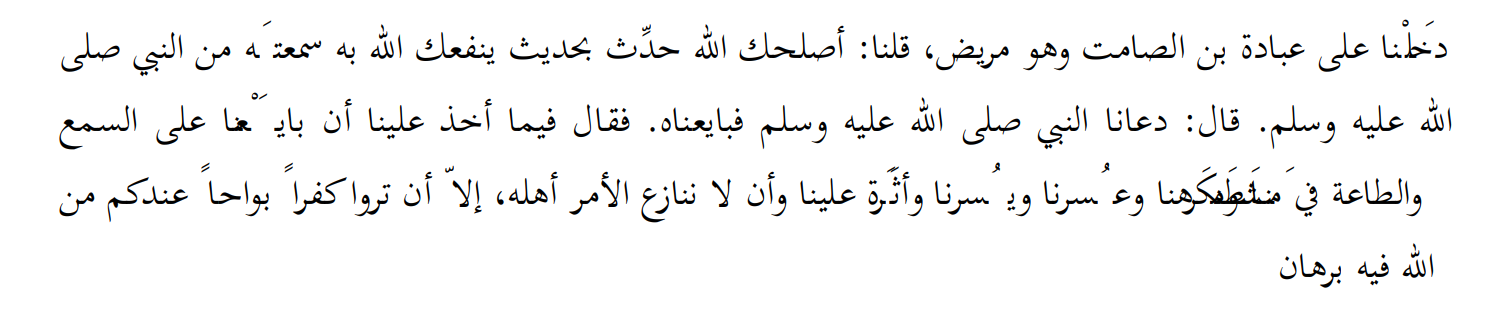
“Entramos na casa de ‘Ubadah bin as-Samit enquanto ele estava doente, e dissemos: Que Allah lhe conceda saúde. Informe-nos de um hadith que tenha ouvido do Profeta ﷺ, pelo qual Allah (SWT) possa beneficiá-lo. Ele disse: O Profeta ﷺ nos convocou e nós lhe prestamos o bay’ah (juramento de lealdade). Entre as condições sob as quais ele tomou de nós o juramento, estava que ouviríamos e obedeceríamos (às ordens), tanto no tempo em que estivéssemos dispostos como no tempo em que estivéssemos cansados, nos tempos de facilidade e de dificuldade, e quando víssemos preferência (dada a outros em detrimento de nós), e que não contestaríamos a autoridade daqueles a quem ela fora confiada, dizendo: a não ser que vejam uma descrença manifesta (kufr bawah), sobre a qual tenham uma prova clara de Allah.”
“We entered the house of ‘Ubadah bin as-Samit while he was ill and we said: May Allah make you healthy, inform us of a hadith you heard from the Prophet (saw) by which Allah (swt) may benefit you. He said: The Prophet (saw) invited us and we gave him our bay’ah (pledge of Allegiance). And among the conditions on which he took the pledge from us, was that we were to listen and obey (the orders) both at the time when we were active and when we were tired , and in the times of ease and hardship and when we see preference (for others over us), and not to dispute the authority of those who are entrusted with it saying: Unless you see open disbelief (kufr bawah) upon which you have a clear proof from Allah.”
O bay'ah para o Khalifah está nas mãos dos muçulmanos, e é direito deles; são eles que prestam o bay'ah, e é o bay'ah deles que faz com que o Khilafah seja contratado para um Khalifah. O bay'ah pode ser feito apertando as mãos ou por escrito. 'Abdullah bin Dinar narrou dizendo:
The bay’ah for the Khalifah is in the hands of the Muslims, and it is their right; it is they who give the bay’ah, and it is their bay’ah which makes the Khilafah contracted for a Khalifah. The bay’ah can be by shaking hand or by writing. ‘Abdullah bin Dinar narrated saying:
“Presenciei Ibn ‘Umar quando as pessoas se reuniram em torno de ‘Abdulmalik bin Marwan. Ele escreveu: Concordo em ouvir e obedecer ao servo de Allah, ‘Abdulmalik, Amir al-Mu’mineen, segundo a Sunnah de Allah e a Sunnah de Seu Profeta ﷺ, na medida em que for capaz.”
“I witnessed bin ‘Umar where the people gathered around ‘Abdulmalik bin Marwan. He wrote: I agree to listen and obey to the slave of Allah, ‘Abdulmalik the Amir al-Mu’mineen, according to the Sunnah of Allah and the Sunnah of His Prophet as much as I am able.”
Além disso, o bay'ah é válido por qualquer meio (waseelah). No entanto, o bay'ah deve ser prestado por uma pessoa madura, por isso é impróprio que seja prestado por um jovem. Abu Aqeel Zahra bin Ma‘bed relatou de seu avô 'Abdullah bin Hisham — que testemunhou o Profeta ﷺ — que sua mãe Zaynab, filha de Hameed, o levou ao Profeta ﷺ e disse: "Ó Profeta de Allah, recebe dele o juramento de fidelidade." O Profeta ﷺ disse:
Moreover, the bay’ah is correct by any means (waseelah). However, the bay’ah has to be given by the mature person, so it is improper to be given by the young. Abu Aqeel Zahra bin Ma‘bed reported from his grandfather ‘Abdullah bin Hisham--who witnessed the Prophet (saw)--that his mother Zaynab, the daughter of Hameed, took him to the Prophet (saw) and said: O Prophet of Allah, take a pledge from him. The Prophet (saw) said:
"Ele é uma criança", passou a mão sobre a cabeça dele e fez uma du'a por ele.
“He is a child, wiped his head and made a du‘a for him.”
Quanto às palavras do bay'ah, elas não estão restritas a termos específicos. No entanto, devem incluir a atuação conforme o Livro de Allah (swt) e a Sunnah do Seu Profeta (saw) pelo Khalifah, e a obediência na adversidade e na facilidade, e a obediência no que agrada e no que desagrada por parte da pessoa que faz o bay'ah (ao Khalifah). Sempre que aquele que faz o juramento tiver dado o seu bay'ah ao Khalifah, ou quando o Khilafah for contratado para o Khalifah pelo bay'ah de outros muçulmanos, então o bay'ah se torna uma confiança sobre o pescoço daquele que dá o bay'ah, e ele não tem permissão para retratá-lo. É um direito do contrato do Khilafah até que ele o tenha dado, e, uma vez dado, deve cumpri-lo. Não lhe é permitido retratar-se dele. Al-Bukhari narrou de Jabir bin 'Abdullah (ra) que um beduíno deu ao Profeta (saw) o seu juramento de lealdade ao Islam, e uma doença o acometeu, então disse ao Profeta (saw): "Permite-me retirar o meu bay'ah", mas o Profeta (saw) recusou, e o homem partiu. Então o Profeta (saw) disse:
As for the words of the bay’ah they are not restricted to specific terms. However they must include acting according to the Book of Allah (swt) and the Sunnah of His Prophet (saw) by the Khalifah, and obedience in hardship and ease and obedience, and whatever pleases and displeases on the part of the person who gives the bay’ah (to the Khalifah). Whenever the one who pledges has given his bay’ah to the Khalifah or the Khilafah is contracted to the Khalifah by the bay’ah of other Muslims, then the bay’ah has become a trust on the neck of the one who gives the bay’ah and he is not allowed to retract it. It is a right for the contract of the Khilafah until he has given it, and once he has given it he must abide by it. He is not allowed to retract from it. Al-Bukhari narrated from Jabir bin ‘Abdullah (ra) that a Bedouin gave the Prophet (saw) his pledge on Islam, and an illness struck him so he said to the Prophet (saw): “Let me withdraw my bay’ah but the Prophet (saw) refused, and the man left. The Prophet (saw) then said:
"Medina é como uma fornalha: expele as impurezas e seleciona as boas, aperfeiçoando-as."
“Medina is like a furnace, it expels out the impurities and selects the good ones and makes them perfect.”
E foi narrado de Nafi‘a, que disse: Ibn ‘Umar (ra) disse-me que ouviu o Profeta ﷺ dizer:
And it is narrated from Nafi‘a who said: Ibn ‘Umar (ra) said to me that he heard the Prophet (saw) saying:
“Quem retirar a mão da obediência (ao Amir) não terá argumento (em sua defesa) quando se apresentar diante de Allah no Dia da Ressurreição.”
“Whoever withdraws his hand from obedience (to the Amir) will find no argument (in his defense) when he stands before Allah on the Day of Resurrection.”
Romper o bay'ah ao Khalifah é retirar a própria mão da obediência a Allah (SWT). Isso se aplica quando o seu bay'ah ao Khalifah é um bay'ah de contrato, ou quando é um bay'ah de obediência a um Khalifah que os muçulmanos aceitaram e ao qual deram o seu bay'ah. Contudo, se ele deu o seu bay'ah, no início, a um Khalifah e este não se consumou porque os muçulmanos, como um todo, não o aceitaram como Khalifah, então ele tem o direito de retirar-se desse bay'ah. A proibição mencionada no hadith refere-se à retirada de um bay'ah dado a um Khalifah, e não a um homem para quem o Khilafah não se concretizou.
To break the bay’ah of the Khalifah is withdrawing of one’s hand from the obedience of Allah (swt). This is the case if his bay’ah to the Khalifah is a bay’ah of contract or it is a bay’ah of obedience to a Khalifah whom the Muslims accepted and gave their bay’ah to. However, if he gave his bay’ah in the beginning to a Khalifah and it was not completed because the Muslims as a whole did not accept him as Khalifah, then he has the right to withdraw from that bay’ah. The prohibition mentioned in the hadith is focused on the withdrawal of a bay’ah to a Khalifah, not to a man for whom the Khilafah was not accomplished