21.6 Tratados de Emergência
21.6 Emergency Treaties
Os muçulmanos podem cair em situações severas que os compelem a fazer coisas que não são permitidas, mas a necessidade o obriga. O Estado Islâmico pode cair em crises internas ou externas que o compelem a firmar tratados que não levam diretamente à transmissão da da‘wah ou à luta no caminho de Allah (swt), mas que facilitam a criação de condições que permitirão transmiti-la no futuro, ou que previnem o mal de interromper a da‘wah, ou que preservam a existência dos muçulmanos. A necessidade obriga que este tipo de tratado seja firmado; portanto, é permitido ao Khalifah firmá-los, e eles são executados sobre os muçulmanos. Esses tratados ocorrem em duas situações que os juristas (fuqaha) declararam claramente, e são elas:
Muslims can fall into severe situations which compel them to matters which are not allowed but the necessity obliges it. The Islamic State can fall into internal or external crises which compel it to contract treaties which do not lead directly to conveying the da’wah or fighting in the way of Allah (swt) but they facilitate creating conditions which will enable conveying it in the future or prevent the evil of stopping the da’wah or preserve the entity of the Muslims. Necessity compels these types of treaties to be contracted therefore it is allowed for the Khalifah to contract them and they are executed upon Muslims. These treaties occur in two situations which the jurisprudents (fuqaha) stated clearly, and they are:
La primeira situação: Se alguns dos povos de guerra solicitarem aos muçulmanos um tratado por anos específicos, sob a condição de que os povos de guerra paguem um kharaj anual de valor determinado e que as normas islâmicas não sejam aplicadas sobre eles em suas terras; isto não é feito, pois equivale a consentir com a descrença, a menos que o Estado não consiga impedir a opressão e veja neste tratado um benefício para os muçulmanos. Nesse ponto, é permitido firmá-lo por necessidade. Nesta situação, não há auxílio ou apoio para eles por parte do Estado Islâmico, pois não estão obrigados por este tratado às normas islâmicas e não deixam de ser povos de guerra quando não obedecem às regras do Islã. Portanto, não é obrigatório para os muçulmanos assumir o apoio a eles. O Mensageiro de Allah ﷺ firmou um tratado com Yuhanna bin Rub’ah enquanto estava em Tabuk, nas fronteiras de Bilad Ash-Sham. Deixou-o em sua região conservando a sua religião, e ele não entrou sob a bandeira dos muçulmanos e sua autoridade. Este tratado de período limitado torna a segurança deste Estado garantida pelo Estado Islâmico. Quem dos muçulmanos entrar nele, entra com a segurança do tratado e não com uma segurança individual, e não lhe é permitido opor-se ao seu povo. Quem dos cidadãos desta terra entrar nas terras muçulmanas, entra com a segurança do tratado e não necessita de uma nova garantia além do tratado, nem é permitido a qualquer muçulmano opor-se a ele. Os comerciantes não são impedidos de levar mercadorias a este Estado, exceto ferramentas usadas na guerra, como armas, materiais bélicos e o que for semelhante a isso, pois são povos de guerra, ainda que os muçulmanos tenham um tratado com eles.
The first situation: If some people of the people of war seek a treaty from the Muslims for specific years on condition that the people of war give kharaj every year for a specified amount and that the Islamic rules are not executed upon them in their lands; this is not done as it is consenting upon disbelief unless the State is not able to prevent oppression and sees in this treaty good for Muslims, then at this point it is allowed to contract it out of necessity. In this situation there is no assistance or support for them from the Islamic State because they are not compelled by this treaty with the Islamic rules and do not depart from being people of war when they do not obey the rules of Islam. So undertaking support for them is not obliged upon the Muslims. The Messenger of Allah (saw) made a treaty with Yuhanna bin Rub’ah while he was at Tabuk in the boundaries of Bilad AsSham. He left him in his zone upon his religion, and he did not enter under the banner of Muslims and their rule. This treaty of limited period makes the security of this State guaranteed by the Islamic State. Whoever enters it from the Muslims enters it with the security of the treaty and not an individual security, and it is not allowed for him to oppose its people. Whoever enters the Muslim lands from the citizens of this land enters with the security of the treaty and does not require a new security other than the treaty, nor is anyone from the Muslims allowed to oppose him. Traders are not prevented from carrying merchandise to this State except tools used in war like weapons and war materials and what is similar to this because they are people of war even if the Muslims have a treaty with them.
A segunda situação: Esta é o oposto da primeira situação, na qual os muçulmanos pagam dinheiro ao seu inimigo em troca do seu silêncio a respeito deles. Os fuqaha mencionaram que, se o inimigo sitiar os muçulmanos e exigir um tratado por anos determinados, sob a condição de que os muçulmanos paguem aos descrentes uma quantia específica a cada ano, não é correto que o Khalifah aceite isso, por causa da vileza e da humilhação que isso implica para os muçulmanos, exceto em caso de necessidade. Isso se dá (quando) os muçulmanos temem a própria extinção e o Khalifah entende que há algum bem nessa trégua. Nesse ponto, não há mal nisso, por causa do que foi narrado.
The second situation: This is opposite to the first situation wherein the Muslims pay money to their enemy in return for their silence regarding them. The fuqaha mentioned that if the enemy sieges the Muslims and require a treaty for specified years on condition that the Muslims pay the disbelievers a specific amount every year, it is not correct for the Khalifah to comply to them upon that due to the contemptibility and humiliation therein for Muslims except under necessity. This is (when) the Muslims fear extermination for themselves, and the Khalifah views there is good in this truce. At this point, there is no harm in that due to what was narrated
"Que os politeístas cercaram a trincheira e os muçulmanos passaram por uma provação, como Allah (swt) disse: ‘Ali os crentes foram postos à prova e abalados com um abalo severo’ [TMQ 33:11]. O Mensageiro de Allah ﷺ enviou a ‘Uyaynah bin Hasan e pediu que ele retornasse com os que estavam com ele, oferecendo-lhe um terço dos frutos de Madinah, mas ele recusou, aceitando apenas a metade. Quando seus mensageiros vieram para redigir o acordo de trégua diante do Mensageiro de Allah ﷺ, os dois líderes dos Ansar, S'aad bin ‘Ubadah e S'aad bin Mu’adh (ra), levantaram-se e disseram: ‘Ó Mensageiro de Allah ﷺ, se isto vem da revelação, então execute o que te foi ordenado; mas se é uma opinião que consideraste, então eles e nós estávamos na jahiliyyah, quando nem eles nem nós tínhamos ainda uma religião, e eles não comiam dos frutos de Madinah senão por compra ou hospitalidade. Agora, quando Allah nos honrou com o deen e enviou Seu Mensageiro entre nós, devemos dar-lhes este dunya estando nós desprezíveis? Não, não lhes daremos senão a espada’. Então ele ﷺ disse: ‘Vi os árabes atirando de um mesmo arco, por isso quis desviá-los de vós. Se rejeitais isso, então é a vós e a eles. Ide embora, pois não vos daremos senão a espada!’”
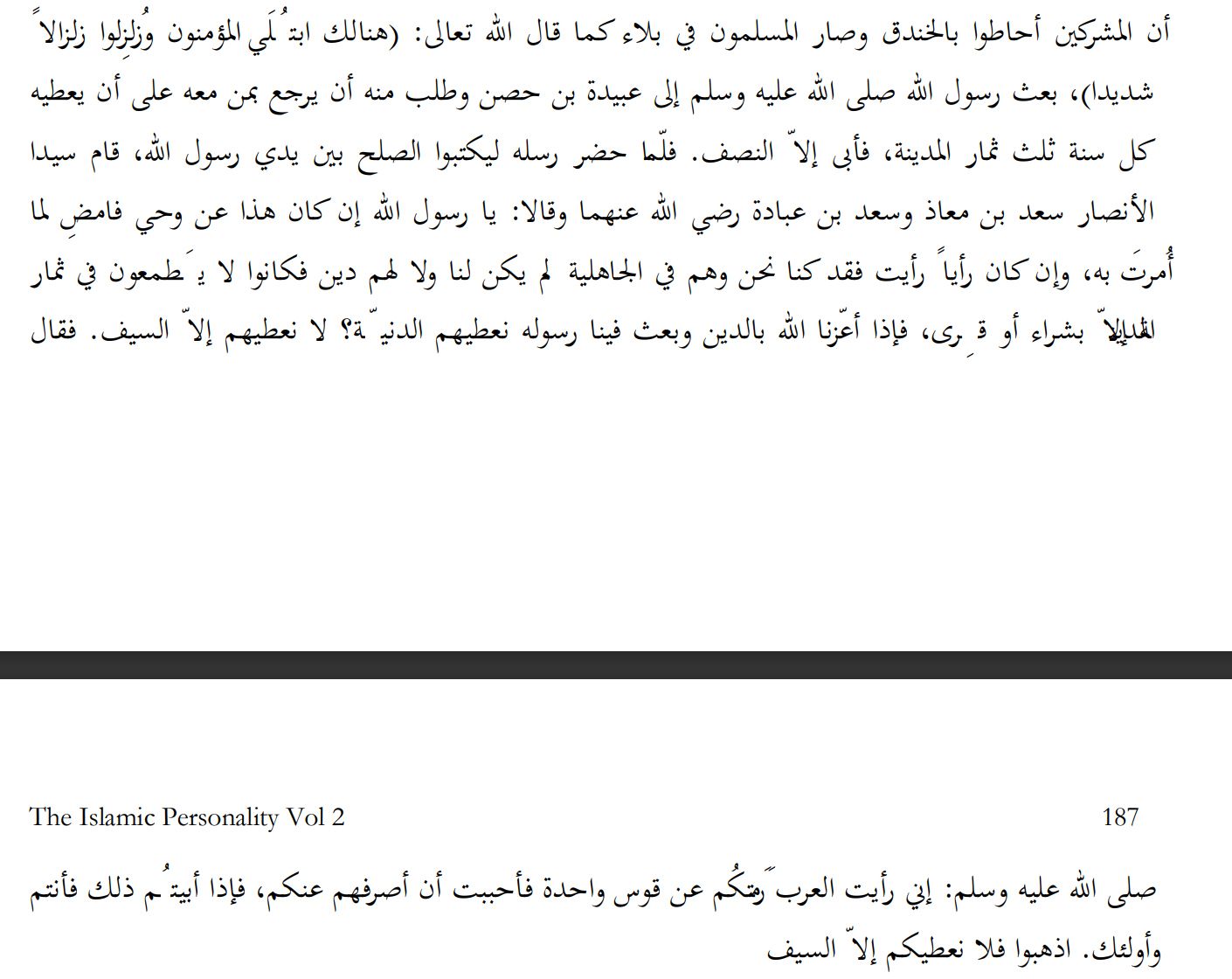
“That the polytheists surrounded the trench and Muslims were in trial like Allah (swt) said: ‘Therein the believers were tested and shaken with a severe shaking’ [TMQ 33:11].The Messenger of Allah (saw) sent to ‘Uyaynah bin Hasan and requested that he return with those together with him upon giving him a third of the fruits of Madinah but he refused except a half. When his messengers appeared to write the truce in front of the Messenger of Allah, the two chiefs of the Ansar, S'aad bin ‘Ubadah and S'aad bin Mu’adh (ra) stood and they said: ‘O Messenger of Allah, if this is from revelation then execute what you are commanded with but if it is an opinion which you considered, then they and we were in jahiliyyah when neither they nor we had a religion yet they did not eat of the fruits of Madinah except through purchase or hospitality. So when Allah honoured us with the deen and sent His Messenger among us, should we give them this dunya while being contemptible? No, we will not give them except the sword. So he (saw) said: ‘I saw the Arabs shooting from one bow so I liked to divert them from you. If you reject that, then it is you and those. Go away for we will not give you except the sword!’”
Isso indica que o Mensageiro de Allah ﷺ inclinou-se inicialmente à trégua devido ao que percebeu da fraqueza dos muçulmanos. Quando viu a força neles, por causa do que disseram Sa'd bin 'Ubadah e Sa'd bin Mu'adh (ra), ele se absteve daquilo, o que indica que não há mal em firmar um tratado com descrentes pagando-lhes dinheiro quando há perigo de dano. Isso porque, se eles conquistassem os muçulmanos, tomariam toda a riqueza e as famílias como cativas (sabaya), de modo que pagar parte da riqueza para salvaguardar os muçulmanos, suas famílias e sua riqueza é menos desprezível e mais benéfico.
This indicates that the Messenger of Allah (saw) initially inclined to the truce due to what he sensed of the Muslims’ weakness. When he saw the strength in them due to what S'aad bin ‘Ubadah and S'aad bin Mu’adh (ra) said, he refrained from that which indicates that there is no harm from contracting a treaty with disbelievers paying them money when there is danger of harm. This is because if they conquered Muslims they would take all the wealth and the families as captives (sabaya), so paying some wealth to safeguard Muslims and their families and wealth is less contemptible and more beneficial.