2.13 Os Profetas e Mensageiros
2.13 The Prophets And Messengers
‘Profeta’ (nabi) e ‘Mensageiro’ (rasul) são dois termos contrastivos, mas ambos compartilham o fato de que uma sharia é revelada a ambos. A diferença entre o Mensageiro e o profeta é que o primeiro é inspirado com uma Sharī‘ah, que lhe é ordenado propagar, enquanto o segundo, ou seja, o profeta, também é inspirado, porém é ordenado a propagar a Sharī‘ah dos mensageiros. Em outras palavras, o mensageiro é ordenado a propagar a própria Sharī‘ah, enquanto o profeta propaga a Sharī‘ah dos mensageiros.
‘Prophet’ (nabi) and ‘Messenger’ (rasul) are two contrastive terms but they share in the respect that a shari’a is revelaed to both of them. The difference between the Messenger and the prophet is that the former is inspired with a Sharī’ah which he is commanded to propagate, whereas the latter, i.e. the prophet is also inspired, but commanded to propagate the Sharī’ah of the messengers. In other words, the messenger is commanded to propagate the Sharī’ah himself, whilst the prophet propagates the Sharī’ah of the messengers.
Al-Qadi al-Baydawi, no comentário sobre o dito de Allah,
Qadi al-Baydawi in commentary of the saying of Allah ,
"Nunca enviamos antes de ti um mensageiro ou um profeta sem que, quando ele formulava um desejo" [TMQ Hajj: 52];
"Never did we send an apostle or a prophet before thee, but, when he framed a desire" [TMQ Hajj: 52];
Ele diz: "O mensageiro é enviado por Allah com uma Sharī'ah renovada ou nova, à qual ele convoca as pessoas, enquanto o profeta é enviado por Allah para confirmar a Sharī'ah anterior." Assim, Musa foi um profeta porque recebeu inspiração de uma Sharī'ah, e um mensageiro porque essa Sharī'ah era para a sua missão. Por outro lado, embora Harun também tenha sido um profeta por ter recebido inspiração de uma Sharī'ah, ele não foi um mensageiro, porque a Sharī'ah que lhe foi revelada não era para a sua missão, mas sim para a missão de Musa. Da mesma forma, Muhammad ﷺ foi um profeta e um mensageiro porque recebeu inspiração de uma Sharī'ah, que era para a sua missão ﷺ.
Says, ‘The messenger is sent by Allah with a revived or new Sharī’ah which he calls people to, whereas the prophet is sent by Allah to affirm the former Sharī’ah.’ Thus, Musa was a prophet because he was inspired with a Sharī’ah and a messenger because this Sharī’ah was for his mission. On the other hand, although Aaron was also a prophet because he was inspired with a Sharī’ah, he was not a messenger because the Sharī’ah, which was revealed to him was not for his mission, rather it was for the mission of Musa . By the same token, Muhammad was a prophet and a messenger because he was inspired with a Sharī’ah, which was for his mission.
A mensagem é a mediação entre Allah e os servos, com o objetivo de explicar e esclarecer o caminho para satisfazer as necessidades deste mundo e da vida futura. A sabedoria exige o envio de mensageiros, pois eles trazem leis e benefícios para as pessoas.
The message is the mediation between Allah and the slaves in order to explain and clarify the method of satisfying the needs of this world and the hereafter. Wisdom necessitates the sending of messengers as they bring laws and benefits for people.
Assim, o envio dos Mensageiros de fato ocorreu. Allah designou Mensageiros dentre a humanidade e os enviou como portadores de boas-novas do Paraíso e da recompensa para o povo da crença e da obediência. Foram advertidores do Fogo do Inferno e do castigo para o povo da descrença e da desobediência, e esclareceram ao homem as necessidades e exigências deste mundo e do Além. Tudo isso porque a mente é incapaz tanto de decidir entre o bem e o mal quanto de compreender o próprio homem e os seus assuntos.
Thus, the sending of Messengers has actually occurred. Allah appointed messengers from amongst mankind and sent them as bearers of glad tidings of paradise and reward to the people of belief and obedience. They were warners of the hell fire and punishment to people of disbelief and disobedience and they clarified the needs and requirements of this world and the hereafter for man. All because the mind is incapable of either deciding the good and bad or able to comprehend man himself and his affairs.
Adão desobedeceu ao mandamento de seu Senhor, então o que ele desejava não alcançou o caminho para ele. Depois disso, seu Senhor o escolheu, voltou-se para ele com Sua misericórdia e lhe mostrou o caminho para Sua nearness favorecida. [TMQ Tā Hā: 121-2]
"Adam slipped the commandment of his Lord then what he had desired, did not get the way to it. Thereafter his Lord chose him and turned to him with his mercy and showed him the way to his favoured nearness" [TMQ Tā Hā: 121-2]
O significado de Ijtaba neste contexto é selecioná-lo. O Alcorão também comprova que Allah tanto ordenou quanto proibiu Adão certas coisas. Por isso, Allah diz,
The meaning of Ijtaba in this context means selecting him. The Quran also proves that Allah both commanded and prohibited Adam certain things. Hence Allah says,
"E dissemos: ó Ādam, habita tu e tua esposa no Paraíso e comei dele à vontade onde quiserdes, mas não vos aproximeis desta árvore, senão sereis dos transgressores." [TMQ Baqarah: 35]
"And we said, O Adam, dwell you and your wife in paradise and eat freely thereof where you will, but do not approach this tree lest you become of the transgressors" [TMQ Baqarah: 35]
Isto prova categoricamente que não houve outro profeta durante o seu tempo. Portanto, Adão era um profeta apenas por revelação e nada mais. Era um profeta que recebeu inspiração de uma Sharī'ah, pois todo mandamento [amr] ou proibição [nahi] é Sharī'ah. Assim, como recebeu inspiração, ele é um profeta.
This categorically proves that there was no other prophet during his time. Therefore, Adam was a prophet by revelation and nothing else. A prophet who was inspired with a Sharī’ah, as every commandment [amr] or prohibition [nahi] is Sharī’ah. Thus since he received inspiration he is a prophet.
A segunda fonte é a Sunnah. Al-Tirmidhi relatou de Abu Said al-Khudri que o Profeta ﷺ disse,
The Second source is the Sunnah. Tirmidhi reported from Abu Said al-Khudri that the prophet said,
"Eu serei o líder dos filhos de Adão no dia da ressurreição, mas não me gabo disso. Terei em minha mão o estandarte do Louvor, mas não me gabo disso; e naquele dia, todos os profetas, desde Adão, estarão sob o meu estandarte."
"I will be the leader of the sons of Adam on the day of resurrection but I do not boast. I will have the banner of al-Hamd in my hand but I do not boast and on that day, all the prophets from Adam will be under my banner."
Por último, o consenso dos Sahaba também prova que Adão foi um profeta.
Lastly, the consensus of the Sahaba also proves that Adam was a prophet.
Quanto à profecia de Muhammad ﷺ, visto que ele também afirmou ser profeta e trouxe milagres, a profecia é conhecida por meio de narrações mutawatir, que a comprovam para além de qualquer dúvida. Quanto ao milagre (isto é, o Alcorão), ele é a palavra de Allah (SWT), que desafiou e confrontou os oradores eloquentes e grandes de Meca. Eles não foram capazes de se opor à sura mais curta do Alcorão, ainda que se esforçassem para isso. Em seguida, abandonaram seus métodos de oposição feitos de discurso e retórica, embora fossem os linguistas mais hábeis e mais respeitados de sua época, e recorreram à força e à espada. Nem mesmo um único dos descrentes incrédulos relatou que alguém tenha sido capaz de produzir algo semelhante ao Alcorão, apesar de terem os meios para transmitir tal informação caso fosse necessário. Tudo isso prova categoricamente que o Alcorão, isto é, o milagre concedido a Muhammad ﷺ, procede de Allah (SWT) e, sem nenhuma dúvida, confirma a veracidade da afirmação do Profeta ﷺ.
As for the prophethood of Muhammad , as he also claimed prophethood and brought forth miracles, the prophethood is known by Mutawatir narrations, which substantiates it beyond any doubt. As for the miracle (i.e. the Qur’ān) it is the speech of Allah , which challenged and defied the eloquent and great speakers of Mecca. They were unable to oppose the shortest Sura of the Qur’ān, although they strived to do so. They then abandoned their styles of opposition from talk and rhetoric, even though they were the best and most revered linguists of their time, to force and the sword. Not even one of the disbelieving Kuffars ever related that someone was ever able to produce anything similar to the Qur’ān, despite the fact that they had the means to relate this information if required. All this categorically proves that the Qur’ān, i.e. the miracle given to Muhammad is from Allah and without any doubt verifies the true claim of the prophet .
O número de profetas e mensageiros é desconhecido, porque Allah não informou ao Seu mensageiro (ﷺ)
The number of prophets and messengers are unknown because Allah informs his messenger,
"Certamente enviamos mensageiros antes de ti; contamos a alguns deles a sua história, e a outros não a contamos." [TMQ Ghafir:78]
"We have sent messengers before you, we have mentioned some of their stories to you, whilst we have not mentioned others." [TMQ Ghafir:78]
Embora o número tenha sido mencionado em alguns Ahadith, esses Ahadith são da categoria Ahad. Portanto, não têm qualquer valor na ‘aqīdah (crença); isto é, não fazem parte da ‘aqīdah (crença). Assumindo que o Hadith Ahad cumprisse todos os pré-requisitos do Usul-al-fiqh, ele levaria apenas a conjectura, e a conjectura não pode ser aceita como parte da crença. Portanto, o número fica limitado aos profetas e mensageiros mencionados no Alcorão, porque isso é definitivo. Além disso, o número de profetas não é mencionado no Hadith Mutawatir. Quanto aos profetas mencionados no Alcorão, Allah diz,
Although the number has been mentioned in some Ahadith, the Ahadith in question are of the Ahad category. Thus they do not have any value in ‘aqīdah (creed); i.e. they do not form part of the ‘aqīdah (creed). Assuming that the Ahad Hadith met all the pre-requisites of Usul-al-fiqh, it would only lead to conjecture, and conjecture can not be accepted as part of belief. Therefore the number is limited to the prophets and messengers mentioned in the Qur’ān because that is definite. Moreover, the number of prophets is neither mentioned in the Mutawatir Hadith. In respect to the prophets mentioned in the Qur’ān, Allah says,
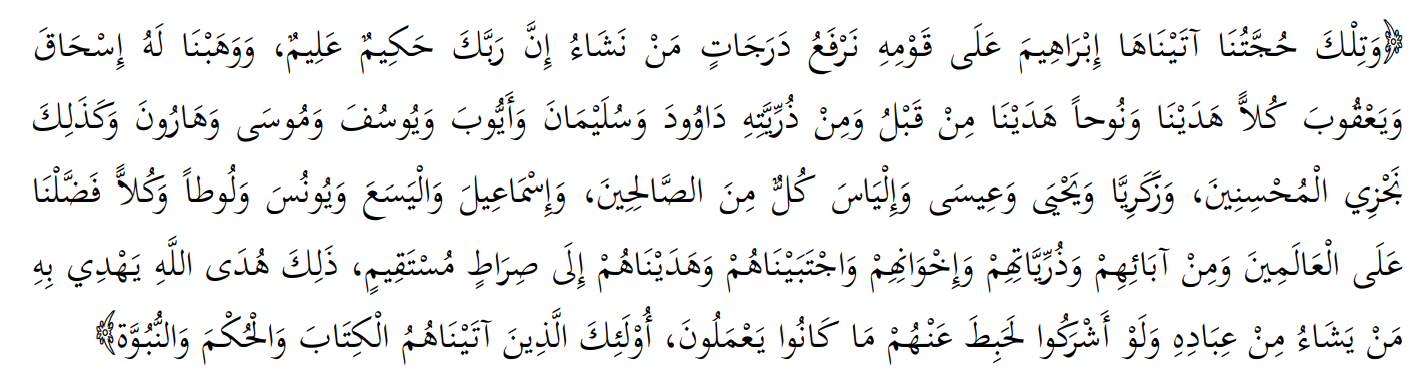
"E este é o Nosso argumento, que concedemos a Abraão contra o seu povo. Elevamos em graus a quem Nós quisermos. Certamente, o teu Senhor é sábio, conhecedor. E concedemos-lhe Ishaq e Yaqub, e a todos eles guiamos; e antes deles guiamos Nuh, e, da sua descendência, a Dawud, Sulaiman, Ayub, Yusuf, Musa e Haroun. Assim recompensamos os que fazem o bem. E a Zakaria, Yahya, Isa e Ilyas. Todos eles estão entre os justos. E a Ismail, Al-Yasa', Yunus e Lut, e a cada um deles preferimos sobre os mundos. E também a alguns dos seus antepassados, da sua descendência e dos seus irmãos; escolhemo-los e guiamo-los para o caminho reto. Esta é a orientação de Allah, com ela guia quem Ele quiser dentre os Seus servos. Mas, se eles tivessem associado outros a Allah, tudo o que haviam feito ter-se-ia perdido. São estes a quem concedemos o Livro, a sabedoria e a profecia." [TMQ An’ām: 83-89]
"And this is our argument that we gave to Abraham against his people, we raise in degrees whom we please, undoubtedly, your lord is wise, knowing. And we gave him Ishaq and Yaqub, we showed the path to all of them and showed the path to Nuh before them, and of his progeny, to Daud and Sulaiman and Ayub and Yusuf and musa and Haroon, and thus we recompense the righteous. And to Zakaria, Yahya, Isa and Ilyas. These are all entitled to be our near ones. And to Ismail and Yasa and Yunus and lot, and to each one we preferred above all in his time. And also to some of their fathers and their progeny and some of their brothers, and we chose them and showed them the straight path. This is the guidance of Allah. He gives whom he will of his bondmen, and if they would have committed polytheism, then surely all that they had already done would have been destroyed. These are they to whom we gave the book and order and prophet hood" [TMQ An’ām: 83-89]
E Ismail, Idris e Dhul-Kifl estavam entre os perseverantes, e Nós os admitimos em Nossa misericórdia. Eles eram, de fato, dos justos. [TMQ Anbiya: 85-86]
"And Ismail and Idrees and Dhul-Kifl all were from the patient ones who we took into our mercy. Indeed they are from the righteous." [TMQ Anbiya: 85-86]
E a Madian enviamos o seu irmão Shu'aib. [TMQ Araf: 85]
"And to Madyan, we sent their brother Shu'aib." [TMQ Araf: 85]
"E aos Thamud enviamos o seu irmão Salih." [TMQ Araf: 73]
"And to Thamud, we sent their brother Salih." [TMQ Araf: 73]
"E a 'Ad, enviamos o seu irmão Hud." [TMQ Araf:65]
"And to A'ad, we sent their brother Hud." [TMQ Araf:65]
E dissemos: "Ó Adão, habita tu e tua esposa no Paraíso." [TMQ Baqarah: 35]
"And we said, o Adam dwell you and your wife in paradise." [TMQ Baqarah: 35]
Muhammad ﷺ é o Mensageiro de Allah. Aqueles que estão com ele são severos com os kuffar e misericordiosos entre si. [TMQ Fath: 29]
"Muhammad is the messenger of Allah. Those with him are severe on the Kuffar and merciful between themselves." [TMQ Fath: 29]
Todos os profetas e mensageiros foram informantes de Allah, pois este é o sentido da profecia e da mensagem. Eles são verídicos, admoestadores da criação para que a missão e a mensagem não se tornem vãs, e são infalíveis quanto à mentira e ao erro em sua propagação, assim como são infalíveis quanto a cometer qualquer pecado. Além disso, não há evidência textual definitiva [qati] no Alcorão ou na Sunnah do Profeta ﷺ que informe sobre o erro dos profetas após sua profecia e seu mensageirismo. Tudo o que foi relatado está ou nos hadiths cuja transmissão é indefinida [dhanni athuboot], ou nos versículos cuja evidência é indefinida [dhanni ad-dalala], e o indefinido [dhanni] não pode sobrepor-se à evidência racional definitiva sobre a infalibilidade. Quanto ao que foi revelado no Alcorão sobre Adão, a respeito de ele ter comido da árvore da qual Allah lhe havia proibido comer, isso não contradiz a exigência de infalibilidade na propagação da mensagem às pessoas na terra, porque o que aconteceu a Adão se deu no Paraíso, cuja sabedoria só é conhecida por Allah. Portanto, este é um assunto separado (ou seja, o comer de Adão do fruto da árvore), pois a infalibilidade está relacionada à propagação da mensagem às pessoas na terra.
All the prophets and messengers were informers from Allah because this is the meaning of prophethood and messengerhood. They are truthful, admonishers to creation lest the mission and message become futile and they are infallible from lying and error in their propagation, just as they are infallible from committing any sin. Further there is no definite [Qati] textual evidence in the Qur’ān or the Sunnah of the prophet informing about the erring of the prophets after their Prophethood of Messengership. Whatever has been reported is either in the ahadith that are indefinite in their transmission [dhanni athuboot] or in the ayat that are indefinite in their evidence [dhanni ad-dalala] and the Indefinite [dhanni] cannot over ride the definite rational evidence on infallibility. As for what was revealed regarding Adam in the Qur’ān about him eating from the tree which Allah had prohibited him to eat from, this does not contradict the requirement of infallibility in the propogation of the message to the people on the earth because what happened from Adam was in the Paradise, the wisdom of which is only known to Allah . Therefore this is separate matter (i.e Adam’s eating of the fruit of the tree) because infallibility is related to the propogation of the message to the people on the earth.