...что он сказал, что этот аят был ниспослан в отношении Посланника Аллаха ﷺ, когда он пытался склонить к исламу своего дядю Абу Талиба. Затем пришли Табиины после Асхаба, которые передавали всё, что упоминали Асхаб, таким же образом. Среди Табиинов были те, кто разъяснял аяты Благородного Корана или указывал причину ниспослания, либо на основании собственного иджтихада в тафсире, либо со слов (других авторитетов), которые им передавали. После Табиинов пришли учёные, которые расширили тафсир и приводили сообщения из иудейских и христианских источников. Муфассиры сменяли друг друга в каждую эпоху и поколение: они разъясняли Коран и расширяли тафсир в каждую эпоху, опираясь на то, что было до них. Муфассиры начали обращать внимание на аяты, чтобы выводить из них предписания и объяснять свои школы мысли с точки зрения свободы воли (ихтияр) и предопределения (джабр). Они стали разъяснять аяты, подтверждая свои взгляды в соответствии со своими склонностями в законоведении, каламе ('ильм аль-Калам), риторике (балага), морфологии (сарф) и грамматике и т. д. Очевидно из изучения тафсиров разных эпох, начиная со времени Асхаба и до наших дней, что тафсир Корана в каждую эпоху находился под влиянием научного движения того времени, он отражал взгляды, теории и школы мысли своего времени. Редко встречались тафсиры, свободные от влияния мнений, идей и правил своего времени.
that he said the verse had been revealed concerning the Messenger of Allah when he tried to win over his uncle Abu Talib to Islam. Then came the Tabi'un after the Sahabah who reported everything the Sahabah mentioned in this manner. From among the Tabi'un there were those who explained the verses of the Noble Qur’ān or stated the cause of revelation, either as their own Ijtihād in tafsīr or by hearing it from (other authorities). After the Tabi'un the 'Ulama came and expanded the tafsīr and quoted reports from the Jews and Christians. The mufassirun succeeded one after another in every age and generation, who explained the Qur’ān and expanded the tafsīr in each age on what had come before. The mufassirun began to give their attention to the verses to deduce rulings from them and explain their schools of thought in terms of freewill (ikhtiyar) and predestination (jabr). And they began to explain verses proving their opinions according to their inclinations in legislation, scholasticism ('ilm al-Kalam), rhetorics (balaagha), declension (sarf) and grammar etc. What is apparent from an examination of the tafaseers through the different ages since the time of the Sahabah until now is that the tafsīr of the Qur’ān in every age was influenced by the scholarly movement of the time, it presented a picture which reflected the views, theories and schools of thought of the time. Seldom were there tafsīrs that were free from the influence of opinions, thoughts and rules of the time.
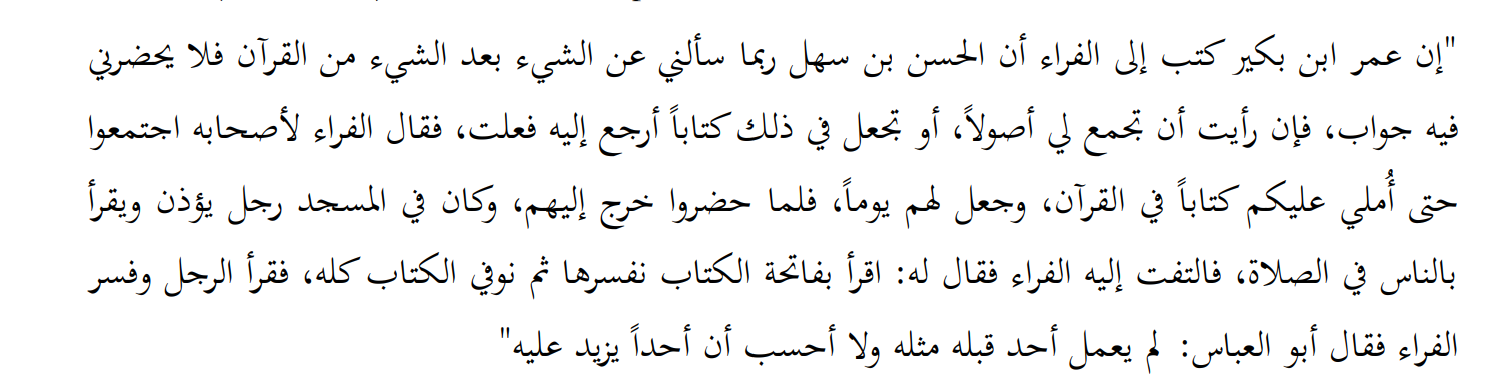
Однако все эти тафсиры не были собраны в книги с первого дня, когда появились муфассиры, то есть со времён ас-Сахабы. Напротив, они менялись в зависимости от обстоятельств на протяжении веков. Вначале тафсир был частью хадиса и одним из его разделов. Хадис был всеобъемлющей темой, охватывавшей все исламские дисциплины. Поэтому передатчик хадиса, так же как он передавал хадис, содержащий юридическое постановление, передавал и хадис, содержавший тафсир аята Корана. Затем, в начале Аббасидской эпохи и ближе к концу Омейядской эпохи, то есть в начале второго века хиджры, авторы стали собирать все схожие и относящиеся к делу хадисы под одной темой и отделять их от других тем. Таким образом, такие дисциплины, как тафсир и фикх, содержавшиеся в хадисе, были отделены друг от друга. Результатом этого разделения наук стало появление отдельных направлений в хадисе, сире, юриспруденции и тафсире. Так возникла наука о тафсире, которая стала самостоятельной дисциплиной и изучалась отдельно. Однако тафсиры не приобрели упорядоченной формы: аяты Корана не излагались в том порядке, в каком они расположены в мусхафе, с последующим за каждым из них толкованием. Напротив, передаваемые тафсиры были разбросаны там и сям, это были толкования разрозненных аятов, как и в случае с хадисами. Такое положение сохранялось до тех пор, пока тафсир не отделился от хадиса и не стал существовать как самостоятельная наука. Тафсир стали писать на каждый аят Корана или часть аята, располагая эти аяты в порядке мусхафа. Первым, кто взялся за толкование Корана, приводя аят за аятом и разъясняя их один за другим, был аль-Фарра' (ум. в 207 г. хиджры). Ибн ан-Надим сообщает в своей книге «аль-Фихрист», что:
However, all of these tafsīrs were not compiled in books from the first day mufassirun came to exist i.e, from the time of the Sahabah. Rather, they changed from situation to situation through the ages. In the beginning, the tafsīr used to be a part of the hadīth and one of its chapters. The hadīth was the all-extensive topic which encompassed all the Islamic disciplines. So the transmitter of a hadīth just as he would narrate a hadīth containing a legal ruling he would also narrate a hadīth which contained the tafsīr of a Qur’ānic verse. Then writers, in the beginning of the Abbasid era and towards the end of the Umayyad era i.e, in the beginning of the second century hijri, began to bring together all the similar and relevant ahadīth under a topic and separate them from other topics. So the disciplines such as tafsīr and fiqh which the hadīth contains were separated from each other. What resulted from the sciences is what resulted in terms of hadīth, Sīrah, jurisprudence and tafsīr. Thus, the science of tafsīr came to exist and it became an independent science which was studied on its own. However, the tafsīrs did not take any organised form, in that verses of Qur’ān were not mentioned in an ordered manner like the arrangement found in the mushaf (Qur’ān) and then followed by their tafsīr. Rather the tafsīrs narrated were scattered here and there. They were tafsīr for miscellaneous verses as was the case with the hadīth. This situation continued until the tafsīr became separated from the hadīth and began to stand up as a science in its own right. Tafsīr was written for each ayah of the Qur’ān or part of an ayah, arranging these verses according to the order in mushaf. The first one to undertake the tafsīr of the Qur’ān quoting ayah after ayah and explain them one after another was al-Farra' (d.207 A.H.). Ibn al-Nadim reports in his book alFihirst that: