Этот хадис ясно указывает на добрых и дурных правителей, а также ясно запрещает выступать против них с мечом, пока они утверждают дин, ведь совершение салята (молитвы) указывает на соблюдение дина и правление по нему.
This hadith is clear in informing about the good and bad leaders, and clear in prohibiting confronting them with the sword as long as they establish the deen, since establishing the salat (prayer) indicates upholding of the deen and ruling by it.
Итак, обязанность мусульман назначить Халифа, который устанавливает законы Ислама и несёт его призыв, — вопрос, в достоверности которого нет никаких сомнений, ведь он подтверждается достоверными текстами Шариата. Более того, это обязательный долг, поскольку Аллах (SWT) сделал фардом для мусульман установление власти Ислама и защиту чести мусульман. Однако этот долг является коллективным: если некоторые люди из Уммы выполнили его, то фард считается исполненным и ответственность снимается с остальной части Уммы. Если же часть Уммы оказалась не в состоянии исполнить фард, хотя и совершала действия, которые ведут к его установлению, то ответственность остаётся на всех мусульманах, и фард лежит на каждом мусульманине до тех пор, пока у мусульман нет Халифа.
So the obligation upon Muslims to appoint the Khalifah who establishes the laws of Islam and conveys its call is a matter which has no doubt with regard to its certainty in the sound texts of Shari’ah. Moreover, it is an obligatory duty due to the fact that Allah (swt) made it fard upon Muslims to establish the rule of Islam and to protect the honour of Muslims. However, this duty is a collective one, so if some people of the Ummah accomplished it, the fard is fulfilled and thus responsibility drops from the rest of the Ummah. And if part of the Ummah was unable to achieve the fard, though they carried out the actions which establish it, then the responsibility remains upon all the Muslims, and the fard remains upon every Muslim as long as Muslims are without a Khalifah.
Уклонение от учреждения Халифата для мусульман относится к величайшим грехам, поскольку это значит пренебрегать исполнением одной из важнейших обязанностей ислама, от которой зависит осуществление дина; более того, от неё зависит даже само существование ислама на поле жизненной борьбы. Поэтому мусульмане в целом совершают великий грех, если не учреждают Халифат для всех мусульман. И если бы все они договорились оставаться без Халифата, грех пал бы на всех мусульман во всех населённых регионах (во всём мире). Однако если некоторые мусульмане взялись за работу по учреждению Халифата, а другие нет, то грех спадает с плеч тех, кто начал работать над учреждением Халифата, хотя фард остаётся на них до тех пор, пока Халифат не будет установлен. Это так потому, что участие в установлении фарда снимает грех за задержку в его установлении в должное время и за его неосуществление, благодаря тому что человек работает над его установлением и ненавидит то, что мешает ему это сделать.
To refrain from establishing a Khalifah for the Muslims is among the greatest sins because it is abstaining from carrying out among the most important obligations of Islam upon which the implementation of the deen depends; nay even the very existence of Islam in the battlefield of life depends upon it as well. So Muslims as a whole commit a great sin by refraining from establishing a Khalifah for all Muslims. And if they all agreed to remain without a Khalifah the sin would befall all Muslims in all inhabited regions (entire world). However, if some of the Muslims embarked on working to establish a Khalifah and the others did not, the sin will drop from the shoulders of those who started to work to establish the Khalifah though the fard remains upon them until the Khalifah is appointed. (This is so) because the involvement in establishing the fard removes the sin for the delay in establishing it in its proper time, and for its non-establishment, due to one’s work to establish it and his hatred of that which prevents him from establishing it.
Что касается тех, кто не участвовал в деятельности по установлению фарда, то грех остаётся на них по истечении трёх дней после ухода Халифа до назначения нового Халифа, поскольку Аллах (subhanahu wa ta'ala) возложил на них фард, который они не исполнили и не занялись работой, необходимой для его выполнения. Поэтому они заслуживают греха и заслуживают наказания Аллаха (subhanahu wa ta'ala) в этой жизни и в последующей. То, что они заслуживают греха из-за воздержания от установления Халифата или от совершения действий, которые (согласно Шариату) устанавливают Халифат, ясно очевидно, ибо мусульманин заслуживает наказания Аллаха (subhanahu wa ta'ala), когда пренебрегает любой из обязанностей, возложенных на него, особенно обязанностью, посредством которой реализуются прочие обязанности, устанавливаются правила дина, возвышается дело Ислама и слово Аллаха (subhanahu wa ta'ala) становится превознесённым на землях ислама и во всём остальном мире.
As for those who were not engaged in the work to establish the fard, the sin will remain on them after three days have passed from the departure of the Khalifah until the appointment of a new Khalifah, because Allah (swt) has entrusted them with a fard which they did not carry out nor engage themselves in the work which is required for its completion. Therefore, they are deserving of sin and deserve the punishment of Allah (swt) in this life and the hereafter. Their deserving of sin due to their refraining from establishing the Khalifah, or performing the actions which (according to Shari’ah) establish the Khalifah, is explicitly clear in that a Muslim deserves the punishment of Allah (swt) when he ignores any of the duties enjoined upon him, particularly the obligation by which the other obligations are implemented, the rules of the deen are established, the cause of Islam is raised high and the word of Allah (swt) becomes exalted in the Islamic lands and the rest of the world.
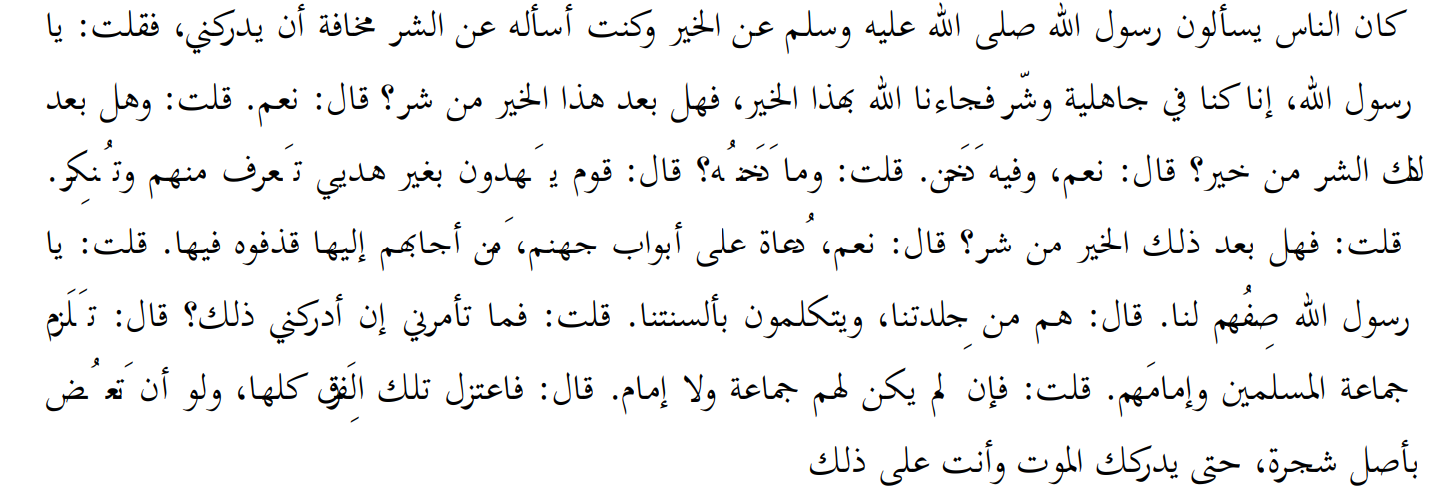
Что касается тех хадисов, в которых говорится об уединении от людей и о том, чтобы ограничиться лишь соблюдением вопросов личного поклонения в делах религии, то эти хадисы не годятся в качестве доказательства для того, чтобы воздерживаться от установления Халифата, и не снимают греха, возникающего из-за такого воздержания. Тот, кто внимательно изучит эти хадисы, увидит, что они относятся к вопросу соблюдения религии, а не к разрешению воздерживаться от установления Халифата для мусульман. Например, аль-Бухари передал со слов Бисра ибн Убайдуллы аль-Хадрami, что он слышал, как Абу Идрис аль-Хулани говорил, что он слышал, как Хузайфа ибн аль-Яман говорил:
As for what came in some of the ahadith regarding isolation from the people, and restricting oneself to adhering only to matters of personal worship of the matters of the deen, these ahadith are not suitable as evidence to refrain from establishing a Khalifah nor removing the sin due to this abstention. Whoever studies these ahadith carefully will find them related to the matter of adhering to the deen rather than permission to refrain from establishing a Khalifah for Muslims. For example, Al-Bukhari narrated about Bisr bin Ubaydullah al-Hadhrami that he heard Abu Idrees al-Khoolani say that he heard Hudhayfah bin al-Yaman saying: