20.3 Шахид
20.3 The Martyr
Шахиды (шухада) делятся на три вида: шахид в Ахирате, но не по правилам этого мира; шахид только в этом мире; и шахид и в этом мире, и в Ахирате. Что касается шахида только в Ахирате, но не в этом мире, то о них говорится в хадисах. В одних преданиях их семь, в других восемь, в других девять, а в некоторых одиннадцать. Достоверной же, как сказано в «Сахихе» Муслима, является позиция, согласно которой их пять. Это: аль-матун, то есть умерший от чумы, то есть известной эпидемии; аль-мабтун, то есть страдающий от поноса; утонувший, умерший из-за воды; погибший при обрушении здания (аль-хадм); и тот, кто погиб на пути возвышения слова Аллаха вне поля боя. Муслим передал от Абу Хурайры (да будет доволен им Аллах), что Посланник Аллаха ﷺ сказал:
Martyrs (shuhadaa) are of three types; the shaheed of the Akhirah but not by the rules of the world; the shaheed of the world only and the shaheed of the world and Akhirah. As for the shaheed of the Akhirah only and not of this world, they are mentioned in the ahadith. In some narrations they are seven, in some eight, in some nine and in some eleven. The authentic (position) as what came in Muslim is that they are five who are: (al-mat’un) who is the one who dies in the plague i.e. the famous pestilence, the (mabtun) who is the one with diarrhoea, the drowned person who dies because of water, the one who dies of (al-hadm) i.e. the collapsed building, and the one who dies in the way of raising the word of Allah outside the battlefield. Muslim narrated from Abu Hurayra (ra) that the Messenger of Allah (saw) said:
«Человек, шедший по дороге, нашёл на пути ветку с колючками и убрал её. Аллах был благодарен ему и простил его. Пророк ﷺ сказал: Мучеников (шухада) пять: умерший от чумы (аль-мат'ун), умерший от болезни живота (аль-мабтун), утонувший, погибший под обрушившимся (зданием) и шахид на пути Аллаха, аззә ва джалла».
“A man walking along the road found a thorn-branch in the road and removed it. Allah was grateful to him and forgave him. He (saw) said: The martyrs (shuhadaa) are five: (al-mat’un), (al-mabtun), the drowned one, the one who died in a collapsed (building) and the shaheed in the way of Allah ‘azza wa jalla.”
Передаёт Муслим со слов Абу Хурайры (ра), который сказал: Посланник Аллаха ﷺ сказал:
Muslim narrated from Abu Hurairah (ra) who said: The Messenger of Allah (saw) said:
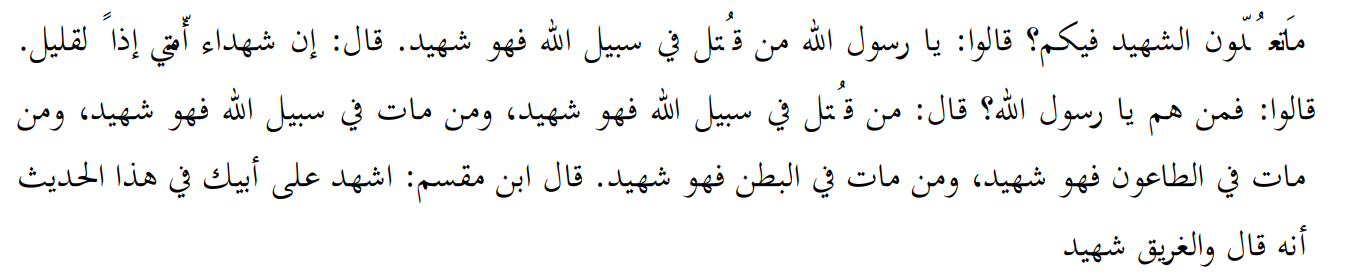
«Кого вы считаете шахидом среди вас?» Они сказали: «О Посланник Аллаха, тот, кто погиб на пути Аллаха, является шахидом». Он сказал: «Тогда шахидов среди моей общины будет немного». Они спросили: «Так кто же они, о Посланник Аллаха?» Он ответил: «Тот, кто погиб на пути Аллаха, — шахид; тот, кто умер на пути Аллаха, — шахид; тот, кто погиб от чумы, — шахид; тот, кто погиб от болезни желудка, — шахид (ибн Мукsим сказал: «Свидетельствую об отце твоём в этом хадисе, что он сказал это»), и утонувший — шахид».
“Whom do you consider a shaheed among you? They said: O Messenger of Allah, the one killed in the way of Allah is a shaheed. He said: Then the shuhadaa among my Ummah would be few. They said: Then who are they, O Messenger of Allah? He said: The one killed in the way of Allah is a shaheed, the one who dies in the way of Allah is a shaheed, the one killed in pestilence is a shaheed, the one killed due to the stomach is a shaheed (ibn Muqsim said: I testify that upon your father in this hadith that he said) and the drowned person is a shaheed.”
Смысл этих шахидов таков: в Аль-Ахира им уготована награда шахидов; что же касается этого мира, то их омывают и совершают над ними молитву. Когда слово «шахид» упоминается в связи с наградой и хадисом об этом, правильно распространять его на этих (людей). Однако если слово «шахид» употребляется без ограничения и без каких-либо дополнительных значений, то оно не понимается как обозначающее этих (людей), а относится только к тем, кто погиб на пути Аллаха.
The meaning of these shuhadaa is that there is for them in the Akhirah the reward of the shuhadaa; as for this world, they are washed and prayed over. When the word “shaheed” is said in connection with reward and the hadith about that, it is correct to generalize it to these (persons). However, if the word “shaheed” is used in an unrestricted manner without any connotation, then it is not taken to denote these (persons) but rather to denote only those killed in the way of Allah.
Что касается шахида в этом мире, а не в Ахирате, то он получает правила шахида этого мира, поскольку его не омывают и не совершают над ним джаназа-намаз, а хоронят в его одеждах. Однако он не получает в Ахирате награды шахида, который сражался, чтобы возвысить слово Аллаха. Это тот, кто сражается не на пути Аллаха, например ради славы или только ради добычи, или же при отступлении. Это потому, что хадисы определили награду шахида для того, кто сражается на пути Аллаха (SWT) и сражается, наступая, а не отступая. Муслим передал от Абу Мусы аль-Аш’ари.
As for the shaheed of the world not the Akhirah, he is the one who takes the rules of the shaheed of the world in so far as he is not washed nor prayed over but rather buried in his clothes. However he does not take in the Akhirah the reward of the shaheed who fought to raise the word of Allah the highest. This is the one who fights in other than the way of Allah such as fighting for fame or booty alone or while retreating. This is because the ahadith specified the shaheed’s reward for the shaheed who fights in the way of Allah (swt), and the one fighting advancing not retreating. Muslim narrated from Abu Musa al-Ash’ari
«Один человек пришёл к Пророку ﷺ и сказал: «О Посланник Аллаха, кто сражается ради добычи, кто сражается ради того, чтобы о нём упоминали, и кто сражается ради того, чтобы его положение было видно, — кто из них на пути Аллаха?» Посланник Аллаха ﷺ сказал: «Тот, кто сражается ради того, чтобы слово Аллаха было высшим, — тот на пути Аллаха»».
“That a man came to the Prophet (saw) and said: O Messenger of Allah, the man who fights for booty, the man who fights to be mentioned and the man who fights so that his rank is seen. Which one is in the way of Allah? The Messenger of Allah (saw) said: ‘The one who fights so that the word of Allah be highest is the one in the way of Allah.”
Муслим передал от Абу Мусы
Muslim narrated from Abu Musa
«Посланника Аллаха ﷺ спросили о человеке, который сражается ради проявления своей храбрости, о том, который сражается из гнева, и о том, который сражается ради показухи (лицемерно). Посланник Аллаха ﷺ сказал: Тот, кто сражается для того, чтобы слово Аллаха было высшим, тот находится на пути Аллаха».
“The Messenger of Allah (saw) was asked about the man who fights (to show his) courage, the one who fights out of anger, and the one who fights to show off (hypocritically). The Messenger of Allah (saw) said: The one who fights so that the word of Allah is highest is in the way of Allah.”
Посланник Аллаха ﷺ поставил условием прощения грехов шахида то, что он сражается, наступая, а не отступая. Муслим передал со слов Абдуллаха ибн Аби Катады, со слов Катады, что тот слышал это от посланника Аллаха ﷺ.
The Messenger made a condition of the shaheed being forgiven his sins that he fights advancing not retreating. Muslim narrated from Abdullah bin Abi Qatadah from Qatadah that he heard it being narrated from the Messenger of Allah
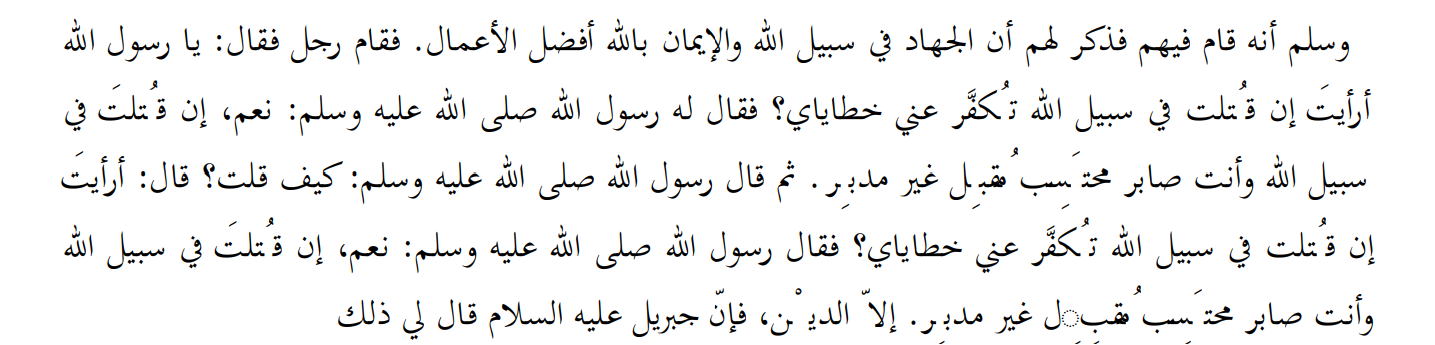
«Так он стоял среди них и напоминал им, что джихад на пути Аллаха и твёрдая вера в Аллаха — лучшие деяния. Тогда поднялся один человек и сказал: «О Посланник Аллаха, как ты считаешь, если я буду сражаться на пути Аллаха, простятся ли мне все мои прегрешения?» Посланник Аллаха ﷺ ответил ему: «Да, если ты будешь сражаться на пути Аллаха, будешь терпелив, будешь уповать на награду, будешь идти вперёд и не отступать». Затем Посланник Аллаха ﷺ сказал: «Что ты сказал?» Он ответил: «Как ты считаешь, если я буду сражаться на пути Аллаха, простятся ли мне все мои грехи?» Посланник Аллаха ﷺ сказал: «Да, если ты будешь терпелив, будешь уповать на награду, будешь идти вперёд и не отступать, кроме как по долгу, ибо так мне сказал Джибриль (мир ему)».»
“That he stood among them and reminded them that jihad in the way of Allah and decisive belief in Allah is the best deeds. So a man stood up and said: O Messenger of Allah, do you see that if I fought in the way of Allah that all my errors would be forgiven? The Messenger of Allah (saw) said to him: Yes, if you fought in the way of Allah and you are patient, hopeful, advancing and not retreating. Then the Messenger of Allah (saw) said: What did you say? He said: Do you see that if I fought in the way of Allah that all my sins would be forgiven? The Messenger of Allah (saw) said: Yes, if you are patient, hopeful, advancing and not retreating except for debts as Jibril (AS) told me that.”
Понимание этого таково: у бегущего с поля боя грехи не прощаются, и он не получает награды шахида. Что же касается того, кто сражается ради славы, то Посланник Аллаха ﷺ разъяснил, что он будет наказан, и всё же назвал его шахидом. Муслим передал от Сулаймана ибн Ясара, который сказал: Люди разошлись от Абу Хурайры (да будет доволен им Аллах), и Натиль, который был из жителей Шама, сказал ему: «О шейх, передай нам хадис, который ты слышал от Посланника Аллаха ﷺ». Он сказал: «Да, я слышал, как Посланник Аллаха ﷺ говорил:
The understanding of this is that the retreating fighter’s sins are not forgiven nor does he have the reward of the shaheed. As for the one fighting for fame, the Messenger (saw) clarified that he would be punished and (yet) called him shaheed. Muslim narrated from Sulayman bin Yasar who said: People dispersed about Abu Hurairah (ra) and Natil who was from the people of Sham said to him: O Sheikh related to us a hadith you heard from the Messenger of Allah (saw). He said: Yes, I heard the Messenger of Allah (saw) saying:
«Поистине, первым, кого будут судить в День Суда, будет человек, который был убит как шахид. Его приведут к Нему (Аллаху), и Он напомнит ему о Своих милостях, и тот признает их. Он (SWT) скажет: «Что ты сделал с ними?» Он ответит: «Я сражался ради Тебя, пока не был убит как шахид». Он скажет: «Ты лжёшь. Ты сражался лишь для того, чтобы о тебе говорили: “Он храбрый”, и так и говорили». Затем Он повелит в отношении него, и его потащат лицом по земле, пока не бросят в Огонь».
“Verily the first person(s) to be judged on the Day of Judgement is a man who was killed as a shaheed. He is brought to Him (Allah) and He informs him of the bounties (of Allah) and he acknowledges them. He (swt) says: What did you do with them? He answers: I fought for you until I was killed as a shaheed. He says: You lied. Rather you fought so that it be said ‘(he is) brave’ and it has been said. Then He commands regarding him and he is dragged upon his face until he is thrown into the Fire”
До конца хадиса. Это указывает на то, что тот, кто был убит ради славы, даже если в этом мире к нему применяются правила шахида, не получит награды шахида в День Суда, а будет наказан.
Till the end of the hadith. This indicates that the one killed for fame, even if he takes the rules of the shaheed in this world, will not gain the reward of the shaheed on the Day of Judgement but would be punished.
Что касается шахида в этом мире и в Последней жизни, то это тот, кто сражается с неверными, чтобы возвысить слово Аллаха, и погибает в бою (на поле боя) между мусульманами и неверными, независимо от того, велось ли сражение на земле войны или на исламской земле. Аллах (SWT) сказал:
As for the shaheed of the world and the Akhirah, he is the one who fights the disbelievers to raise the word of Allah and was killed in the battle (field) between Muslims and disbelievers, whether the fighting was in the land of war or the Islamic land. Allah (swt) said:
«И не считайте мёртвыми тех, кто был убит на пути Аллаха. Нет, они живы и получают удел у своего Господа» {Коран 3:169}.
“Do not think that those killed in the way of Allah are dead. Rather they are alive and receiving sustenance before their Lord” [TMQ 3:169].
Этот шахид — тот, в отношении которого в шариатских нормах установлены особые права. Он определяется как тот, кто был убит в бою с неверными; так же считается и тот, кто был ранен на поле боя и умер от полученной там раны. Что касается всех остальных, они не считаются шахидами. Соответственно, тот, кто был убит в сражении с мятежниками (бугат), не считается шахидом, как и тот, кто был ранен на поле боя, затем выздоровел от раны, а потом умер от её последствий. Шахид, к которому относятся особые правила и о котором Аллах сказал, что он жив, — это тот, кто был убит на поле боя с неверными ради возвеличивания слова Аллаха, и тот, кто был ранен на поле боя и умер от этой раны.
This shaheed is the one upon whose rights came in the Shari’ah rules. He is specified as the one killed in the war with disbelievers; similarly the one who was wounded in the battlefield then died of the wound he received in the battlefield is also considered like the one killed in the battlefield. As for other than these, they are not considered shaheed. Accordingly the one killed in fighting with rebels (bughat) is not considered shaheed nor the one wounded in the battlefield then recovered from the wound then died because of it. The shaheed who has specific rules, and the one about whom Allah stated that he is alive, is specified to the one killed in the battlefield with the disbelievers to raise the word of Allah and the one injured in the battlefield then died due to this wound.
Правило относительно упомянутого шахида таково: его не омывают и не заворачивают в погребальный саван, а хоронят в его крови и одежде, ибо шахид воскреснет в День Суда с запахом своей крови, подобным сладчайшему мускусу. Что же касается того, что шахида не омывают, то это основано на том, что передал аль-Бухари от Джабира, который сказал:
The rule of this mentioned shaheed is that he is neither washed nor shrouded in burial shrouds; rather he is buried in his blood and clothes because the shaheed is resurrected on the Day of Judgement with the smell of his blood like the sweetest-smelling musk. As for not washing the shaheed, this is due to what Al-Bukhari narrated from Jabir who said:
Посланник Аллаха ﷺ собирал по двое из погибших при Ухуде в одну ткань, а затем говорил: «Кто из них больше знал Куръан?» Если ему указывали на одного из двух, он ставил того первым в могильной нише (лихд) и говорил: «Я свидетель над этими». Он повелел похоронить их вместе с их кровью и не совершал над ними молитвы и не омывал их.
“The Messenger of Allah (saw) would collect two men of those killed in Uhud in one cloth, and then he would say: Which one of them knew more of the Qur’an? If one of the two was indicated to him, he brought him forward in the grave-niche (lihd) and said: I am a witness over these. He commanded their burial with their blood and did not pray over them nor wash them.”
И передал Ахмад, что Пророк ﷺ сказал о погибших при Ухуде:
And Ahmad (narrated) that the Prophet (saw) said about those killed in Uhud:
«Не омывайте их, ведь каждая рана или (каждая капля) крови будет источать мускус в День Суда», и он не совершал над ними молитву.
“Do not wash them because each wound or (each drop of) blood will diffuse musk on the Day of Judgement and he did not pray over them.”
Передаётся, что Пророк ﷺ сказал о тех, кто погиб при Ухуде:
It is narrated that the Prophet (saw) said about those killed in Uhud:
«Укройте их в их крови и не омывайте их, ибо нет раны, полученной на пути Аллаха, которая не придёт в День Суда с хлещущей из неё кровью, цвет которой — цвет крови, а запах — запах мускуса.»
“Cover them in their blood and do not wash them as there is no wound wounded in the way of Allah save that it will come on the Day of Judgement with its jugular vein flowing blood whose colour is the colour of blood and the odour is the odour of musk.”
Передаётся от Анаса
It has been narrated from Anas
То, что Пророк ﷺ не совершал погребальную молитву над павшими в битве при Ухуде и не молился за них.
“That the Prophet (saw) did not pray over those killed in Uhud or pray over them.”
Так же, как Пророк ﷺ не омывал тех, кто был убит при Ухуде, он не омывал и шахидов Бадра; подобно этому он не омывал шахидов Ханданда и Хайбара. Таким образом стало ясно, что шахид не омывается. Так же шахид не облачается в саван, как облачается умерший; напротив, он погребается в той одежде, которая на нем есть, на основании слов Посланника Аллаха ﷺ о тех, кто был убит при Ухуде.
Just as he did not wash those killed in Uhud, he did not wash the shuhadaa of Badr; similarly he did not wash the shuhadaa of Khandaq and Khayber. So it became clear that the shaheed is not washed. Similarly the shaheed is not enshrouded as the dead person is shrouded; rather he is shrouded in the clothes that he has due to the Messenger of Allah (saw)’s statement about those killed in Uhud:
«Заверните их в их раны и кровь» (передал Ахмад)
“Cover them in their wounds and blood” (narrated by Ahmad)
И также ввиду того, что передал Ибн Аббас (ра)
And also due to what ibn Abbas (ra) narrated
«Что Посланник Аллаха ﷺ распорядился в отношении погибших в битве при Ухуде: снять с них железо и кожу и похоронить их в их крови и одеждах» (передал Абу Дауд).
“That the Messenger of Allah (saw) commanded about those killed in Uhud that the iron and skins be removed from them and that they be buried with their blood and clothes” (narrated by Abu Dawud).
Что касается молитвы над шахидом, то разрешено молиться над ними и разрешено не молиться над ними. Что же касается дозволенности молитвы над ними, то это основывается на передачах, в которых сообщается, что Посланник Аллаха ﷺ молился над погибшими в битве при Ухуде после их погребения и молился над Хамзой и над человеком, погибшим на поле боя. В «Сахихе» аль-Бухари передаётся от Укбы ибн Амира
As for the prayer over the shaheed, it is allowed to pray over them and it is allowed not to pray over them. As for the permissibility of prayer over them, this is due to the narrations which came that the Messenger (saw) prayed over those killed in Uhud after their burial and prayed over Hamza and a man killed in the battlefield. In Al-Bukhari it is narrated from Uqbah bin ‘Amir
Он (ﷺ) совершил молитву над погибшими в Ухуде спустя восемь лет; молитва над умершими была словно прощание с живыми и с умершими.
“He (saw) prayed over those killed in Uhud after eight years, the prayer over the dead was like a farewell to those alive and those dead.”
И из «Сунан» Абу Дауда от Малика аль-Гифари
And from Abu Dawud from Malik al-Ghiffari
Он ﷺ совершил молитву над погибшими в Ухуде группами по десять человек, и в каждой группе был Хамза, пока он не совершил над ним молитву семьдесят раз.
“He (saw) prayed over those killed in Uhud in groups of ten with Hamza in each ten until he prayed seventy times over him.”
Абу Дауд передал от Абу Салима, от одного из сподвижников Пророка ﷺ, который сказал:
Abu Dawud narrated from Abu Salim from a man of the Prophet (saw)’s Sahabah who said:

Мы внезапно напали на одно из племён Джухайны. Один из мусульман погнался за одним из них, чтобы поразить его, но промахнулся и ранил самого себя. Посланник Аллаха ﷺ сказал: «Ваш брат, о община мусульман». Люди поспешили и нашли его мёртвым. Посланник Аллаха ﷺ накрыл его своей одеждой и кровью, помолился над ним и похоронил его. Они спросили: «Он шахид?» Он ответил: «Да, и я свидетель за него».
“We attacked by surprise a tribe from Juhainah. A man of the Muslims sought a man of them to strike him, but he missed and struck himself. The Messenger of Allah (saw) said: Your brother, O community of Muslims so the people hastened and found him dead. The Messenger of Allah (saw) covered him in his clothes and blood, prayed over him and buried him. They said: Is he a shaheed? He said: Yes, and I am a witness for him.”
«Мы внезапно напали на одно племя из Джухайны. Один из мусульман погнался за одним из них, чтобы ударить его, но промахнулся и поразил самого себя. Посланник Аллаха ﷺ сказал: „Ваш брат, о община мусульман!“ Люди поспешили и нашли его мёртвым. Посланник Аллаха ﷺ накрыл его его одеждой и кровью, совершил над ним молитву и похоронил его. Спросили: „Он шахид?“ Он ответил: „Да, и я свидетельствую за него“».
“We attacked by surprise a tribe from Juhainah. A man of the Muslims sought a man of them to strike him, but he missed and struck himself. The Messenger of Allah (saw) said: Your brother, O community of Muslims so the people hastened and found him dead. The Messenger of Allah (saw) covered him in his clothes and blood, prayed over him and buried him. They said: Is he a shaheed? He said: Yes, and I am a witness for him.”
Что Пророк ﷺ не совершал над погибшими при Ухуде молитву джаназа и не омывал их.
“That the Prophet (saw) did not pray over those killed in Uhud or wash them.”
И передал Ахмад со слов Анаса
And Ahmad narrated from Anas
Шахиды Ухуда не были омыты. Их похоронили в их одеждах, и над ними не совершали погребальную молитву.
“The shuhadaa of Uhud were not washed. They were buried in their clothes and not prayed over.”
Аль-Бухари передал от Джабира ибн Абдуллаха (да будет доволен им Аллах), который сказал:
Al-Bukhari narrated from Jabir bin Abdullah (ra) who said:

Пророк ﷺ сводил в одну могилу по двух мужей из числа погибших при Ухуде, а затем спрашивал: «Кто из них больше заучил Корана?» Когда ему указывали на одного из двоих, он выдвигал того вперёд в могильной нише и говорил: «Я буду свидетелем над ними в День Суда». Он велел похоронить их в их крови и не омывал их и не совершал над ними молитву.
“The Prophet (saw) would combine between two men of those killed in Uhud then say: Which one of them memorized more of the Qur’an? When one of the two was indicated to him, he would bring him forward in the grave-niche and he said: I am the witness over these on the Day of Judgement, commanded their burial in their blood and did not wash them or pray over them.”
Эти хадисы достоверны и однозначно указывают на то, что над шахидом не совершается погребальная молитва. Аш-Шафии ответил на хадис Ибн Аббаса (да будет доволен им Аллах) и на то, что было сказано о смысле молитвы над погибшими при Ухуде перед их погребением: «Сообщение пришло так, будто речь идёт о конкретных случаях, вопреки мутаватиру о том, что Посланник не совершал молитвы над погибшими при Ухуде». Все эти хадисы достоверны, будь то передающие, что Посланник ﷺ совершал молитву над шахидами, или передающие, что он над ними не молился. Нет никакой возможности отвергнуть какой-либо из них на основании его достоверности, ведь все они относятся к тем, что используются в качестве доказательств как по передаче, так и по смыслу. Нет и способа предпочесть один из них другому, ибо маловероятно, что сподвижники забыли совершить молитву над этими шахидами, равно как маловероятно, что они оставили бы вопрос, противоположный установленному о нём ﷺ обычаю совершения молитвы над умершими. Так как же можно отдать предпочтение одному перед другим? Нельзя также говорить, что молитва, упомянутая в хадисах, подтверждающих молитву над шахидом, означает мольбу, так что слово «помолился» значит «сделал дуа». Этого сказать нельзя, поскольку шариатские понятия имеют приоритет над языковыми, пока нет контекста, который бы указывал на иное. Здесь такого контекста нет, поэтому неизбежно, что под молитвой понимается шариатская погребальная молитва над умершим. Нельзя и утверждать, что хадисы о совершении молитвы над умершими отменяют хадисы о её несовершении, поскольку один из них, а именно молитва над погибшими при Ухуде спустя восемь лет, передан позже всех прочих хадисов, ибо он пришёл в передаче Ибн Хиббана.
These ahadith are established and of explicit indication that the shaheed is not prayed over. Ash Shafi’ responded to the hadith of ibn Abbas (ra) and what came of its meaning regarding praying over those killed in Uhud before their burial “that the information came as if it were specific ones in the face of mutawatirah that the Messenger did not pray over those killed in Uhud.” All these ahadith are established whether those narrated that the Messenger (saw) prayed over the shuhadaa or those narrated that he didn’t pray over them. There is no way to reject any of them due to their authenticity, and because they are of those used as proofs in narration and meaning. There is no way to outweigh one over the other as it is remote that the Sahabah forgot to pray over those shuhadaa, just as it is also remote for them to leave an issue which is opposite of what is established about him (saw) of praying over the dead. So how can one be outweighed over the other? Nor should one say that the prayer in the ahadith which established the prayer over the shaheed is the du’a so that his saying “prayed” means made du’a. One cannot say this since the Shari’ah realities precede the linguistic (realities) as long as there is no connotation. Here there is no connotation so it is inevitable that the meaning of prayer is the Shari’ah prayer over the dead. Nor should one say that the ahadith of praying over the dead abrogates the ahadith of not praying over them since one of them, which is the prayer over those killed in Uhud after eight years is prayed to later than all the ahadith since it came in the narration of ibn Hibban
«Затем он вошёл в свой дом и не выходил из него, пока Аллах не предал его смерти.»
“Then he entered his house and did not go out until Allah caused him to die.”
Нельзя говорить, что это отменено, поскольку позднее происхождение хадиса само по себе не является достаточным указанием на отмену; должен быть ещё какой-то признак, из которого понимается отмена. Здесь такого признака нет, поэтому в нём нет никакой отмены. Таким образом, все передачи остаются в силе и толкуются так, что не совершать молитву над шахидом дозволено. Не передаётся, что Посланник Аллаха ﷺ совершал молитву над погибшими при Бадре, Хандаке или Хайбаре. Их также толкуют так, что если кто-то совершает молитву над шахидом, в этом нет ничего (дурного), и людей не запрещают совершать над ними молитву. Шахид назван шахидом (свидетелем), поскольку Рай засвидетельствован для него явным текстом Корана. Аллах (SWT) сказал:
One should not say that because the lateness of the hadith alone is not sufficient indication of abrogation; rather there must be another connotation from which abrogation is understood. Here no connotation is present so there is no abrogation in it. So all the narrations remain recognized and are taken to mean that not praying over the shaheed is allowed. It is not narrated that the Messenger (saw) prayed over those killed in Badr, Khandaq or Khayber. They are also taken to mean that if one prays over the shaheed there is nothing (wrong) in that and people are not prevented from praying over them. The shaheed is named shaheed (witness) as Paradise is witnessed for him by the explicit text of the Qur’an. Allah (swt) said:
Воистину, Аллах приобрёл у верующих их души и их имущество в обмен на рай. Они сражаются на пути Аллаха, убивая и будучи убитыми» [ат-Тауба 9:111].
“Verily Allah purchased from the believers there souls and wealth in return for paradise. They fight in the way of Allah, killing and being killed” [TMQ 9:111].
Муслим передал со слов Джабира, который сказал:
Muslim narrated from Jabir who said:
«Один человек сказал: Где я буду, о Посланник Аллаха, если меня убьют? Он сказал: В Раю. Тогда он бросил финики, которые были у него в руках, и сражался, пока не был убит». А в хадисе Сувайда: «Один человек сказал Пророку ﷺ в день Ухуда».
“A man said: Where am I, O Messenger of Allah, if I am killed? He said: In Paradise. So he threw the dates that were in his hands and fought until he was killed and in the hadith of Suwaid. A man said to the Prophet (saw) on the day of Uhud.”
Передаётся от Анаса ибн Малика (да будет доволен им Аллах), что Посланник Аллаха ﷺ выступил вместе со своими сподвижниками, пока они не опередили многобожников и не пришли к Бадру. Пришли многобожники, и Посланник Аллаха ﷺ сказал:
It is narrated from Anas bin Malik (ra) that the Messenger of Allah (saw) went with his Sahabah until they preceded the polytheists to Badr. The polytheists came and the Messenger of Allah (saw) said:
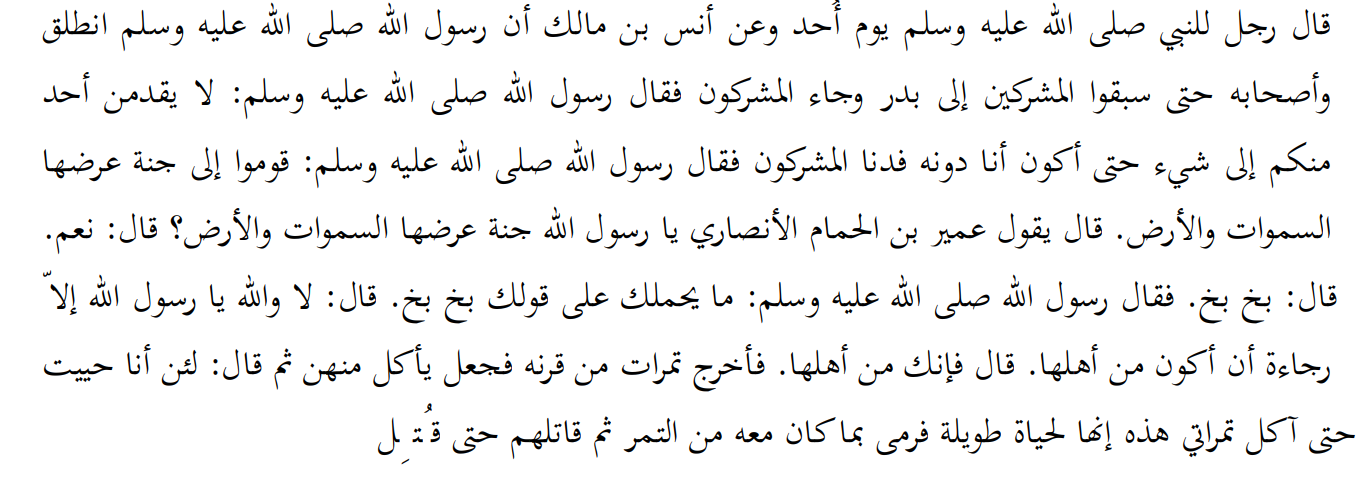
«Пусть никто из вас не выступает ни за чем без моего разрешения». Многобожники приблизились, и Посланник Аллаха ﷺ сказал: «Встаньте к Раю, ширина которого — как небеса и земля». Он сказал: Умайр ибн аль-Хаммам аль-Ансари сказал: «О Посланник Аллаха, Рай, ширина которого — как небеса и земля?» Он сказал: «Бах! Бах!» Посланник Аллаха ﷺ спросил: «Что побудило тебя произнести «Бах! Бах!»?» Он ответил: «Ничто, клянусь Аллахом, кроме надежды стать одним из его обитателей». Он сказал: «Воистину, ты один из его обитателей». Он достал финики из своего колчана и начал их есть. Затем он сказал: «Если бы я дожил до того, чтобы съесть эти финики, это была бы долгая жизнь!» Он выбросил финики, которые были у него, и сражался с ними, пока не был убит». (Передал Муслим).
“Let none of you precede to anything without my being. The polytheists came close so the Messenger of Allah (saw) said: Stand forth to a Paradise whose breadth is that of the heavens and the earth. He said: ‘Umayr bin al-Hammam al-Ansari said: O Messenger of Allah, a Paradise whose breadth is that of the heavens of the earth? He said: (Bakh! Bakh!). So the Messenger of Allah (saw) said: What carried you to your statement, (Bakh! Bakh!). He said: Nothing, by Allah, except the hope that I be one of its people. He said: Verily you are one of its people. He removed dates from his (qaran) and began eating from them. Then he said: If I were to live until I ate these dates, it would then be a long life! He threw the dates that had then fought them until he was killed” (Narrated by Muslim).
Итак, Аллах (swt) и Посланник Аллаха ﷺ засвидетельствовали Рай для шахида. Что касается жизни шахида, то она установлена явным текстом Корана. Аллах (swt) сказал:
So Allah (swt) and the Messenger of Allah (saw) have witnessed the Paradise for the shaheed. As for the life of the shaheed, it is established by the explicit text of the Qur’an. Allah (swt) said:
«Не думайте, что те, кто погиб на пути Аллаха, мертвы; напротив, они живы и получают удел у своего Господа. Они радуются тому, что даровал им Аллах из Своих милостей, и радуются благой вести о тех, кто остался позади и еще не присоединился к ним: что на них не будет страха и они не будут печалиться. Они получают радостную весть о благодеянии от Аллаха и Его милости, ведь Аллах не упускает награды верующих». [TMQ 3:169]
“Do not think that those killed in the way of Allah are dead, rather (they are) alive with sustenance before their Lord. Pleased with what Allah gave them of His favours and with good tidings for those behind them who have not met them, that there is no fear for them nor do they grieve. They have glad tidings of blessings from Allah and His favour, and verily Allah does not cause the reward of the believers to be lost” [TMQ 3:169].
Эта жизнь шахидов скрыта от нас: мы не понимаем её и не постигаем такой, какова она в вечной обители. Хотя мы не понимаем этой сокрытой жизни и не постигаем её, мы всё же верим в её существование, но не понимаем её реальности. Наша убеждённость в её существовании непреложна, поскольку она установлена определённым текстом Корана. Аллах (SWT) сказал:
This life for the shuhadaa is unseen which we do not understand nor perceive as it is in the eternal abode. Although we do not understand this hidden life nor perceive it, nevertheless we believe in its existence but do not understand its reality. Our conviction in its existence is an inevitable matter as it is established by a definite Qur’anic text. Allah (swt) said:
«И не говорите о тех, кто погиб на пути Аллаха: "Они мертвы". Нет, они живы, но вы этого не понимаете» [ТМК 2:154].
“Do not say of those killed in the way of Allah (are) ‘dead’... Rather they are alive but you do not know” [TMQ 2:154].
Жизнь шахидов относится к скрытому (неизвестному), в которое обязательно верить. Что касается достоинства шахидов, то оно велико и не имеет равных, и Пророк ﷺ разъяснил это во множестве хадисов. Аль-Бухари передал со слов Katады, который сказал: я слышал от Анаса ибн Малика (да будет доволен им Аллах), что Пророк ﷺ сказал:
The life of the shuhadaa is from the unseen (matters) in which iman is obliged. As for the virtue of the shuhadaa, it is a great virtue without an equivalent and he (saw) clarified it in numerous ahadith. Al-Bukhari narrated from Qatadah who said: I heard Anas bin Malik (ra) from the Prophet (saw) who said:
«Никто из входящих в Рай не пожелал бы вернуться в этот мир, чтобы обрести всё, что есть на земле, кроме шахидов, которые желали бы вернуться в этот мир, чтобы быть убитыми десять раз из-за той чести (карамы), которую они видят».
“No one who enters Paradise would like to return to the world to obtain all that is upon the world except the shuhadaa who would wish to return to the world to be killed ten times due to what he sees of the honour (karamah).”
И в «Сахихе» аль-Бухари:
And in Al-Bukhari:
«Аль-Мугира бин Шу‘ба сказал: наш Пророк ﷺ сообщил нам послание нашего Господа: тот, кто погибнет среди нас, войдёт в Рай. И Умар сказал Пророку ﷺ: «Разве наши мертвецы не в Раю, а их мертвецы в Огне?» Он ответил: «Да».»
“Al-Mughira bin Shu’bah said that our Prophet (saw) informed us of the message of our Lord that whoever is killed among us goes to Paradise and Umar said to the Prophet (saw): ‘Are not our dead in Paradise and their dead in the Fire. He said: Yes.”
И от Абдуллаха ибн ‘Амра ибн аль-‘Ааса, что Посланник Аллаха ﷺ сказал:
And from Abdullah bin ‘Amru bin al-‘Aas that the Messenger of Allah (saw) said:
«Всем грехам шахида прощаются, кроме долга» (передал Муслим).
“All the shaheed’s sins are forgiven except the debt” (narrated by Muslim).
«Всем грехам шахида прощаются, кроме долга» (передал Муслим).
“All the shaheed’s sins are forgiven except the debt” (narrated by Muslim).
«Тот, кто погиб на пути Аллаха, — все его грехи прощаются, кроме долга».
“The one killed in the way of Allah has all his sins wiped out except the debt.”
Передали аль-Бухари и Муслим от Абу Хурайры (ра), что Пророк ﷺ сказал:
And Al-Bukhari and Muslim narrated from Abu Hurairah (ra) from the Prophet (saw) who said:
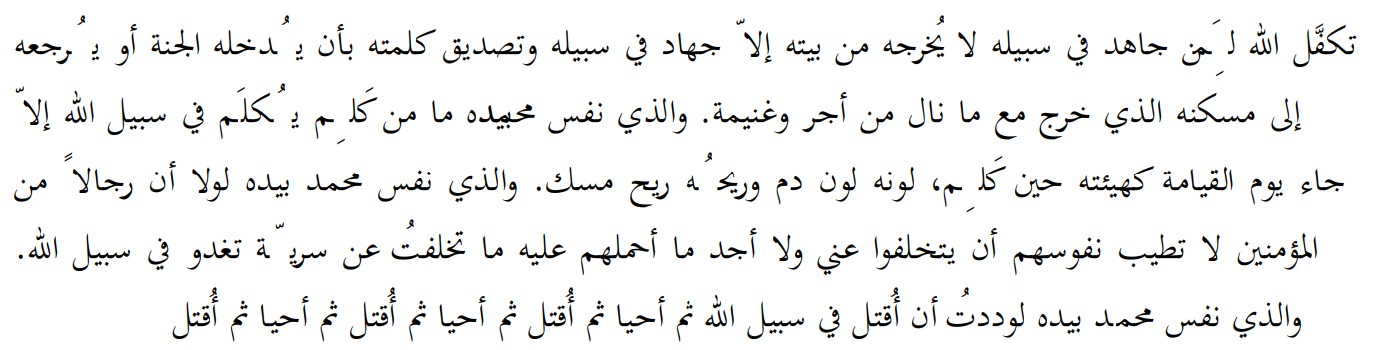
«Аллах гарантирует безопасность тому, кто погибает на пути джихада ради Него, и кто покидает свой дом по какой-либо иной причине, кроме джихада на Его пути и веры в Его слова: что Он введёт его в Рай или вернёт его в обитель, из которой он вышел, вместе с тем вознаграждением или добычей, которых он достиг. Клянусь Тем, в Чьей руке душа Мухаммада ﷺ, всякий, кто будет ранен на пути Аллаха, не предстанет в День Суда иначе, как в том виде, в котором был ранен: его цвет будет цветом крови, а запах — запахом мускуса. Клянусь Тем, в Чьей руке душа Мухаммада ﷺ, если бы не было среди верующих людей, чьи души не желают оставаться позади меня (когда я выступаю), и если бы у меня не было возможности дать им средства для передвижения, я не остался бы позади ни одного отряда, отправляющегося утром на пути Аллаха. Клянусь Тем, в Чьей руке душа Мухаммада ﷺ, я хотел бы погибнуть на пути Аллаха, затем воскреснуть, затем быть убитым, затем воскреснуть, затем быть убитым, затем воскреснуть, затем быть убитым».
“Allah guarantees security for the one who dies jihad in His way, not leaving his house for any other reason except jihad in His way and believing in His words, that He will enter him into Paradise or return him to his abode from which he left together with what he achieved of reward or booty. By the One in whose hand lies the should of Muhammad, whoever is wounded in the way of Allah will not come on the Day of Judgement except in his form when he was wounded, his colour the colour of blood and his odour the odour of musk. By the one in whose hand lies the soul of Muhammad, were it not that there were men among the believers whose souls are not pleased to stay behind me (when I go) nor do I find that could carry them upon, I would not stay behind any expedition that goes out in the way of Allah in the morning. By the One in whose hand lies the soul of Muhammad, I would love to die in the way of Allah then I am resurrected then killed, then resurrected then killed, then resurrected then killed.”