2.15 Ufunuo
2.15 The Revelation
Kila Muslim lazima aamini wahyi, kwa kuwa ni jambo la msingi katika imani. Hata hivyo, dalili ya wahyi si ya kiakili, bali hukubaliwa kwa msingi wa matini sahihi. Kwa kuwa wahyi hauna hisia wala uhalisia unaoonekana, akili haiwezi kuthibitisha usahihi wake. Kwa hiyo kila jaribio la kuthibitisha wahyi kwa njia ya akili litakuwa si sahihi, kwani haiwezekani kutumia akili kuthibitisha jambo lisilo na uhalisia unaoonekana.
Each and every Muslim must believe in revelation, as it is a fundamental aspect of belief. However, the evidence for revelation is not rational, rather it is accepted on the basis of authentic texts. Since revelation does not have a tangible sensation or reality, the mind cannot verify its validity. Therefore every attempt to prove revelation by means of the intellect will be incorrect, as it is not possible to use the mind to prove something without a tangible reality.
Kwa hiyo, kama ilivyotajwa awali, ushahidi wa wahyi si wa kiakili; bali umethibitishwa kwa misingi ya riwaya sahihi. Maandishi ya wazi ya Qur'ani yanathibitisha kwamba Mtume Muhammad ﷺ alipokea wahyi. Allah (SWT) anasema,
Hence, as mentioned earlier, the evidence for revelation is not intellectual; rather it is established on the basis of authentic narrations. The Definite text of the Qur’ān verifies that the messenger Muhammad recieved revelation. Allah says,
Vivyo hivyo, Allah, Mwenye Heshima, Mwenye hekima yote, anakufunulia wewe na wale waliokuwa kabla yako. [TMQ Shura: 3]
"Likewise Allah, the Honourable, the all-wise, reveals to you and to those before you." [TMQ Shura: 3]
Na hivyo hivyo tumekufunulia Roho kwa amri yetu. [TMQ Shura:52]
"And likewise we have revealed to you an invigorate thing by our command." [TMQ Shura:52]
"Wala yeye hasemi kwa matamanio yake. Hakika hiyo ni wahyi unaofunuliwa." [TMQ Najm: 3]
"And he doesn't utter from his own desire. Indeed it is an inspired inspiration" [TMQ Najm: 3]
Hakika, Ewe Nabii! Sisi tumekuteremshia wahyi kama tulivyomteremshia Nuhu na manabii waliokuja baada yake. [TMQ Nisa: 163]
"Undoubtedly, O prophet! We have sent revelation to you as we sent it to Noah and the prophets after him." [TMQ Nisa: 163]
"Na fuata yale yanayofunuliwa kwako, na subiri mpaka Allah autoe hukumu yake, naye ndiye mbora wa wenye kuhukumu." [TMQ 10:109]
"And follow that which is revealed to you and have patience until Allah decrees and He is the best of judges." [TMQ 10:109]
Wahyi alioteremka kwa mtume ulikuwa na hali tatu, na manabii wote waliotangulia walipokea wahyi kupitia hali hizi tu na si nyingine. Hali hizi zote zimeainishwa chini ya wahyi ambao Allah anaueleza katika Qur'ani. Yeye anasema,
The revelation that descended on the messenger had three states, all prophets before him recieved the revelation through these only and not another. These states are all categorised under the revelation which Allah explains in the Qur’ān. He says,
Haifai kwa binadamu yeyote kwamba Mwenyezi Mungu amzungumzie isipokuwa kwa wahyi, au kwamba awe nyuma ya pazia la utukufu, au kwa kutuma wajumbe na kumfunulia amtakaye. [TMQ Shura: 51]
"And it is not fit for any man that Allah should speak to him but through revelation, or that the man may be at the other side of the veil of grandeur, or by sending messengers and inspiring whom he wills." [TMQ Shura: 51]
Yaani, Mwenyezi Mungu (SWT) huwasiliana na binadamu kwa njia tatu tu: kwa wahyi, kwa kuzungumza kutokea nyuma ya pazia, au kwa kutuma mjumbe. Wahyi ulioteremshwa kwa Mtume ﷺ ulikuwa na hali mbili. Yeye ﷺ alizieleza hali hizo alipoulizwa mara moja: "Wahyi unakufikia vipi?" Akajibu,
That is, Allah only communicates with man through inspiration, through verbal contact via a veil or by sending messengers. The revelation that descended upon the messenger had two states. He informed about them when he was once asked, "How does the revelation come to you?" He replied,
Wakati mwingine huja kama mlio wa kengele au kelele za kengele, na hiyo ndiyo huwa mzito zaidi kwangu. Kisha inaponiacha, nakuwa nimeshika kila kitu. Na wakati mwingine malaika huja kwangu kwa umbo la mwanadamu, akasema nami, nami nakuwa na ufahamu wa anachosema.ﷺ [Bukhari]
"Sometimes it comes like the clattering or the jingling of a bell which is severest on me and when it leaves me, I have absorbed everything. And sometimes the angel comes to me in a form of a man and speaks to me and I am aware of what is being said." [Bukhari]
Hali hizi mbili ni kama ifuatavyo: Kwanza, malaika humfunulia nabii kwa ishara, bila kutumia maneno wala lugha. Wahyi unaingizwa katika akili ya nabii, kama alivyosema.
These two states are as follows: Firstly- the angel inspires the prophet by indication and without using words or language. The revelation is inspired into the mind of the prophet , just as he said,
Ruh Al-Quds (Jibril) alinipulizia moyoni kwamba hakuna nafsi itakayokufa hadi imekamilisha riziki yake na ajali yake. Basi mcheni Allah enyi watu, na tafuteni njia za kufanya mema. [Extraced by AlHakim]
"Ruh Al-Quds (Jibril) inspired in to me that no soul shall die until it has completed its Rizq and its Ajal. Therefore fear Allah O people and acquire the means to do good" [Extraced by AlHakim]
Na Mtume pia alipata maono kutoka kwa Mwenyezi Mungu wakati wa kuamka na wakati wa usingizi. Baadhi ya hayo yalimfunulia akiwa macho, na alikuwa na maono fulani katika ndoto zake, na yote hayo yalikuwa wahyi. Kama Mama wa Waumini, Aisha alisema,
Also the messenger whilst dreaming had visions that he received from Allah both in the states of consciousness and sleep. Some of it was inspired to him whilst he was awake and he would have certain visions in his dreams all of which were revelation. As the mother of the believers, Aisha said,
Kwanza kabisa, Mtume ﷺ alianza kuona ndoto za kweli katika usingizi wake. Kila ndoto aliyoiona ilikuwa ya kweli, wazi kama mwanga wa asubuhi.
"Firstly, the messenger began seeing true visions in his sleep. Every vision he had was true as clear as the morning."
Mtume pia alikuwa akihisi kwamba aina fulani ya wahyi ilikuwa karibu kushuka, lakini haukushuka. Aisha alisimulia kwamba Harith ibn Hashim alimwuliza Mtume ﷺ, "Ee Mtume, wahyi unakujia vipi?" Mtume ﷺ akasema,
The messenger would also feel that some form of revelation was about to come, but it didn't come. Aisha narrated that Harith ibn Hashim asked the messenger , "O messenger, how does the revelation come to you?" The messenger said,
Wakati mwingine hujia kama mlio wa kengele unaogongana, ambao ni mkali zaidi kwangu, na inaponiacha, nakuwa nimeshapokea kila kitu. [Bukhari]
"Sometimes it comes like the clattering /jingling of a bell which is severest on me and when it leaves me, I have absorbed everything." [Bukhari]
Mabadiliko haya yote, yaani ufunuo (wahy), ndoto, ufunuo bila maneno, na kila jambo linalofanana nayo, ni hali moja, na yanaingia chini ya kauli ya Allah,
All these variations i.e. inspiration, dream, revelation without talk and everything similar constitute one state and fall within the saying of Allah ,
Hakuna kitu isipokuwa wahyi [TMQ Shura: 51]
"Nothing but revelation" [TMQ Shura: 51]
Kwa sababu kiisimu, kitenzi "kufunulia mtu" kinapotumika maana yake ni kuashiria au kutikisa kichwa. Hivyo Allah humfunulia na kumtia moyo. Allah anasema,
Because linguistically when the verb "to reveal to someone" is used it means to indicate or shake ones head. Thus Allah reveals to him and inspires him. Allah says,
"Na Mola wako alimfunulia nyuki" [TMQ Nahl: 68]
"And your lord inspired the bee", [TMQ Nahl: 68]
Hivyo ndivyo ufunuo kwa nyuki ulivyo: ni ufunuo na maarifa ya kiasili yaliyo ndani ya moyo wa nyuki.
Thus the inspiration to the bee is: the inspiration and the innate knowledge within the bee’s heart.
Hali ya pili ni wahyi unaoletwa kwa njia ya mawasiliano ya kinywa kutoka kwa Malaika. Unafikishwa kwa maneno kwa Nabii ﷺ baada ya yeye kujua kwa ushahidi wa wazi kwamba huu ni wahyi, na kwamba mjumbe wa ujumbe ni Malaika, yaani Jibril. Allah (SWT) anasema,
The second state is the revelation inspired by means of oral communication from the angel. It is transmitted orally to the prophet after he learns through decisive evidence that this is revelation and the message bearer is the angel, i.e. Jibril. Allah says,
Roho aminifu ameshuka nayo. Juu ya moyo wako ili uwe mwonyaji. [TMQ Shuara: 193]
"The trusted spirit has descended with it. On your heart that you may warn." [TMQ Shuara: 193]
Kwa maneno mengine, Allah humtuma Jibril ambaye huzungumza na Mtume, ambaye kwa wakati mmoja husikia na kuhifadhi maneno yake. Aisha (RA) alisimulia kwamba Mtume ﷺ alisema,
In other words, Allah sends Jibril who speaks with the messenger who simultaneously both hears and preserves his words. Aisha narrated that the prophet said,
Wakati mwingine malaika huja kwangu kama mwanaume, na huzungumza nami, nami nakuwa na fahamu ya anachosema ﷺ. [Bukhari]
"And sometimes the angel comes to me as a man and he talks to me and I am conscious of what he is saying." [Bukhari]
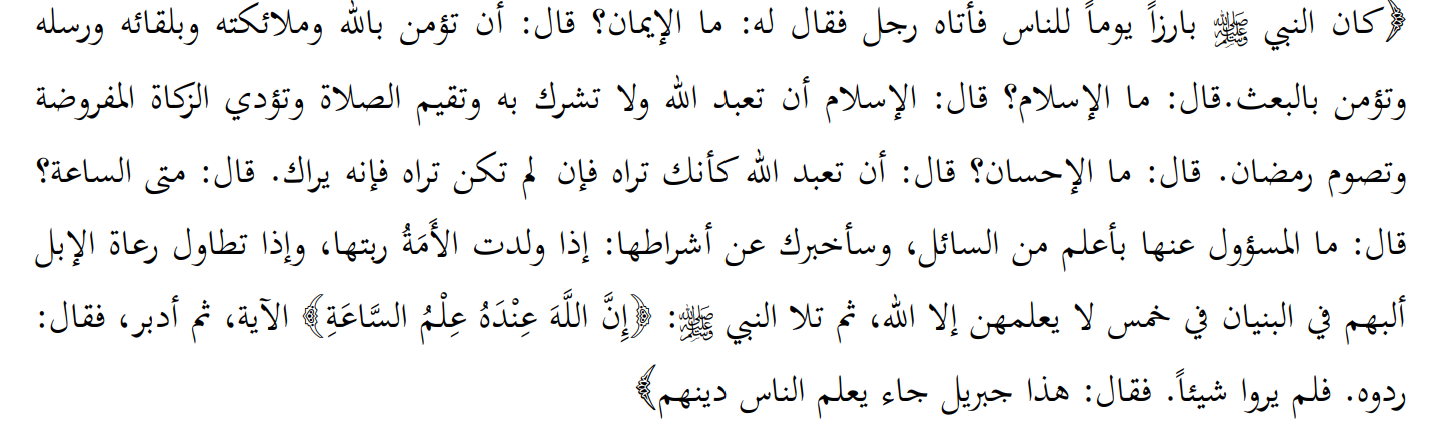
Abu Hurairah alisimulia kwamba Mtume ﷺ alikuwa pamoja na watu siku moja, mtu mmoja akaja na kumuuliza, "Iman ni nini?" Yeye ﷺ akasema, "Ni kuamini Allah, malaika Wake, kukutana Naye, Mitume Yake na Ufufuo." Akauliza, "Uislamu ni nini?" Yeye ﷺ akasema, "Uislamu ni kwamba umwabudu Allah wala usimshirikishe chochote, usimamishe Sala, utoe Zaka iliyowajibishwa, na ufunge Ramadhani." Akauliza, "Ihsaan ni nini?" Yeye ﷺ akasema, "Ni kwamba umwabudu Allah kana kwamba unamuona, na ikiwa wewe huwezi kumuona, basi bila shaka Yeye anakuona." Akauliza, "Saa itakuja lini?" Yeye ﷺ akasema, "Aliyeulizwa juu yake hana ujuzi zaidi kuliko aliyeuliza. Nitakueleza alama zake: Mama atakapozaa bwana wake, na wachungaji watakapojenga majengo marefu. Ni miongoni mwa mambo matano ambayo hakuna yeyote anayeyajua isipokuwa Allah." Kisha Mtume ﷺ akasoma Aya: {Hakika Allah ana ujuzi wa Saa.} Kisha yule mtu akageuka na kuondoka. Mtume ﷺ akawaambia Masahaba: "Mwiteni!" Lakini hawakuona chochote. Akasema, "Huyu alikuwa Jibril, alikuja kuwafundisha watu Dini yao." [Bukhari]
Abu Hurairah narrated that the prophet was with the people one day when a person came and asked him, "What is Emaan?" He said, "It is the belief in Allah , his angels, in the meeting with him , his messengers and the resurrection." He asked, "What is Islam?" He said, "Islam is that you worship Allah and do not commit Shirk, establish the prayer, pay the enjoined Zakat and you fast in Ramadan." He said, "What is Ihsaan?" He said, "That you worship Allah as if you see him, and if you can not see him, surely he sees you." He said, "When is the hour?" He said, "The one questioned about it knows no better then the questioner. I will tell you of its signs. When the mother will give birth to her Master and when the shepherd will build tall buildings. It is one of the five things that no one will know them except Allah ." Then the prophet recited the Ayat, "Indeed Allah has the knowledge of the hour." Then the man turned and left. The prophet said to the Sahaba call him but they didn't see anything. He said, "This was Jibril, he came to teach people their Deen." [Bukhari]
Kuna matukio kadhaa yaliyotajwa katika Hadith ambapo Jibril alishuka na kuzungumza na Mtume ﷺ, nao wakasikiliza. Hii ilikuwa ni aina ya wahyi kwa Mtume ﷺ, kwani malaika angemweleza maana kwa njia ya mazungumzo. Wahyi wa maneno na maana ni maalum kwa Qur'ani Tukufu. Kuhusu wahyi wa maana, Mtume ﷺ angeyaeleza haya kwa kutumia maneno yake mwenyewe, kwa matendo yake, yaani utekelezaji, au kwa kimya, na hii ndiyo Sunnah.
There are a number of incidents mentioned in Ahadith in which Jibril descended and talked to the prophet and he would listen. This was a form of revelation for the messenger, as the angel would tell the messenger the meanings in the form of a conversation. The revelation by words and meaning is restricted to the Noble Qur’ān. As for revelation by meaning, the messenger would express this by using his own words, through application i.e. his actions, or by silence and this is the Sunnah.
Hadith Qudsi inachukuliwa kuwa ni Sunnah kwa sababu ingawa maana yake imeteremshwa kutoka kwa Mwenyezi Mungu, maneno yake ni ya Mtume ﷺ. Maneno ya Hadith Qudsi si ya Mwenyezi Mungu kwa kuwa maneno yanayotoka kwa Mwenyezi Mungu ni mahsusi kwa Qur'ani, na hili linathibitishwa na kutoweza kwake kuigwa. Ingawa Sunnah huja kwa namna ya wahyi, ndoto, na kutiwa moyoni moja kwa moja, pia huja wakati wa kuwa macho na kama mazungumzo baina ya Jibril na Mtume ﷺ.
The Hadith Qudsi is regarded as Sunnah because although its meaning is revealed from Allah its words are from the prophet . The words of the Hadith Qudsi are not from Allah because the words that are from Allah are specifically for the Qur’ān and this is proven by its inimitability. Although the Sunnah comes in the forms of inspiration, dream and is cast directly in the heart, it also comes both in wakefulness and as a dialogue between Jibril and the messenger .
Qur'ani haikuteremshwa isipokuwa kupitia kwa Mtume kwa sababu maneno yake yanatoka kwa Allah. Kuna aya nyingi zinazoeleza ufunuo wa Qur'ani. Allah (SWT) anasema,
The Qur’ān is only revealed through the messenger because its words are from Allah . There are numerous ayats detailing the revelation of the Qur’ān. Allah says,
Na tumekuteremshia Qur'ani kwa lugha ya Kiarabu. [TMQ Shura:7]
"And we have revealed the Quran to you in Arabic" [TMQ Shura:7]
Na yale Tuliyokufunulia (Ewe Muhammad ﷺ) katika Kitabu, ndiyo haki (kabisa). [TMQ Fatir: 31]
" And what We have revealed to you (O Muhammad [saw]) of the Book, it is the (very) truth " [TMQ Fatir: 31]
Kitabu kinachorejelewa ni Qur'ani, na "min" hapa ni kuonyesha uwakilishi.
The book referred to is the Qur’ān and “min” here is to indicate representation.
"Qur'ani hii imefunuliwa kwangu ili nikuonyeni kwayo na yeyote itakayemfikia." [TMQ An’aam: 6]
“This Qur'ân has been revealed to me that I may therewith warn you and whomsoever it may reach " [TMQ An’aam: 6]
Tunakusimulia (Muhammad ﷺ) habari bora kabisa kupitia Wahyi Wetu kwako, Qur'ani hii. [TMQ Yoosuf: 3]
" We relate to you (Muhammad [sal-Allâhu 'alayhi wa sallam]) the best of stories through Our Revelations to you, of this Qur'ân" [TMQ Yoosuf: 3]
Na soma unachofunuliwa (ee Muhammad ﷺ) katika Kitabu (Qur'ani) cha Mola wako Mlezi. Hakuna awezaye kubadilisha Maneno Yake. [TMQ alKahf: 27]
" And recite what has been revealed to you (O Muhammad PBUH) of the Book (the Qur'ân) of your Lord. None can change His Words, " [TMQ alKahf: 27]
Ni Qur'ani. Kuna aya nyingine pia, zinazotaja ufunuo kwa ujumla, ikiwemo Sunnah. Kwa mfano, Allah anasema,
It is the Qur’ān. There are other ayats as well, which mention the revelation in general including the Sunnah. For example, Allah says,
"Iwapo nitaendelea kuongozwa, ni kwa sababu ya Wahyi wa Mola wangu kwangu." [TMQ As-saba: 50]
" If I remain guided, it is because of the Revelation of my Lord to me” [TMQ As-saba: 50]
Na Yeye anasema,
And He says,
Hakika, Sisi tumekuteremshia Wahyi (Ewe Muhammad ﷺ), kama tulivyomteremshia Wahyi Nuhu (Nuhu) na Manabii waliokuja baada yake. [TMQ Nisa: 163]
" Verily, We have sent the Revelation to you (O Muhammad [saw]) as We sent the Revelation to Nûh (Noah) and the Prophets after him" [TMQ Nisa: 163]
Na Yeye anasema,
And He says,
Na fuata yale yanayokufunulia kutoka kwa Mola wako. Hakika Allah ni Mjuzi wa yale mnayoyafanya. [TMQ Ahzaab: 2]
"And follow that which is revealed to you from your Lord. Verily, Allâh is Well-Acquainted with what you do" [TMQ Ahzaab: 2]
Hizi hali mbili zilizotajwa zimejadiliwa katika matini, na hali ya tatu imetajwa katika kauli Yake,
These two mentioned states have been discussed in the texts, The third state is mentioned in His saying,
Au kutoka nyuma ya pazia” [TMQ Shura: 51]
"Or from behind a veil” [TMQ Shura: 51]
Hiki ndicho kilichotokea kwa Musa. Aya hii inaashiria tukio ambalo Allah alizungumza na Musa kutoka nyuma ya pazia. Yaani, kama vile mtu aliye nyuma ya pazia anavyozungumza na baadhi ya watu wenye hadhi na watu mashuhuri. Anazungumza kutoka nyuma ya pazia, na ingawa mtu husikia sauti ya mwenzake, hamwoni. Hivi ndivyo Allah alivyozungumza na Musa.
This is what happened with Musa . This Ayat is indicating to the incident in which Allah spoke to Musa from behind a veil. That is, just as the veiled person speaks with some dignitaries and with people of distinction. He speaks from behind a veil and although one hears the other person’s voice, he does not see him. This is the manner in which Allah spoke with Musa .
Tukio kama hili lilitokea mara moja tu kwa Nabii ﷺ wakati wa Isra' na Mi'raj, ambalo halikutajwa tu katika Hadith sahihi, bali pia limeashiriwa katika Surat al-Najm. Allah (SWT) anasema,
Such an incident only occurred once with the prophet during the al-Isra wal-Miraj, which has not only been mentioned in an authentic Hadith, but has also been indicated by Sura al-Najm. Allah says,
Ni Wahyu tu uliofunuliwa. {Amefundishwa na mwenye nguvu nyingi [Jibril].} {Mwenye umbo kamili na akili timamu. Kisha yeye (Jibril) akasimama imara.} {Alipokuwa katika upeo wa juu wa upeo wa macho, kisha akakaribia na kusogea karibu,} {Akawa umbali wa urefu wa pinde mbili au karibu zaidi. Basi (Allah) akamfunulia mja wake [Muhammad ﷺ kupitia Jibril (as)] alichomfunulia.} [TMQ Najm: 4-10]
"It is only a Revelation revealed.He has been taught (this Qur'ân) by one mighty in power [Jibril].One free from any defect in body and mind then he (Jibrîl) rose and became stable.While he [Jibrîl)] was in the highest part of the horizon, Then he [Jibrîl] approached and came closer, And was at a distance of two bows' length or (even) nearer. So (Allâh) revealed to His slave [Muhammad [saw] through Jibrîl [as]] whatever He revealed." [TMQ Najm: 4-10]
Isipokuwa tukio hili, yaani al-Isra wal-Mi'raj, wahyi ulimshukia Nabii ﷺ kwa njia ya ufunuo na kupitia mjumbe.
With the exception of this event i.e. al-Isra wal-Miraj, the revelation descended upon the prophet in the form of an inspiration and through a messenger.
Aina zote za wahyi ni ushahidi. Mawasiliano kati ya malaika na mtume, kwa kuzungumza, au kwa ishara, au kwa mazungumzo, ni wahyi ulio wazi. Ilhamu na ndoto za kweli ni wahyi ulio wazi, na Allah kusema na manabii pia ni aina ya wahyi. Wahyi huu ni hoja ya kukata shauri, kwa kuwa umepokewa katika matini sahihi kabisa na zenye maana isiyo na shaka.
All the types of revelation are forms of evidence. The communication between the angel and the messenger by talk or indication or conversation is a clear revelation. The inspiration and visions are clear revelations and Allah speaking to the prophets is also a form of revelation. This revelation is a categorical proof as it has been reported in the most authentic and definite texts of definite meaning.