21. Sera ya Vita
21. The War Policy
Siasa ya vita ni kusimamia mambo ya vita kulingana na hali ya jambo lenyewe, ili kuleta ushindi kwa Waislamu na kushindwa kwa maadui zao. Faida ya kivitendo ya haraka inaonekana wazi ndani yake. Shari'a iliruhusu ndani ya vita mambo ambayo iliyakataza nje ya vita, na ikakataza ndani ya vita mambo ambayo iliyaruhusu nje ya vita. Iliruhusu ndani yake kumdanganya adui, ilhali hilo limekatazwa nje ya vita. Kwa njia hii, ilifanya kwa siasa ya vita kanuni zinazochukuliwa kuwa mahsusi kwa vita. Miongoni mwa mambo haya ni yale yanayohusiana na kushughulika na adui. Miongoni mwa hayo kuna yanayohusiana na vitendo vya vita chenyewe, mengine yanahusiana na jeshi la Kiislamu, na mengine yanahusiana na mambo yasiyo ya haya.
War policy is taking care of the affairs of war upon the position of its matter so as to make the victory for Muslims and defeat for their enemies. The immediate practical aspect is apparent in it. The Shar’a allowed within war things it forbade in other than it, and forbade things within it that it allowed in other than it. It allowed within it lying to the enemy whereas this is forbidden in other than war. In this way, it made for the war policy rules considered specific to war. From these considerations are those related with regards to dealing with the enemy. Of these is what is related to the actions of war itself, others are related to the Islamic army and others related to other than these.
Miongoni mwa mambo yanayohusu mwenendo na adui, Uislamu umewawekea Khalifa na Waislamu kufanya na adui jambo linalofanana na lile alilowafanyia Waislamu, na kuwaruhusu kufanya na adui jambo linalofanana na lile alilowaruhusu Waislamu, hata kama ni miongoni mwa mambo yaliyoharamishwa. Allah (SWT) amesema:
Among what is related to dealing with the enemy, Islam ordained for the Khalifah and Muslims to do with the enemy similar to what the enemy did to the Muslims and permit upon the enemy similar to what the enemy allowed upon the Muslims, even if it were from the forbidden things. Allah (swt) said:
“Ikiwa mtaadhibiwa, basi adhibuni kwa mfano wa yale mliyoadhibiwa nayo. Na mkisubiri, hakika hiyo ni bora kwa wanaosubiri.” [TMQ 9:126]
“If you are punished with then punish with similar to what you were punished with. And if you are patient, it is better for the patient ones” [TMQ 9:126].
Inasemekwa kuwa sababu ya kushushwa kwa aya hii ni kwamba washirikina waliwakatakata Waislamu siku ya Uhud; walipasua matumbo yao, wakakata sehemu zao za siri na kukata ncha za pua zao. Hawakumwacha yeyote bila kumkatakata isipokuwa Handhala bin Ar-Rahib. Mtume wa Allah ﷺ alisimama juu ya Hamza ambaye alikuwa amekatakatwa, na alikuwa katika hali mbaya ya kutisha kwa sababu tumbo lake lilikuwa limepasuliwa na pua yake ilikuwa imekatwa, basi akasema:
It is narrated that the cause for the revelation of this ayah is that the polytheists mutilated Muslims on the day of Uhud; they slit open their stomachs, cut their private parts and slit the tips of their noses. They did not leave anyone without mutilating him except Handhala bin Ar-Rahib. The Messenger of Allah (saw) stood over Hamza who had been mutilated, and he was an evil sight as his stomach had been split and his nose cut so he said:
"Naapa kwa Yule anayeapwa kwa jina Lake, kama Mwenyezi Mungu (SWT) akinipa ushindi juu yao, nitawakatilia viungo sabini badala yenu."
“By the One who is sworn by, if Allah grants me victory over them I will mutilate seventy in your place”
Aya hii ilifunuliwa wakati wa vita. Ingawa inakataza kupindukia katika kukatakata viungo, bado inaruhusu waziwazi Waislamu kufanya jambo linalofanana na lile lililofanywa kwao na makafiri. Hata inaeleweka kutoka kwenye aya hii kwamba inaruhusiwa kukatakata maiti za makafiri waliokatakata maiti za Waislamu, isipokuwa kwamba hawapaswi kupindukia katika ukatakataji kuliko walivyofanya wao, ingawa ukatakataji wa viungo ni haramu, na kumekuja habari kuhusu hilo. Hata hivyo, Waislamu wanaweza kulifanya iwapo makafiri wamewakatakata maiti za Waislamu. Sawa na hili ni hila na kuvunja mkataba: iwapo adui atafanya hivyo, au kuna hofu kwamba atafanya hivyo, basi inaruhusiwa kwetu kufanya hivyo pia. Vinginevyo, si halali kwetu kufanya hivyo. Inaruhusiwa kwetu kufanya hivi ingawa kuna makatazo kuhusu hilo kulingana na sera za vita, kwa kuwa katazo hilo linatumika tu pale ambapo adui hajalifanya. Iwapo wao wamelifanya, basi inaruhusiwa kwa Waislamu kulifanya. Allah (SWT) amesema:
So this ayah was revealed. The ayat was revealed in war, and even though it prohibits excess in mutilation nevertheless it is explicit in allowing Muslims to do similar to what the disbelievers did to them. It is even understood from the ayah the permissibility of mutilated those killed among the disbelievers who mutilated those killed among the Muslims, except that it is not exceeded in mutilation what they did although mutilation is haram and there came news regarding that. However, the Muslims can do it if disbelievers mutilated those killed among the Muslims. Similar to this is deceit and breaking the covenant if the enemy does that or it is feared from him that he will do it, then it is allowed for us to do it. Otherwise it is not allowed for us to do it. It is allowed for us to do this even though there are prohibitions about it according to the war policy since its prohibition is only where the enemy has not done it. If they do it, it is allowed for Muslims to do it. Allah (swt) said:
"Na ukihofia khiyana kutoka kwa watu, basi watupie (ahadi yao) kwa usawa (ala siwa)" [TMQ 8:58].
“If you fear treachery from a people, then throw it against them equally (ala siwa)” [TMQ 8:58].
Kwa hiyo, inaruhusiwa kwa Waislamu kutumia silaha za nyuklia katika vita vyao dhidi ya adui, hata kama hii ilitokea kabla adui hajazitumia dhidi yao (Waislamu), kwa kuwa mataifa yote yanaruhusu matumizi ya silaha za nyuklia vitani. Kwa hiyo, inaruhusiwa kuzitumia ingawa ni haramu kutumia silaha za nyuklia kwa sababu zinaangamiza ubinadamu, ilhali jihadi ni kuufufua ubinadamu kwa Uislamu, na si kuuangamiza ubinadamu.
Accordingly it is allowed for Muslims to use nuclear weapons in their war with the enemy, even if this was before the enemy used them against them (Muslims) as all States permit the use of nuclear weapons in war. So it is allowed to use them although it is forbidden to use nuclear weapons since they destroy humanity whereas jihad is to revive humanity with Islam and not to exterminate humanity.
Miongoni mwa mambo yanayohusu vitendo vya vita ni kwamba Waislamu wanaweza kuchoma miti ya makafiri, chakula chao, mashamba yao, na nyumba zao, na kuviharibu. Allah (SWT) amesema:
Of what is related to actions of war is that Muslims can burn the trees of disbelievers, their food, farms, and homes and destroy them. Allah (swt) said:
Hukukata mtende wowote (leena) wala kuuacha ukiwa juu ya mizizi yake isipokuwa kwa idhini ya Allah na ili awatweze wakaidi.
“You did not cut any palm-tree (leena) or leave it standing upon its roots except by the permission of Allah and in order to disgrace the transgressors”
Mtume wa Allah ﷺ alikata miti ya mitende pamoja na kutambua kwamba hilo lingefasiriwa dhidi yake. Kuhusu yale yaliyosimuliwa na Yahya bin Said Al-Ansar, kwamba Abu Bakr As-Siddiq (ra) alimwambia kiongozi wa jeshi aliyemtuma Sham:
The Messenger of Allah (saw) did burn the palm-trees together with his realization that it would be interpreted against him. As for what is narrated by Yahya bin Said Al-Ansar that Abu Bakr As-Siddiq (ra) said to the army leader he sent to Sham:
"Msikate mishipa ya miguu ya kondoo wala ngamia isipokuwa kwa ajili ya chakula, wala msichome moto miti ya mitende, wala msiifurikishe maji."
“Do not hamstring sheep or camels except for food nor burn palm-trees or flood them”
Wasahaba wote walikubaliana juu ya jambo hili bila mtu yeyote kulipinga: msingi katika vita ni kutoharibu makazi wala kukata miti. Hata hivyo, ikiwa Khalifah au kiongozi wa jeshi anaona kwamba kushinda vita kunamlazimu kuharibu makazi au kukata miti, au kwamba kuharakisha kupata ushindi kunahitaji jambo hili, basi kwa mujibu wa sera ya vita inaruhusiwa kukata miti na kuharibu makazi, kama alivyofanya Mtume wa Allah ﷺ. Kwa namna hiyo hiyo ni kuua na kuchoma mifugo, na kila kitu alichonacho adui; ikiwa sera ya vita inahitaji hivyo, basi anaweza kufanya hivyo hata kama ilikuwa imekatazwa. Allah (SWT) amesema:
Upon which all the Sahabah consented without any one disputing this, this is the origin in war which is not spoiling habitation or cutting trees. However, if the Khalifah or army leader views that gaining the battle necessitates him destroying habitation or cutting trees, or hastening to gain the battle requires this, then it is allowed in war policy to cut trees and destroy habitation as did the Messenger of Allah (saw). Similar to this is killing and burning cattle, and all that the enemy possesses; if the war policy requires this, then he may do it even if it was forbidden. Allah (swt) said:
Wala hawakanyagi nyayo yoyote inayowakasirisha makafiri, wala hawapati (nala) chochote kutoka kwa adui isipokuwa kwamba tendo jema linaandikwa kwa ajili yao. [TMQ 9:120]
“Nor do they tread any foot-print which angers the disbelievers or acquire/obtain (nala) anything from the enemy except that a good deed is written fro them” [TMQ 9:120].
Hotuba hii ni ya jumla katika kila kitu, na hakuna ushahidi mwingine wowote utakaofunga au kubainisha aya hii kwa maana yake, iwe ni aya nyingine au hadithi, kwa hiyo inabaki katika ujumla wake. Zimekuja hadithi sahihi zilizothibitishwa kuhusu kuruhusiwa kuchoma nyumba, na kuchoma na kukata miti. Imesimuliwa kutoka kwa Ibn Umar:
This speech is general in everything and there is no other evidence what would bind or specify this ayah in its essence, whether any other ayah or hadith, so it remains in its generality. There came authenticated ahadith about the permissibility of burning houses, and burning and cutting trees. It has been narrated from ibn Umar:
Hakika Mtume wa Allah ﷺ alikata na kuchoma miti ya mitende ya Banu Nadhir.
“Verily the Messenger of Allah (saw) cut and burnt the palm-trees of Banu Nadhir.”
Hapo Hasan alisema, "Ilikuwa rahisi kwa watu mashuhuri wa Quraish kumchoma Buwaira ambaye cheche zake zilikuwa zikiruka kila upande." Na juu ya hilo aya ikateremshwa:
Upon this Hasan said It was easy for the nobles of Quraish to burn Buwaira whose sparks were flying in all directions, And upon this the ayah was revealed:
"Hamkukata mtende wowote wala hamkuuacha ukisimama juu ya mizizi yake" [TMQ 59:5].
“You did not cut any palm-tree or leave it standing upon its roots” [TMQ 59:5].
Imepokewa kutoka kwa Jarir bin Abdullah, aliyesema: Mtume wa Allah ﷺ alisema:
It is narrated from Jareer bin Abdullah who said: The Messenger of Allah (saw) said:
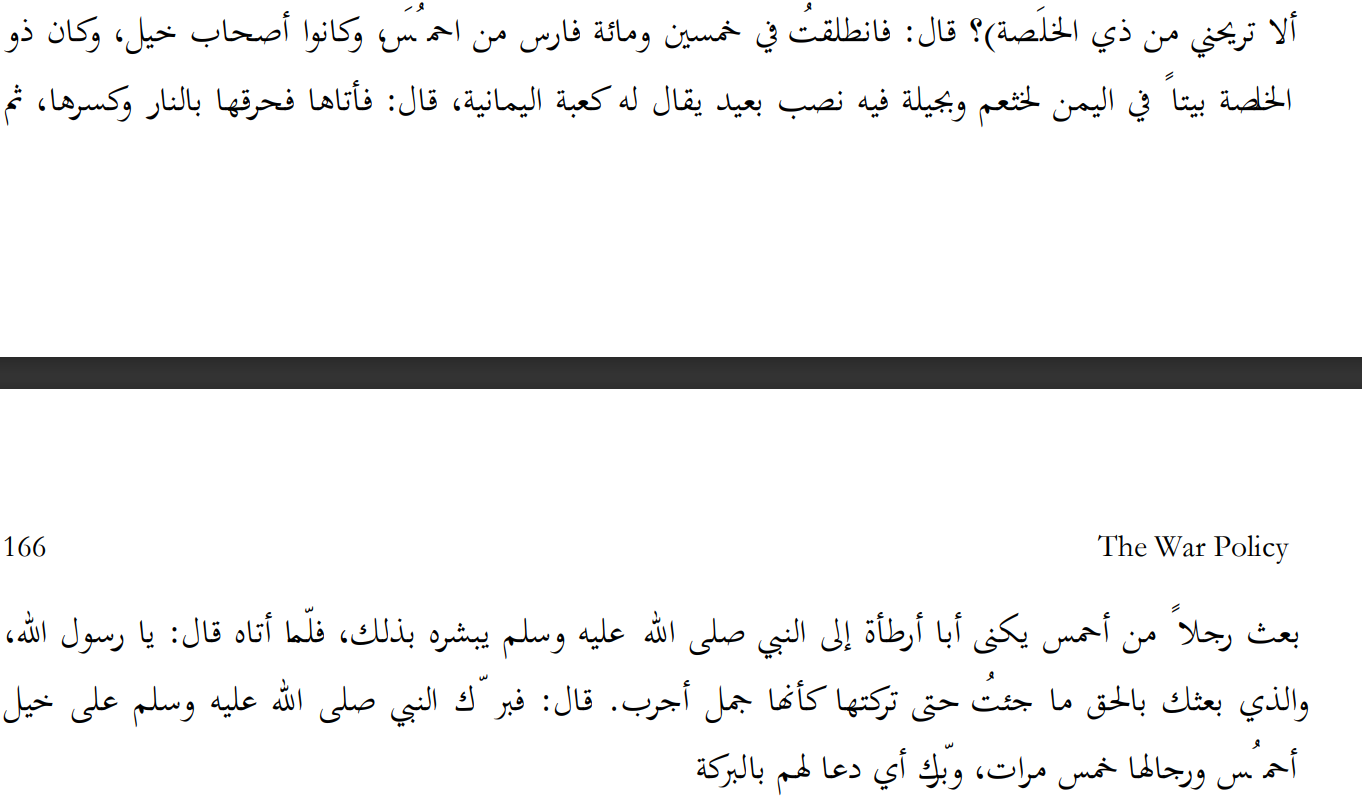
"Je, hutaniondolea mzigo wa Dhu al-Khalsa?" Akasema: Basi nilitoka pamoja na wapanda farasi mia moja na hamsini kutoka Ahnus, nao walikuwa watu wa farasi waliofungwa. Dhu al-Khalsa lilikuwa nyumba huko Yemen kwa ajili ya Khath'am na Bujayla, yenye sanamu zilizokuwa zikiabudiwa, nayo iliitwa Al-Ka'aba ya Yemen. Akasema: Basi nilifika kwake, nikaichoma kwa moto na kuiharibu. Kisha mtu mmoja kutoka Ahnus, aliyejulikana kwa jina la Abu Arta'a, alitumwa kwa Nabii ﷺ ili kumpa habari njema juu ya hili. Alipomfikia, alisema: Ewe Mjumbe wa Allah, naapa kwa Yule aliyekutuma kwa haki, sikurudi hadi nilipoliacha kama ngamia. Akasema: "Basi Nabii ﷺ aliwabariki farasi wa Ahnus na watu wao mara tano."
“Will you not grant me rest from Dhu al-Khalsa. He said: So I departed with one hundred and fifty horsemen from Ahnus, and they were people of tethered horses. Dhu al-Khalsa was a house in Yemen for Khath’am and Bujayla with idols that were worshipped, and it was called the Ka’aba of Yemen. He said: so I came to it, burnt it with fire and destroyed it. Them a man from Ahnus whose epithet was Abu Arta’a was sent to the Prophet (saw) to give him the good news about this. When he reached him, he said: O Messenger of Allah, by the One who sent you with the truth, I did not come until I had left it as if it were camels. He said: ‘So the Prophet (saw) blessed the horses of Ahnus and their men five times’”
Na "barraka" maana yake ni kuomba baraka kwao. Na Ahmad, Abu Dawud na Ibn Majah walisimulia kutoka kwa Usamah bin Zayd aliyesema:
And “barraka” means prayed for blessing for them. And Ahmad, Abu Dawud and ibn Majah narrated from Usamah bin Zayd who said:
Mtume wa Allah ﷺ alinituma kwenda mji uitwao Ibni, akasema: Fika huko kisha uuchome moto.
“The Messenger of Allah (saw) sent me to a town called Ibni and said: Reach it then burn.”
Hii Ibni ni Yubna ya Palestina. Pia inaonekana katika wasia wa Umar (ra) uliopokewa na Malik katika Al-Muwatta, na kulinganisha kwake na hadith hizi kunaonyesha kuwa kuchoma na kukata miti, pamoja na kubomoa nyumba, kunaruhusiwa pale tu vita vinapohitaji hivyo. Kwa hiyo jambo hili linaingia katika sera ya vita. Katika yanayohusu jeshi la Kiislamu ni kwamba Imamu au kiongozi wa jeshi anaweza kuwazuia wanafiki, wakiukaji, waliokimbia, wachochezi na watu wa aina yao wasiende uwanjani wa vita, kwa sababu ya kauli ya Allah (SWT):
This Ibni is the Yubna of Palestine. It also appears in the testament of Umar (ra) narrated by Malik in Al-Muwatta and its comparision with these ahadith that burning and cutting of trees, and the destruction of homes is only where the battle or war requires this. So it enters into the war policy. Of what relates to the Islamic army is that the Imam or army leader can prevent the hypocrites, transgressors, those put to flight, agitators and their like from going to the battlefield due to Allah’s statement:
lakini Allah alichukizwa na kutoka kwao, kwa hiyo akawafanya wakae nyuma, na ikasemwa (kwao): "Kaeni pamoja na wale wanaokaa (majumbani)." Lau wangalitoka pamoja nanyi, wasingewaongezea chochote isipokuwa fujo, na wangalikimbia huku na huko katikati yenu (wakieneza uharibifu) na kupanda fitina miongoni mwenu. [TMQ 9:47]
“but Allâh was averse to their being sent forth, so He made them lag behind, and it was said (to them): "Sit you among those who sit (at home Had they marched out with you, they would have added to you nothing except disorder, and they would have hurried about in your midst (spreading corruption) and sowing sedition among you” [TMQ 9:47]
Ingawa Imamu hamzuii mnafiki au mkosaji kushiriki ndani yake. Hata hivyo, iwapo sera ya vita inahitaji kuwazuia wasiende vitani au wasimamie hatua fulani, inaruhusiwa kwa Khalifa na kiongozi wa jeshi kufanya hivyo. Kuhusu mambo yasiyohusu kupambana na adui, vitendo vya vita au jeshi la Kiislamu, hili ndilo lililotokea kwa Mtume ﷺ alipokuwa akirejea kutoka vita vya Banu Mustaliq. Alirejea pamoja na Waislamu kwa haraka kubwa sana. Alikuwa akitembea usiku na mchana kwa juhudi zake zote hadi alipofika Madina. Alilichosha jeshi la Kiislamu ingawa kanuni ni kuwa wepesi kwa jeshi. Kutoka kwa Jabir, aliyesema:
Although the Imam does not prevent the hypocrite or transgressor from participating within it. However, if the war policy requires preventing them from going to battle or undertaking or supervising a specific action, it is allowed for the Khalifah and the army leader to do so. As for what is related to other than dealing with the enemy, the actions of war or the Islamic army, this is what occurred with the Messenger (saw) in his return from the battle of Banu Mustaliq. He returned with the Muslims in surpassing haste. He would walk during the night and day to his utmost effort until he reached Madinah. He exhausted the Islamic army even though the rule is being easy with the army. From Jabir who said:
Mjumbe wa Allah ﷺ alikuwa akichelewa nyuma wakati wa safari, akiwasukuma kwa upole wale dhaifu na kuwaweka nyuma yake, kisha akiwaombea du'a.
“The Messenger of Allah (saw) would lag behind in travel, gently urge the weak and put him behind him and make du’a for them”
Hata hivyo, sera ya vita iliyohusiana na kile ambacho Abdullah bin ‘Ubayy bin Salul alikuwa akikifanya cha kuchochea fitina kati ya Waislamu, Muhajirina na Ansar, ililazimu kutosafiri kwa mwendo wa mwanajeshi dhaifu zaidi wa jeshi, bali kusafiri kwa mwendo wa mwenye nguvu zaidi wao, ili kutoacha nafasi ya mjadala au ubishi.
However the war policy in relation to what Abdullah bin ‘Ubayy bin Salul was doing of creating strife between Muslims, the Muhajireen and Ansar, necessitated not travelling according to the travel of the weakest of the army but travelling the travel of their strongest so as not to leave a place for discussion or debate.
Kwa namna hii, siasa ya vita inahitaji kwamba Imamu achukue hatua zinazohitajika ili kushughulikia mambo ya vita, ili apate ushindi katika mapigano au vita na adui apate kushindwa. Hata hivyo, hili linawekewa mipaka pale ambapo hakuna dalili ya maandiko iliyokuja kuhusu kitendo fulani mahsusi; iwapo kuna maandiko mahsusi, haijuzu kufanya kitendo hicho kwa kisingizio cha siasa ya vita. Badala yake, ni wajibu kujizuia na maandiko kulingana na muktadha ambao yalikuja. Ikiwa maandiko yamekuja kwa namna ya hukumu iliyo wazi bila sababu ('illah), basi haijuzu kuchukua hatua hiyo; ikiwa maandiko yamekuja na 'illah (sababu), basi maandiko yanafuatwa kulingana na sababu hiyo. Ikiwa maandiko yamekuja na katazo, na ikaja kwamba Mtume ﷺ alilifanya katika mazingira maalum, basi hatua hiyo haiwezi kuchukuliwa isipokuwa katika mazingira hayo. Kuna maandiko kuhusu vitendo ambavyo Shari'a iliyakataza, hivyo katazo hufuatwa kulingana na yale yaliyokuja. Wala haifai kusema kuwa siasa ya vita inaruhusu jambo hilo, kwa kuwa siasa ya vita ni ya jumla, isipokuwa pale ambapo kuna maandiko yanayotoa jambo fulani nje ya ujumla huo; basi maandiko hufuatwa katika yale yaliyobainishwa nayo. Imam Ahmad amesimulia kutoka kwa Safwan bin 'Asal, aliyesema: Mtume ﷺ alitutuma katika msafara wa kivita na akasema:
In such manner the war policy requires that the Imam undertake the actions required to take care of the affairs of war so as to gain victory in the battle or war and defeat for the enemy. However, this is restricted to where no text came upon a specific action; if there exists a specific text, it is not allowed to perform this action under the pretext of war policy. Rather it is obliged that one restricts (himself) to the text according to the context in which it came. If the text came in a definite form without reason (illah), then it is not allowed to undertake the action; if the text came with an (illah) reason, then the text is followed according to the reason. If the text came with a prohibition, and it came that the Messenger (saw) did it in specific circumstances, then one cannot undertake the action except in those circumstances. There came texts about actions which the Shar’a prevented so the prevention is followed according to what came. Nor should one say the war policy (allows it) because the war policy is general except where there came a text excluding a matter for the generality so the text is followed in what is specified by it. Ahmad narrated from Safwan bin ‘Asal who said: The Messenger of Allah (saw) sent us in an expedition and said:
"Safiri kwa jina la Allah na katika njia ya Allah. Pigana na wale wasiomwamini Allah. Usiwakate viungo, usiwadanganye, wala usimuue mtoto." Al-Bukhari amesimulia kutoka kwa Ibn Umar aliyesema:
“Travel in the name of Allah and in the way of Allah. Fight those who do not believe in Allah. Do not mutilate, deceive or kill a child.” Al-Bukhari narrated from ibn Umar who said:
Al-Bukhari alisimulia kutoka kwa Ibn Umar aliyesema:
Al-Bukhari narrated from ibn Umar who said:
Mwanamke mmoja aliuawa katika moja ya vita vya Mtume wa Allah ﷺ, hivyo Mtume wa Allah ﷺ akakataza kuuawa kwa wanawake na watoto. (SWT)
“A woman was found killed in one of the battles of the Messenger of Allah (saw), so the Messenger of Allah (SAW) prohibited the killing of women and children.”
Na Ahmad alisimulia kutoka kwa Al-Aswad bin Sar'i aliyesema: Mtume wa Allah ﷺ alisema:
And Ahmad narrated from Al-Aswad bin Sar’i who said: The Messenger of Allah (saw) said:
"Kuna nini kwa watu ambao mauaji yao yamezidi hadi wakawaua watoto?" Mtu mmoja alisema: "Ee Mjumbe wa Allah ﷺ, hao ni watoto tu wa washirikina." Akasema: "Hakika bora yenu ni watoto wa washirikina."
“What is wrong with the people whose killing exceeded today until they killed children? A man said: O Messenger of Allah (saw), they are merely the children of polytheists. He said: Verily the best of you are the children of polytheists.”
Abu Dawud alisimulia kutoka kwa Anas kwamba Mtume wa Allah ﷺ alisema:
Abu Dawud narrated from Anas that the Messenger of Allah (saw) said:
"Nendeni kwa jina la Allah, kwa msaada wa Allah na kwa imani ya Mjumbe wa Allah ﷺ. Msiwaue mzee mkongwe aliye karibu kufa, mtoto wala mwanamke, na msifanye khiyana. Kusanyeni mateka yenu na muwe wacha Mungu, kwa kuwa Allah (SWT) huwapenda wacha Mungu."
“Go forth in the name of Allah, with Allah and in the creed of the Messenger of Allah. Do not kill a perishing old man, a child or a woman and do not betray. Gather together your booties and be righteous as Allah loves the righteous.”
Ahadith hizi zilikataza vitendo maalum katika vita, kwa hiyo si sahihi kwamba vifanywe katika vita kwa kisingizio cha Mjumbe wa Allah ﷺ; badala yake vinafanywa tu kwa namna maandiko yalivyokuja. Zimekuja pia maandiko yaliyoruhusu kufanya mambo haya yote kwa kutumia mizinga na mabomu, na mashambulizi yote ya mbali kwa kitu kizito, hata kama wanawake na watoto watauawa, ikiwa haiwezekani kuwafikia makafiri isipokuwa kwa kuwaua kutokana na kuchanganyika kwao nao. Al-Bukhari amesimulia kutoka kwa As-Sa'b bin Jaththama
These ahadith prohibited specific actions in war so it is not correct that they be done in war under the pretext of Messenger of Allah (saw); rather they are only done in the way the texts came. There came texts that allowed doing all these matters by shooting cannons and bombshells, and all that strikes from afar with something heavy even if women and children are killed if it is not possible to reach the disbelievers except by killing them due to their mixing with them. Al Bukhari narrated from As-S’ab bin Jithama
Alipoulizwa Mjumbe wa Allah ﷺ kuhusu watu wanaojihifadhi miongoni mwa washirikina, pamoja na wanawake na watoto wao, endapo wao watapigwa. Akasema: "Wao ni miongoni mwao."
“That the Messenger of Allah (saw) was asked about the people taking shelter among the polytheists and their women and children, if they are struck. He said: They are of them.”
Kwamba Mtume wa Allah ﷺ aliulizwa kuhusu watu wanaojihifadhi miongoni mwa washirikina, pamoja na wanawake wao na watoto wao, iwapo watapigwa. Akasema: "Wao ni miongoni mwao."
“That the Messenger of Allah (saw) was asked about the people taking shelter among the polytheists and their women and children, if they are struck. He said: They are of them.”
"Nilimuuliza Mjumbe wa Allah ﷺ kuhusu watoto wa washirikina ambao tunawaua pamoja nao. Akasema: Ndiyo, kwani wao ni miongoni mwao."
“I asked the Messenger of Allah (saw) about the children of polytheists whom we kill along with them. He said: Yes, for they are of them.”
Al-Tabarani, kutoka kwa Thawr bin Yazid
At-Tabarani extracted from Thawr bin Yazid
Kwamba Nabii ﷺ alirusha mawe kwa mjinjiniki dhidi ya watu wa Taif.
“That the Prophet (saw) hoisted a catapult upon the people of Taif.”
Wakati manjano linapofyatuliwa, halibagui kati ya wanawake, watoto, miti n.k., jambo linaloonyesha kwamba silaha nzito kama mizinga na mabomu zinapotumika vitani, basi inaruhusiwa kuua, kuharibu na kuharibu kila kitu kwa kuzitumia. Vivyo hivyo, ikiwa haiwezekani kuwafikia makafiri isipokuwa kwa kuwaua wanawake na watoto; wakipigwa kwa sababu ya kuchanganyika kwao nao, kuwaua kunaruhusiwa. Kuhusu kufanya kila moja ya mambo haya peke yake bila manjano au bila hali ya kutoweza kuwatofautisha na makafiri tunaopigana nao, kuna kauli ya kina kulingana na yaliyokuja katika matini. Kuhusu watoto, ni haramu kabisa kuwaua katika hali nyingine isipokuwa zile mbili zilizotajwa awali; hali hiyo hiyo inatumika kwa mtumwa, yaani mfanyakazi aliye miongoni mwa watu kwa shinikizo, kwani yeye ni miongoni mwa wanyonge. Hii ni kutokana na katazo la kuwaua mmoja wao kwa namna ya uhakika bila kuwa na sababu yoyote. Kuhusu wanawake, jambo hilo huangaliwa; akipigana basi inaruhusiwa kumuua, na asipopigana basi hairuhusiwi kumuua. Hili ni kulingana na yaliyosimuliwa na Ahmad na Abu Dawud kutoka kwa Rabah bin Rabi’ kwamba alikuwa pamoja na Mtume wa Allah ﷺ katika vita vilivyopiganwa na Khalid bin Walid mbele yake. Rabah na Masahaba wa Mtume wa Allah ﷺ walipita karibu na mwanamke aliyeuawa katika kile kikundi cha mbele kilichopiga. Walisimama kumtazama na wakashangazwa na uzuri wake, mpaka Mtume wa Allah ﷺ alipowakuta akiwa juu ya mnyama wake, hivyo wakampisha mahali. Mtume wa Allah ﷺ alisimama juu yake na akasema:
When the catapult is fired, it does not distinguish between women, children, trees etc which indicates that heavy weapons such as cannons and bombshells when used in war then it is allowed to kill, destroy and spoil everything by them. Similarly if it is not possible to reach the disbelievers except by killing women and children; if they are struck due to their mixing with them, killing them is allowed. As for doing each one of these matters alone without the catapult or other than the situation of not being possible to distinguish them and the disbelievers whom we are fighting, in this there is a detailed statement according to what came in the texts. As for children, it is absolutely haram to kill them in other than the two previously mentioned situations; the same applies to the slave i.e. the employee who is with a people through compulsion as he is among the weak people. This is due to the the prohibition of killing either of them in a definite way without being reasoned by any reason. As for women, it is looked into; if she fights then it is allowed to kill her and if she does not, then it is not allowed to kill her. This is according to what Ahmad and Abu Dawud narrated from Rabah bin Rabi’ that he left together with the Messenger of Allah (saw) in a battle which was fought with Khalid bin Walid at its front. Rabah and the Sahabah of the Messenger of Allah (saw) passed by a woman killed in what the front (group) had struck. They stopped to look at her and were astounded by her beauty, until the Messenger of Allah (saw) met them upon his mount so they made a place for him. The Messenger of Allah (saw) stopped over her and said:
"Huyu si mtu wa kupigana naye. Nenda ukutane na Khalid, umwambie: Usiwaue watoto wala mwajiriwa."
“This is not someone to fight. Go meet Khalid and say to him: Do not kill children or the hireling.”
Kwa hiyo hadith ilifanya sababu ya kukatazwa kumuua kwake kuwa ni kwamba yeye hapigani. Hili linaimarishwa na hadith ya Abu Dawud iliyopokewa kutoka kwa ‘Ikrimah kwamba Nabii ﷺ
So the hadith made the reason for the prohibition of killing her that she does not fight. This is strengthened by Abu Dawud narrated from ‘Ikrimah that the Prophet (saw)

“Alipita karibu na mwanamke aliyeuawa siku ya Hunain, akasema: Nani amemuua huyu? Mwanamume mmoja akasema: Mimi, ewe Mjumbe wa Allah ﷺ. Nilimchukua kama ngawira na nikamweka nyuma yangu. Alipoona kushindwa kwetu, alinyoosha mkono wake kuelekea mpini wa upanga wangu ili aniue, nami nikamuua. Mjumbe wa Allah ﷺ hakukataza hilo.”
“Passed by a woman killed on the day of Hunain and said: Who killed this one? A man said: I did, O Messenger of Allah (saw). I took her as booty and placed her behind me. When she saw defeat over us, she extended (her hand) to the hilt of my sword to kill me so I killed her. The Messenger of Allah (saw) did not prohibit (this).”
Hii inaweka wazi kwamba mwanamke akipigana, kumuua kunaruhusiwa; na asipopigana, kumuua hakuruhusiwi. Kuhusu mzee aliye karibu kufa, ikiwa anakufa bila kubaki faida yoyote kwa makafiri wala madhara kwa Waislamu, hairuhusiwi kumuua kwa sababu ya katazo la kumuua. Hata hivyo, ikiwa yuko na faida kwa makafiri au madhara kwa Waislamu, basi kumuua kunaruhusiwa. Hii ni kwa sababu ya yale aliyosimulia Ahmad na At-Tirmidhi kutoka kwa Samra kwamba Mtume ﷺ alisema:
This clarifies that when the women fights, killing her is allowed; and if she does not fight then killing her is not allowed. As for the perishing old man, if he is perishing without there remaining any benefit to the disbelievers or harm to Muslims, it is not allowed to kill him due to the prohibition of killing him. However, if there is benefit in him for the disbelievers or harm to Muslims, it is allowed to kill him. This is due to what Ahmad and At-Tirmidhi narrated from Samra that the Prophet (saw) said:
"Waueni wazee wa washirikina"
“Kill the old men of the polytheists”
Na pia kwa sababu ya kile Al-Bukhari alichosimulia kutoka kwenye hadithi ya Abu Musa kwamba Mtume ﷺ alipomaliza kutoka Hunain, alimtuma Abu Amir kuwa kiongozi wa jeshi la Awtas. Alikutana na Dureed As Sama, ambaye alikuwa na umri wa miaka mia moja na kitu, na walikuwa wamemleta ili awape mipango ya vita. Abu Amir alimuua, na Mtume ﷺ hakukataa hilo kutoka kwake. Kwa hiyo hadithi ya Anas (ra) inaeleweka kuwa ni yule mzee aliyekaribia kufa bila kuwa na faida yoyote ndani yake wala madhara yanayotoka kwake; yeye ni yule mzee anayekaribia kufa kama ilivyokuja katika hadithi hiyo hiyo. Mambo haya ambayo yamekatazwa kuyafanya hayafanywi isipokuwa kulingana na jinsi maandishi yalivyokuja nayo. Chochote kinachozidi hapo hakiruhusiwi. Hakuna kitendo kinachofanywa na Waislamu kwa adui yao asiyeamini ambacho si cha kuchukiza mradi kitendo hicho kimetokea katika hali ya vita, iwe kitendo hicho kilikuwa halali au haramu nje ya vita. Hakuna kitu kinachotengwa na hili isipokuwa kitendo ambacho kumekuja katazo la jumla dhidi yake katika vita.
And also due to what Al-Bukhari narrated from the hadith of Abu Musa that when the Prophet (saw) finished from Hunain, he sent Abu Amir over the army of Awtas. He met Dureed As Sama, and he was one hundred (years) and something, and they had brought him to plan the war for them. Abu Amir killed him and the Prophet (saw) did not reject that from him. Accordingly the hadith of Anas (ra) is taken to mean the perishing old man without being any benefit in him or harm emanating from him; he is the perishing old man as came in the same hadith. These matters for which came prohibition about performing them are not done except according to how the text came with them. Anything beyond that is not allowed. No action done by Muslims to their disbeliever enemy is repulsive as long as this action occurred in the situation of war, whether this action was allowed (halal) or forbidden (haram) outside of war. Nothing is excluded from this except the action for which there has come an absolute prohibition against it in war.