2.15 启示
2.15 The Revelation
每一位穆斯林都必须相信启示,这是信仰的基本内容之一。然而,启示的证据并非理性证明,而是依据可靠的经文而被接受。由于启示没有可感知的实体或现实形态,理智无法验证其真实性。因此,任何试图借助理智来证明启示的做法都是错误的,因为在没有可感知现实的情况下,理智不可能用来证明某件事物。
Each and every Muslim must believe in revelation, as it is a fundamental aspect of belief. However, the evidence for revelation is not rational, rather it is accepted on the basis of authentic texts. Since revelation does not have a tangible sensation or reality, the mind cannot verify its validity. Therefore every attempt to prove revelation by means of the intellect will be incorrect, as it is not possible to use the mind to prove something without a tangible reality.
因此,正如前文所述,启示的证据并非来自理性推论,而是建立在可靠的传述之上。《古兰经》的明确经文证实,使者穆罕默德ﷺ确实接受了启示。安拉说:
Hence, as mentioned earlier, the evidence for revelation is not intellectual; rather it is established on the basis of authentic narrations. The Definite text of the Qur’ān verifies that the messenger Muhammad recieved revelation. Allah says,
同样,那尊贵、睿智的真主也向你以及在你之前的众先知启示。 [TMQ Shura: 3]
"Likewise Allah, the Honourable, the all-wise, reveals to you and to those before you." [TMQ Shura: 3]
"这样,我们依照自己的命令,把一个生命之灵(al-Ruh)启示给你。" [TMQ Shura:52]
"And likewise we have revealed to you an invigorate thing by our command." [TMQ Shura:52]
“他不是凭私欲而说话。这不过是启示的默示。” [TMQ Najm: 3]
"And he doesn't utter from his own desire. Indeed it is an inspired inspiration" [TMQ Najm: 3]
"诚然,哦,先知!我们已经向你启示,正如我们曾向努哈以及在他之后的众先知启示一样。" [TMQ Nisa: 163]
"Undoubtedly, O prophet! We have sent revelation to you as we sent it to Noah and the prophets after him." [TMQ Nisa: 163]
“你要遵循那降示给你的启示,并且忍耐,直到真主作出判决。祂是最公正的裁判者。” [TMQ 10:109]
"And follow that which is revealed to you and have patience until Allah decrees and He is the best of judges." [TMQ 10:109]
使者所接受的启示有三种状态,在他之前的所有先知所接受的启示也只通过这三种方式,不会有其他方式。这些状态都归于安拉在《古兰经》中所阐述的启示之下。安拉说:
The revelation that descended on the messenger had three states, all prophets before him recieved the revelation through these only and not another. These states are all categorised under the revelation which Allah explains in the Qur’ān. He says,
"真主与人说话,不外乎三种方式:或借启示,或在幔幕之外,或派遣使者降示祂所意欲的启示。" Note: this is a faithful rendering of the Qur'anic verse (Ash-Shura 42:51), so no ﷺ is added here. [TMQ Shura: 51]
"And it is not fit for any man that Allah should speak to him but through revelation, or that the man may be at the other side of the veil of grandeur, or by sending messengers and inspiring whom he wills." [TMQ Shura: 51]
也就是说,安拉只通过三种方式与人交流:启示、隔着帷幕的言语,或派遣使者。降临到使者身上的启示有两种状态。当有人曾问他:“启示是如何降临到你身上的?”他对此作了说明,回答道:
That is, Allah only communicates with man through inspiration, through verbal contact via a veil or by sending messengers. The revelation that descended upon the messenger had two states. He informed about them when he was once asked, "How does the revelation come to you?" He replied,
有时它像铃声的叮当作响一样降临,这对我来说最为沉重;当它离开我时,我已领会了其中的一切。有时天使以人的形象来到我这里与我说话,我便明白所说的内容。 [Bukhari]
"Sometimes it comes like the clattering or the jingling of a bell which is severest on me and when it leaves me, I have absorbed everything. And sometimes the angel comes to me in a form of a man and speaks to me and I am aware of what is being said." [Bukhari]
这两种状态如下:第一,天使通过示意的方式向先知启示,不借助言语或语言。启示被灌入先知的心中,正如他所说的那样,
These two states are as follows: Firstly- the angel inspires the prophet by indication and without using words or language. The revelation is inspired into the mind of the prophet , just as he said,
“圣灵(吉卜利勒)启示我说:任何灵魂在完成其所得的给养和寿限之前,都不会死去。因此,众人啊,你们应当敬畏真主,并努力获取行善的途径。” [Extraced by AlHakim]
"Ruh Al-Quds (Jibril) inspired in to me that no soul shall die until it has completed its Rizq and its Ajal. Therefore fear Allah O people and acquire the means to do good" [Extraced by AlHakim]
同样,使者在梦中也获得了安拉赐予他的异象,无论是在清醒还是睡眠的状态中。其中一些是在他清醒时启示给他的,而他在梦中所见的某些景象也都是启示。信士们的母亲阿伊莎说道:
Also the messenger whilst dreaming had visions that he received from Allah both in the states of consciousness and sleep. Some of it was inspired to him whilst he was awake and he would have certain visions in his dreams all of which were revelation. As the mother of the believers, Aisha said,
首先,使者开始在睡梦中看到真实的异象。他所见的每一个异象都如清晨的曙光般清晰真实。ﷺ
"Firstly, the messenger began seeing true visions in his sleep. Every vision he had was true as clear as the morning."
使者ﷺ也会感觉到某种启示即将降临,但启示并没有降临。阿伊莎(愿真主喜悦她)叙述说,哈里斯·本·希沙姆(愿真主喜悦他)问使者ﷺ:"使者啊,启示是如何降临到您身上的呢?"使者ﷺ说:
The messenger would also feel that some form of revelation was about to come, but it didn't come. Aisha narrated that Harith ibn Hashim asked the messenger , "O messenger, how does the revelation come to you?" The messenger said,
有时它像铃铛的叮当声一样降临,对我来说这最为沉重;当它离开我时,我已经领悟了其中的全部内容。 [Bukhari]
"Sometimes it comes like the clattering /jingling of a bell which is severest on me and when it leaves me, I have absorbed everything." [Bukhari]
所有这些变化形式,即启示、梦境、无言语的启示以及一切类似的情形,都属于同一种状态,并且都包含在真主的这句话之中,
All these variations i.e. inspiration, dream, revelation without talk and everything similar constitute one state and fall within the saying of Allah ,
"除了启示以外别无其他" [TMQ Shura: 51]
"Nothing but revelation" [TMQ Shura: 51]
因为从语言上讲,动词"向某人启示"用来表示的是示意或摇头。因此,安拉向他启示,并给他灵感。安拉说:
Because linguistically when the verb "to reveal to someone" is used it means to indicate or shake ones head. Thus Allah reveals to him and inspires him. Allah says,
“你的主启示蜜蜂”, [TMQ Nahl: 68]
"And your lord inspired the bee", [TMQ Nahl: 68]
因此,蜜蜂所得到的启示,就是蜜蜂心中的启示与天生的知识。
Thus the inspiration to the bee is: the inspiration and the innate knowledge within the bee’s heart.
第二种状态是通过天使以口述方式传达的启示。在先知凭借确凿的证据得知这是启示、而传达信息者是天使即吉卜利勒之后,启示便口头传达给先知。安拉说:
The second state is the revelation inspired by means of oral communication from the angel. It is transmitted orally to the prophet after he learns through decisive evidence that this is revelation and the message bearer is the angel, i.e. Jibril. Allah says,
这段话出自《古兰经》(诗人章 26:193-194)。按照规则,经文内不加ﷺ。 { 忠实的灵魂将它降下, 降在你的心上,好使你成为警告者。 } [TMQ Shuara: 193]
"The trusted spirit has descended with it. On your heart that you may warn." [TMQ Shuara: 193]
换句话说,安拉派遣吉卜勒利勒天使,他与使者交谈,使者同时既聆听又保存他的话语。阿伊莎(愿安拉喜悦她)传述,先知ﷺ说:
In other words, Allah sends Jibril who speaks with the messenger who simultaneously both hears and preserves his words. Aisha narrated that the prophet said,
"有时天使会以人的形象来到我这里,他同我说话,我能听清他所说的每一句。"ﷺ [Bukhari]
"And sometimes the angel comes to me as a man and he talks to me and I am conscious of what he is saying." [Bukhari]
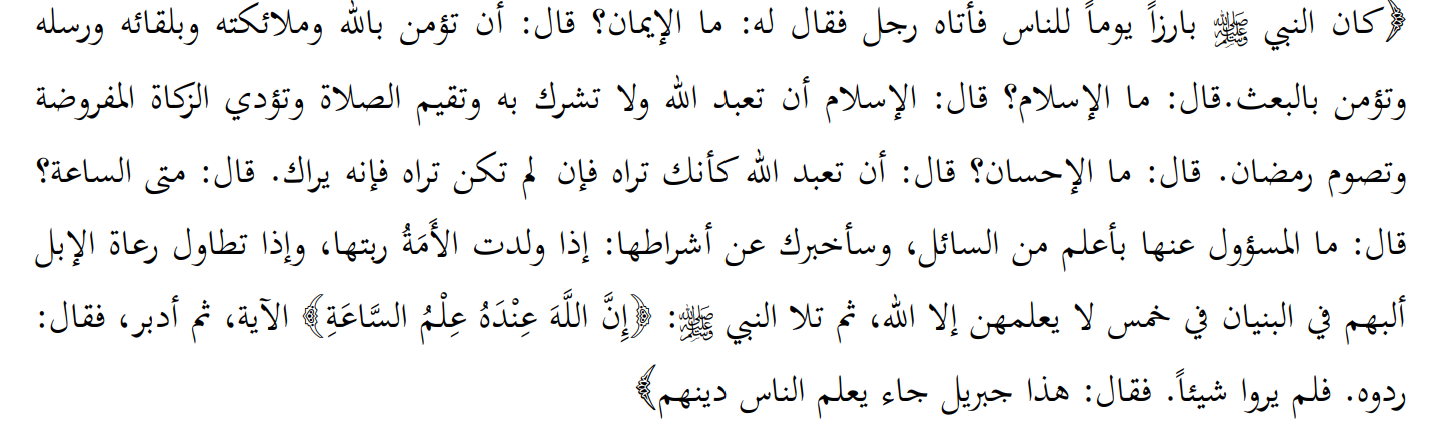
阿布·胡赖拉传述:有一天,先知ﷺ与众人同在时,一个人来问他:“什么是信仰(ima)?”他ﷺ说:“信仰是相信安拉、相信他的天使、相信与他相见、相信他的使者,以及相信复活。”那人又问:“什么是伊斯兰?”他ﷺ说:“伊斯兰是你崇拜安拉而不以任何事物与他并列为伴,谨守拜功,缴纳应缴的天课,并在莱麦丹月封斋。”那人又问:“什么是伊赫桑(ihsaan)?”他ﷺ说:“是你崇拜安拉,仿佛你看见他;如果你看不见他,那么他确实看见你。”那人又问:“审判日何时到来?”他ﷺ说:“被问的人并不比提问的人更知道此事。我将告诉你它的一些迹象:当婢女生下她的主人,当牧羊人竞相建造高楼。这是五件只有安拉才知道的事之一。”随后,先知ﷺ诵读了这节经文:“安拉那里有关于复活时刻的知识。”然后那人转身离去。先知ﷺ对圣门弟子说:“把他叫回来。”他们却没有看见任何人。先知ﷺ说:“这是哲卜拉伊勒,他来教导人们他们的宗教。” [Bukhari]
Abu Hurairah narrated that the prophet was with the people one day when a person came and asked him, "What is Emaan?" He said, "It is the belief in Allah , his angels, in the meeting with him , his messengers and the resurrection." He asked, "What is Islam?" He said, "Islam is that you worship Allah and do not commit Shirk, establish the prayer, pay the enjoined Zakat and you fast in Ramadan." He said, "What is Ihsaan?" He said, "That you worship Allah as if you see him, and if you can not see him, surely he sees you." He said, "When is the hour?" He said, "The one questioned about it knows no better then the questioner. I will tell you of its signs. When the mother will give birth to her Master and when the shepherd will build tall buildings. It is one of the five things that no one will know them except Allah ." Then the prophet recited the Ayat, "Indeed Allah has the knowledge of the hour." Then the man turned and left. The prophet said to the Sahaba call him but they didn't see anything. He said, "This was Jibril, he came to teach people their Deen." [Bukhari]
有许多圣训提到,吉卜利勒曾降临并与先知交谈,而先知则倾听。这也是对使者的一种启示形式,天使以对话的方式向使者传达其含义。以文字与含义同时启示的,仅限于高贵的《古兰经》。至于以含义启示的,使者会用自己的话语来表达,或通过实践即他的行为来表达,或以沉默来表达,而这些便是圣行(Sunnah)。
There are a number of incidents mentioned in Ahadith in which Jibril descended and talked to the prophet and he would listen. This was a form of revelation for the messenger, as the angel would tell the messenger the meanings in the form of a conversation. The revelation by words and meaning is restricted to the Noble Qur’ān. As for revelation by meaning, the messenger would express this by using his own words, through application i.e. his actions, or by silence and this is the Sunnah.
圣训Qudsi(至圣之训)被视为逊奈(Sunnah),因为其意义是由安拉启示的,但其文字出自先知ﷺ。圣训Qudsi的文字不是出自安拉,因为出自安拉的文字专属于《古兰经》,这一点由其无法模仿的特性所证明。逊奈虽然以启示、梦境以及直接投入心中的方式降临,但它也会在清醒之时降临,并表现为吉卜利勒与使者ﷺ之间的对话。
The Hadith Qudsi is regarded as Sunnah because although its meaning is revealed from Allah its words are from the prophet . The words of the Hadith Qudsi are not from Allah because the words that are from Allah are specifically for the Qur’ān and this is proven by its inimitability. Although the Sunnah comes in the forms of inspiration, dream and is cast directly in the heart, it also comes both in wakefulness and as a dialogue between Jibril and the messenger .
《古兰经》只通过使者降示,因为它的词句来自真主。《古兰经》中有许多经文详细叙述了《古兰经》的降示。真主说:
The Qur’ān is only revealed through the messenger because its words are from Allah . There are numerous ayats detailing the revelation of the Qur’ān. Allah says,
我们确已将这部《古兰经》以阿拉伯语降示给你。 [TMQ Shura:7]
"And we have revealed the Quran to you in Arabic" [TMQ Shura:7]
“以及我启示你的经典,都是真理”(使者啊,你以) Note: I've kept the original text's wording. The original has "(O Muhammad [saw])" as the addressee, which I've rendered as ﷺ after the name per the rules. Corrected translation: “我启示给你(穆罕默德ﷺ)的经典,正是真理。” [TMQ Fatir: 31]
" And what We have revealed to you (O Muhammad [saw]) of the Book, it is the (very) truth " [TMQ Fatir: 31]
这里所指的书是《古兰经》,而“min”在此表示代表性(即“从……之中”的意思,用以指明所代表的部分)。
The book referred to is the Qur’ān and “min” here is to indicate representation.
“这部《古兰经》是启示给我的,借此我可以警告你们以及所有它所能到达的人。” [TMQ An’aam: 6]
“This Qur'ân has been revealed to me that I may therewith warn you and whomsoever it may reach " [TMQ An’aam: 6]
“我们通过启示给你(穆罕默德ﷺ)的这部《古兰经》,向你讲述最美好的故事。” [TMQ Yoosuf: 3]
" We relate to you (Muhammad [sal-Allâhu 'alayhi wa sallam]) the best of stories through Our Revelations to you, of this Qur'ân" [TMQ Yoosuf: 3]
“你当诵读主的经典,那是启示你的。没有人能更改他的言辞。” [TMQ alKahf: 27]
" And recite what has been revealed to you (O Muhammad PBUH) of the Book (the Qur'ân) of your Lord. None can change His Words, " [TMQ alKahf: 27]
这是《古兰经》。还有其他经文,概括地提到了启示,包括圣训(逊奈)。例如,安拉说:
It is the Qur’ān. There are other ayats as well, which mention the revelation in general including the Sunnah. For example, Allah says,
"如果我能保持正道,那是因为我的主向我所作的启示。" [TMQ As-saba: 50]
" If I remain guided, it is because of the Revelation of my Lord to me” [TMQ As-saba: 50]
而祂说:
And He says,
"的确,我已启示你(穆罕默德ﷺ),正如我曾启示努哈(挪亚)以及他之后的众先知一样。" [TMQ Nisa: 163]
" Verily, We have sent the Revelation to you (O Muhammad [saw]) as We sent the Revelation to Nûh (Noah) and the Prophets after him" [TMQ Nisa: 163]
而祂说:
And He says,
“并当遵循主降示你的启示,安拉确是彻知你们所作为的。” [TMQ Ahzaab: 2]
"And follow that which is revealed to you from your Lord. Verily, Allâh is Well-Acquainted with what you do" [TMQ Ahzaab: 2]
这两种状态在经文中都有讨论。第三种状态见于他的话:
These two mentioned states have been discussed in the texts, The third state is mentioned in His saying,
或者隔着帷幕 [TMQ Shura: 51]
"Or from behind a veil” [TMQ Shura: 51]
这就是发生在穆萨身上的事。这节经文指的是安拉在隔着帷幕的情况下与穆萨对话的事件。正如蒙着面纱的人与一些显贵和地位尊崇的人交谈一样,他隔着帷幕说话,虽然人们能听到对方的声音,却看不见他。安拉与穆萨对话的方式正是如此。
This is what happened with Musa . This Ayat is indicating to the incident in which Allah spoke to Musa from behind a veil. That is, just as the veiled person speaks with some dignitaries and with people of distinction. He speaks from behind a veil and although one hears the other person’s voice, he does not see him. This is the manner in which Allah spoke with Musa .
这样的事件只在先知ﷺ的夜行与升天(al-Isra wal-Miraj)中发生过一次,这不仅见于可靠的圣训,也由《星辰章》(Sura al-Najm)所指示。安拉说:
Such an incident only occurred once with the prophet during the al-Isra wal-Miraj, which has not only been mentioned in an authentic Hadith, but has also been indicated by Sura al-Najm. Allah says,
"这只是一启降示的启示。他是由一位大能者[吉卜利勒]教导的。这位大能者身体与心智都无任何缺陷,然后他[吉卜利勒]站起身来,稳定而立。当他[吉卜利勒]在地平线的最高处时,接着他[吉卜利勒]靠近并逐渐接近,距离只有两张弓的长度,甚至更近。于是(安拉)借吉卜利勒[阿莱赫·赛俩姆]将祂所要降示的,启示给祂的仆人[穆罕默德ﷺ]。" [TMQ Najm: 4-10]
"It is only a Revelation revealed.He has been taught (this Qur'ân) by one mighty in power [Jibril].One free from any defect in body and mind then he (Jibrîl) rose and became stable.While he [Jibrîl)] was in the highest part of the horizon, Then he [Jibrîl] approached and came closer, And was at a distance of two bows' length or (even) nearer. So (Allâh) revealed to His slave [Muhammad [saw] through Jibrîl [as]] whatever He revealed." [TMQ Najm: 4-10]
除了这件事——即伊斯拉与米拉只——启示降临先知ﷺ时,是以默示的形式,并借由使者传达的。
With the exception of this event i.e. al-Isra wal-Miraj, the revelation descended upon the prophet in the form of an inspiration and through a messenger.
所有启示的类型都是证据。天使与使者之间通过言语、示意或对话进行的交流,是明确的启示。灵感和异象是明确的启示,安拉与众先知的对话也是启示的一种形式。这种启示是决定性的证据,因为它见于最真实、含义确定的明确经文之中。
All the types of revelation are forms of evidence. The communication between the angel and the messenger by talk or indication or conversation is a clear revelation. The inspiration and visions are clear revelations and Allah speaking to the prophets is also a form of revelation. This revelation is a categorical proof as it has been reported in the most authentic and definite texts of definite meaning.