21.6 紧急条约
21.6 Emergency Treaties
穆斯林可能陷入严重的境况,迫使他们去做原本不被允许的事情,但出于necessity(必要/迫切需要)而不得不如此。伊斯兰国可能陷入内部或外部的危机,迫使它缔结一些并不直接导向传达da’wah或在主道上作战的条约,但这些条约有助于创造条件,使未来能够传达伊斯兰教义,或防止阻止da'wah的恶果,或保全穆斯林的实体。必要性迫使缔结这类条约,因此哈里发缔结它们是被允许的,并且它们对穆斯林具有约束力。这类条约出现在两种情况下,法学家(fuqaha)已对此作了明确阐述,它们是:
Muslims can fall into severe situations which compel them to matters which are not allowed but the necessity obliges it. The Islamic State can fall into internal or external crises which compel it to contract treaties which do not lead directly to conveying the da’wah or fighting in the way of Allah (swt) but they facilitate creating conditions which will enable conveying it in the future or prevent the evil of stopping the da’wah or preserve the entity of the Muslims. Necessity compels these types of treaties to be contracted therefore it is allowed for the Khalifah to contract them and they are executed upon Muslims. These treaties occur in two situations which the jurisprudents (fuqaha) stated clearly, and they are:
第一种情况:如果交战国的一些人为了特定的年限向穆斯林寻求停战协议,条件是交战国每年缴纳特定数额的哈拉只(税赋),并且伊斯兰律法不在他们的领土上执行;这样的做法是不允许的,因为这等同于默许了kufr(不信)——除非国家无法制止压迫,并且认为这一协议对穆斯林有利,那么在此时出于necessity(需要)则允许订立。在这种情况下,伊斯兰国家不对他们提供援助或支持,因为他们并未受此协议约束遵行伊斯兰律法,当他们不遵守伊斯兰教法时,也不会因此脱离交战国的身份。因此,穆斯林没有义务为他们提供支持。先知穆罕默德ﷺ在塔布克(Tabuk),即沙姆(Bilad AsSham)边境时,与尤哈纳·本·鲁拜(Yuhanna bin Rub’ah)订立了协议。他让对方留在其辖区内,保持其宗教,而未让其进入穆斯林的旗帜与统治之下。这一有限期限的协议,使该国的安全由伊斯兰国家予以保障。穆斯林中凡进入该地者,是凭借协议的安全进入,而非凭个人的安全,且不得与其居民为敌。凡该地的居民进入穆斯林领土者,是凭借协议的安全进入,不需要协议之外的新的安全保证,穆斯林中也没有人可以对其加以阻挠。商人被允许将商品运往该国,但武器、战争物资以及类似用于战争的器械除外,因为他们仍是交战国之人,即使穆斯林与其订有协议。
The first situation: If some people of the people of war seek a treaty from the Muslims for specific years on condition that the people of war give kharaj every year for a specified amount and that the Islamic rules are not executed upon them in their lands; this is not done as it is consenting upon disbelief unless the State is not able to prevent oppression and sees in this treaty good for Muslims, then at this point it is allowed to contract it out of necessity. In this situation there is no assistance or support for them from the Islamic State because they are not compelled by this treaty with the Islamic rules and do not depart from being people of war when they do not obey the rules of Islam. So undertaking support for them is not obliged upon the Muslims. The Messenger of Allah (saw) made a treaty with Yuhanna bin Rub’ah while he was at Tabuk in the boundaries of Bilad AsSham. He left him in his zone upon his religion, and he did not enter under the banner of Muslims and their rule. This treaty of limited period makes the security of this State guaranteed by the Islamic State. Whoever enters it from the Muslims enters it with the security of the treaty and not an individual security, and it is not allowed for him to oppose its people. Whoever enters the Muslim lands from the citizens of this land enters with the security of the treaty and does not require a new security other than the treaty, nor is anyone from the Muslims allowed to oppose him. Traders are not prevented from carrying merchandise to this State except tools used in war like weapons and war materials and what is similar to this because they are people of war even if the Muslims have a treaty with them.
第二种情况:这与第一种情况相反,即穆斯林向敌人支付钱财,以换取其对穆斯林不加侵扰。法学家们提到,如果敌人围困穆斯林,并要求在特定年限内订立和约,条件是穆斯林每年向异教徒支付一定数额的钱财,那么哈里发同意此事是不正当的,因为其中包含对穆斯林的卑贱与屈辱,除非出于必要。这种情况是指穆斯林担心自身被灭绝,且哈里发认为此次停战有益。此时,由于所引述的依据,这样做并无不妥。
The second situation: This is opposite to the first situation wherein the Muslims pay money to their enemy in return for their silence regarding them. The fuqaha mentioned that if the enemy sieges the Muslims and require a treaty for specified years on condition that the Muslims pay the disbelievers a specific amount every year, it is not correct for the Khalifah to comply to them upon that due to the contemptibility and humiliation therein for Muslims except under necessity. This is (when) the Muslims fear extermination for themselves, and the Khalifah views there is good in this truce. At this point, there is no harm in that due to what was narrated
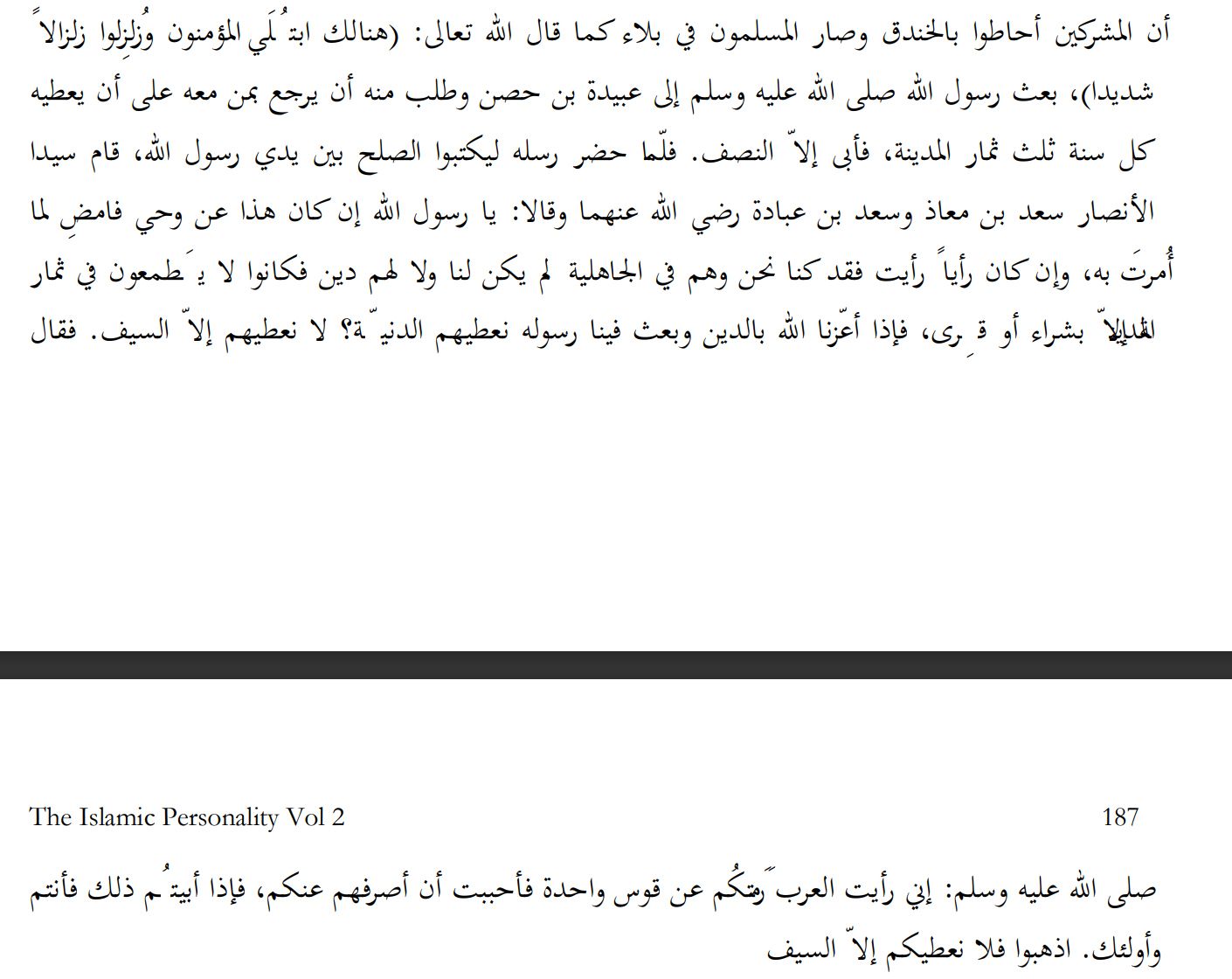
“当多神教徒包围了壕沟,穆斯林遭受考验,正如真主(subhanahu wa ta'ala)所说:{那时,信士们遭受了考验,并受到了剧烈的震撼}[TMQ 33:11]。 先知(ﷺ)派人去见欧亚奈·本·哈桑,要求他带着他的人回去,并答应给他麦地那一半的果实,但他只同意一半。当他的使者来到先知面前准备书写停战协议时,安莎尔的两位领袖萨阿德·本·欧拜德和萨阿德·本·穆阿兹(愿真主喜悦他们)站了起来,说:“真主的使者啊,如果这是来自启示的,那就执行您所奉命的事;但如果这是您经过思考的意见,那么,他们和我们在蒙昧时期时,既没有宗教,他们也只能通过购买或款待才能吃到麦地那的果实。当真主以宗教尊荣了我们,并派遣他的使者到我们中间,我们怎能把这世俗之物交给他们,使自己蒙受屈辱呢?不,我们只会给他们刀剑。”于是先知(ﷺ)说:“我看到阿拉伯人从同一张弓上射箭,所以我希望让他们转而不与你们为敌。如果你们拒绝,那么这件事就由你们和他们自己决定。你们走吧,我们只会给你们刀剑!””
“That the polytheists surrounded the trench and Muslims were in trial like Allah (swt) said: ‘Therein the believers were tested and shaken with a severe shaking’ [TMQ 33:11].The Messenger of Allah (saw) sent to ‘Uyaynah bin Hasan and requested that he return with those together with him upon giving him a third of the fruits of Madinah but he refused except a half. When his messengers appeared to write the truce in front of the Messenger of Allah, the two chiefs of the Ansar, S'aad bin ‘Ubadah and S'aad bin Mu’adh (ra) stood and they said: ‘O Messenger of Allah, if this is from revelation then execute what you are commanded with but if it is an opinion which you considered, then they and we were in jahiliyyah when neither they nor we had a religion yet they did not eat of the fruits of Madinah except through purchase or hospitality. So when Allah honoured us with the deen and sent His Messenger among us, should we give them this dunya while being contemptible? No, we will not give them except the sword. So he (saw) said: ‘I saw the Arabs shooting from one bow so I liked to divert them from you. If you reject that, then it is you and those. Go away for we will not give you except the sword!’”
这表明,真主的使者ﷺ最初由于察觉到穆斯林的软弱而倾向于停战。当他看到穆斯林因萨阿德·本·欧拜达和萨阿德·本·穆阿兹(愿真主喜悦他们)所说的话而表现出的力量时,他便放弃了这一做法。这说明,在有受害危险的情况下,与异教徒订立协议并向他们支付钱财,并无不妥。因为如果他们战胜穆斯林,就会掠走全部财产,并将家眷掳为俘虏(萨巴亚)。因此,支付一部分钱财以保护穆斯林及其家眷和财产,既不那么卑下,也更有利。
This indicates that the Messenger of Allah (saw) initially inclined to the truce due to what he sensed of the Muslims’ weakness. When he saw the strength in them due to what S'aad bin ‘Ubadah and S'aad bin Mu’adh (ra) said, he refrained from that which indicates that there is no harm from contracting a treaty with disbelievers paying them money when there is danger of harm. This is because if they conquered Muslims they would take all the wealth and the families as captives (sabaya), so paying some wealth to safeguard Muslims and their families and wealth is less contemptible and more beneficial.