20. 圣战(Jihad)
20. Jihad
“圣战”(जिहाद)是指为了真主(SWT)而在战斗中付出努力,无论是直接参战,还是以财物、见解或增加人数等方式予以协助,或其他形式。为提升真主之言的至高地位而战,即是圣战。至于在真主(SWT)之道上以言论进行的圣战,只有当言论与为真主而战直接相关时,才算圣战。若与之不直接相关,即便言论艰辛,即便其结果有益于提升真主之言的地位,也不属于沙里尔(教法)意义上的圣战。这是因为在教法中,圣战特指战斗,因此凡与战斗直接相关的事物都包括在内。写作与演说与此类似:若与为真主之道而战直接相关,例如向军队演讲以激励其直接作战,或以言辞煽动对敌人的战斗,则属于圣战;否则不属于。政治斗争和谴责统治者,都不被称为圣战,尽管其回报很大,对穆斯林的益处也很大。问题不在于艰辛与否,也不在于益处大小,而在于这一词在教法中所含的专门意义。沙里亚意义上的圣战,指的是战斗,以及与之相关的见解、言论、写作、战略等事务。
Jihad is expending (one’s) effort in fighting in the way of Allah (swt) directly or assisting by wealth or opinion or increasing numbers or other than that. The fighting to raise the word of Allah is jihad. As for jihad by speaking in the path of Allah (swt), this is jihad if the speech relates directly to fighting in the way of Allah. If it does not relate directly to it, it is not Shar’i jihad even if it involves difficulty and even if the results benefit in raising the word of Allah (swt). This is because jihad in Shar’a is specific to fighting, so there enters within it everything related directly to fighting. Similar to the opinion is writing and speaking; they are jihad if they are related directly to fighting in the way of Allah (swt) like the speech to the army to encourage it to fight directly or words inciting fighting the enemies. If not, this is not (jihad). Neither political struggle nor rebuking the rulers is termed jihad though their reward is high and their benefit to the Muslims great. The issue is neither difficulty nor the benefit, but rather it is the Shar’i meaning with which it came for this word. The Shari’ah meaning is fighting and all that it relates to from opinion, speech, writing, strategy and other things.
圣战的起因并不是吉兹亚税,尽管当他们接受吉兹亚税时我们会停止与他们作战。相反,圣战的起因在于,我们所作战的对象是拒绝了伊斯兰召唤(da’wah)的异教徒(kuffar)。安拉(SWT)说:
The cause of jihad is not jizyah even though we stop (fighting) them when they accept the jizyah. Rather, the cause of jihad is that those whom we fight are disbelievers (kuffar) who rejected the da’wah. Allah (swt) said:
“你们要与那些不信安拉、不信末日,也不禁止安拉和祂的使者所禁止之事,也不遵从真道的有经人作战,直到他们亲手缴纳人头税,并且处于卑微的地位。”{《古兰经》9:29}
Fight those who do not believe in Allah nor the Last Day, nor forbid what Allah and His Messenger have forbidden, nor follow the deen of truth among the People of the Book until they pay the jizyah from their hands while they are humiliated” [TMQ 9:29].
命令与他们作战,是因为他们具有不信的属性,也就是说,因为他们不信安拉和末日等等,所以与他们作战。因此,这一描述是一种限定,此时它就成为一个原因。所以,作战的原因是不信。另有经文也提到了这一点:
The command to fight them is (due to) their attribute of disbelief i.e. fight them because they do not believe in Allah and the Last Day etc. So this description is a restriction and at this point it becomes a cause. So the cause of fighting is disbelief. It came in another ayah:
“信道的人们啊!你们要和与你们接近的不信道者作战,愿他们在你们身上发现严厉。” [TMQ 9:123]
“O you who believe, fight those who encircle you (close to you geographically) of the disbelievers and let them find harshness in you” [TMQ 9:123]
所以,对他们作战的命令是因为其不信的属性。类似的经文还有很多,例如:
So the command to fight them is due to the attribute of disbelief. There are many similar ayat such as:
“与撒旦的盟友作战” [TMQ 4:76]
“Fight the allies of Satan” [TMQ 4:76]
和
And
“与不信道的领袖们作战” [TMQ 9:12]
“Fight the leaders of disbelief” [TMQ 9:12]
和
And
“与多神论者全面作战” [TMQ 9:36]
“Fight the polytheists altogether” [TMQ 9:36]
所有这些经文都是以一种特定的属性作为战斗的原因来命令战斗的,这一属性就是不信。至于缴纳人头税(jizyah),《古兰经》将其与卑微相结合,作为停止战斗的原因,而不是战斗的原因。由此可以理解,圣战的原因是不信。如果我们所要战斗的人接受了伊斯兰的召唤(da'wah),他们就成为穆斯林;如果他们拒绝接受伊斯兰,但接受缴纳人头税并接受伊斯兰的统治,那么这一点就会被接受,他们也不会被战斗,因为强迫他们接受伊斯兰是不被允许的。只要他们接受被伊斯兰统治并缴纳人头税,即使他们没有接受伊斯兰,也已经顺从了召唤。因此,在他们接受被伊斯兰统治并缴纳人头税之后,就不允许再与他们作战。然而,如果他们接受缴纳人头税却拒绝接受伊斯兰的统治,那么就不允许从他们那里接受这一点,因为战斗的原因依然存在,即他们是拒绝接受召唤的不信者,因此与他们作战仍然是义务,这一义务并未从穆斯林的肩上卸下。至于哈里发与他们签订的紧急条约,即哈里发接受他们缴纳的人头税,同时让他们依照不信的制度自我统治,这是由于内外环境尚不具备条件,伊斯兰律法(Shar'a)在这种紧急的必要情况下给予了让步,因此不能以此作类比推理。所以,圣战的原因就是我们所要战斗的人是拒绝接受召唤的不信者,除此之外没有其他圣战的原因。至于人头税连同卑微成为停止战斗的原因,这仅适用于非多神教的阿拉伯人。至于多神教的阿拉伯人,除了伊斯兰或战斗之外,不接受他们的任何其他选择,这是依据真主的话语:
All these ayat command the fighting due to a specific attribute which is the cause of fighting i.e. disbelief. As for the payment of jizyah, the Qur’an combined it with humiliation as the cause of stopping the fighting not the cause of fighting. From here it is understood that the cause of jihad is disbelief. If those whom we fight accept the da’wah they become Muslims; if they refuse to accept Islam (but) accept to pay the jizyah and be ruled by Islam, it is accepted from them and they are not fought as it is not permitted to force them to accept Islam. As long as they accept to be ruled by it and pay the jizyah, they have submitted to the da’wah even if they have not accepted Islam. Accordingly, it is not allowed to fight them after they accept to be ruled by it and pay the jizyah. However, if they accept to pay the jizyah but refuse to be ruled by Islam, it is not allowed to accept this from them because the cause of fighting which is that they are disbelievers who have refused to accept the da’wah remains standing so fighting them remains obligatory, an obligation which has not fallen from the Muslims’ necks. As for the emergency treaties in which the Khalifah accepts from them the jizyah while leaving them to rule themselves by the system of disbelief, due to the absence of compliance of the external and internal circumstances for it, the Shar’a gave concession to this emergency situation in the situations of necessity so no analogy is done upon it. Therefore the cause of jihad is that those whom we fight are disbelievers who refused to accept the da’wah and there is no other cause for jihad. As for jizyah together with humiliation being a cause to stop fighting, this is only with non polytheist Arabs. As for polytheist Arabs, it is not accepted from them except Islam or fighting due to Allah’s statement:
“你们将与他们作战,或者他们归信伊斯兰。”[TMQ 48:16]
“You will fight them or they will become Muslims” [TMQ 48:16].
圣战是由《古兰经》和圣训的明确经文所规定的义务。安拉(SWT)说:
Jihad is obligatory by the explicit text of the Qur’an and Hadith. Allah (swt) said:
“你们应当与他们作战,直到不再有迫害(fitnah),而宗教完全归于真主。” [TMQ 8:39]
“Fight them so that there remains no (fitnah) and the deen becomes only for Allah” [TMQ 8:39]
他(swt)说:
And He (swt) said:
“你们应当与那些不信真主、不信末日、不禁止真主和祂的使者所禁止之事、也不遵奉真理之教的有经人作战,直到他们亲手缴纳人头税,并且处于卑微的地位。” [TMQ 9: 29 ]
“Fight those who don’t believe in Allah nor the Last Day, nor forbid what Allah and His Messenger have forbidden, nor follow the deen of truth among the People of the Book until they pay the jizyah from their hands while they are humiliated” [TMQ 9: 29 ]
安拉(SWT)说:
And Allah (swt) said:
“如果你们不出征(圣战),他将以痛苦的刑罚惩罚你们” [TMQ 9: 39]
“If you do not go out (for jihad), He will punish you with a painful punishment” [TMQ 9: 39]
他(swt)说:
And He (swt) said:
“{ 信道的人们啊!你们当与你们附近的不信道者作战,让他们在你们之中觉得严厉。}”[古兰经 9:123]
“O you who believe, fight those who encircle you of the disbelievers and let them find harshness in you” [TMQ 9: 123].
据阿奈斯(ra)所传,他说:“安拉的使者(ﷺ)说:
It is narrated from Anas (ra) who said: “The Messenger of Allah (saw) said:
“你们要用财产、双手和舌头与多神教徒作战。”(由安-奈萨仪辑录)
“Fight the polytheists with your wealth, your hands and your tongues” (narrated by An-Nisai).
又据安斯传述,先知ﷺ说:
Also from Anas that the Prophet (saw) said:
“的确!清晨或傍晚出发为主道而战,胜过今世及其中的一切。”(布哈里传述)
“Verily! Setting out in the early morning or in the evening in order to fight in Allah's way is better than the world and what it contains.” (narrated by Al-Bukhari).
他还传述,他说:先知ﷺ说:
He also narrated that he (saw) said:
“我奉命与人们作战,直到他们说‘除真主外,别无应拜之主’”
“I was commanded to fight the people until they say ‘There is no god but Allah”
伊玛目艾哈迈德和艾布·达伍德转述,安斯说:安拉的使者ﷺ说:
Imam Ahmad and Abu Dawud narrated from Anas who said: The Messenger of Allah (saw) said:
“……自安拉派遣我为先知之日起,圣战将持续进行,直到我的民众中最后一人与达贾尔(敌基督)作战为止。任何暴君的暴政,以及任何公正统治者的公正,都不会使其失效。”
“…jihad will be performed continuously since the day Allah sent me as a prophet until the day the last member of my community will fight with the Dajjal (Antichrist). The tyranny of any tyrant and the justice of any just (ruler) will not invalidate it.”
据宰德·本·哈立德传述,他说:真主的使者ﷺ说:
It has been narrated from Zayd bin Khalid who said: The Messenger of Allah (saw) said:
“谁为安拉之道准备了一位战士,他便也是参战了;谁在他(战士)离去后善待其家眷,他便也是参战了。”(由艾哈迈德记录)
“Whoever prepares a warrior in the way of Allah has (also) fought, and whoever takes care of his family in goodness (khayr) after him has (also) fought” (narrated by Ahmad).
有人问道:“真主的使者啊,人中哪一种最好?”真主的使者ﷺ说:“以自己的身体和财产在真主的道路上奋斗(圣战)的信士。”(布哈里辑录)
“It was said: O Messenger of Allah, which of the people is better? The Messenger of Allah (saw) said: ‘A believer who does jihad in the way of Allah by his body and wealth” (narrated by Al-Bukhari).
他说道ﷺ:
And he (saw) said:
“谁死去时未曾参战,心中也未曾想过参战,他就是死于伪善的一个分支上。”ﷺ
“Whoever dies without fighting or his soul thinking of fighting has died upon a branch of hypocrisy.”
据阿布·奥法(愿真主喜悦他)传述:真主的使者ﷺ说:
It has been narrated from Abi Awfa (ra) that the Messenger of Allah (saw) said:
“你要知道,天堂就在刀剑的阴影之下”(布哈里传述)。
“Know that paradise is beneath the shade of swords” (narrated by Al-Bukhari).
据艾布·胡莱赖(愿安拉喜悦他)传述,他说:
It is narrated from Abu Hurayra (ra) who said:

有一位圣门弟子经过一条山谷,谷中有甘甜的溪流,他对其美景惊叹不已,便说:如果我离开众人,住在这条山谷里,会怎样呢?但在未征得安拉的使者ﷺ的许可之前,我绝不会这样做。于是他把此事告诉了安拉的使者ﷺ,使者ﷺ说:不要这样做,因为你们中一人在安拉之道上站立(征战),胜过他在家中礼拜七十年。(由提尔米迟记录)
“One of the Sahabah of the Messenger of Allah (saw) passed by a ravine with rivers of sweet water in it and was astounded by its beauty, so he said: What if I separated from the people and stayed in this ravine? But I will never do it until I seek permission from the Messenger of Allah (saw) so he mentioned that to the Messenger of Allah who said: Do not do (so) for the standing of one of you in the way of Allah is better than his praying in his house for seventy years” (narrated by At-Tirmidhi).
圣战对进攻而言是集体义务(fard kifayah),而对抵御来犯之敌而言是个人义务(fard ‘ayn),对其余人则仍是集体义务。在敌人被驱逐、伊斯兰之地从其污秽中解放出来之前,此项义务不会解除。圣战对进攻而言是集体义务,意思是即使敌人没有先与我们交战,我们也要主动与其作战。如果在任何时期没有穆斯林进行进攻性的战斗,那么他们都因放弃此项义务而有罪。如果埃及人进行了进攻性的圣战,那么印度尼西亚人的义务便随之解除,因为穆斯林已经实际地与好战的不信道者作战,圣战的义务便已得到履行。然而,如果穆斯林与不信道者之间爆发了战斗,但仅凭埃及人与不信道者作战尚不足以达成集体义务的要求,那么此项义务并不会因埃及和伊拉克人的行动而从印度和印度尼西亚人身上解除。相反,它须由最近的(穆斯林)承担,然后是距敌人次近的人,直到达成足够的人力;如果除非所有穆斯林都参与才能达成足够,那么圣战便成为所有穆斯林的义务,直至敌人被征服。若哈里发没有命令某人出征,圣战对他而言仍是集体义务;而对于哈里发命令其参战的人,圣战便因真主的启示而成为他的义务,真主说:
Jihad is an obligation of sufficiency (fard kifayah) offensively, and an individual obligation (fard ‘ayn) against the enemy who attacks them while being a obligation of sufficiency upon the rest. The obligation does not fall until the enemy is expelled and the Islamic land liberated from their filth. The meaning of jihad being an obligation of sufficiency offensively is that we start fighting the enemy even if they do not start (fighting) us. If no Muslim performs the fighting offensively at any period then they will be sinful for leaving it. If the people of Egypt perform the offensive jihad then (its obligation) falls from the people of Indonesia, as there exists practical fighting by Muslims against belligerent disbelievers therefore the obligation of jihad has occurred. However if fighting broke out between Muslims and disbelievers but the sufficiency (kifayah) has not occurred by the people of Egypt fighting the disbelievers alone, then its obligation does not fall from the people of India and Indonesia by the performance of the people of Egypt and Iraq. Rather it is obligatory upon the nearest (Muslim) then the nearest to the enemy until sufficiency occurs; if sufficiency does not occur except with all the Muslims, then jihad becomes obligatory upon all the Muslims until the enemy is subdued. Jihad is an obligation of sufficiency (fard kifayah) if the Khalifah has not told him to advance; as for the one whom the Khalifah has told him to take part, then jihad has become obligatory upon him due to Allah’s statement:
“信道的人们啊!你们怎么了?当人们对你们说:‘你们应当为真主而出征’时,你们却紧贴着地面不肯动身。”
“O you who believe, what is wrong with you that when it is said: ‘Go forth in the way of Allah’ you hold firm to the earth”
以及他的(saw)的教导: Note: per the rules, "(saw)" is an abbreviated honorific and should be replaced with ﷺ after the Prophet's mention, so the correct output is: 以及他ﷺ的教导:
And his (saw) statement:
“如果有人请你前进,那你就前进。”(布哈里与穆斯林辑录)
“And if you are asked to advance, then advance.” (Narrated by Bukhari & Muslim)
伊斯兰国中“足够性”(Kifāyah)之圣战的含义是:会出现一群人来承担圣战,他们的作战足以承担此责任。这群人可以是像欧麦尔(愿真主喜悦他)时代那样,有专门登记在册的军队名册(Dawāwīn);也可以是像艾卜·伯克尔(愿真主喜悦他)时代那样,自愿为圣战做好准备。无论是前者、后者,还是两者兼有,只要敌人来犯时他们能够保卫自身,这项责任便以足够性义务的形式落在他们身上。如果他们无力防御,哈里发就应准备其他人投入圣战,依此类推。进攻性的圣战并不意味着我们直接主动与敌人开战,而是必须先向他们传达伊斯兰的邀请。
The meaning of the sufficiency in jihad in the Islamic State is that there arise for jihad a people whose fighting is sufficient; whether they are an army for whom there are books of accounts (dawawin) for this as was the case in the time of Umar (ra), or they had prepared themselves for jihad freely as was the case in the time of Abu Bakr (ra). It is the same whether the first ones or the latter ones or both of them together such that if the enemy targets them they are able to defend so it is a obligation of sufficiency upon them. If they are unable to defend, then the Khalifah prepares others for jihad and so on. Offensive jihad does not mean that we initiate fighting the enemy directly; rather we must first call them to Islam.
不允许穆斯林与尚未接触到伊斯兰宣教(da’wah)的人作战;相反,必须先向不信者宣讲伊斯兰。如果他们拒绝,就要求他们缴纳人头税(jizyah);如果他们仍然拒绝,我们就与他们作战。穆斯林(圣训学家穆斯林)援引苏莱曼·本·布赖达的话,他从其父那里转述:
If is not allowed for Muslims to fight those whom the Islamic da’wah has not reached; rather, the disbelievers must first be called to Islam. If they reject, then they are asked to pay the jizyah; and if they reject, we fight them. Muslim narrated from Sulayman bin Buraydah from his father:
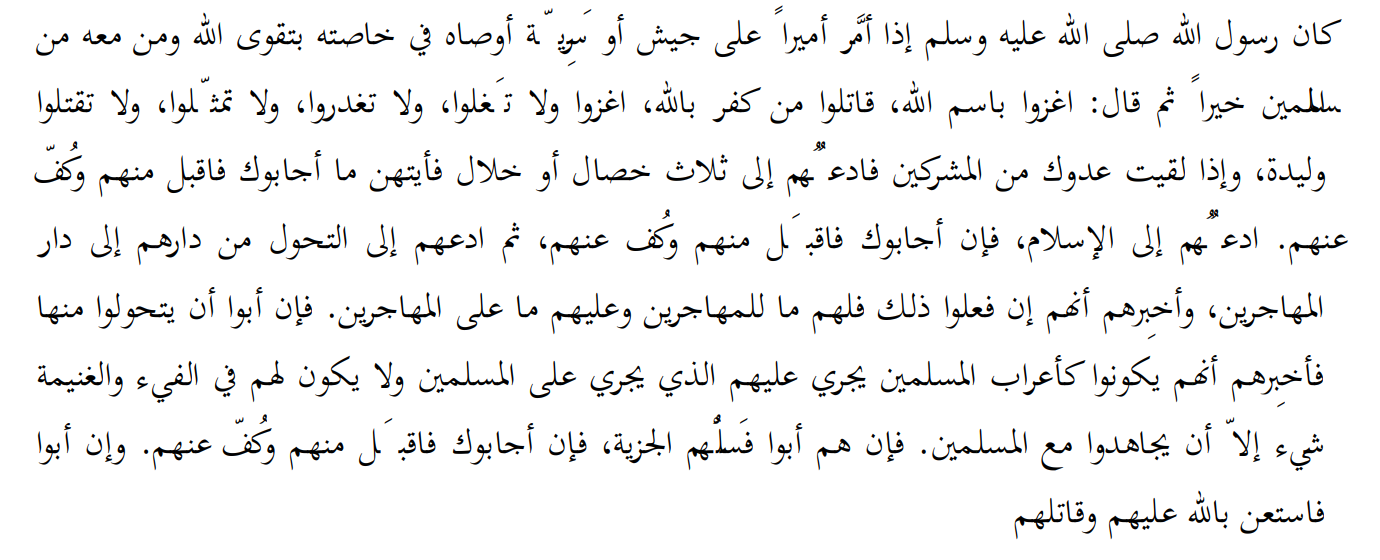
“每当先知派遣某人率领一支军队时,安拉的使者ﷺ总会特别嘱咐他敬畏安拉,并善待与他同行的穆斯林。他ﷺ说:‘奉安拉之名,为安拉之道而战。与不信安拉的人作战。作战,但不要背信弃义,不要侵吞战利品,不要残害尸体,不要杀害儿童。当你们遇到来自多神教徒中的敌人时,请他们在三件事中择一:他们回应其中任何一件,你就接受,并停止与他们作战。先邀请他们皈依伊斯兰,如果他们响应,你就接受,并停止与他们作战。然后邀请他们离开自己的土地,迁往多神教徒的土地。告诉他们,如果这样做,他们将与多神教徒享有同等的权利和义务。如果他们拒绝,就告诉他们,他们将如同穆斯林中的贝都因人(居住在沙漠中的人)一样,服从安拉对信士的同样律令。但他们将得不到法伊ʼ(Fay’)或战利品的份额,除非他们与穆斯林并肩作战。如果他们拒绝皈依伊斯兰,就要求他们缴纳人头税。如果他们这样做,你就接受,并停止与他们作战。但如果他们拒绝,那就向安拉祈求帮助以对抗他们,并与他们作战。”
“Whenever he appointed a man to lead a military detachment, the Messenger of Allah (saw) would advise him especially to fear Allah and treat the Muslims with him well. He (saw) said: ‘Fight in the Name of Allah and in the cause of Allah. Fight those how disbelieve in Allah. Fight but do not be treacherous, do not steal from the spoils of war, do not mutilate and do not kill children. When you meet your enemy from among the polytheists, call them to one of three things. Whichever of them they respond to, accept it from them and refrain from fighting them. Invite them to accept Islam, and if they respond then accept it from them and refrain from fighting them. Then invite them to leave their land and move to the land of the polytheists. Tell them that if they do that, then they will have the same rights and duties as the polytheists. If they refuse, then tell them that they will be like the Muslim Bedouins (who live in the desert), subject to the same rulings of Allah as the believers. But they will have no share of Fay’ or war spoils, unless they fight alongside the Muslims. If they refuse to enter Islam, then ask them to pay the Poll-tax. If they do that, then accept it from them and refrain from fighting them. But if they refuse, then seek the help of Allah against them and fight them”
又据伊本·阿拔斯(愿安拉喜悦他)转述:
And from ibn Abbas (ra):
“安拉的使者ﷺ从未发动战争,除非他先邀请了对方”(由艾哈迈德记录)。
“The Messenger of Allah (saw) never fought except that he invited them” (Narrated by Ahmad).
据Furwat bin Maseek所传,他说:
And from Furwat bin Maseek who said:
我问真主的使者:我是否应该与我族中向(敌人)前进的人作战,对抗那些逃跑的人?他说:是的。当我转身离开时,他叫住我说:在你邀请他们信仰伊斯兰之前,不要与他们作战。ﷺ
“I said to the Messenger of Allah, should I fight with those of my people advancing (against) those of them fleeing? He said: Yes. When I turned (to go), he called me and said: Do not fight them until you invite them to Islam.”