17. Halifelik
17. The Khilafah
Hilafet, İslam Şeriatının hükümlerini uygulamak ve İslam'ın davetini dünyaya taşımak amacıyla dünyadaki bütün Müslümanlar için genel veya kapsayıcı liderliktir. Hilafet ile İmamet aynı anlamdadır; çünkü İmamet ve Hilafet aynı mana taşır. Birçok sahih hadis bunları aynı anlamda zikretmiştir. Bu iki terimden hiçbiri, Kur'an ve Sünnet olan şer'i delillerde, diğerinden farklı bir anlamla gelmemiştir; zira bu ikisi (kaynaklar), şer'i hükümlerin tek kaynaklarıdır. Hilafet veya İmamet terimine bağlı kalmak zorunlu değildir, ancak terimin anlamına bağlı kalmak zorunludur.
The Khilafah is the general or overall leadership for all the Muslims in the world in order to establish the laws of the Islamic Shari’ah and to carry the da’wa of Islam to the world. It is the same as the Imamah, as the Imamah and Khilafah have the same meaning. Several saheeh ahadith mention them with the same meaning. Neither of the two terms has ever come with any meaning different from the other in any Shari’ah text i.e. the Qur’an or the Sunnah, as these two (sources) are the only Shari’ah sources. It is not compulsory to hold to the term of Khilafah or Imamah, but rather it is compulsory to hold to the meaning of the term.
Hilafeti kurmak, dünyanın her bölgesindeki bütün Müslümanlar üzerine farzdır. Hilafeti kurmak, Allah'ın (c.c.) Müslümanlara farz kıldığı herhangi bir farzın yerine getirilmesi gibi, içinde tercih veya müsamaha bulunmayan kaçınılmaz bir meseledir. Bunu yerine getirmekte ihmal göstermek, Allah'ın (c.c.) en ağır cezayla cezalandırdığı en büyük günahlardan biridir.
Establishing the Khilafah is an obligation upon all Muslims in all regions of the world. Establishing it, like the performing of any obligation that Allah (swt) obliged upon Muslims, is an inevitable matter without choice or leniency in it. Negligence in performing it is one of the worst sins for which Allah (swt) punishes with the strictest of the punishments.
Hilafetin tüm Müslümanların üzerinde kurulmasının delilleri (şunlardır): Kur'an, Sünnet ve Sahabe icması.
The evidence for establishing the Khilafah upon all Muslims (come from): The Qura'n, The Sunnah and Ijmaa as-Sahabah.
Kur'an'a gelince, Allah (c.c.), Elçisine (ﷺ) kendisine indirilen her şeye göre Müslümanlar arasında hükmetmesini emretmiştir ve bu emri, kesin bir biçimde kendisine (ﷺ) verilmiştir. Allah (c.c.) Peygamber'e (ﷺ) şöyle hitap etmiştir:
As for the Qura'n, Allah (swt) has ordered the Messenger (saw) to rule between Muslims by all that He (swt) revealed to him (saw), and His order (swt) to him was in a decisive manner. Allah (swt) addressed the Prophet (saw) saying:
Qur'an verse is inside braces-like quote here; the user gave it as plain text. Translate faithfully. Since it's a Qur'an verse, no ﷺ is added (and no Prophet mention needed beyond "you" addressing the Prophet, which is not a name mention). "Aralarında Allah'ın indirdiği ile hükmet ve sana gelen hakikatten ayrılarak onların boş arzularına uyma." [TMQ 5:48]
"And rule between them by that which Allah revealed to you, and do not follow their vain desires away from the truth which came to you" [TMQ 5:48]
Ve O (SWT) şöyle buyurdu:
And He (swt) said:
Ve aralarında Allah'ın sana indirdiğiyle hükmet, onların keyiflerine uyma ve Allah'ın sana indirdiklerinin bir kısmından bile seni saptırmalarına karşı sakın (dikkatli ol). [TMQ 5:49]
"And rule between them by that which Allah revealed to you and do not follow their whims, and beware (be on the alert) that they may deviate you away from even some part of what Allah revealed to you" [TMQ 5:49]
Allah'ın (SWT) Peygamber'e (ﷺ) hitap eden sözü, onu sınırlayan bir delil bulunmadıkça Ümmet'ine yönelik bir hitaptır. Bu konuda Peygamber'e (ﷺ) özgü kılan bir delil yoktur; dolayısıyla bu hitap, hükmü (hukm) uygulamak üzere tüm Müslümanlaradır. Hilafet'in kurulması, hükmün ve yönetim otoritesinin kurulmasından başka bir şey anlamına gelmez. Ayrıca Allah (SWT), Müslümanlara yöneticiler, yani yöneticiler olan idareciye itaat etmeyi farz kılmıştır; bu da yönetici otoritenin varlığının Müslümanlar için farz olduğunu gösterir. Allah (SWT) şöyle buyurmuştur:
The speech of Allah (swt) to the Prophet (saw) is a speech to his Ummah unless there is evidence which limits the speech to him (saw). In this case there is no such evidence, so the address is to all the Muslims to establish the rule (hukm). The establishment of the Khalifah does not mean other than the establishment of the rule and the authority. Moreover, Allah (swt) made it obligatory upon Muslims to obey those in authority i.e. the ruler, which indicates that the existence of the one in authority is obligatory upon Muslims. Allah (swt) said:
"Ey iman edenler! Allah'a itaat edin, Peygambere ve aranızdaki emir sahiplerine itaat edin." [TMQ 4:59]
"O you who believe obey Allah and obey the Messenger and those in authority amongst you" [TMQ 4:59]
Allah (c.c.) bir var olmayan kimseye itaati emretmez. Bu da yönetici konumundaki kişinin varlığının zorunlu olduğunu gösterir. Allah (c.c.) yöneticilere itaati emrettiğinde, aslında onların kurulmasını emretmiş olur. Yöneticinin kurulmasının sonucu, şer'i hükmün (hukm shar'i) tesisidir; onun kurulmaması ise şer'i hükmün ihmal edilmesine yol açar. Dolayısıyla onun varlığı zorunludur, çünkü onun kurulmamasının sonucu, yasaklanmış olan şeylerden, yani şer'i hükmün ihmalinden olacaktır.
Allah (swt) does not order obedience to someone who does not exist. This indicates that the existence of the person in authority is obligatory. When Allah (swt) commands obedience to those in authority then He (swt) is commanding their establishment. The result of establishing the ruler is the establishment of the Shari’ah rule (hukm shar’i) and the failure to establish it will result in neglecting the Shari’ah rule (hukm shar’i). Thus his existence is obligatory as the result of the failure to establish it is will be from the prohibited matters i.e. the neglect of the Shari’ah rule (hukm shar’i).
Sünnete gelince, Nâfi‘ rivayet etti: Abdullah bin Ömer bana, Peygamber ﷺ'in şöyle buyurduğunu duyduğunu söyledi:
As for the Sunnah, Nafi‘ reported saying: Abdullah bin ‘Umar said to me that he heard the Prophet (saw) saying:
“Kim itaatten elini çekerse, Kıyamet Günü Allah ile, kendisi için hiçbir delili olmadan karşılaşır; kim de boynunda bir biat (bey'at) olmaksızın ölürse, cahiliye ölümüyle ölmüş olur.”
“Whoever removes his hand from obedience will meet Allah on the Day of Resurrection without having any proof for him, and whoever dies without a pledge of allegiance (bay’ah) on his neck dies a death of ignorance (jahiliyyah).”
Peygamber (sav) her Müslüman'a boynunda bir bey'at bulunmasını farz kıldığını ve kim boynunda bir bey'at olmaksızın ölürse cahiliye ölümüyle öldüğünü beyan etti. Bey'at, Halife'den başkası için olamaz. Peygamber (sav), her Müslüman'a boynunda bir Halife'ye bey'at bulunmasını farz kıldı; ancak her Müslüman'a bir Halife'ye bey'at etmeyi farz kılmadı. Farz olan, yeterli şartlara sahip her Müslüman'ın boynunda bir bey'atın bulunmasıdır; yani, her Müslüman'ın boynunda ona bey'at hakkı doğuran bir Halife'nin varlığıdır. Dolayısıyla her Müslüman'ın boynuna bey'atı koyan, bizzat (şahsen) bey'at verip vermemesine bakılmaksızın Halife'nin varlığıdır. Bu nedenle Peygamber'in (sav) bu hadisi, Halife'nin atanmasının farz olduğunun delilidir; bey'atın farz olduğunun delili değildir. Çünkü Peygamber'in (sav) kınadığı şey, bir Müslüman'ın ölünceye kadar boynunda bey'at bulunmamasıdır; bey'atın yokluğunu kınamamıştır. Müslim, Ebu Hureyre'den (ra), onun da Peygamber'den (sav) şöyle dediğini rivayet etmiştir:
So the Prophet (saw) made it compulsory upon every Muslim to have a bay’ah on his neck, and described that whoever dies without a bay’ah on his neck that he dies a death of jahiliyyah. The bay’ah cannot be for anyone except the Khalifah. The Prophet (saw) made it obligatory upon every Muslim to have on his neck a bay’ah to a Khalifah, yet he did not make it an obligation upon every Muslim to give bay’ah to a Khalifah. The duty is the existence of a bay’ah on the neck of every eligible Muslim i.e. the existence of a Khalifah who accordingly deserves a bay’ah upon the neck of every Muslim. So it is the presence of the Khalifah which places a bay’ah on the neck of every Muslim, whether the Muslim actually gave a bay’ah to him (in person) or not. Therefore, this hadith of the Prophet (saw) is evidence that the appointment of the Khalifah is an obligation and not a proof that giving the bay’ah is obligatory. This is so because what was rebuked by the Prophet (saw) was the absence of a bay’ah on the neck of a Muslim until he dies, but he did not rebuke the absence of the bay’ah. Muslim narrated from Al-’Araj from Abu Hurairah (ra) from the Prophet (saw) who said:
“Dikkat edin, imam bir kalkandır; insanlar onun arkasında savaşır ve onunla kendilerini korurlar.”
“Behold, the Imam is a shield from behind whom the people fight and by whom they protect themselves.”
Müslim, Ebû Hâzim'in şöyle dediğini rivayet etmiştir:
And Muslim reported from Abu Hazim who said:
"Beş yıl boyunca Ebu Hureyre'nin yanında bulundum ve onun Peygamber ﷺ'den rivayet ederek şöyle dediğini işittim: Peygamberler İsrailoğulları'nı yönetirdi. Bir peygamber öldüğünde yerine başka bir peygamber geçerdi, fakat benden sonra peygamber yoktur. Halifeler olacak ve sayıca çok olacaklardır. Sahabeler sordular: Bize ne emredersin? Buyurdu: Onlara birer birer biat'ı yerine getirin ve haklarını verin. Şüphesiz Allah, onlara emanet ettiği şeyler hakkında onlara hesap soracaktır."
“I accompanied Abu Hurairah for five years and heard him reporting from the Prophet who said: The Prophets ruled over the children of Israel. Whenever a Prophet died another Prophet succeeded him, but there will be no Prophet after me. There will be Khulafaa and they will number many. They asked: What then do you order us? He said: Fulfil the bay’ah to them one after the other and give them their due right. Surely Allah will ask them about what He entrusted them with.”
Ve İbn ‘Abbas'tan, Peygamber ﷺ'in şöyle buyurduğu rivayet edilmiştir:
And from bin ‘Abbas from the Prophet (saw) who said:
“Kim emirinde hoşuna gitmeyen bir şey görürse sabretsin. Çünkü kim İslam'ın otoritesi olan sultandan bir karış bile ayrılır ve bu durumda ölürse, cahiliyye ölümü ölmüş olur.”
“If anyone sees in his Amir something that displeases him let him remain patient. For, behold, he who separates himself from the sultan (authority of Islam) by even so much as a hand span and dies thereupon, has died a death of jahiliyyah”.
Bu hadislerde Peygamber (sav), Müslümanların işlerini idare edecek yöneticilerden bahsetmekte ve onları bir kalkan, yani bir koruyucu olarak tanımlamaktadır. Dolayısıyla İmam'ın bir kalkan olarak tanımlanması, İmam'ın varlığının faydalarını bildiren bir haberdir ve bu nedenle bir eylem emridir. Çünkü Allah (sb) ve Peygamber (sav) tarafından bildirilen haber bir kınama içeriyorsa, bu bir yasaklama emridir; bir övgü içeriyorsa, bu bir eylem emridir. Emredilen eylem bir hükm-ü şer'i (şer'i hüküm) uygulamak için zorunluysa ya da ihmali bir şer'i hükmün ihmal edilmesine yol açıyorsa, bu emir kesin bağlayıcıdır. Bu hadislerde ayrıca Müslümanların işlerini idare edenlerin Halifeler olduğuna dair bilgi vardır ki bu, onların atanmasına dair bir emri gösterir. Yine bu hadisler, Müslümanların yönetimden ayrılmasının yasaklandığını da içermektedir; bu da Müslümanlar için kendilerine bir yönetici, yani hükümet atamanın farz olduğunu gösterir. Üstelik Peygamber (sav), Müslümanlara Halife'ye itaat etmelerini ve onun halifeliğine itiraz edenlerle savaşmalarını emretmiştir; bu da bir Halife atanmasını ve onun hilafetini, onunla çekişen kimselere karşı savaşarak korumayı emreden bir hükümdür. Müslim, Peygamber'in (sav) şöyle buyurduğunu rivayet etmiştir:
In these ahadith, the Prophet (saw) informs us that leaders will run the affairs of Muslims, and they include the description of the Khalifah as a shield i.e. a protection. So the description of the Imam as a shield is informative of the benefits of the presence of the Imam, thus it is a command for action. This is because if the information conveyed by Allah (swt) and the Prophet (saw) contained rebuke then it is a command of prohibition, and if it contained praise then it is a command for action. If the ordered action is necessary to implement a hukm shari’ (Shari’ah rule), or by its negligence a hukm shar‘i will be neglected, then this command is decisive. In these ahadith there is information also that those who run the affairs of Muslims are Khulafaa, which indicates an order to appoint them. They also include a prohibition for Muslims to separate from the authority, which indicates the obligation upon Muslims to appoint an authority for themselves i.e. ruling. Moreover, the Prophet (saw) ordered the Muslims to obey the Khalifah and to fight those who dispute his authority as Khalifah, which indicates an order to appoint a Khalifah and to protect his Khilafah by fighting against whosoever disputes with him. Muslim reported that the Prophet (saw) said:
"Kim bir imama biat edip ona elini ve kalbinin meyvesini verirse, gücü yettiği sürece ona itaat etsin; eğer başka biri gelip onunla çekişirse, o adamın boynunu vurun."
“He who pledged allegiance to an Imam giving him the clasp of his hand and the fruit of his heart shall obey him as long as he can, and if another comes to dispute with him you have to strike the neck of that man.”
Yani imama itaat etme emri, onu kurmaya yönelik bir emirdir ve imama itiraz edenlerle savaşma emri, bu emrin tek bir halifeliğin varlığını sürdürmede kesin olduğunun delilidir.
So the command to obey the Imam is an order to establish him, and the command to fight those who dispute with him is evidence that this command is decisive in maintaining the presence of one Khalifah.
Sahabe'nin (ra) icmaına gelince, hepsi Peygamber'in (sav) vefatından sonra onun yerine bir halife, yani hilafet makamına geçecek bir kişi atanmasının zorunlu olduğu konusunda birleşmişlerdir. Ayrıca her birinin ölümünün ardından, önce Ebu Bekir'in, sonra Ömer'in, sonra Osman'ın yerine bir halefin atanması konusunda da hepsi görüş birliği içinde olmuşlardır. Sahabe'nin (ra) halife tayin etme konusundaki icmaı, Peygamber'in (sav) vefatından sonra, defnini geciktirip onun yerine bir halefin atanmasıyla meşgul olmalarında açıkça ortaya çıkmıştır. Oysa ölünün defnedilmesi farzdır ve defin hazırlığıyla yükümlü olanların, defni tamamlayana kadar başka bir işle meşgul olmaları haramdır. Sahabe (ra), Peygamber'in (sav) defin hazırlığıyla meşgul olmak zorundaydı; ancak bazıları defni gerçekleştirmek yerine bir halife tayin etmeyle uğraştı, bazıları ise bu uğraşa sessiz kalarak, defni geciktirmeye, geciktirmeyi reddetme ve Peygamber'i (sav) defnetme gücüne sahip olmalarına rağmen, iki gece boyunca katıldı. Dolayısıyla bu, ölüyü defnetmek yerine bir halife atamakla meşgul olma konusunda bir icmaydı. Bu meşruiyet kazanamazdı, eğer halife atamak, ölünün defnedilmesinden daha zorunlu olmasaydı. Ayrıca bütün Sahabe (ra), hayatları boyunca bir halife atamanın vaciplik olduğu konusunda birleşmişlerdir. Halifenin seçileceği kişi konusunda görüş ayrılığına düşmüş olsalar da, ne Peygamber (sav) vefat ettiğinde ne de Hulefa-i Raşidin'den herhangi biri öldüğünde, bir halife atanması konusunda asla ihtilaf etmemişlerdir. Bu nedenle Sahabe'nin icmaı, halife atanmasının farz olduğuna dair açık ve güçlü bir delildir.
As for the Ijma’a of the Sahabah (ra) they all agreed upon the necessity to establish a successor or Khalifah to the Prophet (saw) after his death, and they all agreed to appoint a successor to Abu Bakr, then to ‘Umar, then to ‘Uthman, after the death of each one of them. The Ijma’a of the Sahabah (ra) to establish a Khalifah manifested itself emphatically when they delayed the burial of the Prophet (saw) after his death while engaged in appointing a successor to him, despite the fact that the burial of the dead person is fard, and that it is haram upon those who are supposed to prepare for his burial to engage themselves in anything else until they complete the burial. The Sahabah (ra) were obliged to engage themselves in preparing the burial of the Prophet (saw), instead some of them engaged themselves in appointing a Khalifah rather than carrying out the burial, and some others kept silent on this engagement and participated in delaying the burial for two nights despite their ability to deny the delay and their ability to bury the Prophet (saw). So this was an Ijma’a to engage themselves in appointing a Khalifah rather than to bury the dead. This could not be legitimate unless the appointment of a Khalifah is more obligatory than the burial of the dead. Also, all the Sahabah (ra) agreed throughout their lives upon the obligation of appointing a Khalifah. Although they disagreed upon the person to be elected as a Khalifah, they never disagreed upon the appointment of a Khalifah, neither when the Prophet (saw) died, nor when any of the Khulafaa ar-Rashidun died. Therefore the Ijma’a of the Sahabah is clear and strong evidence that the appointment of a Khalifah is obligatory.
"Bir farzın (vacibin) yerine getirilmesi için gerekli olan şey de kendisi bir farzdır."
‘What is necessary to accomplish a wajib (duty) is itself a wajib’
Bu ilahi ilkeye göre Halifeliğin kurulması da farzdır.
So the establishment of a Khalifah is also compulsory according to this divine principle.
Dolayısıyla bu delillerden açıkça anlaşılmaktadır ki, Müslümanlar arasında yönetimin ve otoritenin kurulması farzdır; yine açıktır ki, Şeriat hükümlerini uygulamak amacıyla, salt yönetim ve otorite için değil, yönetimi ve otoriteyi üstlenecek bir Halifenin atanması Müslümanlar üzerine farzdır. Müslim'in, Peygamber ﷺ'in şu sözünü Avf bin Malik'ten rivayet ettiğini iyice düşünün:
Therefore, it is clear from these evidences that the establishment of the rule and the authority amongst Muslims is fard, and it is also clear that the appointment of a Khalifah who takes the charge of the rule and the authority is compulsory upon Muslims in order to implement the Shari’ah rules and not merely for the sake of rule and authority in themselves. Reflect upon what Muslim narrated of his saying (saw) via ‘Awf bin Malik:
"Liderlerinizin (İmamlarınızın) en iyisi, sizin sevdiğiniz ve sizi sevdikleri, sizin için dua ettiğiniz ve onların da sizin için dua ettikleri kimselerdir; liderlerinizin en kötüsü ise, sizin nefret ettiğiniz ve sizi nefret ettikleri, sizin onlara lanet ettiğiniz ve onların da size lanet ettikleri kimselerdir. Allah'ın Elçisine ﷺ şöyle soruldu: 'Onlara kılıçla karşı çıkmayalım mı?' O şöyle buyurdu: 'Hayır, aranızda namazı (yani İslam'ı) ikame ettikleri sürece değil.'"
“The best of your Imams (leaders) are those whom you love and they love you, who pray for you and you pray for them; and the worst of your Imams are those whom you hate and they hate you and you curse them and they curse you. The Messenger of Allah (saw) was asked: Should we not face them with the swords? He said: No, not as long as they establish salat (meaning Islam) among you.”
Bu hadis, iyi ve kötü yöneticiler hakkında açık bilgi vermekte ve onlar dini ayakta tuttukları sürece kılıçla karşı çıkmayı yasaklamaktadır; çünkü namazı kılmak, dinin ayakta tutulduğunu ve onunla hükmedildiğini göstermektedir.
This hadith is clear in informing about the good and bad leaders, and clear in prohibiting confronting them with the sword as long as they establish the deen, since establishing the salat (prayer) indicates upholding of the deen and ruling by it.
Müslümanların, İslam'ın hükümlerini uygulayan ve çağrısını ileten Halife'yi atamakla yükümlü olmaları, Şeriat'ın sahih nasslarında kesinliği hakkında hiçbir şüphe bulunmayan bir meseledir. Dahası, Allah (SWT) Müslümanlara İslam'ın yönetimini kurmayı ve Müslümanların onurunu korumayı farz kıldığı için bu bir farz-ı ayndır. Ancak bu görev kolektif bir görevdir; dolayısıyla Ümmet'in bir kısmı bunu gerçekleştirirse farz yerine getirilmiş olur ve sorumluluk Ümmet'in geri kalanından düşer. Eğer Ümmet'in bir kısmı farzı gerçekleştirmekten aciz kalır, ancak onu tesis eden eylemleri yerine getirirse, sorumluluk yine tüm Müslümanların üzerinde kalır ve Müslümanlar Halifesiz oldukları sürece farz her Müslüman üzerinde devam eder.
So the obligation upon Muslims to appoint the Khalifah who establishes the laws of Islam and conveys its call is a matter which has no doubt with regard to its certainty in the sound texts of Shari’ah. Moreover, it is an obligatory duty due to the fact that Allah (swt) made it fard upon Muslims to establish the rule of Islam and to protect the honour of Muslims. However, this duty is a collective one, so if some people of the Ummah accomplished it, the fard is fulfilled and thus responsibility drops from the rest of the Ummah. And if part of the Ummah was unable to achieve the fard, though they carried out the actions which establish it, then the responsibility remains upon all the Muslims, and the fard remains upon every Muslim as long as Muslims are without a Khalifah.
Müslümanlar için bir Halife tayin etmekten kaçınmak, en büyük günahlardan biridir; çünkü bu, dinin uygulanmasının bağlı olduğu, İslam'ın en önemli farzlarından birini yerine getirmekten çekinmek demektir. Hatta İslam'ın hayat savaş meydanındaki varlığı bile buna bağlıdır. Dolayısıyla Müslümanlar topluca, tüm Müslümanlar için bir Halife tayin etmekten kaçınarak büyük bir günah işlemiş olurlar. Eğer hepsi Halifesiz kalmayı kabul etseler, günah bütün yeryüzündeki tüm Müslümanların üzerine olurdu. Ancak Müslümanlardan bir kısmı Halife tayin etmek için çalışmaya başlar, diğerleri ise başlamazsa, günah Halife tayin etmek için çalışmaya başlayanların omuzlarından düşer; yine de Halife atanana kadar farz onların üzerinde kalmaya devam eder. Bunun sebebi şudur: Farzın yerine getirilmesine emek vermek, onun vaktinde kılınmamasının ve hiç yerine getirilmemesinin günahını kaldırır; çünkü kişi, onu yerine getirmek için çalışmakta ve onu engelleyen şeye karşı tepki göstermektedir.
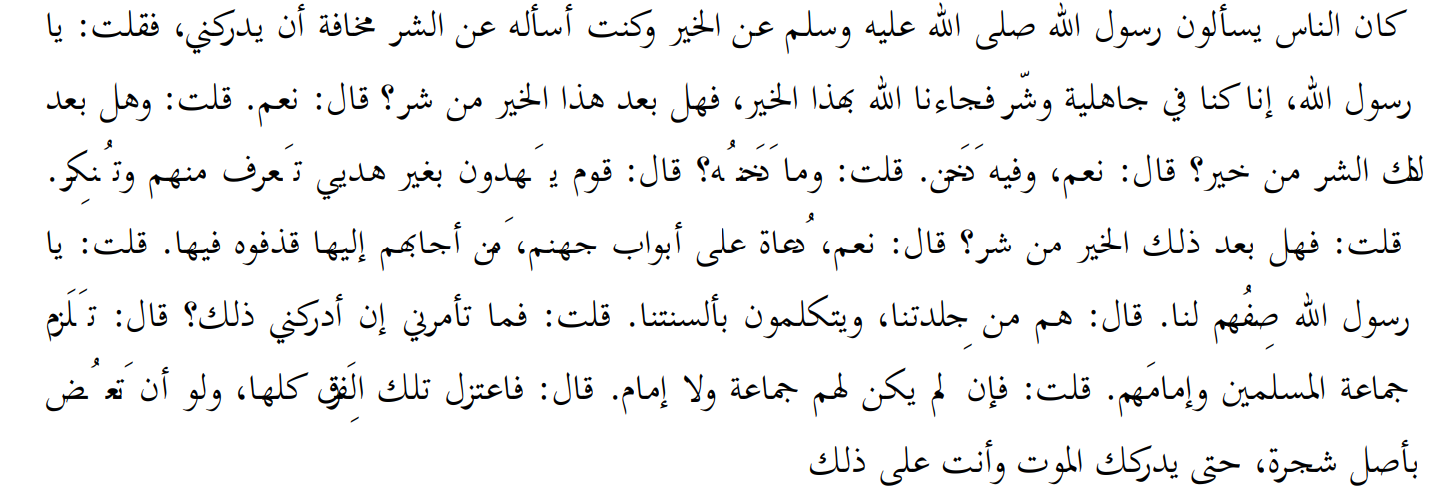
"İnsanlar Allah'ın Resulü'ne (sallallahu aleyhi ve sellem) hayırdan soruyorlardı, ben ise bana yetişmesinden korkarak ona şerri soruyordum. Dedim ki: Ey Allah'ın Resulü! Biz cahiliyye ve kötülük içindeydik, sonra Allah bize bu hayrı getirdi. Peki bu hayırdan sonra bir kötülük var mıdır? Buyurdu ki: Evet. Dedim ki: O kötülükten sonra bir hayır var mıdır? Buyurdu ki: Evet, ve onda bir duman (dühan) vardır. Dedim ki: Onun dumanı nedir? Buyurdu ki: Benim hidayetimle olmayan bir yolda hidayet üzere olduklarını söyleyen insanlar. Onlardan bazılarını tanırsın, bazılarını inkar edersin. Dedim ki: Bu hayırdan sonra yine bir kötülük var mıdır? Buyurdu ki: Evet, Cehennem kapılarına davet eden davetçiler (du'at) vardır. Kim onların davetine icabet ederse, onu oraya atarlar. Dedim ki: Ey Allah'ın Resulü, bize onları tarif et. Buyurdu ki: Onlar bizim cildimizden (kendi kavmimizdendirler) ve bizim dilimizle konuşurlar. Dedim ki: Eğer bu durum bana yetişirse bana ne emredersin? Buyurdu ki: Müslümanların cemaatine ve onların imamına bağlı kal. Dedim ki: Müslümanların ne bir cemaati ne de bir imamı olmazsa? Buyurdu ki: O zaman ölüm sana gelinceye kadar bir ağacın köküne sarılsan bile, bütün o fırkalardan uzaklaş."
“The people used to ask the Prophet of Allah (saw) about the good and I used to ask him about the bad in fear that it might catch me. So I said: O Prophet of Allah! We were in times of jahiliyyah and mischief then Allah brought us this good, so is there any mischief after this good? He (saw) said: Yes. I said: Will there be any good after that mischief? He said: Yes, and it has smoke (dukhan). I said: What is its smoke? He said: People guiding but not on my guidance. You recognise some (from them) and deny some. I said: Will there be any mischief after that good? He said: Yes, callers (du’at) who invite at the doors of Hellfire. They throw him into it (hell) whoever accepted their invitation. I said: O Prophet of Allah, describe them to us. He said: They are of our own skin (of our people) and talk our language. I said: What do you order me to do if that (matter) caught me? He said: Adhere to the jama‘ah of Muslims and their Imam. I said: What if the Muslims have no jama‘ah nor an Imam? He said: Then separate from all those groups, even if you (have to) bite the root of a tree till death comes to you as such.”
Bu hadis, Peygamber'in (sav) Müslümanlara cemaate bağlı kalmalarını ve imamlarına itaat etmelerini, cehennem kapılarına çağıran kimselerden ise uzak durmalarını emrettiğini açıkça ifade etmektedir. Soru soranın, Müslümanların ne imamı ne de cemaati bulunmadığı bir durumda, cehennem kapılarına çağıran bu davetçilere karşı ne yapması gerektiğini sorması üzerine Peygamber (sav), onu bütün bu gruplardan ayrılmaya emretmiş; Müslümanlardan kopmamasını ve bir imam tayin etme çabasından vazgeçmemesini emretmiştir. Dolayısıyla emri açıktır: "Bütün bu gruplardan ayrıl." Hatta bu gruplardan uzaklaşmanın, ölüm kendisine gelinceye kadar bir ağacın kökünü ısırmak zorunda kalmasına yol açsa bile, ayrılığı vurgulamıştır. Bunun anlamı, dinine sarılmak ve cehennem kapısında duran sapkın davetçilerden uzak durmaktır. Bu hadiste, bir Halifeliği kurma çalışmasını terk etmek için hiçbir mazeret ya da izin yoktur; hadis, yalnızca dinine bağlı kalma ve cehennem kapılarındaki davetçileri terk etme emriyle sınırlıdır. Halifeliği kurmak için çalışmayan kimse ise günaha girer. Dolayısıyla kişi, sapkın grupları, davetçilerin sapkınlığından dinini korumak için terk etmekle emrolunmuştur; ancak bu, Müslüman topluluktan uzaklaşmak ve İslam hukukunu kurma ve Müslümanlara bir imam tayin etme çalışmasını bırakmak anlamına gelmez.
This hadith is clear in its expression that the Prophet (saw) ordered the Muslims to adhere to the jama‘ah of Muslims and to adhere to their Imam, and to leave those who invite people to the doors of hell. The questioner asked him what he has should do in relation to those callers at the doors of Hellfire in the situation wherein the Muslims have no Imam and no jama‘ah; thereupon the Prophet (saw) ordered him to separate from all these groups, not to disassociate himself from the Muslims nor to abstain from the action for establishing an Imam. So his order is clear “Separate from all those groups”, and he emphasised the separation from those groups even to the extent that his isolation from them would make him clench to the trunk of a tree until death comes to him. Its meaning is to adhere to your deen and keep away from the misguiding callers who are at the doors of Hellfire. In this hadith there is no excuse or permission (for anybody) to abandon the work for establishing a Khalifah, it is, rather, confined to the command of adhering to the deen and abandoning the callers at the doors of hell, and the sin will remain on him if he does not work to establish a Khalifah. So he is ordered to abandon the misguiding groups in order to save his deen from the callers of the misguidance, even if he had to bite the root of a tree, but not to distance himself from the Muslim community and abandon the work for establishing the laws of the deen and establishing an Imam for Muslims.
Bir diğer örnek, Ebu Said el-Hudri'den rivayet edilen ve el-Buhari'nin naklettiği şu hadistir. Ebu Said el-Hudri şöyle demiştir:
Another example is what al-Bukhari narrated from Abu Said al-Khudri, who said:
Allah'ın Elçisi ﷺ şöyle buyurdu: "Öyle bir zaman gelecek ki, Müslümanın en hayırlı malı, fitnelerden dinini kurtarmak için dağların tepelerine ve yağmur yağan yerlere (vadilere) götüreceği koyunlar olacak."
“The Messenger of Allah (saw) said: A time will come that the best property of a Muslim will be sheep which he will take on the top of mountains and the places of rainfall (valleys) so as to flee with his religion from afflictions (fitan)”
Bu, Müslümanların toplumundan kopmak, din hükümlerini uygulamayı bırakmak ve yeryüzünde Hilafet bulunmadığı halde Müslümanlar için bir Hilafet kurmaktan vazgeçmek anlamına gelmez. Bütün içeriği, fitne zamanlarında Müslüman için en değerli servetin ne olduğunu açıklamaktan ibarettir; insanlardan ayrılmaya ve halktan soyutlanmaya teşvik etmez.
This does not mean that one should isolate oneself from the Muslim community, abandon practising the laws of the deen and establishing a Khalifah for Muslims when there is no Khilafah on earth. All that it contains is an explanation of what is the best wealth of the Muslim at the times of affliction; it does not encourage separation from the Muslims and isolation from the people.
Buna göre, yeryüzündeki hiçbir Müslümanın, Allah'ın (c.c.) emrettiği dini ikame etme görevini terk etmek için bir mazereti yoktur. Bu görev, yeryüzünde bir Hilafet bulunmadığında Müslümanlar için bir Halife'nin kurulmasıdır; Allah'ın (c.c.) haremlerini korumak için Allah'ın (c.c.) hadlerini uygulayacak kimse bulunmadığında ve dinin hükümlerini uygulayarak Müslüman topluluğu "La ilahe illallah, Muhammedun Resulullah" sancağı altında birleştirecek kimse olmadığında bunu kurmaktır. Bu görevin yerine getirilmesi için çalışmayı, gerçekten tamamlanana kadar terk etmeye İslam'da hiçbir izin yoktur.
Accordingly, no Muslim on the face of this earth has an excuse to abandon the duty of establishing the deen which Allah (swt) has ordered, that is, the establishment of a Khalifah for Muslims when there is no Khilafah on the earth, when there is no one to implement the punishments (hudood) of Allah (swt) to protect the sanctities of Allah (swt), and no one to implement the laws of the deen and unify the Muslim community under the banner of La ilaha illa Allah, Muhammad ur-Rasul Allah. There is no permission in Islam to abandon the work for this duty until it is indeed completed.