9. Bilim ve Kültür
9. Science And Culture
Arapça dilinde denir ki: "Adam ilmi ('alima) elde etti." Bu, onun ilmin (‘ilm) gerçek hakikatine ulaştığı anlamına gelir. Bir şeyin ilmini elde etmesi, onu bilmesi, yani bir konudan haberdar olması veya onunla tanışması demektir. Dilde ayrıca denir ki: "Anlayışı kazandı (thaqifa)", yani mahir olmuş, dolayısıyla eğitimli ve kültürlü (thaqif) olmuştur. Bir dili anlamış (thaqifa) demek, onu ustalıkla ve çabuk kavramış demektir. Bu dilsel anlamlar, kelimelerin kullanımının temelini oluşturur. Ancak bu kelimeler, dilsel anlamla ilgili başka anlamları ifade etmek için kullanılırsa bu caizdir; nitekim gramerde "fa'il" (özne) kelimesinin benimsenmesinde olduğu gibi. Kelimelerin dilsel anlamı baskındı ve bu yüzden eskiler, ‘ilm kelimesini bilimler ve disiplinler arasında ayrım yapmaksızın her türlü bilgi için kullanırlardı. Daha sonra insanlar, aklî ve tabii disiplinleri bütün insanlara ait kabul ederken, diğer geleneksel (naklî) disiplinleri, aktarıldığı milletle sınırlı görmeye başladılar. Bunun ardından hem ‘ilm hem de kültür (thaqafa), farklı belirli disiplinlere göre tanımlanmaya başlandı ve dilsel anlamlarından farklı terimsel anlamlar kazandı. Bu terminolojiye göre şu anlamları taşırlar: İlim (‘ilm), gözlem, deney ve eğitim yoluyla elde edilen bilgidir; fizik, kimya ve diğer deneysel bilimler gibi. Kültür (thaqafa) ise nakil, öğrenme ve çıkarım yoluyla elde edilen bilgidir; tarih, diller, fıkıh, felsefe ve diğer deneysel olmayan disiplinlerin incelenmesinde olduğu gibi. Bilimsel olmayan başka disiplinler de vardır ki, kültür (ṯaqāfa) kapsamına girmelerine rağmen ilim (ʿilm) olarak kabul edilirler; örneğin aritmetik, mühendislik ve sanayi gibi. Kültür kapsamına girseler de bilim sayılırlar, çünkü bunlar bütün insanlar için evrenseldir ve herhangi bir millete özgü değildir. Benzer şekilde, sanayiye benzeyen zanaatlarla ilgili kültürün her unsuru, mesela ticaret ve denizcilik, ilmin bir parçası sayılır ve evrenseldir. Resim, heykel ve müzik gibi sanatlara gelince, bunlar kültürün parçasıdır. Belirli bir bakış açısını izlerler; yani belirli bir kültürü temsil ederler. Kültür (ṯaqāfa) ile ilim (ʿilm) arasındaki fark budur.
In Arabic language it is said: the man has obtained (‘alima) knowledge (‘ilm). This means that he attained the true reality of knowledge (‘ilm). He gained knowledge of a thing means he became cognisant of it, which means that he became informed of a matter or acquainted with it. Also in the language it is said: He has gained comprehension (thaqifa), which means that he has become proficient, thus he is educated and cultured (thaqif). He has understood (thaqifa) a language (means) he has mastered and understood it swiftly. These linguistic meanings are the basis of the use of words, However if these words were used to indicate other meanings that relate to the linguistic meaning then that is permitted, like in the case of the adoption of the word fa’il (subject) in grammar for example. The linguistic meaning (of the words) was prevailing and this is why the ancients used to apply the word ‘ilm on all forms of knowledge without differentiating between the sciences and disciplines. Then people began to consider intellectual and natural disciplines as being general to all people whilst other traditional (textual) disciplines were considered specific to the nation from which it was transferred. Subsequently, each of science (‘ilm) and culture (thaqafa) began to be defined according to different specific disciplines, acquiring terminological meanings which were different to their linguistic meanings. According to this terminology they have the following meaning: Science (‘ilm) is the knowledge which is acquired through observation, experimentation and education like physics, chemistry and the rest of the empirical sciences and culture (thaqafa) is the knowledge which is acquired by way of transmission, learning and deduction as in (the study of) history, languages, jurisprudence (fiqh), philosophy and the rest of the non-empirical disciplines. And there are other non-empirical disciplines which are included as sciences (‘ilm) even though they come within culture such as arithmetic, engineering and industry; even though they come under culture (thaqafa) they are regarded as part of science because they are universal to all people and not specific to any one nation. In a similar way anything from the culture related to crafts which resemble industry such as trade and shipping; they are considered to be part of science and they are universal. As for the arts such as; painting, sculpture and music they are part of culture. They follow a particular viewpoint; which is a specific culture. The difference between culture (thaqafa) and science (‘ilm)
Bilimin bütün milletler için evrensel olduğu ve herhangi bir milletin diğerini dışlayacak şekilde ona özgü olmadığı görüşüdür. Kültürse (thaqafa) özgü olabilir; çünkü ortaya çıktığı millete nispet edilir, ya da milletin kendine özgü ve ayırt edici niteliklerinden bir parça olabilir; örneğin edebiyat, kahramanların biyografileri ve hayata dair felsefeleri gibi. Ya da evrensel olabilir; örneğin ticaret, denizcilik vb. Bu nedenle bilim, evrensel olduğu ve herhangi bir millete özgü olmadığı için tüm milletlerden evrensel olarak benimsenir. Kültüre (thaqafa) gelince, millet kendi kültüründen başlamalıdır; onu inceleyip bilinçli hale geldiğinde, zihninde yerleşip netleşinceye kadar, ancak o zaman diğer kültürleri incelemeye geçebilir. Müslümanlar, bir kişinin kendi çabasıyla elde ettiği ilimler ile başkalarından aldığı ilimler arasında ayrım yapardı. İbn Haldun, el-Mukaddime adlı kitabında şöyle der:
is that science is universal to all nations and not specific to any nation to the exclusion of another nation. As for culture (thaqafa) it might be specific, being ascribed to the nation from which it resulted or it may be part of the nation’s specific and particular characteristics such as literature and biographies of heroes, and their philosophy concerning life or they may be universal such as trade, shipping etc. Therefore, science is adopted universally from all nations because it is universal and not specific to any particular nation. As for culture (thaqafa) the nation should begin with its own culture, when she has studied it and is cognisant of it until it becomes focused in their minds then they can study other cultures. The Muslims used to differentiate between the sciences which a person used to attain by himself and the sciences he used to receive from others. Ibn Khaldun says in his book al-Muqaddima:
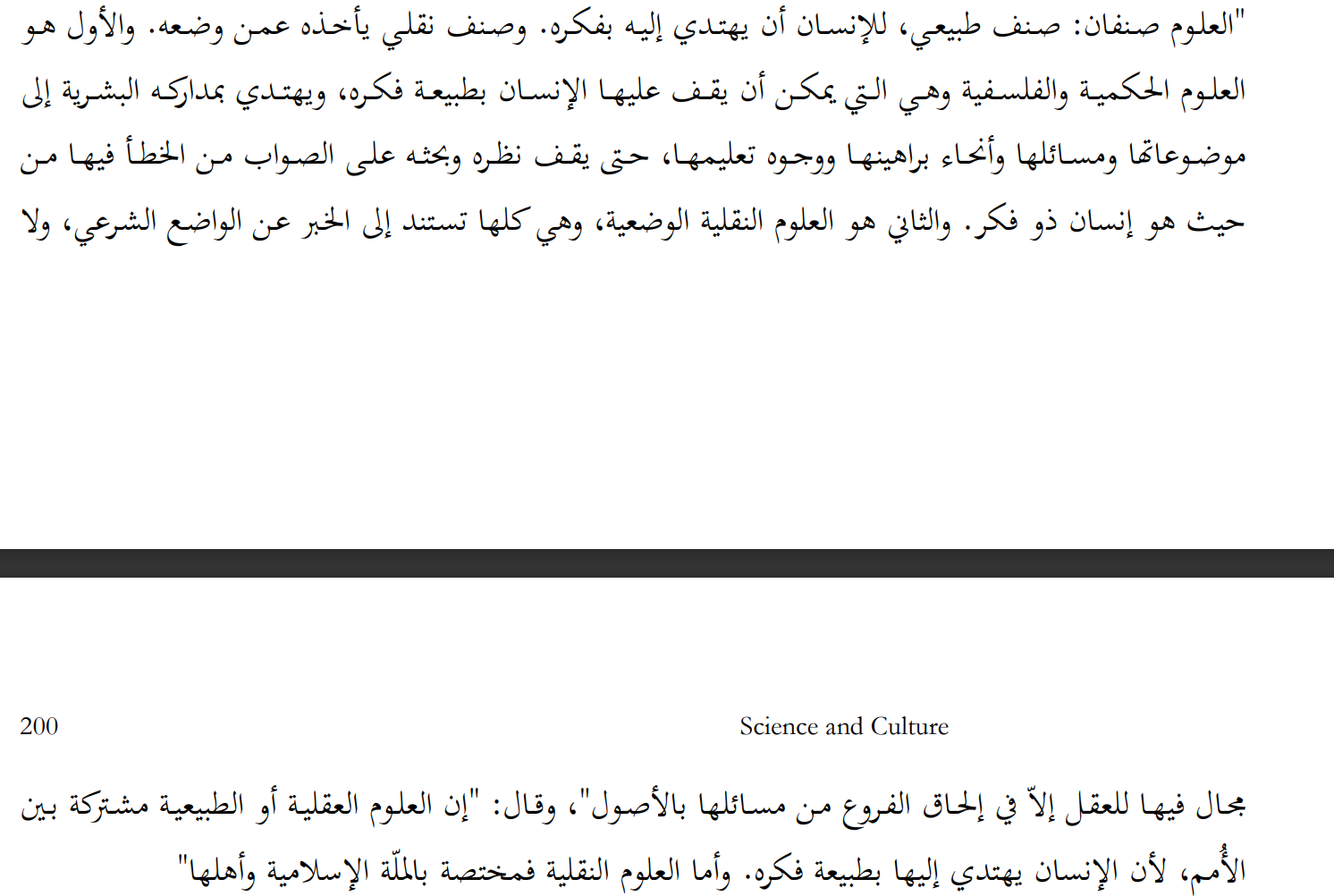
İlimler iki türlüdür: Birincisi, insanın düşünerek ulaşması gereken tabii türdür; ikincisi ise onu yazan kişiden aldığı nakli (metne dayalı) türdür. Birinci tür, insanın düşünce yoluyla araştırabileceği, insan melekeleri aracılığıyla konularına, meselelerine, bütün kesin delillerine ve öğretilerinin yönlerine yol bulabileceği felsefi ve kısa özlü (hikmet) ilimlerdir. Böylece insan, düşünme yetisine sahip bir insan olarak, idrak ve incelemesinde yanlış olandan doğru görüşü ayırt eder. İkincisi ise metne dayalı ve yazılı ilimlerdir. Bunlar şer'i bir kaynaktan gelen habere dayanır. Akıl bu konuda, dallara ait meseleleri usule (temele) bağlamaktan başka bir alana sahip değildir.
“The sciences are of two types: A natural type which is for man to arrive at through his thinking and a textual type which he takes from the one who authored it. The first are the philosophical and aphoristic sciences which he can seek by his thought and be guided through the human faculties to its subjects and issues and all its decisive proofs and aspects of its teachings. So as in his discernment and study he attains the correct (opinion) from the incorrect, in his capacity as a human being possessing the faculty of thought. The second are the textual and written sciences. They depend on the report coming from a shar’i source. The mind has no scope in this regard except to relate the branch issues to the usul (foundation)”.
Ayrıca şöyle demiştir: "Akli ya da doğal ilimler, insanın düşüncesi yoluyla bunlara doğal olarak ulaşması sebebiyle bütün milletlere ortaktır. Nakli ilimler ise Müslüman dine ve onun mensuplarına özgüdür." Görünüşe göre İbn Haldun'un nakli ilimleri İslam milletiyle sınırlandırmasıyla kastettiği yalnızca bir örnekti; çünkü İslam milleti dışındaki milletlerin de kendilerine özgü nakli ilimleri vardır, mesela hukuk ve dil gibi. İbn Haldun'un bu ifadesi, ilim ile kültür arasında ayrım yaptığını göstermemektedir. Yalnızca nakli ilimler ile akli ilimler arasında ayrım yaptığını gösterir. Onun yorumları, Müslümanların ilim ile kültür arasında ayrım yaptığının kanıtı değil, yalnızca disiplinler arasında ayrım yaptıklarının kanıtıdır. Dolayısıyla onları iki bölüme ayırmışlardır. Ancak bu bölme, elde ediliş biçimine göre değil, genel olarak elde edilişlerine göre yapılmıştır. Bu nedenle onları akli ilimler, yani akılla elde edilen, ve nakli ilimler, yani metinden elde edilen olarak adlandırmışlardır. Oysa bugün insanlar disiplinler arasında, bunların alınma biçimine göre ayrım yapmaktadır. Bu nedenle deneysel yöntemle elde edilen her şeye "ilim" (ilm) adını verirken, deneysel yöntem dışındaki yollarla elde edilen her şeye "kültür" (sakafa) adını vermektedirler.
He also said “The rational or natural sciences are common to all nations since man arrives at them naturally through his thought. As for the textual sciences they are specific to the Muslim religion and its adherents.” It appears that what Ibn Khaldun meant by specifying the textual sciences with the Islamic millah was only an example because nations other than the Islamic nation as well have textual sciences specific to them such as their legislation and language. Ibn Khaldun’s statement does not indicate that he distinguished between science and culture. It only indicates that he distinguished between textual and rational sciences. His comments are not an evidence to say that the Muslims used to differentiate between science and culture rather they are an evidence to prove that the Muslims used only to differentiate between disciplines. Thus, they divided them into two sections. However their division was in terms of their general acquisition and not in terms of the manner of acquisition. So they designated them as rational sciences i.e, acquired via the mind. And textual sciences acquired from the text. However, people today differentiate between disciplines in terms of the manner in which they were received. Thus, they apply the term ‘science’ (‘ilm) on anything that is acquired through the empirical method and they apply the term ‘culture’ (thaqafa) on anything acquired by means other than the empirical method