20.3 Şehit
20.3 The Martyr
Şehitler (şuhedâ) üç çeşittir: Ahiret şehidi olup dünya hükümlerine göre şehit olmayanlar; yalnızca dünya şehidi olanlar ve hem dünya hem de ahiret şehidi olanlar. Yalnızca ahiret şehidi olup dünyada şehit sayılmayanlar ise hadislerde zikredilmiştir. Bazı rivayetlerde yedi, bazılarında sekiz, bazılarında dokuz ve bazılarında on bir olarak geçmektedir. Müslim'de gelen sahih görüşe göre ise beş kişidir: (el-matûn), yani veba, meşhur salgın hastalık ile ölen kişi; (el-mebtûn), yani ishal hastalığından ölen kişi; suda boğularak ölen kişi; (el-hedm), yani yıkılan bina altında kalarak ölen kişi ve Allah'ın kelimesini yüceltmek yolunda, savaş meydanı dışında ölen kişi. Müslim, Ebû Hureyre (ra)'den rivayet etmiştir ki Allah'ın Resulü ﷺ şöyle buyurmuştur:
Martyrs (shuhadaa) are of three types; the shaheed of the Akhirah but not by the rules of the world; the shaheed of the world only and the shaheed of the world and Akhirah. As for the shaheed of the Akhirah only and not of this world, they are mentioned in the ahadith. In some narrations they are seven, in some eight, in some nine and in some eleven. The authentic (position) as what came in Muslim is that they are five who are: (al-mat’un) who is the one who dies in the plague i.e. the famous pestilence, the (mabtun) who is the one with diarrhoea, the drowned person who dies because of water, the one who dies of (al-hadm) i.e. the collapsed building, and the one who dies in the way of raising the word of Allah outside the battlefield. Muslim narrated from Abu Hurayra (ra) that the Messenger of Allah (saw) said:
Yolda yürüyen bir adam, yol üzerinde bir diken dalı buldu ve onu kaldırdı. Allah ona şükretti ve onu bağışladı. Peygamber ﷺ şöyle buyurdu: "Şehitler beştir: (al-mat'un), (al-mabtun), boğulan kişi, göçük (bir bina) altında ölen kişi ve Allah yolunda şehit olan kişi." Allah azze ve celle.
“A man walking along the road found a thorn-branch in the road and removed it. Allah was grateful to him and forgave him. He (saw) said: The martyrs (shuhadaa) are five: (al-mat’un), (al-mabtun), the drowned one, the one who died in a collapsed (building) and the shaheed in the way of Allah ‘azza wa jalla.”
Ebu Hureyre (ra)'den rivayet edilmiştir, o şöyle dedi: Allah'ın Resulü ﷺ şöyle buyurdu:
Muslim narrated from Abu Hurairah (ra) who said: The Messenger of Allah (saw) said:
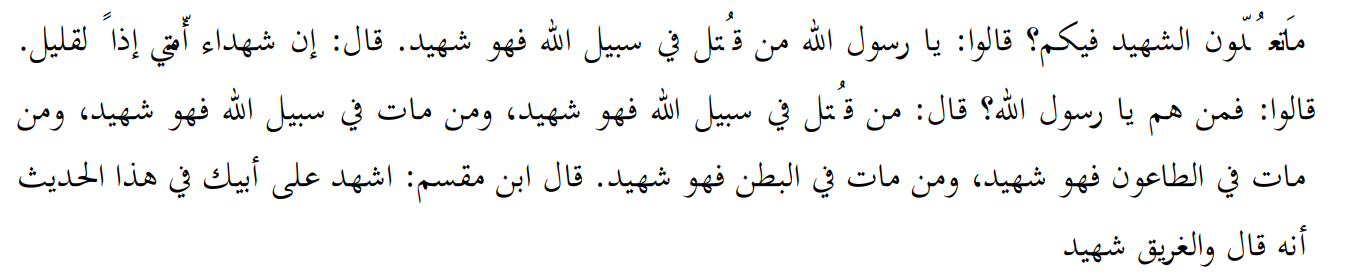
"Aranızda kimi şehit sayarsınız?" dedi. Sahabeler, "Ey Allah'ın Elçisi, Allah yolunda öldürülen şehittir" dediler. Peygamber ﷺ, "O zaman ümmetim içindeki şehitler az olur" dedi. Sahabeler, "Peki onlar kimlerdir, ey Allah'ın Elçisi?" dediler. Peygamber ﷺ şöyle buyurdu: "Allah yolunda öldürülen şehittir, Allah yolunda ölen şehittir, veba ile öldürülen şehittir, karın hastalığından ölen şehittir ve boğularak ölen şehittir." (İbn Muksim dedi ki: Bu hadiste babanın da şahitlik ettiğini söylüyorum; o şöyle demişti.)
“Whom do you consider a shaheed among you? They said: O Messenger of Allah, the one killed in the way of Allah is a shaheed. He said: Then the shuhadaa among my Ummah would be few. They said: Then who are they, O Messenger of Allah? He said: The one killed in the way of Allah is a shaheed, the one who dies in the way of Allah is a shaheed, the one killed in pestilence is a shaheed, the one killed due to the stomach is a shaheed (ibn Muqsim said: I testify that upon your father in this hadith that he said) and the drowned person is a shaheed.”
Bu şehidlerden kastedilen, ahirette onlar için şehidlerin sevabının bulunmasıdır; dünyada ise onlar yıkanır ve üzerlerine cenaze namazı kılınır. "Şehit" kelimesi sevapla ve bu konudaki hadisle ilgili olarak söylendiğinde, bu kimseleri de kapsayacak şekilde genelleştirilmesi doğrudur. Ancak "şehit" kelimesi herhangi bir çağrışım olmaksızın, kayıtsız şartsız kullanıldığında ise bu kimseleri kapsadığı anlaşılmaz; yalnızca Allah yolunda öldürülenleri ifade ettiği kabul edilir.
The meaning of these shuhadaa is that there is for them in the Akhirah the reward of the shuhadaa; as for this world, they are washed and prayed over. When the word “shaheed” is said in connection with reward and the hadith about that, it is correct to generalize it to these (persons). However, if the word “shaheed” is used in an unrestricted manner without any connotation, then it is not taken to denote these (persons) but rather to denote only those killed in the way of Allah.
Dünyevi şehit, ahirette değil, dünyada şehit hükmünü alan kişidir; yani yıkanmaz, cenaze namazı kılınmaz, elbiseleriyle birlikte gömülür. Ancak ahirette, Allah'ın kelimesinin en yüce olması için savaşan şehidin sevabını almaz. Bu kişi, Allah yolu dışında savaşan kimsedir; örneğin yalnızca şöhret veya ganimet için ya da geri çekilirken savaşan kişi gibi. Bunun nedeni, hadislerin Allah (swt) yolunda savaşan, geri çekilmeyip ileriye doğru savaşan şehidin sevabını belirtmiş olmasıdır. Müslim, Ebu Musa el-Eş'ari'den rivayet etmiştir.
As for the shaheed of the world not the Akhirah, he is the one who takes the rules of the shaheed of the world in so far as he is not washed nor prayed over but rather buried in his clothes. However he does not take in the Akhirah the reward of the shaheed who fought to raise the word of Allah the highest. This is the one who fights in other than the way of Allah such as fighting for fame or booty alone or while retreating. This is because the ahadith specified the shaheed’s reward for the shaheed who fights in the way of Allah (swt), and the one fighting advancing not retreating. Muslim narrated from Abu Musa al-Ash’ari
Bir adam Peygamber ﷺ'in yanına gelip şöyle dedi: "Ey Allah'ın Resulü! Ganimet için savaşan, şöhret için savaşan ve mertebesinin görülmesi için savaşan adam hangisi Allah yolundadır?" Allah'ın Resulü ﷺ şöyle buyurdu: "Allah'ın kelimesinin en yüce olması için savaşan kimse Allah yolundadır."
“That a man came to the Prophet (saw) and said: O Messenger of Allah, the man who fights for booty, the man who fights to be mentioned and the man who fights so that his rank is seen. Which one is in the way of Allah? The Messenger of Allah (saw) said: ‘The one who fights so that the word of Allah be highest is the one in the way of Allah.”
Müslim, Ebu Musa'dan rivayet etmiştir.
Muslim narrated from Abu Musa
"Allah'ın Elçisi'ne (ﷺ), cesaretini göstermek için savaşan adam, öfkeyle savaşan adam ve gösteriş için (riyakârca) savaşan adam hakkında soruldu. Allah'ın Elçisi (ﷺ) şöyle buyurdu: Allah'ın kelimesinin en yüce olması için savaşan kimse, Allah yolundadır."
“The Messenger of Allah (saw) was asked about the man who fights (to show his) courage, the one who fights out of anger, and the one who fights to show off (hypocritically). The Messenger of Allah (saw) said: The one who fights so that the word of Allah is highest is in the way of Allah.”
Elçi, şehidin günahlarının bağışlanması için bir şart koymuştur: geri çekilerek değil, ileriye doğru ilerleyerek savaşmak. Müslim, Abdullah bin Ebi Katade'den, onun da Katade'den rivayet ettiğine göre, Allah'ın Elçisi'nden bunun rivayet edildiğini işittiğini nakletmiştir ﷺ.
The Messenger made a condition of the shaheed being forgiven his sins that he fights advancing not retreating. Muslim narrated from Abdullah bin Abi Qatadah from Qatadah that he heard it being narrated from the Messenger of Allah
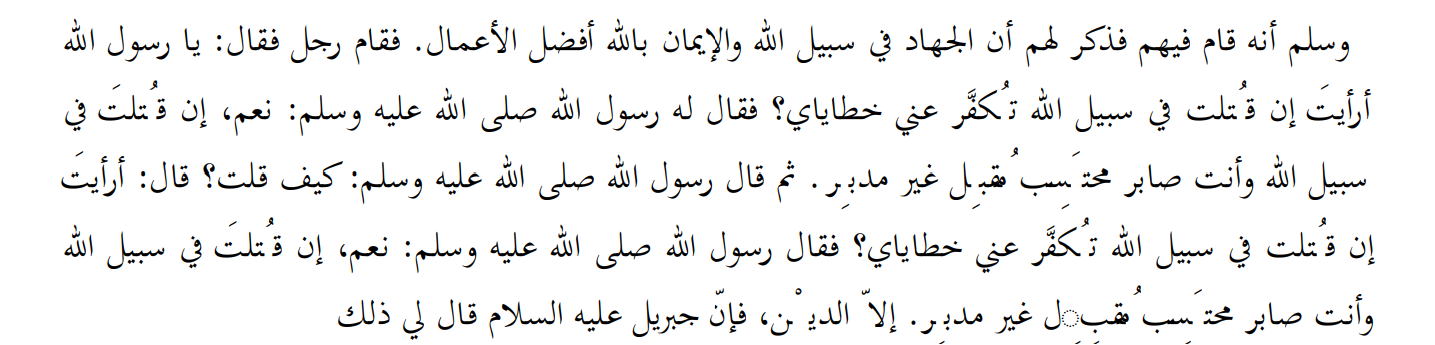
"Aralarında durduğunu ve onlara Allah yolunda cihadın ve Allah'a kesin inancın en hayırlı amellerden olduğunu hatırlattığını (aktarır). Bunun üzerine bir adam ayağa kalkıp şöyle dedi: Ey Allah'ın Resulü, Allah yolunda savaşırsam bütün hatalarımın bağışlanacağını düşünüyor musun? Allah'ın Resulü ﷺ ona şöyle dedi: Evet, eğer Allah yolunda savaşır ve sabreder, umutlu olur, ileriye doğru ilerler ve geri çekilmezsen (bağışlanır). Sonra Allah'ın Resulü ﷺ şöyle buyurdu: Ne dedin? Adam dedi ki: Allah yolunda savaşırsam bütün günahlarımın bağışlanacağını düşünüyor musun? Allah'ın Resulü ﷺ şöyle buyurdu: Evet, eğer sabreder, umutlu olur, ileriye doğru ilerler ve geri çekilmezsen; ancak borç hariç. Çünkü Cibril (AS) bana bunu böyle söyledi."
“That he stood among them and reminded them that jihad in the way of Allah and decisive belief in Allah is the best deeds. So a man stood up and said: O Messenger of Allah, do you see that if I fought in the way of Allah that all my errors would be forgiven? The Messenger of Allah (saw) said to him: Yes, if you fought in the way of Allah and you are patient, hopeful, advancing and not retreating. Then the Messenger of Allah (saw) said: What did you say? He said: Do you see that if I fought in the way of Allah that all my sins would be forgiven? The Messenger of Allah (saw) said: Yes, if you are patient, hopeful, advancing and not retreating except for debts as Jibril (AS) told me that.”
Bu anlayışa göre, geri çekilen savaşçının günahları bağışlanmaz ve şehidin sevabı da ona verilmez. Şöhret için savaşan kişiye gelince, Elçi (sav) onun cezalandırılacağını açıklamış, buna rağmen ona şehit demiştir. Müslim, Süleyman bin Yesar'dan rivayet etmiştir ki: İnsanlar Ebu Hureyre'nin (ra) etrafından dağılmıştı. Şam halkından olan Nâtil ona dedi ki: Ey Şeyh, Allah'ın Elçisinden (sav) işittiğin bir hadisi bize anlat. O da dedi ki: Evet, Allah'ın Elçisinin (sav) şöyle dediğini işittim:
The understanding of this is that the retreating fighter’s sins are not forgiven nor does he have the reward of the shaheed. As for the one fighting for fame, the Messenger (saw) clarified that he would be punished and (yet) called him shaheed. Muslim narrated from Sulayman bin Yasar who said: People dispersed about Abu Hurairah (ra) and Natil who was from the people of Sham said to him: O Sheikh related to us a hadith you heard from the Messenger of Allah (saw). He said: Yes, I heard the Messenger of Allah (saw) saying:
"Kıyamet gününde hesaba çekilecek ilk kişiler, şehit olarak öldürülen bir adamdır. Onu (Allah'ın huzuruna) getirirler, O da ona (Allah'ın) nimetlerini bildirir ve o bunları kabul eder. O (subhanehu ve teala) şöyle buyurur: 'Bunlarla ne yaptın?' O cevap verir: 'Senin yolunda, öldürülüp şehit oluncaya kadar savaştım.' O buyurur: 'Yalan söyledin. Aksine, sen 'cesur' denilsin diye savaştın ve bu da söylendi.' Sonra onun hakkında emir verilir ve yüz üstü sürüklenerek ateşe atılır."
“Verily the first person(s) to be judged on the Day of Judgement is a man who was killed as a shaheed. He is brought to Him (Allah) and He informs him of the bounties (of Allah) and he acknowledges them. He (swt) says: What did you do with them? He answers: I fought for you until I was killed as a shaheed. He says: You lied. Rather you fought so that it be said ‘(he is) brave’ and it has been said. Then He commands regarding him and he is dragged upon his face until he is thrown into the Fire”
Hadisin sonuna kadar. Bu, şöhret için öldürülen kişinin, dünyada şehidin hükümlerini alsa bile, Kıyamet Günü şehidin sevabını kazanamayacağını, aksine cezalandırılacağını göstermektedir.
Till the end of the hadith. This indicates that the one killed for fame, even if he takes the rules of the shaheed in this world, will not gain the reward of the shaheed on the Day of Judgement but would be punished.
Dünya ve ahiret şehidine gelince, o, Allah'ın kelimesini yüceltmek için kâfirlerle savaşan ve Müslümanlar ile kâfirler arasındaki savaş alanında öldürülen kişidir; bu savaş harb diyarında olsun, ya da İslam topraklarında olsun fark etmez. Allah (SWT) şöyle buyurmuştur:
As for the shaheed of the world and the Akhirah, he is the one who fights the disbelievers to raise the word of Allah and was killed in the battle (field) between Muslims and disbelievers, whether the fighting was in the land of war or the Islamic land. Allah (swt) said:
"Allah yolunda öldürülenleri sakın ölü sanmayın. Aksine onlar diri olup Rableri katında rızık almaktadırlar." [Âl-i İmrân, 3:169].
“Do not think that those killed in the way of Allah are dead. Rather they are alive and receiving sustenance before their Lord” [TMQ 3:169].
Bu şehit, Şeriat hükümlerinde haklarında özel kurallar gelen kimsedir. Kâfirlerle yapılan savaşta öldürülen kişi olarak belirlenmiştir; aynı şekilde savaş meydanında yaralanıp sonra aldığı yaradan dolayı ölen kimse de savaş meydanında öldürülen gibi kabul edilir. Bunların dışındakiler ise şehit sayılmaz. Buna göre asilerle (bağîlerle) çarpışırken öldürülen kimse şehit sayılmaz; savaş meydanında yaralanıp sonra yarasından iyileşen, sonra da bu yüzünden ölen kimse de şehit sayılmaz. Özel hükümleri bulunan ve Allah'ın hakkında "diridir" buyurduğu şehit ise, Allah'ın kelimesini yüceltmek için kâfirlerle savaş meydanında öldürülen ve bu yaradan dolayı ölen kimseye özgüdür.
This shaheed is the one upon whose rights came in the Shari’ah rules. He is specified as the one killed in the war with disbelievers; similarly the one who was wounded in the battlefield then died of the wound he received in the battlefield is also considered like the one killed in the battlefield. As for other than these, they are not considered shaheed. Accordingly the one killed in fighting with rebels (bughat) is not considered shaheed nor the one wounded in the battlefield then recovered from the wound then died because of it. The shaheed who has specific rules, and the one about whom Allah stated that he is alive, is specified to the one killed in the battlefield with the disbelievers to raise the word of Allah and the one injured in the battlefield then died due to this wound.
Bu sözü edilen şehidin hükmü, yıkanmaması ve kefene sarılmaması, bunun yerine kanı ve elbisesiyle birlikte gömülmesidir; çünkü şehit, Kıyamet Günü kanının kokusuyla, en güzel kokulu misk gibi dirilir. Şehidin yıkanmamasına gelince, bu, Buhari'nin Cabir'den rivayet ettiği hadise dayanmaktadır. Cabir şöyle demiştir:
The rule of this mentioned shaheed is that he is neither washed nor shrouded in burial shrouds; rather he is buried in his blood and clothes because the shaheed is resurrected on the Day of Judgement with the smell of his blood like the sweetest-smelling musk. As for not washing the shaheed, this is due to what Al-Bukhari narrated from Jabir who said:
Allah'ın Elçisi ﷺ, Uhud'da öldürülenlerden iki kişiyi bir elbiseye sararak bir araya getirirdi, sonra şöyle buyururdu: "Bunlardan hangisi Kur'an'ı daha iyi biliyordu?" İkisinden biri kendisine gösterildiğinde, onu kabirdeki lahde (lihd) öne alır ve şöyle derdi: "Ben bunlara karşı şahitim." Onların kanlarıyla birlikte defnedilmelerini emretti; onların cenaze namazını kılmadı ve yıkamadı.
“The Messenger of Allah (saw) would collect two men of those killed in Uhud in one cloth, and then he would say: Which one of them knew more of the Qur’an? If one of the two was indicated to him, he brought him forward in the grave-niche (lihd) and said: I am a witness over these. He commanded their burial with their blood and did not pray over them nor wash them.”
Ve Ahmed (rivayet etmiştir) ki Peygamber ﷺ Uhud'da şehit olanlar hakkında şöyle buyurmuştur:
And Ahmad (narrated) that the Prophet (saw) said about those killed in Uhud:
“Onları yıkamayın; çünkü her yara ya da (her damla) kan, Kıyamet Günü'nde misk kokusu yayacaktır.” Ve (Peygamber) onların cenazesine namaz kılmadı. Note on the honorific: the original text does not mention the Prophet in this sentence, but the phrase "he did not pray over them" refers to him, so the translation adds the honorific ﷺ after "Peygamber" as required.
“Do not wash them because each wound or (each drop of) blood will diffuse musk on the Day of Judgement and he did not pray over them.”
Uhud'da şehid edilenler hakkında Peygamber ﷺ şöyle buyurmuştur:
It is narrated that the Prophet (saw) said about those killed in Uhud:
"Onları kanlarıyla örtün ve yıkamayın; çünkü Allah yolunda yaralanan hiçbir yara yoktur ki Kıyamet Günü, rengi kan rengi, kokusu misk kokusu olan kan akan bir damarla gelmesin."
“Cover them in their blood and do not wash them as there is no wound wounded in the way of Allah save that it will come on the Day of Judgement with its jugular vein flowing blood whose colour is the colour of blood and the odour is the odour of musk.”
Enes'ten rivayet edilmiştir
It has been narrated from Anas
"Peygamber ﷺ'in, Uhud'da öldürülenler için cenaze namazı kılmadığı ve onlara namaz kılmadığı."
“That the Prophet (saw) did not pray over those killed in Uhud or pray over them.”
Tıpkı Uhud'da öldürülenleri yıkamadığı gibi, Bedir şehitlerini de yıkamamıştır; benzer şekilde Hendek ve Hayber şehitlerini de yıkamamıştır. Böylece şehidin yıkanmadığı anlaşılmıştır. Aynı şekilde şehit, ölü kişinin kefenlendiği gibi kefenlenmez; bunun yerine, Allah'ın Elçisi ﷺ'in Uhud şehitleri hakkındaki sözü gereğince, üzerinde bulunan elbiseleriyle defnedilir.
Just as he did not wash those killed in Uhud, he did not wash the shuhadaa of Badr; similarly he did not wash the shuhadaa of Khandaq and Khayber. So it became clear that the shaheed is not washed. Similarly the shaheed is not enshrouded as the dead person is shrouded; rather he is shrouded in the clothes that he has due to the Messenger of Allah (saw)’s statement about those killed in Uhud:
"Onları yaraları ve kanlarıyla birlikte örtün" (Ahmed rivayet etmiştir)
“Cover them in their wounds and blood” (narrated by Ahmad)
Ve yine İbn Abbas'ın (ra) rivayet ettiği hadis sebebiyle
And also due to what ibn Abbas (ra) narrated
"Resulullah (sav) Uhud'da şehit düşenler hakkında, üzerlerindeki demir ve deriler çıkarılsın ve kanları ile elbiseleriyle birlikte defnedilsin diye emretmiştir." (Ebu Davud tarafından rivayet edilmiştir.)
“That the Messenger of Allah (saw) commanded about those killed in Uhud that the iron and skins be removed from them and that they be buried with their blood and clothes” (narrated by Abu Dawud).
Şehid için cenaze namazına gelince, onların üzerine namaz kılmak da caizdir, kılmamak da caizdir. Onların üzerine namaz kılmanın caiz olması, Peygamber ﷺ'in Uhud'da öldürülenlerin defnedildikten sonra onlar için namaz kıldığı ve Hamza ile savaş alanında öldürülen bir adam için namaz kıldığı yönündeki rivayetlere dayanmaktadır. Buhari'de Ukbe bin Amir'den rivayet edilmiştir:
As for the prayer over the shaheed, it is allowed to pray over them and it is allowed not to pray over them. As for the permissibility of prayer over them, this is due to the narrations which came that the Messenger (saw) prayed over those killed in Uhud after their burial and prayed over Hamza and a man killed in the battlefield. In Al-Bukhari it is narrated from Uqbah bin ‘Amir
"Peygamber ﷺ, sekiz yıl sonra Uhud'ta şehit düşenler için cenaze namazı kıldı; ölüler için kılınan bu namaz, hem sağlara hem ölülere bir veda gibiydi."
“He (saw) prayed over those killed in Uhud after eight years, the prayer over the dead was like a farewell to those alive and those dead.”
Ebu Davud'dan, Malik el-Ghiffari'den
And from Abu Dawud from Malik al-Ghiffari
"Peygamber ﷺ, Uhud'da şehit düşenleri on kişilik gruplar halinde cenaze namazı kıldırdı; her grubun içinde Hamza da bulunuyordu, ve Hamza'ya yetmiş kez namaz kıldırana kadar bunu sürdürdü."
“He (saw) prayed over those killed in Uhud in groups of ten with Hamza in each ten until he prayed seventy times over him.”
Ebû Dâvûd, Ebû Sâlim aracılığıyla, Peygamber ﷺ'in ashabından bir adamın şöyle dediğini rivayet etmiştir:
Abu Dawud narrated from Abu Salim from a man of the Prophet (saw)’s Sahabah who said:

“Cüheyne kabilesinden bir topluluğa gafil avlayarak saldırdık. Müslümanlardan bir adam, onlardan bir adamı vurmak için peşine düştü, ama vuramadı ve kendini vurdu. Allah'ın Resulü ﷺ şöyle buyurdu: 'Kardeşiniz, ey Müslümanlar topluluğu!' Bunun üzerine insanlar acele ettiler ve adamı ölü buldular. Allah'ın Resulü ﷺ onu kendi elbisesi ve kanıyla örttü, onun cenaze namazını kıldı ve defnetti. Sahabeler sordular: 'Şehit midir?' O da şöyle buyurdu: 'Evet, ben de onun için şahidim.'”
“We attacked by surprise a tribe from Juhainah. A man of the Muslims sought a man of them to strike him, but he missed and struck himself. The Messenger of Allah (saw) said: Your brother, O community of Muslims so the people hastened and found him dead. The Messenger of Allah (saw) covered him in his clothes and blood, prayed over him and buried him. They said: Is he a shaheed? He said: Yes, and I am a witness for him.”
Juhayne kabilesinden bir topluluğa gafil avlayarak saldırdık. Müslümanlardan bir adam, onlardan birini vurmak için peşine düştü, ama vuramadı ve kendi kendini vurdu. Allah'ın Resulü ﷺ şöyle buyurdu: "Kardeşiniz, ey Müslüman topluluğu!" Bunun üzerine insanlar acele ettiler ve onu ölmüş buldular. Allah'ın Resulü ﷺ onu kendi elbisesiyle ve kanıyla örttü, onun cenaze namazını kıldı ve onu defnetti. Sahabeler sordu: "Şehid mi?" O ﷺ buyurdu: "Evet, ve ben onun için şahidim."
“We attacked by surprise a tribe from Juhainah. A man of the Muslims sought a man of them to strike him, but he missed and struck himself. The Messenger of Allah (saw) said: Your brother, O community of Muslims so the people hastened and found him dead. The Messenger of Allah (saw) covered him in his clothes and blood, prayed over him and buried him. They said: Is he a shaheed? He said: Yes, and I am a witness for him.”
Peygamberin (sav) Uhud'da öldürülenler için cenaze namazı kılmadığı ve onları yıkamadığı.
“That the Prophet (saw) did not pray over those killed in Uhud or wash them.”
Ve Ahmed, Enes'ten rivayet etmiştir
And Ahmad narrated from Anas
Uhud şehitleri yıkanmadı. Üzerlerindeki elbiseleriyle defnedildiler ve kendileri için cenaze namazı kılınmadı.
“The shuhadaa of Uhud were not washed. They were buried in their clothes and not prayed over.”
Cabir bin Abdullah (ra) şöyle rivayet etmiştir:
Al-Bukhari narrated from Jabir bin Abdullah (ra) who said:

Peygamber ﷺ, Uhud'da öldürülenlerden iki kişiyi bir arada defnederdi, sonra şöyle buyururdu: "Bunlardan hangisi Kur'an'ı daha çok ezberlemişti?" İkisinden biri kendisine işaret edildiğinde, onu kabir çukurunda öne alırdı ve şöyle buyurdu: "Kıyamet günü bunlara ben şahit olacağım." Onları kanlarıyla birlikte defnedilmelerini emretti, ne yıkadı ne de cenazelerine namaz kıldı.
“The Prophet (saw) would combine between two men of those killed in Uhud then say: Which one of them memorized more of the Qur’an? When one of the two was indicated to him, he would bring him forward in the grave-niche and he said: I am the witness over these on the Day of Judgement, commanded their burial in their blood and did not wash them or pray over them.”
Bu hadisler sahih ve şehidin üzerine namaz kılınmadığını açıkça gösteren nitelikte. Imam Şafiî, İbn Abbas'ın (ra) hadisine ve Uhud'da öldürülenlerin defnedilmeden önce üzerlerine namaz kılınması meselesinde ortaya çıkan anlama cevap vererek şöyle demiştir: "Bu rivayet, mütevatir olan 'Resulullah'ın Uhud'da öldürülenlerin üzerine namaz kılmadığı' bilgisine karşı, sanki belirli kişilere özgüymüş gibi gelmiştir." Bütün bu hadisler, ister Resulullah'ın (ﷺ) şehitlerin üzerine namaz kıldığını bildiren, ister kılmadığını bildiren rivayetler olsun, sahihtir. Bunlardan hiçbirini sahihliği sebebiyle reddetmenin bir yolu yoktur; zira hepsi rivayet ve anlam bakımından delil olarak kullanılanlardandır. Birini diğerine tercih etmenin de yolu yoktur; çünkü Sahabe'nin Uhud şehitlerinin üzerine namaz kılmayı unutmuş olması uzak bir ihtimaldir. Aynı şekilde, Resulullah'ın (ﷺ) ölülerin üzerine namaz kıldığına dair sabit olan genel durumun tersi bir uygulamayı Sahabe'nin terk etmesi de uzak bir ihtimaldir. O halde biri diğerine nasıl tercih edilebilir? Şehit üzerine namaz kıldığını bildiren hadislerdeki "namaz"ın dua anlamında olduğunu ve "namaz kıldı" ifadesinin "dua etti" anlamına geldiğini söylemek de doğru değildir. Çünkü şer'î hakikatler, karine bulunmadığı sürece lugavî hakikatlerden önce gelir. Burada herhangi bir karine yoktur; dolayısıyla "namaz" kelimesinin, ölünün üzerine kılınan şer'î namaz anlamında olması zorunludur. Ölü üzerine namaz kılmaya dair hadislerin, namaz kılınmadığını bildiren hadisleri neshettiğini söylemek de doğru değildir. Çünkü bunlardan biri olan, Uhud'da öldürülenlerin sekiz yıl sonra kılınan namazı, İbn Hibban'ın rivayetinde geldiği için, diğer bütün hadislerden daha sonra gerçekleşmiş olan bir olaydır.
These ahadith are established and of explicit indication that the shaheed is not prayed over. Ash Shafi’ responded to the hadith of ibn Abbas (ra) and what came of its meaning regarding praying over those killed in Uhud before their burial “that the information came as if it were specific ones in the face of mutawatirah that the Messenger did not pray over those killed in Uhud.” All these ahadith are established whether those narrated that the Messenger (saw) prayed over the shuhadaa or those narrated that he didn’t pray over them. There is no way to reject any of them due to their authenticity, and because they are of those used as proofs in narration and meaning. There is no way to outweigh one over the other as it is remote that the Sahabah forgot to pray over those shuhadaa, just as it is also remote for them to leave an issue which is opposite of what is established about him (saw) of praying over the dead. So how can one be outweighed over the other? Nor should one say that the prayer in the ahadith which established the prayer over the shaheed is the du’a so that his saying “prayed” means made du’a. One cannot say this since the Shari’ah realities precede the linguistic (realities) as long as there is no connotation. Here there is no connotation so it is inevitable that the meaning of prayer is the Shari’ah prayer over the dead. Nor should one say that the ahadith of praying over the dead abrogates the ahadith of not praying over them since one of them, which is the prayer over those killed in Uhud after eight years is prayed to later than all the ahadith since it came in the narration of ibn Hibban
Sonra evine girdi ve Allah ona ölümü verene kadar dışarı çıkmadı.
“Then he entered his house and did not go out until Allah caused him to die.”
Bunu söylememek gerekir, çünkü hadisin sonradan geldiğini bilmek tek başına neshin (hükmün kaldırılmasının) varlığını göstermeye yeterli değildir; onun yanında neshi anlamamızı sağlayan başka bir delalet bulunmalıdır. Burada böyle bir delalet yoktur, dolayısıyla bu konuda nesh yoktur. Bu nedenle bütün rivayetler geçerliliğini korur ve şehidin cenaze namazının kılınmamasının caiz olduğu anlamına gelir. Rivayet edilmemiştir ki Resulullah (sav) Bedir, Handak veya Hayber'de öldürülenlerin cenaze namazını kılmış olsun. Bu rivayetler ayrıca şu anlama da gelir: Şehidin cenaze namazı kılınırsa bunda bir sakınca yoktur ve insanların onlara cenaze namazı kılmaları engellenmez. Şehide, Kur'an'ın açık nassıyla cennetin kendisine şahit olduğu için "şehit" (şahit) adı verilmiştir. Allah (swt) şöyle buyurmuştur:
One should not say that because the lateness of the hadith alone is not sufficient indication of abrogation; rather there must be another connotation from which abrogation is understood. Here no connotation is present so there is no abrogation in it. So all the narrations remain recognized and are taken to mean that not praying over the shaheed is allowed. It is not narrated that the Messenger (saw) prayed over those killed in Badr, Khandaq or Khayber. They are also taken to mean that if one prays over the shaheed there is nothing (wrong) in that and people are not prevented from praying over them. The shaheed is named shaheed (witness) as Paradise is witnessed for him by the explicit text of the Qur’an. Allah (swt) said:
Gerçekten Allah, müminlerden canlarını ve mallarını, karşılığında cenneti vermek üzere satın almıştır. Onlar Allah yolunda savaşırlar; öldürürler ve öldürülürler. [TMQ 9:111]
“Verily Allah purchased from the believers there souls and wealth in return for paradise. They fight in the way of Allah, killing and being killed” [TMQ 9:111].
Müslim, Cabir'in şöyle dediğini rivayet etmiştir:
Muslim narrated from Jabir who said:
Bir adam şöyle dedi: Eğer öldürülürsem nerede olacağım, ey Allah'ın Elçisi? O da şöyle buyurdu: Cennette. Bunun üzerine elindeki hurmaları attı ve öldürülene kadar savaştı. Suveyd'in rivayetinde ise şöyle geçer: Uhud günü bir adam Peygamber ﷺ'e şöyle dedi.
“A man said: Where am I, O Messenger of Allah, if I am killed? He said: In Paradise. So he threw the dates that were in his hands and fought until he was killed and in the hadith of Suwaid. A man said to the Prophet (saw) on the day of Uhud.”
Enes bin Malik'ten (ra) rivayet edildiğine göre, Allah'ın Elçisi ﷺ Sahabileriyle birlikte yola çıktı ve müşriklerden önce Bedir'e vardılar. Müşrikler geldiklerinde Allah'ın Elçisi ﷺ şöyle buyurdu:
It is narrated from Anas bin Malik (ra) that the Messenger of Allah (saw) went with his Sahabah until they preceded the polytheists to Badr. The polytheists came and the Messenger of Allah (saw) said:
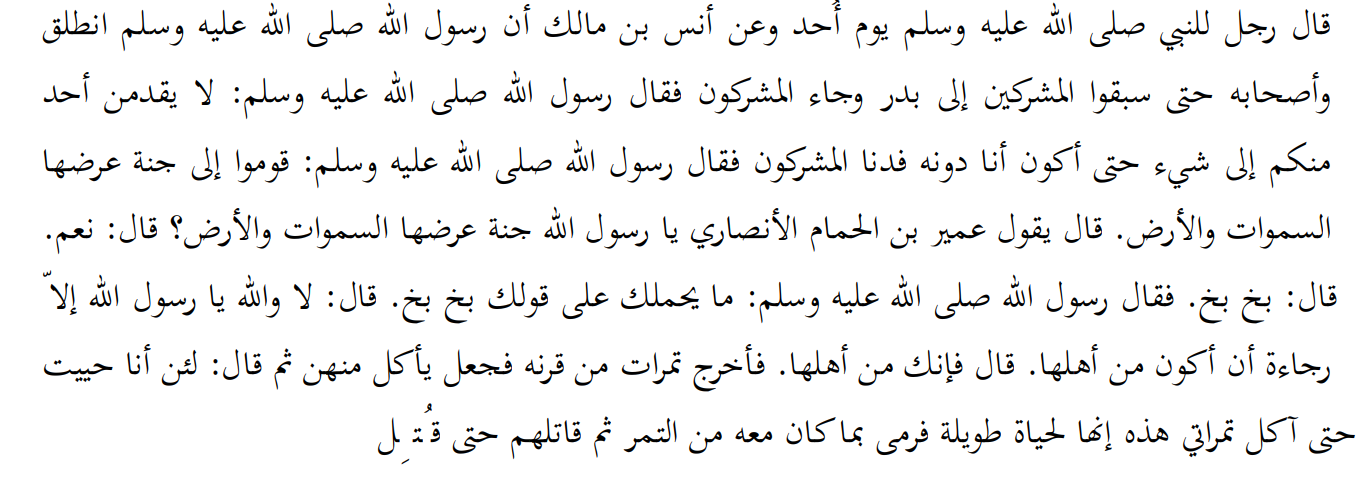
"Hiçbiriniz benim olmadan hiçbir şeye öne geçmesin." Müşrikler yaklaşınca Allah'ın Resulü ﷺ şöyle buyurdu: Göklerle yerin genişliği kadar olan bir Cennet'e doğru ilerleyin. Bunun üzerine ‘Umeyr bin el-Hümam el-Ensari dedi ki: Ey Allah'ın Resulü, göklerle yerin genişliği kadar bir Cennet mi? Bunun üzerine Allah'ın Resulü ﷺ şöyle buyurdu: (Bah! Bah!). Allah'ın Resulü ﷺ sordu: Seni "Bah! Bah!" demeye sevk eden nedir? Dedi ki: Allah'a yemin olsun ki, yalnızca o Cennet'in halkından olma umudu. Bunun üzerine Allah'ın Resulü ﷺ şöyle buyurdu: Şüphesiz sen o Cennet'in halkındansın. Bunun üzerine kuru hurmalarını (karanından) çıkarıp yemeye başladı. Sonra dedi ki: Eğer bu hurmaları yiyene kadar yaşarsam, bu uzun bir ömür olur! Sonra elindeki hurmaları fırlattı ve öldürülünceye kadar savaştı. (Müslim rivayet etmiştir.)
“Let none of you precede to anything without my being. The polytheists came close so the Messenger of Allah (saw) said: Stand forth to a Paradise whose breadth is that of the heavens and the earth. He said: ‘Umayr bin al-Hammam al-Ansari said: O Messenger of Allah, a Paradise whose breadth is that of the heavens of the earth? He said: (Bakh! Bakh!). So the Messenger of Allah (saw) said: What carried you to your statement, (Bakh! Bakh!). He said: Nothing, by Allah, except the hope that I be one of its people. He said: Verily you are one of its people. He removed dates from his (qaran) and began eating from them. Then he said: If I were to live until I ate these dates, it would then be a long life! He threw the dates that had then fought them until he was killed” (Narrated by Muslim).
Yani Allah (SWT) ve Allah'ın Elçisi ﷺ, şehit için Cennet'e tanıklık etmişlerdir. Şehidin hayatı ise Kur'an'ın açık nassıyla sabittir. Allah (SWT) şöyle buyurmuştur:
So Allah (swt) and the Messenger of Allah (saw) have witnessed the Paradise for the shaheed. As for the life of the shaheed, it is established by the explicit text of the Qur’an. Allah (swt) said:
{Allah yolunda öldürülenleri ölü sanmayın; aksine onlar, Rableri katında rızıklanarak diri(dirler).} {Allah'ın lütfundan kendilerine verdiklerine sevinç içindedirler ve arkalarından henüz kendilerine katılmamış olanlar için de, üzerlerine korku olmadığı ve üzüntü çekmeyecekleri müjdesiyle sevinirler. Allah'tan bir nimet ve lütuf müjdesi alırlar; şüphesiz Allah, iman edenlerin mükafatını zayi etmez.} [Tevbe/Âl-i İmrân 3:169].
“Do not think that those killed in the way of Allah are dead, rather (they are) alive with sustenance before their Lord. Pleased with what Allah gave them of His favours and with good tidings for those behind them who have not met them, that there is no fear for them nor do they grieve. They have glad tidings of blessings from Allah and His favour, and verily Allah does not cause the reward of the believers to be lost” [TMQ 3:169].
Şehitler için olan bu hayat, ebedî yurtta olduğu gibi bizim anlayamadığımız ve kavrayamadığımız gayba ait bir hayattır. Bu gizli hayatı anlamıyor ve kavrayamıyor olsak da, varlığına inanıyoruz; ancak gerçekliğini anlamıyoruz. Varlığına olan inancımız kaçınılmaz bir meseledir, çünkü kesin bir Kur'an metniyle sabittir. Allah (SWT) şöyle buyurmuştur:
This life for the shuhadaa is unseen which we do not understand nor perceive as it is in the eternal abode. Although we do not understand this hidden life nor perceive it, nevertheless we believe in its existence but do not understand its reality. Our conviction in its existence is an inevitable matter as it is established by a definite Qur’anic text. Allah (swt) said:
“Allah yolunda öldürülenlere ‘ölüler’ demeyin… Aksine onlar diridirler, ancak siz bunu fark etmezsiniz.” {Bakara 2:154}
“Do not say of those killed in the way of Allah (are) ‘dead’... Rather they are alive but you do not know” [TMQ 2:154].
Şehitlerin hayatı, imanın zorunlu olduğu gayb meselelerindendir. Şehitlerin faziletine gelince, bu eşi benzeri olmayan büyük bir fazilettir ve Peygamber ﷺ bunu pek çok hadiste açıklamıştır. Buhari, Katade'den rivayet etmiştir; Katade şöyle demiştir: Enes bin Malik (ra)'den işittim, o da Peygamber ﷺ'den şöyle dediğini nakletti:
The life of the shuhadaa is from the unseen (matters) in which iman is obliged. As for the virtue of the shuhadaa, it is a great virtue without an equivalent and he (saw) clarified it in numerous ahadith. Al-Bukhari narrated from Qatadah who said: I heard Anas bin Malik (ra) from the Prophet (saw) who said:
"Cennete giren hiçbir kimse, dünyada bulunan her şeyi elde etmek için dünyaya geri dönmek istemez; yalnızca şehitler hariç. Onlar, gördükleri ikram (karamah) sebebiyle, on kez öldürülmek üzere dünyaya geri dönmeyi isterler."
“No one who enters Paradise would like to return to the world to obtain all that is upon the world except the shuhadaa who would wish to return to the world to be killed ten times due to what he sees of the honour (karamah).”
Ve Buhârî'de:
And in Al-Bukhari:
Muğîre bin Şu'be şöyle dedi: Peygamberimiz ﷺ bize Rabbimizin mesajını bildirdi: Aramızdan kim öldürülürse cennete gider. Ömer de Peygamber ﷺ'e şöyle dedi: "Bizim ölülerimiz cennette, onların ölüleri ise cehennemde değil mi?" O da: "Evet" dedi.
“Al-Mughira bin Shu’bah said that our Prophet (saw) informed us of the message of our Lord that whoever is killed among us goes to Paradise and Umar said to the Prophet (saw): ‘Are not our dead in Paradise and their dead in the Fire. He said: Yes.”
Abdullah bin ‘Amru bin al-‘Aas'tan rivayet edilmiştir: Allah'ın Resulü ﷺ şöyle buyurmuştur:
And from Abdullah bin ‘Amru bin al-‘Aas that the Messenger of Allah (saw) said:
“Şehidin borcu hariç bütün günahları bağışlanır” (Müslim rivayet etmiştir).
“All the shaheed’s sins are forgiven except the debt” (narrated by Muslim).
“Şehidin borcu hariç bütün günahları bağışlanır” (Müslim rivayet etmiştir).
“All the shaheed’s sins are forgiven except the debt” (narrated by Muslim).
"Allah yolunda öldürülen kimsenin borcu dışında bütün günahları silinir."
“The one killed in the way of Allah has all his sins wiped out except the debt.”
Buhari ve Müslim, Ebu Hureyre'den (ra), Peygamber'den (ﷺ) naklederek şöyle buyurduğunu rivayet etmişlerdir:
And Al-Bukhari and Muslim narrated from Abu Hurairah (ra) from the Prophet (saw) who said:
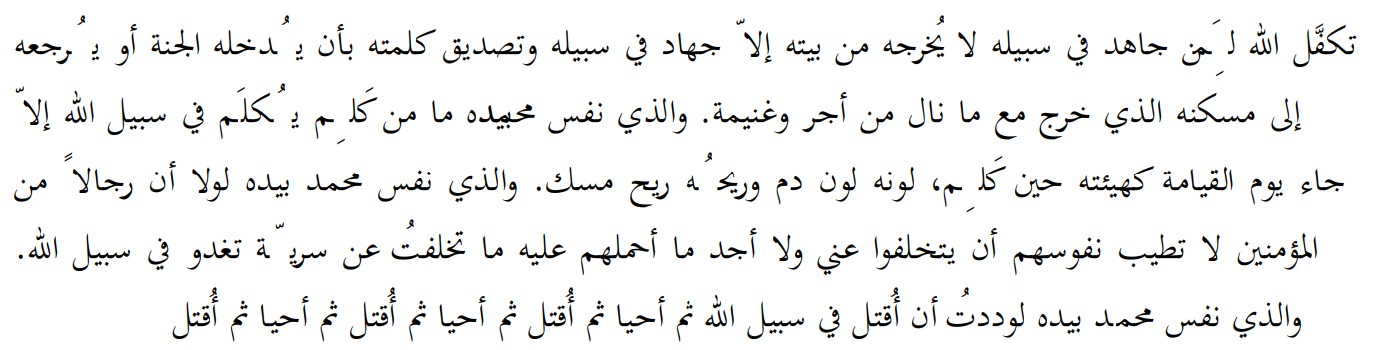
“Allah, Allah yolunda cihad ederken ölen kimsenin güvenliğini garanti altına alır; evinden Allah yolunda cihad etmek ve O'nun sözlerine iman etmek dışında hiçbir sebeple çıkmayan kimseyi, onu Cennet'e koyacağını veya ayrıldığı evine, elde ettiği sevap ve ganimetle birlikte geri döndüreceğini garanti eder. Muhammed ﷺ'in canı elinde olan Zat'a yemin olsun ki, Allah yolunda yaralanan hiç kimse, yaralandığı hâlinde, rengi kan rengi ve kokusu misk kokusu olarak Kıyamet Günü'ne gelmeyecektir. Muhammed ﷺ'in canı elinde olan Zat'a yemin olsun ki, mü'minler arasında, ardımda kalmaktan hoşnut olmayan, benim (gittiğim zaman) geride kalmamı istemeyen ve onları da bindirebileceğim bir şey bulamayan kimseler olmasaydı, Allah yolunda sabah çıkan hiçbir seriyyeden geri kalmazdım. Muhammed ﷺ'in canı elinde olan Zat'a yemin olsun ki, Allah yolunda öldürülmeyi çok isterdim; sonra diriltilip yine öldürülmeyi, sonra yeniden diriltilip yine öldürülmeyi, sonra yeniden diriltilip yine öldürülmeyi isterdim.”
“Allah guarantees security for the one who dies jihad in His way, not leaving his house for any other reason except jihad in His way and believing in His words, that He will enter him into Paradise or return him to his abode from which he left together with what he achieved of reward or booty. By the One in whose hand lies the should of Muhammad, whoever is wounded in the way of Allah will not come on the Day of Judgement except in his form when he was wounded, his colour the colour of blood and his odour the odour of musk. By the one in whose hand lies the soul of Muhammad, were it not that there were men among the believers whose souls are not pleased to stay behind me (when I go) nor do I find that could carry them upon, I would not stay behind any expedition that goes out in the way of Allah in the morning. By the One in whose hand lies the soul of Muhammad, I would love to die in the way of Allah then I am resurrected then killed, then resurrected then killed, then resurrected then killed.”