cewa ya ce ayah din an saukar da ita game da Manzon Allah ﷺ lokacin da ya yi ƙoƙarin jawo kawunsa Abu Dalib zuwa Musulunci. Sa'an nan suka zo Tabi'un bayan Sahabbai, waɗanda suka ruwaito duk abin da Sahabbai suka ambata ta wannan hanya. Daga cikin Tabi'un akwai waɗanda suka yi bayanin ayoyin Alƙur'ani mai girma ko suka faɗi dalilin saukar ayah, ko dai ta hanyar ijtihadinsu a tafsiri ko kuma ta hanyar jin hakan daga (wasu malamai). Bayan Tabi'un malaman ilimi suka zo suka faɗaɗa tafsiri, suka kawo rahotanni daga Yahudawa da Nasara. Masu tafsiri sun gaji juna daga zamani zuwa zamani da kowane tsara, waɗanda suka yi bayanin Alƙur'ani kuma suka faɗaɗa tafsiri a kowane zamani bisa abin da ya gabata. Masu tafsiri sun fara mai da hankali ga ayoyi don cire hukunce-hukunce daga cikinsu da bayyana mazhabobinsu dangane da zaɓin ra'ayi (ikhtiyar) da ƙaddara (jabr). Sun fara bayyana ayoyi suna tabbatar da ra'ayoyinsu bisa ga karkatarsu a shari'a, ilimin tauhidi ('ilm al-Kalam), balaga, sarf da nahawu da sauransu. Abin da yake bayyana idan aka duba tafsirai ta zamuna daban-daban tun zamanin Sahabbai har zuwa yanzu shi ne cewa tafsirin Alƙur'ani a kowane zamani ya sami tasiri daga motsin ilimi na zamanin, ya nuna hoton da ke nuna ra'ayoyi, ka'idoji da mazhabobin zamanin. Ba kasafai ake samun tafsirai da suka kuɓuta daga tasirin ra'ayoyi, tunani da ƙa'idojin zamanin ba.
that he said the verse had been revealed concerning the Messenger of Allah when he tried to win over his uncle Abu Talib to Islam. Then came the Tabi'un after the Sahabah who reported everything the Sahabah mentioned in this manner. From among the Tabi'un there were those who explained the verses of the Noble Qur’ān or stated the cause of revelation, either as their own Ijtihād in tafsīr or by hearing it from (other authorities). After the Tabi'un the 'Ulama came and expanded the tafsīr and quoted reports from the Jews and Christians. The mufassirun succeeded one after another in every age and generation, who explained the Qur’ān and expanded the tafsīr in each age on what had come before. The mufassirun began to give their attention to the verses to deduce rulings from them and explain their schools of thought in terms of freewill (ikhtiyar) and predestination (jabr). And they began to explain verses proving their opinions according to their inclinations in legislation, scholasticism ('ilm al-Kalam), rhetorics (balaagha), declension (sarf) and grammar etc. What is apparent from an examination of the tafaseers through the different ages since the time of the Sahabah until now is that the tafsīr of the Qur’ān in every age was influenced by the scholarly movement of the time, it presented a picture which reflected the views, theories and schools of thought of the time. Seldom were there tafsīrs that were free from the influence of opinions, thoughts and rules of the time.
Duk waɗannan tafsirai ba a tattara su a cikin littattafai tun ranar da malaman tafsiri (mufassirun) suka fara wanzuwa ba, watau tun zamanin Sahabbai. Maimakon haka, sun canja daga wani hali zuwa wani a tsawon zamani. Da farko, tafsiri ya kasance wani ɓangare ne na hadisi kuma ɗaya daga cikin babin sa. Hadisi shi ne babban fage mai faɗi wanda ya ƙunshi dukan ilimomin Musulunci. Don haka mai ruwaito hadisi, kamar yadda zai ruwaito hadisin da ke ɗauke da hukuncin shari'a, haka zalika zai ruwaito hadisin da ke ɗauke da tafsirin wata aya ta Alƙur'ani.
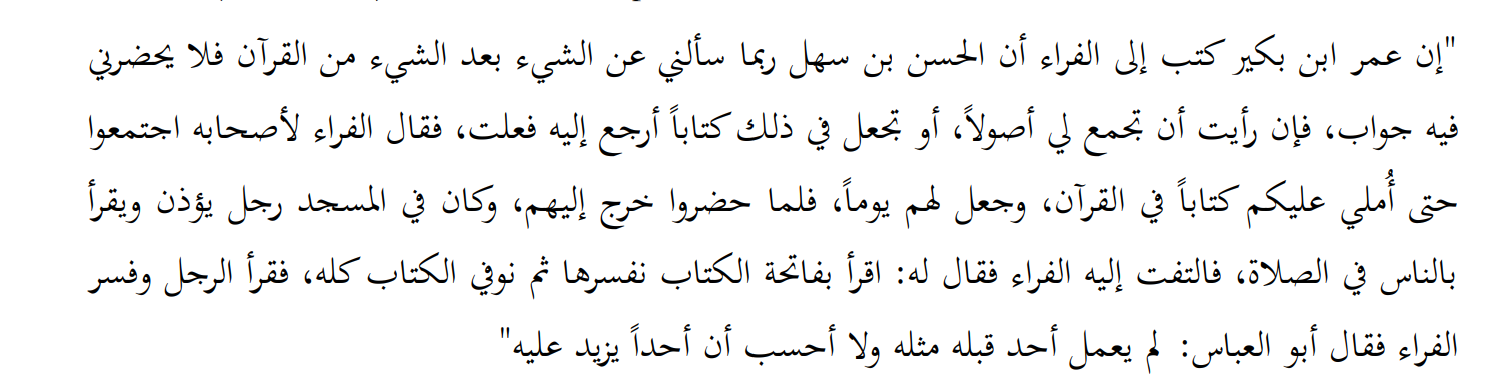
Sannan marubuta, a farkon zamanin Abbasawa da kuma ƙarshen zamanin Umayyawa, watau a farkon ƙarni na biyu hijira, suka fara tara dukan hadisan da suka yi kama da juna kuma suka dace da juna a ƙarƙashin wani babi, suka raba su da sauran babuna. Sai ilimomi kamar tafsiri da fiƙhu waɗanda hadisi ya ƙunsa suka rabu da juna. Abin da ya biyo bayan ilimomin shi ne abin da ya biyo bayan hadisi, da Sira, da fiƙhu, da tafsiri. Ta haka ilimin tafsiri ya wanzu, ya zama ilimi mai zaman kansa da ake nazari a kansa. Duk da haka, tafsiri bai kai ga samun tsari mai tsari ba, ta yadda ayoyin Alƙur'ani ba a ambace su cikin tsari irin na cikin mushaf ba, sannan a biyo su da tafsirinsu. Maimakon haka, tafsirai da aka ruwaito sun warwatse a nan da can. Sun kasance tafsirin ayoyi daban-daban, kamar yadda lamarin yake ga hadisi. Wannan hali ya ci gaba har tafsiri ya rabu da hadisi ya fara tsayuwa a matsayin ilimi mai zaman kansa. An rubuta tafsiri ga kowace aya ta Alƙur'ani ko wani ɓangare na aya, ana tsara waɗannan ayoyi bisa tsarin da suke a cikin mushaf. Mutum na farko da ya yi tafsirin Alƙur'ani yana ambaton aya bayan aya yana bayyana su ɗaya bayan ɗaya shi ne al-Farra' (d. 207 H). Ibn al-Nadim ya ruwaito a cikin littafinsa al-Fihrist cewa:
However, all of these tafsīrs were not compiled in books from the first day mufassirun came to exist i.e, from the time of the Sahabah. Rather, they changed from situation to situation through the ages. In the beginning, the tafsīr used to be a part of the hadīth and one of its chapters. The hadīth was the all-extensive topic which encompassed all the Islamic disciplines. So the transmitter of a hadīth just as he would narrate a hadīth containing a legal ruling he would also narrate a hadīth which contained the tafsīr of a Qur’ānic verse. Then writers, in the beginning of the Abbasid era and towards the end of the Umayyad era i.e, in the beginning of the second century hijri, began to bring together all the similar and relevant ahadīth under a topic and separate them from other topics. So the disciplines such as tafsīr and fiqh which the hadīth contains were separated from each other. What resulted from the sciences is what resulted in terms of hadīth, Sīrah, jurisprudence and tafsīr. Thus, the science of tafsīr came to exist and it became an independent science which was studied on its own. However, the tafsīrs did not take any organised form, in that verses of Qur’ān were not mentioned in an ordered manner like the arrangement found in the mushaf (Qur’ān) and then followed by their tafsīr. Rather the tafsīrs narrated were scattered here and there. They were tafsīr for miscellaneous verses as was the case with the hadīth. This situation continued until the tafsīr became separated from the hadīth and began to stand up as a science in its own right. Tafsīr was written for each ayah of the Qur’ān or part of an ayah, arranging these verses according to the order in mushaf. The first one to undertake the tafsīr of the Qur’ān quoting ayah after ayah and explain them one after another was al-Farra' (d.207 A.H.). Ibn al-Nadim reports in his book alFihirst that: