17.3 Alkawarin Biyayya (bay'ah)
17.3 The Pledge (bay’ah)
Bai'ah wajibi ne a kan dukkan Musulmi, kuma haƙƙi ne ga kowane Musulmi, namiji ko mace. Dalilin cewa wajibi ne yana cikin hadisai masu yawa na Annabi ﷺ, inda ya ce:
Bay’ah is an obligation upon all Muslims, and it is a right for every Muslim, man or woman. The evidence for it being an obligation is in many ahadith of the Prophet (saw), in which he said:
"Duk wanda ya mutu ba tare da bai'a a wuyansa ba, ya mutu mutuwar jahiliyya."
“Whosoever dies without having a bay’ah upon his neck dies a death of jahiliyyah.”
Dangane da kasancewarta haƙƙin Musulmi, bai'ah da kanta tana nuna hakan, domin bai'ah Musulmi ne suke yi wa Khalifah, ba Khalifah ne yake yi wa Musulmi ba. Bai'ar Musulmi ga Manzon Allah ﷺ an tabbatar da ita a cikin hadisai. Al-Bukhari ya ruwaito cewa 'Ubadah bin as-Samit (ra) ya ce:
As for being a right for Muslims, the bay’ah itself indicates that, because the bay’ah is offered by the Muslims to the Khalifah, and not by the Khalifah to the Muslims. The bay’ah of the Muslims to the Prophet (saw) was confirmed in the ahadith. Al-Bukhari reported that ‘Ubadah bin as-Samit (ra) said:
"Mun yi wa Annabi ﷺ mubaya'a cewa za mu ji kuma mu yi masa biyayya a cikin abin da yake faranta mana rai da abin da yake ɓata mana rai, cewa ba za mu yi jayayya game da umarnin waɗanda ke da iko ba, cewa za mu faɗi gaskiya duk inda muke, kuma cewa ba za mu ji tsoron zargin kowa ba idan muka aikata ko muka faɗi abu saboda Allah."
“We made a bay’ah to the Prophet (saw) to hear and to obey in whatever pleases and displeases us, and that we would not dispute the order of those in charge, that we would speak the truth wherever we are, and that we would not fear the blame of anyone when acting or speaking for the sake of Allah.”
Al-Bukhari ya ruwaito daga Ayyub, daga Hafsa, daga Umm ‘Atiyyah wacce ta ce:
Al-Bukhari reported from Ayyub from Hafsa from Umm ‘Atiyyah who said:
“Mun yi wa Annabi ﷺ mubaya’a, sai ya karanta mini aya cewa: {Ba za su yi wa Allah shirka da kome ba} (TMQ 60.12). Ya kuma hana mu kuka da makoki a kan matattu. Wata mace daga cikinmu ta miƙa hannunta ta ce: ‘Wata mace ta yi kuka a kan wani mamaci na iyalina, kuma ina so in biya ta saboda wannan kukan.’ Annabi ﷺ bai ce komai ba. Sai ta tafi, ta kuma dawo.”
“We gave a bay’ah to the Prophet (saw) and he recited to me the verse That they will not associate anything in worship with Allah (TMQ 60.12). And he also prevented us from wailing and lamenting over the dead. A woman from us held her hand out and said, "Such-and-such a woman cried over a dead person belonging to my family and I want to compensate her for that crying" The Prophet did not say anything in reply and she left and returned.”
Kuma a cikin Al-Bukhari daga Abu Hurairah (ra) wanda ya ce: Annabi ﷺ ya ce:
And in Al-Bukhari from Abu Hurairah (ra) who said: The Prophet (saw) said:
"(Akwai) mutum uku da Allah ba zai yi magana da su ba a Ranar Tashin Alƙiyama, kuma ba zai tsarkake su ba, kuma suna da azaba mai tsanani: Mutumin da yake da ruwa mai yawa a kan hanya, sai ya hana matafiyi daga gare shi; mutumin da ya yi wa Imam mubaya'a saboda al'amuran duniya kawai, idan Imam ya ba shi abin da yake so, sai ya cika mubaya'ar a gare shi, idan kuma bai ba shi ba, sai bai cika ba; da kuma mutumin da ya sayar da kaya ga wani bayan sallar la'asar, ya rantse da Allah cewa an ba shi kaza da kaza a kansa, alhali ba a ba shi ba, sai mutumin ya gaskata shi ya saya."
“(There are) three persons to whom Allah will not talk on the Resurrection Day, nor purify them, and for them is a severe punishment: A person who has an excess of water on the road and prevents the wayfarer from it; a person who gives bay’ah to an Imam for his worldly affairs only, so if the Imam gave him that which he wants he fulfilled (the bay’ah) to him, otherwise he would not; and a person trading a commodity to another after asr (late afternoon) and he swore by Allah that he was offered so and so for it, although he was not, and the person believed him and bought it.”
Al-Bukhari ya ruwaito daga ‘Abdullah bin ‘Umar (ra) wanda ya ce:
Al-Bukhari narrated from ‘Abdullah bin ‘Umar (ra) who said:
Sa'ad da muka yi wa Annabi ﷺ mubaya'a na ji da bi, yakan ce mana: Gwargwadon iyawarku.
“When we gave a bay’ah to the Prophet (saw) to hear and obey, he would say to us: As much as you are capable of”
"Sa'ad da muka yi wa Annabi ﷺ mubaya'a na ji da biyayya, sai ya ke ce mana: Gwargwadon iyawarku."
“When we gave a bay’ah to the Prophet (saw) to hear and obey, he would say to us: As much as you are capable of”
Na yi wa Annabi ﷺ mubaya'a cewa zan ji kuma zan bi, sai ya umarce ni: Gwargwadon iyawarka, kuma in yi wa kowane Musulmi nasiha ta gari.
“I gave bay’ah to the Prophet (saw) to hear and obey and he instructed me: As much as you are able, and to give good advice to every Muslim.”
Al-Bukhari ya ruwaito daga Junada bin Abu Umayyah, wanda ya ce:
Al-Bukhari narrated from Junada bin Abu Umayyah who said:
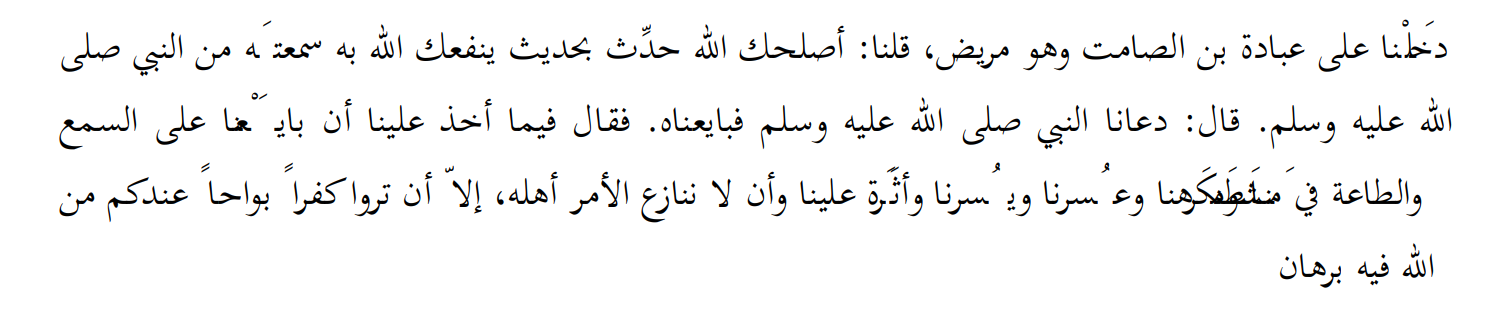
Mun shiga gidan ‘Ubadah bin as-Samit sa’ad da yake rashin lafiya, sai muka ce masa: Allah ya sa ka warke, ka gaya mana wani hadisi da ka ji daga Manzon Allah ﷺ, wanda Allah (SWT) zai amfanar da kai da shi. Ya ce: Manzon Allah ﷺ ya kira mu, muka yi masa mubaya’a (alkawarin biyayya). Daga cikin sharuddan da ya karɓi mubaya’a a kansu daga gare mu, shi ne cewa za mu saurara mu yi biyayya (ga umarni), ko a lokacin da muke da ƙarfi ko a lokacin da muka gaji, da a lokutan sauƙi da wahala, da lokacin da muka ga an fifita wasu a kanmu, da kuma kada mu yi jayayya da masu ikon da aka damƙa wa mulki, face idan kun ga kafirci bayyananne (kufr bawah) wanda kuke da hujja bayyananniya daga Allah a kansa.
“We entered the house of ‘Ubadah bin as-Samit while he was ill and we said: May Allah make you healthy, inform us of a hadith you heard from the Prophet (saw) by which Allah (swt) may benefit you. He said: The Prophet (saw) invited us and we gave him our bay’ah (pledge of Allegiance). And among the conditions on which he took the pledge from us, was that we were to listen and obey (the orders) both at the time when we were active and when we were tired , and in the times of ease and hardship and when we see preference (for others over us), and not to dispute the authority of those who are entrusted with it saying: Unless you see open disbelief (kufr bawah) upon which you have a clear proof from Allah.”
Bai'ar Khalifa tana hannun Musulmi, kuma haƙƙinsu ne; su ne suke bada baiʼa, kuma baiʼarsu ce ke sa a ƙulla Khilafah ga Khalifa. Baiʼa na iya kasancewa ta hanyar girgiza hannu ko ta rubutu. ʼAbdullahi ɗan Dinar ya riwaito yana cewa:
The bay’ah for the Khalifah is in the hands of the Muslims, and it is their right; it is they who give the bay’ah, and it is their bay’ah which makes the Khilafah contracted for a Khalifah. The bay’ah can be by shaking hand or by writing. ‘Abdullah bin Dinar narrated saying:
"Na shaida Ibn 'Umar lokacin da mutane suka taru kewaye da 'Abdulmalik bin Marwan. Ya rubuta: Na amince da sauraro da biyayya ga bawan Allah, 'Abdulmalik Amir al-Mu'mineen, bisa ga Sunnar Allah da Sunnar ManzonSa ﷺ gwargwadon iyawata."
“I witnessed bin ‘Umar where the people gathered around ‘Abdulmalik bin Marwan. He wrote: I agree to listen and obey to the slave of Allah, ‘Abdulmalik the Amir al-Mu’mineen, according to the Sunnah of Allah and the Sunnah of His Prophet as much as I am able.”
Haka kuma, bai'a tana da inganci ta kowace hanya (waseela). Sai dai, dole ne babba mai hankali ya yi bai'a, don haka bai dace yaro ya yi ba. Abu Aqeel Zahra bin Ma'bed ya ruwaito daga kakansa 'Abdullahi bin Hisham — wanda ya shaida Annabi ﷺ — cewa mahaifiyarsa Zaynab, 'yar Hameed, ta kai shi wajen Annabi ﷺ, sai ta ce: Ya Annabin Allah, ka karɓi bai'a daga gare shi. Sai Annabi ﷺ ya ce:
Moreover, the bay’ah is correct by any means (waseelah). However, the bay’ah has to be given by the mature person, so it is improper to be given by the young. Abu Aqeel Zahra bin Ma‘bed reported from his grandfather ‘Abdullah bin Hisham--who witnessed the Prophet (saw)--that his mother Zaynab, the daughter of Hameed, took him to the Prophet (saw) and said: O Prophet of Allah, take a pledge from him. The Prophet (saw) said:
Yana yaro ne, ya shafa kansa kuma ya yi masa addu'a.
“He is a child, wiped his head and made a du‘a for him.”
Dangar kalmomin bai'ah ba su takaitattu ga wasu kalmomi na musamman ba. Sai dai dole ne su hada da yin aiki bisa Littafin Allah (SWT) da Sunnar Annabinsa ﷺ daga bangaren Khalifah, da biyayya a cikin wahala da sauki, da biyayya, da duk abin da ya faranta da abin da ya bata wa mai bayar da bai'ah (ga Khalifah) rai. Duk lokacin da wanda zai yi bai'ah ya ba da bai'ahsa ga Khalifah, ko kuma Khilafah ta kulla wa Khalifah ta bai'ahn sauran Musulmi, to bai'ah ta zama amana a wuyan mai bayar da bai'ah, kuma ba a yarda ya janye ta ba. Haƙƙi ne ga kwangilar Khilafah har sai ya bayar da ita, kuma da zarar ya bayar da ita dole ne ya cika ta. Ba a yarda ya janye daga cikinta ba. Al-Bukhari ya ruwaito daga Jabir bin Abdullah (RA) cewa wani Balarabe ya bai wa Annabi ﷺ bai'ahn Musulunci, sai wata cuta ta same shi, sai ya ce wa Annabi ﷺ: "Ka bar ni in janye bai'ahta", amma Annabi ﷺ ya ƙi, sai mutumin ya tafi. Sannan Annabi ﷺ ya ce:
As for the words of the bay’ah they are not restricted to specific terms. However they must include acting according to the Book of Allah (swt) and the Sunnah of His Prophet (saw) by the Khalifah, and obedience in hardship and ease and obedience, and whatever pleases and displeases on the part of the person who gives the bay’ah (to the Khalifah). Whenever the one who pledges has given his bay’ah to the Khalifah or the Khilafah is contracted to the Khalifah by the bay’ah of other Muslims, then the bay’ah has become a trust on the neck of the one who gives the bay’ah and he is not allowed to retract it. It is a right for the contract of the Khilafah until he has given it, and once he has given it he must abide by it. He is not allowed to retract from it. Al-Bukhari narrated from Jabir bin ‘Abdullah (ra) that a Bedouin gave the Prophet (saw) his pledge on Islam, and an illness struck him so he said to the Prophet (saw): “Let me withdraw my bay’ah but the Prophet (saw) refused, and the man left. The Prophet (saw) then said:
"Madina kamar tanderu take, tana fitar da datti tana zaɓar masu kyau tana sa su cikakku."
“Medina is like a furnace, it expels out the impurities and selects the good ones and makes them perfect.”
Kuma an ruwaito daga Nafi'a wanda ya ce: Ibn 'Umar (ra) ya ce mini cewa ya ji Annabi ﷺ yana cewa:
And it is narrated from Nafi‘a who said: Ibn ‘Umar (ra) said to me that he heard the Prophet (saw) saying:
"Duk wanda ya janye hannunsa daga biyayya (ga Amir) ba zai sami hujja (ta kare kansa) ba idan ya tsaya a gaban Allah a Ranar Tashi."
“Whoever withdraws his hand from obedience (to the Amir) will find no argument (in his defense) when he stands before Allah on the Day of Resurrection.”
Yin karya bay'ar Khalifah shi ne janye hannun mutum daga biyayya ga Allah (SWT). Wannan yana faruwa idan bay'arsa ga Khalifah bay'ar kwangila ce, ko kuma bay'ar biyayya ce ga Khalifah da Musulmai suka karɓa suka kuma ba shi bay'arsu. Amma idan ya ba wani Khalifah bay'a tun farko, kuma bai cika ba saboda Musulmai baki ɗaya ba su karɓe shi a matsayin Khalifah ba, to yana da 'yancin janyewa daga wannan bay'ar. Haramcin da aka ambata a cikin hadisi ya shafi janye bay'a ga Khalifah ne, ba ga mutumin da ba a cika Khilafah a kansa ba.
To break the bay’ah of the Khalifah is withdrawing of one’s hand from the obedience of Allah (swt). This is the case if his bay’ah to the Khalifah is a bay’ah of contract or it is a bay’ah of obedience to a Khalifah whom the Muslims accepted and gave their bay’ah to. However, if he gave his bay’ah in the beginning to a Khalifah and it was not completed because the Muslims as a whole did not accept him as Khalifah, then he has the right to withdraw from that bay’ah. The prohibition mentioned in the hadith is focused on the withdrawal of a bay’ah to a Khalifah, not to a man for whom the Khilafah was not accomplished