9. Kimiyya da Al'adu
9. Science And Culture
A cikin harshen Larabci ana cewa: mutumin ya samu ('alima) ilimi ('ilm). Ma'anar hakan ita ce ya kai ga gaskiyar hakikanin ilimi. Idan aka ce ya sami ilimin wani abu, ma'anarsa ya san shi, wato an sanar da shi wani al'amari ko ya saba da shi. Haka kuma a harshen ana cewa: ya samu fahimta (thaqifa), wato ya kware, don haka ya zama mai ilimi da wayewa (thaqif). Ya fahimci harshe (thaqifa) yana nufin ya ƙware da shi kuma ya fahimce shi cikin sauri. Waɗannan ma'anonin harshe su ne tushen amfani da kalmomi. Sai dai idan an yi amfani da waɗannan kalmomi don nuna wasu ma'anoni masu alaƙa da ma'anar harshe, to hakan halal ne, kamar yadda aka karɓi kalmar fa'il (mai aiki) a nahawu misali. Ma'anar harshe ce ta fi yaɗuwa, shi ya sa tsoffin malamai suke amfani da kalmar 'ilm a kan dukkan nau'ikan ilimi ba tare da bambance tsakanin ilimomi da fannoni ba. Daga baya mutane suka fara ɗaukar ilimomin hankali da na halitta a matsayin waɗanda suka shafi kowa, yayin da ilimomin naqli (na rubutu) aka ɗauke su a matsayin na al'ummar da aka karɓo su daga gare ta. Daga nan kowane daga cikin 'ilm da thaqafa ya fara samun ma'anar ƙayyadaddiyar ƙa'ida gwargwadon fannin da yake, har ya sami ma'anonin ƙa'ida (istilahi) waɗanda suka bambanta da ma'anonin harshensu. Bisa ga wannan istilahi, suna da ma'anoni kamar haka: 'Ilm shi ne ilimin da ake samu ta hanyar lura, gwaji da koyarwa, kamar ilimin kimiyyar lissafi (physics), sinadarai (chemistry) da sauran ilimomin gwaji. Thaqafa kuwa shi ne ilimin da ake samu ta hanyar watsawa, karatu da hasashe, kamar nazarin tarihi, harsuna, fiqhu, falsafa da sauran fannonin da ba na gwaji ba. Akwai kuma wasu ilimomi marasa na gwaji waɗanda ake ɗaukar su a matsayin kimiyya (‘ilm) duk da cewa suna cikin al'adu (thaqafa), kamar lissafi (arithmetic), injiniyanci (engineering) da masana'anta (industry). Duk da cewa suna ƙarƙashin al'adu (thaqafa), ana ɗaukar su a matsayin wani ɓangare na kimiyya saboda suna na duniya ga dukan mutane, ba na wata al'umma ɗaya ba. Haka kuma, duk wani abu daga al'adu da ya shafi sana'o'in hannu waɗanda suka yi kama da masana'anta, kamar kasuwanci da sufurin jiragen ruwa, ana ɗaukar su a matsayin wani ɓangare na kimiyya, kuma suna na duniya. Amma fasaha irin su zane-zane (painting), sassaƙa (sculpture) da waƙa/kiɗa (music) suna cikin al'adu (thaqafa). Suna bin wani ra'ayi na musamman, wato wata al'ada ta musamman. Bambancin da ke tsakanin al'adu (thaqafa) da kimiyya (‘ilm) ke nan.
In Arabic language it is said: the man has obtained (‘alima) knowledge (‘ilm). This means that he attained the true reality of knowledge (‘ilm). He gained knowledge of a thing means he became cognisant of it, which means that he became informed of a matter or acquainted with it. Also in the language it is said: He has gained comprehension (thaqifa), which means that he has become proficient, thus he is educated and cultured (thaqif). He has understood (thaqifa) a language (means) he has mastered and understood it swiftly. These linguistic meanings are the basis of the use of words, However if these words were used to indicate other meanings that relate to the linguistic meaning then that is permitted, like in the case of the adoption of the word fa’il (subject) in grammar for example. The linguistic meaning (of the words) was prevailing and this is why the ancients used to apply the word ‘ilm on all forms of knowledge without differentiating between the sciences and disciplines. Then people began to consider intellectual and natural disciplines as being general to all people whilst other traditional (textual) disciplines were considered specific to the nation from which it was transferred. Subsequently, each of science (‘ilm) and culture (thaqafa) began to be defined according to different specific disciplines, acquiring terminological meanings which were different to their linguistic meanings. According to this terminology they have the following meaning: Science (‘ilm) is the knowledge which is acquired through observation, experimentation and education like physics, chemistry and the rest of the empirical sciences and culture (thaqafa) is the knowledge which is acquired by way of transmission, learning and deduction as in (the study of) history, languages, jurisprudence (fiqh), philosophy and the rest of the non-empirical disciplines. And there are other non-empirical disciplines which are included as sciences (‘ilm) even though they come within culture such as arithmetic, engineering and industry; even though they come under culture (thaqafa) they are regarded as part of science because they are universal to all people and not specific to any one nation. In a similar way anything from the culture related to crafts which resemble industry such as trade and shipping; they are considered to be part of science and they are universal. As for the arts such as; painting, sculpture and music they are part of culture. They follow a particular viewpoint; which is a specific culture. The difference between culture (thaqafa) and science (‘ilm)
Shi ne cewa ilimi na duniya ne ga dukkan al'ummomi, ba na wata al'umma ba ne kebantacce ba tare da wata al'umma ba. Dangane da al'adu (thaqafa) kuwa, yana iya zama na musamman, a danganta shi da al'ummar da ya fito daga cikinta, ko kuma ya zama wani ɓangare na halaye na musamman da keɓantattu na al'umma, kamar adabi da tarihin rayuwar jarumai, da falsafarsu game da rayuwa; ko kuma ya zama na duniya, kamar kasuwanci, jigila ta teku da sauransu. Saboda haka, ana karɓar ilimi daga dukkan al'ummomi a duniya, domin shi na duniya ne, ba na wata al'umma ta musamman ba. Amma dangane da al'adu (thaqafa), ya kamata al'umma ta fara da al'adunta na kanta, idan ta yi nazarinta kuma ta san su, har sai sun kafu a zukatanta, sannan za ta iya nazarin al'adun wasu. Musulmi a da sun kasance suna banbance tsakanin ilimomin da mutum yake samu da kansa, da ilimomin da yake karɓa daga wasu. Ibn Khaldun ya ce a cikin littafinsa al-Muqaddima:
is that science is universal to all nations and not specific to any nation to the exclusion of another nation. As for culture (thaqafa) it might be specific, being ascribed to the nation from which it resulted or it may be part of the nation’s specific and particular characteristics such as literature and biographies of heroes, and their philosophy concerning life or they may be universal such as trade, shipping etc. Therefore, science is adopted universally from all nations because it is universal and not specific to any particular nation. As for culture (thaqafa) the nation should begin with its own culture, when she has studied it and is cognisant of it until it becomes focused in their minds then they can study other cultures. The Muslims used to differentiate between the sciences which a person used to attain by himself and the sciences he used to receive from others. Ibn Khaldun says in his book al-Muqaddima:
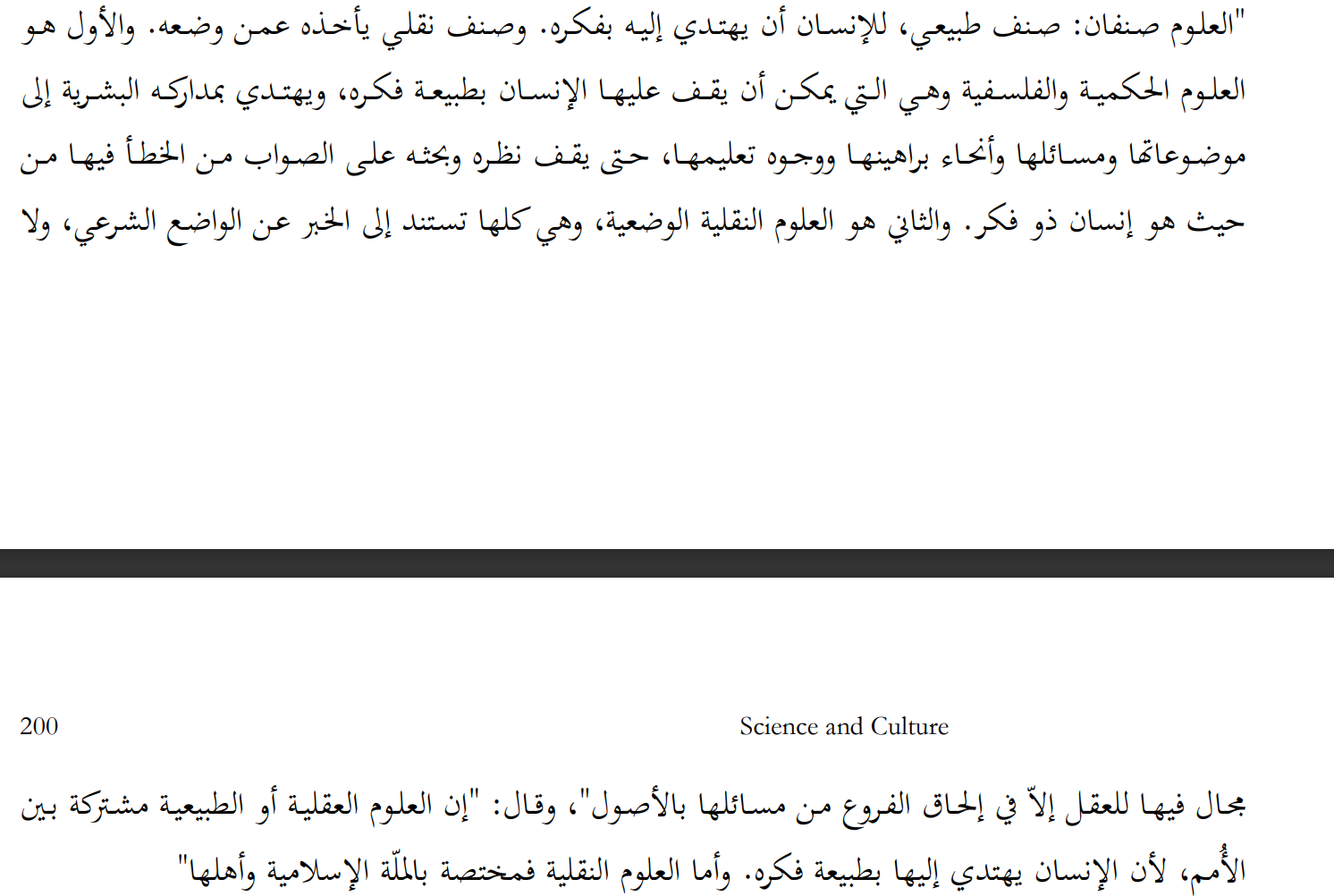
Ilimomi suna da nau'i biyu: nau'i na halitta wanda mutum zai isa gare shi ta hanyar tunaninsa, da nau'i na nassi wanda yake ɗauka daga wanda ya rubuta shi. Na farko su ne ilimomin falsafa da na hikima waɗanda zai iya nema da tunaninsa, kuma a shiryar da shi ta hanyar ƙarfin ɗan adam zuwa ga mas'aloli da al'amuransa da dukkan hujjojinsa masu yanke hukunci da fannonin koyarwarsa. Ta haka, a cikin fahimta da nazarinsa, yana kai wa ga ra'ayi daidai daga wanda ba daidai ba, a matsayinsa na ɗan adam mai ƙarfin tunani. Na biyu kuwa su ne ilimomin nassi da rubutu. Suna dogara ne da rahoto daga tushen shari'a. Hankali ba shi da wani gurbi a wannan fanni sai dai ya danganta al'amuran reshe da usul (tushe).
“The sciences are of two types: A natural type which is for man to arrive at through his thinking and a textual type which he takes from the one who authored it. The first are the philosophical and aphoristic sciences which he can seek by his thought and be guided through the human faculties to its subjects and issues and all its decisive proofs and aspects of its teachings. So as in his discernment and study he attains the correct (opinion) from the incorrect, in his capacity as a human being possessing the faculty of thought. The second are the textual and written sciences. They depend on the report coming from a shar’i source. The mind has no scope in this regard except to relate the branch issues to the usul (foundation)”.
Ya kuma ce: "Ilimomin hankali ko na halitta suna da yawa ga dukkan al'ummai, domin mutum yana kaiwa gare su ta dabi'a ta hanyar tunaninsa. Amma ilimomin nassi kuwa suna keɓe ga addinin Musulunci da mabiyansa." Ga alama abin da Ibn Khaldun ya nufa da keɓe ilimomin nassi ga millar Musulunci misali ne kawai, domin al'ummai banda al'ummar Musulunci ma suna da ilimomin nassi nasu keɓantattu, kamar dokokinsu da harshensu. Maganar Ibn Khaldun ba ta nuna cewa ya bambanta tsakanin ilimi da al'ada ba. Tana nuna kawai ya bambanta tsakanin ilimomin nassi da na hankali. Maganganunsa ba hujja ba ce da ke nuna cewa Musulmai sun kasance suna bambanta tsakanin ilimi da al'ada, sai dai hujja ce da ke tabbatar da cewa Musulmai sun kasance suna bambanta tsakanin fannoni kawai. Don haka suka raba su kashi biyu. Sai dai rabe-raben nasu ya kasance ne bisa ga yadda ake samun su gaba ɗaya, ba bisa ga hanyar samun su ba. Don haka suka sanya musu suna ilimomin hankali, watau waɗanda ake samu ta hanyar tunani, da ilimomin nassi, waɗanda ake samu daga nassi. Amma a yau mutane suna bambanta tsakanin fannoni ta fuskar hanyar da aka karɓe su. Don haka sukan yi amfani da kalmar 'ilimi' (ʿilm) ga duk abin da ake samu ta hanyar gwaji da lura, kuma sukan yi amfani da kalmar 'al'ada' (thaqafa) ga duk abin da ake samu ta wata hanya banda hanyar gwaji da lura.
He also said “The rational or natural sciences are common to all nations since man arrives at them naturally through his thought. As for the textual sciences they are specific to the Muslim religion and its adherents.” It appears that what Ibn Khaldun meant by specifying the textual sciences with the Islamic millah was only an example because nations other than the Islamic nation as well have textual sciences specific to them such as their legislation and language. Ibn Khaldun’s statement does not indicate that he distinguished between science and culture. It only indicates that he distinguished between textual and rational sciences. His comments are not an evidence to say that the Muslims used to differentiate between science and culture rather they are an evidence to prove that the Muslims used only to differentiate between disciplines. Thus, they divided them into two sections. However their division was in terms of their general acquisition and not in terms of the manner of acquisition. So they designated them as rational sciences i.e, acquired via the mind. And textual sciences acquired from the text. However, people today differentiate between disciplines in terms of the manner in which they were received. Thus, they apply the term ‘science’ (‘ilm) on anything that is acquired through the empirical method and they apply the term ‘culture’ (thaqafa) on anything acquired by means other than the empirical method