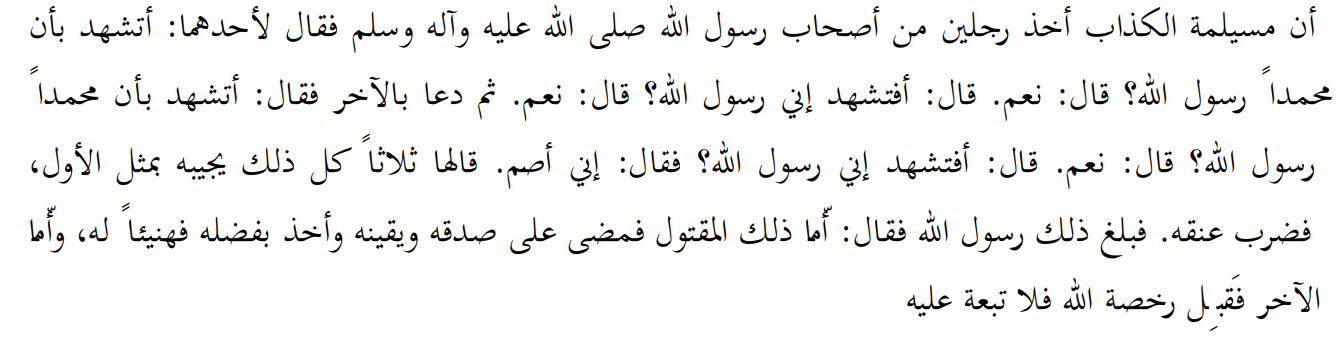
Maudu'in shi ne maudu'in masoya da mabiya addini suke yi da kafirai, sauran ayar kuma tana bayani ne a kan wannan maudu'i. Wannan saboda Allah (SWT) ya hana muminai daukar kafirai a matsayin abokai, kuma ya danganta wannan haramci da tabbataccen hukunci cewa duk wanda ya yi haka, ya dauki kafirai a matsayin abokai, to Allah ya kubuta daga gare shi. Sannan ya keɓe daga wannan haramci mai karfi yanayi guda daya, wato idan mumini yana tsoron cutarwa daga kafiri, to a nan an halatta masa ya yi abota da kafirai domin ya kare kansa daga wannan cutarwa. Wannan ana nufin idan Musulmi yana karkashin ikon kafirai, an kayar da shi a al'amarinsa, watau tsoron kafiri yana halatta masa yin abota da shi. Idan tsoron ya kau, to abotar ta zama haramun. Saboda haka yanayin ba nuna abota ba ne alhali ana boye wani abu daban, a'a, batun shi ne keɓe yanayin tsoron mumini ga kafiri lokacin da Musulmi ya kasa a al'amarinsa daga cikakken haramcin yin abota da shi. Ma'anar ayar ita ce tabbataccen haramci ga muminai na daukar kafirai a matsayin abokan zama, da neman taimakonsu, da dogara gare su, da yin soyayya da su. Don haka ta haramta wa muminai yin abota da kafirai maimakon muminai, sannan ta keɓe yanayi guda daga cikin wannan, wato yanayin da ake tsoron kafiran idan Musulmi yana karkashin ikonsu. A nan ana halatta nuna soyayya gare su da yin abota da su domin kare kai daga sharrinsu da cutarwarsu. Wato ana halatta daukar su a matsayin abokai a yanayin da ake tsoron su lokacin da suke da iko a kan Musulmi. Baya ga haka, ba a halatta ko kadan. Wannan hukunci kuma ya shafi kafirai ne kawai dangane da muminai, domin an saukar da ayar ne a kan al'amarin muminai da suke da alaka ta abota da mushrikai a Makka. Ya hana mutanen Madina abota da masu shirka a Makka, kuma ya hana dukkan muminai, sai dai ya keɓe daga wannan muminan da ke Makka waɗanda suka sha kaye a al'amarinsu. Don haka ya keɓe su saboda kasancewar tsoron cutar kafirai da ke kusa da su. Wannan shi ne maudu'in ayar, kuma wannan shi ne ma'anarta, kuma wannan ita ce hukuncin Shari'a da aka samo daga cikinta, wato hana muminai yin abota da kafirai ta kowane irin abota, kamar goyon baya, soyayya, taimako da sauransu, domin kalmar (awliya) ta zo a ayar a matsayin ta gaba ɗaya, tana ƙunshe da dukkan ma'anoninta. Haka kuma an yarda a yi abota da su a halin tsoro, wato tsoron cutarsu da zaluncinsu, idan kafirai suka yi galaba a kan Musulmi, Musulmi kuma suka sha kaye a al'amarinsu, kamar yadda yanayin Musulmin Makka yake tare da masu shirka. Babu wata ma'ana a cikin ayar sai wannan, kuma babu wani hukunci da aka samo daga gare ta sai wannan hukuncin. Amma abin da wasu ke cewa, cewa "taqiyya" shi ne Musulmi ya nuna akasin abin da ke ɓoye a zuciyarsa a gaban duk wanda yake tsoron cutarsa ko yake tsoron ya san gaskiyarsa da abin da ke cikin ransa, ko wannan mutum kafiri ne ko mumini, wannan magana kuskure ne kawai. Ayar ba ta nuna wani abu daga wannan ba, domin ma'anar: "Sai dai idan kun ji tsoro daga gare su (tuqat)", wato sai dai idan kun ji tsoron wani abu daga gare su da ya kamata a ji tsoronsa, kamar yadda ma'anar "ittaqaytu" shi ne na ji tsoronsa, su "tuqat" da "taqiyya" ma'ana ɗaya suke da ita. Wannan keɓewa ne daga hana muminai yin abota da kafirai maimakon muminai, don haka yana takaita ne ga abin da aka keɓe daga cikinsa.
The subject is the subject of believers befriending disbelievers and the rest of the ayah is detailing the subject. This is because Allah (swt) prohibited the believers from taking the disbelievers as friends, and linked this prohibition with a definite decisiveness that the one who does that and takes the disbelievers as friends then Allah is absolved from him. The he excluded from this decisive prohibition one situation which is the believer fearing harm from the disbeliever, wherein it is allowed for him to befriend the disbelievers to prevent this harm. This is if the Muslim were under the disbelievers’ authority defeated in his affair i.e. the fear of the disbeliever permits his befriending. If the fear disappears then the befriending is forbidden. Accordingly the situation is not displaying befriending and hiding something else, but the issue is excluding the situation of the believer’s fear of the disbeliever when the Muslim is defeated in his affair from the generality of forbidding his befriending him. The meaning of the ayah is the decisive prohibition for the believers from taking the disbelievers as friends for them, and that they seek their assistance and depend upon them, and that they befriend them and there be love between them. So it forbade the believers from befriending disbelievers instead of believers then excluded one situation from this, which is in the situation where there exists fear from them when they are under their authority. Then it is allowed to display love for them and to befriend them to prevent their evil and harm. That is, it is allowed to take them as i.e. friends in the situation where there exists fear from them when they are under their rule. Apart from that, it is absolutely not allowed. This is for the disbelievers only in relation with the believers as the ayah was revealed in the affair of the believers who had relations friendship with the polytheists in Makkah. It prohibited those in Madinah from befriending the polytheists in Makkah and it prohibited all believers but excluded from that the believers who were in Makkah who were defeated in their affair. So it excluded them due to the existence of fear of the harm of the disbelievers near to them. This is the subject of the ayah and this is its meaning, and this is the Shari’ah rule deduced from it which is the forbidding of the believers befriending the disbelievers in all types of befriending, for support, friendship, assistance etc as the word (awliya) came general in the ayah covering all its meanings, and the permission of befriending them in the situation of fearing them i.e. fearing their violence and harm when the disbelievers are victorious over Muslims and the Muslims are defeated in their affair exactly like the situation of the Muslims in Makkah with the polytheists. There does not exist any other meaning in the ayah nor any rule other than this rule deducted from it. As for what some say that “taqiyyah” is that a Muslim displays opposite to what is hidden before any person from whom he fears harm or fears his knowing his reality and what is in his soul whether that person is a disbeliever or believer, this statement is pure error. The ayah does not indicate anything of this since the meaning of: “Except if you fear from them (tuqat)” i.e. except if you fear from them something to be frightened of as the meaning of “atqaytu” something “taqiyyah” is I feared it, and (tuqat) and (taqiyyah) are of one meaning. This is excluded from the prohibition of believers befriending disbelievers instead of believers so it is specific to what is excluded of it.
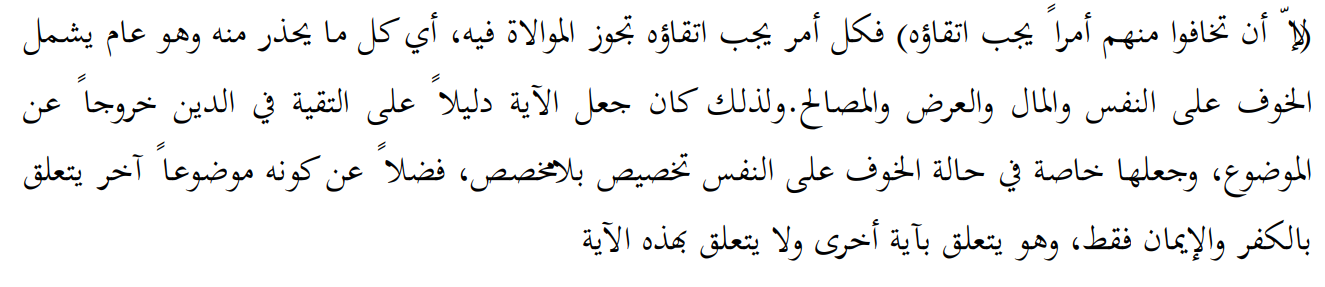
Saboda haka, nuna ƙauna ga shugaban Musulmi saboda tsoron cutarsa alhali shi azzalumi ne, mai ketare iyaka, yana mulki da kafirci, haram ne. Haka kuma nuna ƙauna ga Musulmin da yake saɓa maka a ra'ayi, alhali kana ɓoye ƙiyayya gare shi, haram ne. Kuma nuna rashin bin ƙa'idojin Musulunci, ko rashin kula da shi a gaban kafiri ko azzalumi, ba a yarda da shi ba. Duk wannan da duk abin da yake kama da shi munafunci ne, wanda Shari'a ta haramta wa Musulmi. Domin maganar "Sai dai idan kun ji tsoro daga gare su wani abin tsoro (tuqat)" an takaita ta ga halin Musulmai da suke a Makka tsakanin mushrikai, watau an takaita ta ga yanayin kasancewar Musulmai a ƙarƙashin ikon kafirai, babu kuma ikon kawar da mulkinsu, watau an ci su a al'amarinsu. A nan ne kawai aka halatta musu su yi abota da kafirai saboda tsoron abin da ake tsoro daga gare su, ko a kan rayuwarsu, dukiyarsu, mutuncinsu ko muradansu. A wannan yanayi kaɗai ake halatta a riƙa kafirai abokai maimakon mumunai. Duk abin da ya shiga ƙarƙashin wannan yanayi, to yana halatta a riƙa kafirai abokai maimakon mumunai. Abin da ake nufi shi ne a bayyana yanayin da yake halatta wa mumunai su yi abota da kafirai, wato inda Musulmai suka sha kaye a al'amarinsu a gaban kafirai, kamar inda suke ƙarƙashin ikonsu ko mulkinsu; ba wani abu kuma ba.
Accordingly displaying affection for the Muslim ruler due to fearing his harm when he is an oppressor, a transgressor, ruling by disbelief is haram. Similarly displaying affection for the Muslim contradicting you in the opinion while hiding hate for him is haram, and to show lack in restriction by Islam or not caring for it in front of the disbeliever or transgressor is not permitted. All of that and what is similar to that is hypocrisy which the Shar’a made haram upon Muslims since the subject of “Except if you fear from them something to fear (tuqat)” is restricted to the reality of Muslims who were in Makkah between polytheists i.e. restricted to the situation of the existence of Muslims under the authority of disbelievers and there is no capability for them to remove their authority i.e. defeated in their affair. Then it is allowed for them to befriend the disbelievers in fear over what is feared from them whether over their lives, wealth, honour or interests. In this situation alone it is allowed to take disbelievers as friends instead of believers. Everything that enters under this situation allows taking disbelievers as friends instead of believers. The issue is clarifying the situation wherein it is allowed for believers to befriend disbelievers which is where Muslims are defeated in their affair before disbelievers like where they are under their authority or rule; it is absolutely nothing else.
Muhammad bin Jareer At-Tabari ya ce a cikin tafsirinsa: "Ra'ayin da ke cikin fassarar faɗinsa: 'Kada muminai su riƙi kafirai a matsayin abokai maimakon muminai' har zuwa faɗinsa 'sai dai idan kuna tsoron wani abu daga gare su da ya cancanci a ji tsoro (tuqat).' Abu Ja'far ya ce: Wannan hani ne daga Allah (swt) ga muminai kada su riƙi kafirai a matsayin masu taimako, masu goyon baya da mataimaka. Saboda haka ya yi kasr ga 'yatakhidhu' (riƙewa) a wurin sanya hani mai ƙarfi, amma ya yi kasr ga 'dhal' tare da shi saboda 'sakina' da ke haɗuwa da 'sakina'. Ma'anar wannan ita ce: 'Kada ku riƙi kafirai, ya ku muminai, a matsayin mataimaka da masu goyon baya suna abota da su, maimakon Musulmi, a kan addininsu, kuma ku taimake su a kan Musulmi, ku nuna musu raunin (Musulmi). Duk wanda ya yi haka, to ba ya cikin Allah (swt) a kowane abu, wanda ke nufin an 'yantar da shi daga Allah (swt), kuma Allah (swt) ya 'yantar da kansa daga gare shi saboda ridda daga addininsa da shiga cikin kufr. 'Sai dai idan kuna tsoron wani abu daga gare su da ya cancanci a ji tsoro (tuqat)' (watau) sai dai idan kuna cikin ikonsu kuna tsoron rayukanku, to ku nuna abota da harshenku, ku ɓoye gabarku a gare su, amma kada ku zama masu goyon bayan abin da suke a kai na kufr, kada kuma ku taimake su a kan Musulmi da aiki," kamar yadda aka ce:
Muhammad bin Jareer At-Tabari said in his tafseer: “The view in interpreting His statement: ‘Let not the believers take the disbelievers as friends instead of believers’ until His statement ‘except if you fear from them something to be feared (tuqat).’ Abu Ja’far said: This is a prohibition from Allah (swt) for the believers not to take disbelievers as helpers and supporters and assisters. Accordingly He made (kasr) for “yatakhidhu” (to take) in the position of making the prohibition decisive but He made (kasr) for the “dhal” together with it due to the “sakina” which meets a “sakina”. The meaning of this is "Do no take, O you believers, the disbelievers as assisters and supporters befriending them, instead of Muslims, upon their religion and assist them against Muslims and direct them to their (Muslims’) weaknesses. For whoever does that then he is not from Allah (swt) in anything which means that he has been absolved from Allah (swt) and Allah (swt) is absolved from him by his apostasy from His deen and his entering into kufr ‘except if you fear from them something to be feared (tuqat)’ (i.e.) except if you are in their authority and fear them for your lives then show friendship by your tongues and hide your enmity from them but do not be partisans for what they are upon of kufr and do not help them against a Muslim by action" just as:
Al-Muthni ya ba ni labari cewa: Abdullah bin Sahr ya ce: Mu'awiyya bin Salih ya sanar da ni daga Ali (ra) daga Ibn Abbas (ra) cewa Maganarsa (swt): "Kada muminai su riki kafirai a matsayin abokai maimakon muminai," sai dai idan kafirai sun rinjayi, to sai su nuna musu alheri amma su saba musu a addininsu, da kuma Maganarsa (swt): "sai dai idan kuna tsoron wani abu daga gare su abin tsoro (tuqat)," har ya ce:
Al-Muthni narrated to me: Abdullah bin Sahr said: Mu’awiyya bin Salih informed me from Ali (ra) from ibn Abbas (ra) that His (swt) statement: “Let not the believers take disbelievers as friends instead of believers” except if the disbelievers become victorious so they shown them kindness but contradict them in their deen and that His (swt) statement: ‘except if you fear from them something to be feared (tuqat)’ until he said:
Al-Hasan bin Yahya ya ba ni labari cewa Abdurraziq ya sanar da mu cewa Mu'ammar ya sanar da mu game da maganar Allah (SWT): "Kada muminai su riƙi kafirai a matsayin abokai," cewa Qatadah ya ce: Ba a halatta ga mumini ya riƙi kafiri a matsayin aboki a cikin addininsa ba. Kuma game da maganar Allah (SWT): "Sai dai idan kuna jin tsoron wani abu daga gare su wanda ya kamata a ji tsoronsa," cewa: akwai dangantakar jini a tsakaninku da shi, saboda haka kana abokantaka da shi saboda hakan. Abu Ja'far ya ce: Abin da Qatadah ya faɗa a tafsirinsa yana nasa ne shi kaɗai, kuma ba shi ne alkibla da ma'anar fili ta ayar ke nunawa ba, sai dai idan kuna jin tsoron kafirai wani abu da ya kamata a ji tsoronsa. Ma'ana mafi ƙarfi daga cikin ma'anonin waɗannan kalmomi ita ce: sai dai idan kuna jin tsoron wani abu daga gare su. Taqiyyar da Allah (SWT) ya ambata a cikin wannan ayar taqiyya ce daga kafirai, ba daga wasu ba. Qatadah kuwa ya ɗauki ma'anarta da cewa: sai dai idan kuna jin tsoron Allah (SWT) saboda dangantakar jini tsakaninku da su, wani abu da ya kamata a ji tsoronsa, don haka ya haɗa dangantakar jini wadda ba ta da ƙarfi dangane da ma'anar maganar. Tafsirin Alƙur'ani yana bisa ma'ana mafi ƙarfi ta fili na sanannen harshen Larabawa kamar yadda aka yi amfani da shi a tsakaninsu." (Kalmomin At-Tabari sun ƙare).
Al-Hasan bin Yahya narrated to me that Abdurraziq informed us that Mu’ammar informed us from His (swt) statement: ‘Let not the believers take the disbelievers as friends’ that Qatadah said: It is not allowed for a believer to take a disbeliever as a friend in his deen. And His (swt) statement: ‘Except if you fear from them something to be feared’: that there is between you and him kinship so you befriend him for that. Abu Ja’far said: That which was said by Qatadah in his interpretation is for him alone nor is it the direction which the clear apparent meaning of the ayah indicates except if you fear from the disbelievers something to be feared. The stronger of the meanings of these words is except if you fear from them something to be feared. The (taqiyyah) which Allah (swt) mentioned in this ayah is the (taqiyyah) from the disbelievers not others and Qatadah took it to mean except if you fear Allah (swt) because of the kinship between you and them something to be feared so you united its blood-relationship which is not stronger in relation to the meaning of the speech. The interpretation in the Qur’an is upon the stronger apparent (meaning) of the known speech of the Arabs as was used among them” (At-Tabari’s words ends).
Kuma Abu Ali Al-Fadhl bin Al-Hasn At-Tabarsi ya ce a cikin littafinsa ‘Majmu Al-Bayan fi tafseer Al-Qur’an’ cewa maganar Allah: ‘Kada muminai su riƙi kafirai a matsayin abokai maimakon muminai, duk wanda ya aikata haka ba ya cikin Allah ta kowane hali, sai dai idan kuna tsoron wani abu daga gare su (tuqat). Allah yana gargaɗin ku game da Kansa, kuma zuwa ga Allah ne komawa’, Ya’qub da Sahl sun karanta shi da (taqiyyah), wanda karatun Al-Hasan da Mujahid ne, sauran kuwa sun karanta shi da (tuqat)… Sa’ad da Allah ya bayyana cewa Shi ne Sarkin duniya da Lahira, kuma Mai iko (Al-Qadir) bisa ɗaukaka da wulakantarwa, sai Ya hana muminai yin abota da waɗanda ba su da daraja ko wulakanci daga maƙiyansa, don a yi marmarin abin da ke wurinsa da waliyyansa, muminai, ba maƙiyansa ba, watau kafirai. Don haka Ya ce: ‘Kada muminai su riƙi kafirai a matsayin abokai/masu taimako (awliya)’, watau bai dace muminai su riƙi kafirai a matsayin abokai ga kansu ba, su nemi taimakonsu, su nemi mafaka a wurinsu, kuma su nuna musu soyayya kamar yadda Allah (swt) ya faɗa a wurare da dama na Alƙur’ani, kamar maganarSa (swt):
And Abu Ali Al-Fadhl bin Al-Hasn At-Tabarsi said in his ‘Majmu Al-Bayan fi tafseer Al-Qur’an’ that Allah’s statement: ‘Let not the believers take the disbelievers as friends instead of believers, and whoever does that is not of Allah in anything except if you fear from them something to be feared (tuqat). And Allah warns you against Himself and to Allah is the return’ that Yaqub and Sahl recited it as (taqiyyah) which is the recitation of Al-Hasan and Mujahid with the rest as (tuqat)…When Allah clarifies that He is the King of the world and Hereafter, and All-Capable (Al-Qadir) to honour and humble, He prohibited believers from befriending those who have no honour nor humiliation from His enemies so that the eagerness becomes for what is with Him and His friends, the believers, not His enemies i.e the disbelievers. So He said: ‘Let not the believers take the disbelievers as friends/supporters (awliya)’ i.e. it does not suit the believers to take disbelievers as friends for themselves, seek assistance from them, seek refuge with them and show love for them like He (swt) said in numerous places of the Qur’an like His (swt) statement: