2.13 Annabawa da Manzanni
2.13 The Prophets And Messengers
'Annabi' da 'manzo' kalmomi biyu ne masu bambanci, amma sun yi daidai a cikin cewa an saukar da shari'a ga dukkansu. Bambancin da ke tsakanin manzo da annabi shi ne cewa na farko an yi masa wahayi da shari'a wadda aka umarce shi ya yada, alhali na biyun, watau annabi, shi ma ana yi masa wahayi, amma an umarce shi ya yada shari'ar manzanni. A takaice, manzo an umarce shi ya yada shari'ar da kansa, yayin da annabi ke yada shari'ar manzanni.
‘Prophet’ (nabi) and ‘Messenger’ (rasul) are two contrastive terms but they share in the respect that a shari’a is revelaed to both of them. The difference between the Messenger and the prophet is that the former is inspired with a Sharī’ah which he is commanded to propagate, whereas the latter, i.e. the prophet is also inspired, but commanded to propagate the Sharī’ah of the messengers. In other words, the messenger is commanded to propagate the Sharī’ah himself, whilst the prophet propagates the Sharī’ah of the messengers.
Al-Qadi al-Baydawi a cikin tafsirinsa na faɗin Allah
Qadi al-Baydawi in commentary of the saying of Allah ,
"Ba mu taba aika wani manzo ko annabi ba kafin ka, sai dai idan ya yi buri, sai Shaidan ya jefa cikin burinsa."
"Never did we send an apostle or a prophet before thee, but, when he framed a desire" [TMQ Hajj: 52];
Ya ce, ‘Manzon Allah yana aika shi ne da wata Shari’ah da aka sabunta ko aka sabuntata, wacce yake kira mutane zuwa gare ta, alhali kuwa annabi Allah yana aika shi ne domin ya tabbatar da Shari’ah ta baya.’ Don haka, Musa ya kasance annabi saboda an yi masa wahayin wata Shari’ah, kuma manzo saboda wannan Shari’ah tana cikin manufarsa. A gefe guda kuma, ko da yake Haruna ma annabi ne saboda an yi masa wahayin wata Shari’ah, bai kasance manzo ba, domin Shari’ar da aka saukar masa ba don manufarsa ta ke ba, face don manufar Musa ﷺ. Haka nan, Muhammad ﷺ annabi ne kuma manzo ne saboda an yi masa wahayin wata Shari’ah, wacce take don manufarsa.
Says, ‘The messenger is sent by Allah with a revived or new Sharī’ah which he calls people to, whereas the prophet is sent by Allah to affirm the former Sharī’ah.’ Thus, Musa was a prophet because he was inspired with a Sharī’ah and a messenger because this Sharī’ah was for his mission. On the other hand, although Aaron was also a prophet because he was inspired with a Sharī’ah, he was not a messenger because the Sharī’ah, which was revealed to him was not for his mission, rather it was for the mission of Musa . By the same token, Muhammad was a prophet and a messenger because he was inspired with a Sharī’ah, which was for his mission.
Manzanci shi ne tsakani tsakanin Allah da bayinSa, domin bayyanawa da fayyace hanyar biyan bukatun wannan duniya da na lahira. Hikima tana bukatar aiko manzanni, domin su kawo dokoki da amfani ga mutane.
The message is the mediation between Allah and the slaves in order to explain and clarify the method of satisfying the needs of this world and the hereafter. Wisdom necessitates the sending of messengers as they bring laws and benefits for people.
Don haka, aika Manzanni ta faru a zahiri. Allah ya zaɓi manzanni daga cikin ɗan Adam, ya aike su a matsayin masu bayar da labarin farin ciki game da Aljanna da lada ga mutanen imani da biyayya. Su ne masu gargaɗi game da Wutar Jahannama da azaba ga mutanen kafirci da rashin biyayya, kuma sun bayyana wa mutum abubuwan da yake buƙata da abin da ake bukata a duniya da lahira. Duk wannan saboda hankali ba shi da ikon yanke hukunci a kan nagari da mugunta, ba kuma ya iya fahimtar kansa da al'amuransa.
Thus, the sending of Messengers has actually occurred. Allah appointed messengers from amongst mankind and sent them as bearers of glad tidings of paradise and reward to the people of belief and obedience. They were warners of the hell fire and punishment to people of disbelief and disobedience and they clarified the needs and requirements of this world and the hereafter for man. All because the mind is incapable of either deciding the good and bad or able to comprehend man himself and his affairs.
Adam ya saɓa umarnin Ubangijinsa, sai abin da ya nufa bai samu hanyar kaiwa gare shi ba. Bayan haka Ubangijinsa ya zaɓe shi, ya karɓi tubarsa da rahamarsa, ya kuma nuna masa hanyar kusancinsa mai daraja. [TMQ Tā Hā: 121-2]
"Adam slipped the commandment of his Lord then what he had desired, did not get the way to it. Thereafter his Lord chose him and turned to him with his mercy and showed him the way to his favoured nearness" [TMQ Tā Hā: 121-2]
Ma'anar kalmar Ijtaba a nan ita ce zaɓe shi. Haka kuma Alƙur'ani ya tabbatar da cewa Allah ya umarci Adam da wasu abubuwa, kuma ya hana shi wasu abubuwa. Saboda haka Allah ya ce,
The meaning of Ijtaba in this context means selecting him. The Quran also proves that Allah both commanded and prohibited Adam certain things. Hence Allah says,
Kuma muka ce, "Ya Adam, ku zauna kai da matarka a Aljannah, ku ci daga cikinta yadda kuka so, amma kada ku kusanci wannan itaciya, don kada ku zama daga cikin azzalumai." [TMQ Baqarah: 35]
"And we said, O Adam, dwell you and your wife in paradise and eat freely thereof where you will, but do not approach this tree lest you become of the transgressors" [TMQ Baqarah: 35]
Wannan a bayyane yake yana tabbatar da cewa babu wani annabi a zamaninsa. Saboda haka, Adam annabi ne ta hanyar wahayi kawai, babu wani abu dabam. Annabi ne da aka yi wa wahayi da Shari'ah, domin kowane umarni [amr] ko hani [nahi] Shari'ah ce. Don haka, tun da an yi masa wahayi, shi annabi ne.
This categorically proves that there was no other prophet during his time. Therefore, Adam was a prophet by revelation and nothing else. A prophet who was inspired with a Sharī’ah, as every commandment [amr] or prohibition [nahi] is Sharī’ah. Thus since he received inspiration he is a prophet.
Tushe na biyu shi ne Sunnah. Tirmizi ya ruwaito daga Abu Sa'id al-Khudri cewa Annabi ﷺ ya ce,
The Second source is the Sunnah. Tirmidhi reported from Abu Said al-Khudri that the prophet said,
"Ni ne zan zama shugaban 'ya'yan Adam a ranar kiyama, amma ba na yin fahariya. Zan rike tutar al-Hamd a hannuna, amma ba na yin fahariya, kuma a wannan rana, dukkan annabawa tun daga Adam za su kasance karkashin tutata."
"I will be the leader of the sons of Adam on the day of resurrection but I do not boast. I will have the banner of al-Hamd in my hand but I do not boast and on that day, all the prophets from Adam will be under my banner."
A ƙarshe, ijma'in Sahabbai ma yana tabbatar da cewa Adam annabi ne.
Lastly, the consensus of the Sahaba also proves that Adam was a prophet.
Game da annabcin Muhammadu ﷺ, saboda shi ma ya yi da'awar annabci kuma ya kawo mu'ujizai, annabcinsa an sani ta hanyar riwayoyin Mutawatir, wadanda ke tabbatar da shi ba tare da wata shakka ba. Game da mu'ujiza (watau Alkur'ani), ita ce maganar Allah ﷻ, wadda ta kalubalanci tare da kalubalantar manyan masu fasaha da iya magana na Makka. Ba su iya adawa da mafi gajeren surar Alkur'ani ba, duk da cewa sun yi kokarin yin haka. Sai suka watsar da hanyoyin adawarsu ta magana da fasaha, duk da cewa su ne mafi kwarewa da girma a harshe a zamaninsu, suka koma ga karfi da takobi. Ko da daya daga cikin kafirai ba ta taba ruwaito cewa wani ya taba iya kawo wani abu makamancin Alkur'ani ba, duk da cewa suna da hanyoyin ruwaita wannan bayani idan an bukata. Duk wannan yana tabbatar da cewa Alkur'ani, watau mu'ujizar da aka bai wa Muhammadu ﷺ, daga Allah ﷻ yake, kuma ba tare da wata shakka ba yana tabbatar da gaskiyar da'awar Annabi ﷺ.
As for the prophethood of Muhammad , as he also claimed prophethood and brought forth miracles, the prophethood is known by Mutawatir narrations, which substantiates it beyond any doubt. As for the miracle (i.e. the Qur’ān) it is the speech of Allah , which challenged and defied the eloquent and great speakers of Mecca. They were unable to oppose the shortest Sura of the Qur’ān, although they strived to do so. They then abandoned their styles of opposition from talk and rhetoric, even though they were the best and most revered linguists of their time, to force and the sword. Not even one of the disbelieving Kuffars ever related that someone was ever able to produce anything similar to the Qur’ān, despite the fact that they had the means to relate this information if required. All this categorically proves that the Qur’ān, i.e. the miracle given to Muhammad is from Allah and without any doubt verifies the true claim of the prophet .
Adadin annabawa da manzanni ba a sani ba, domin Allah ya sanar da manzonsa.
The number of prophets and messengers are unknown because Allah informs his messenger,
"Lalle mun aiko manzanni gabanka, daga cikinsu akwai waɗanda muka labarta maka labarinsu, akwai kuma waɗanda ba mu labarta maka ba." [TMQ Ghafir:78]
"We have sent messengers before you, we have mentioned some of their stories to you, whilst we have not mentioned others." [TMQ Ghafir:78]
Ko da yake an ambaci adadin a wasu Hadisai, Hadisan da ake magana a kansu na nau'in Ahad ne. Saboda haka ba su da wani muhimmanci a cikin 'aqīdah (akida); wato ba sa cikin 'aqīdah. Koda a ce Hadisin Ahad ya cika dukkan sharuddan Usul-al-fiqh, hakan zai kai ga hasashe kawai, kuma ba za a iya karɓar hasashe a matsayin wani ɓangare na imani ba. Saboda haka, adadin ya takaita ga annabawa da manzannin da aka ambata a cikin Alkur'ani, domin hakan tabbatacce ne. Haka kuma, ba a ambaci adadin annabawa ba a cikin Hadisi Mutawatir. Game da annabawan da aka ambata a cikin Alkur'ani, Allah ya ce,
Although the number has been mentioned in some Ahadith, the Ahadith in question are of the Ahad category. Thus they do not have any value in ‘aqīdah (creed); i.e. they do not form part of the ‘aqīdah (creed). Assuming that the Ahad Hadith met all the pre-requisites of Usul-al-fiqh, it would only lead to conjecture, and conjecture can not be accepted as part of belief. Therefore the number is limited to the prophets and messengers mentioned in the Qur’ān because that is definite. Moreover, the number of prophets is neither mentioned in the Mutawatir Hadith. In respect to the prophets mentioned in the Qur’ān, Allah says,
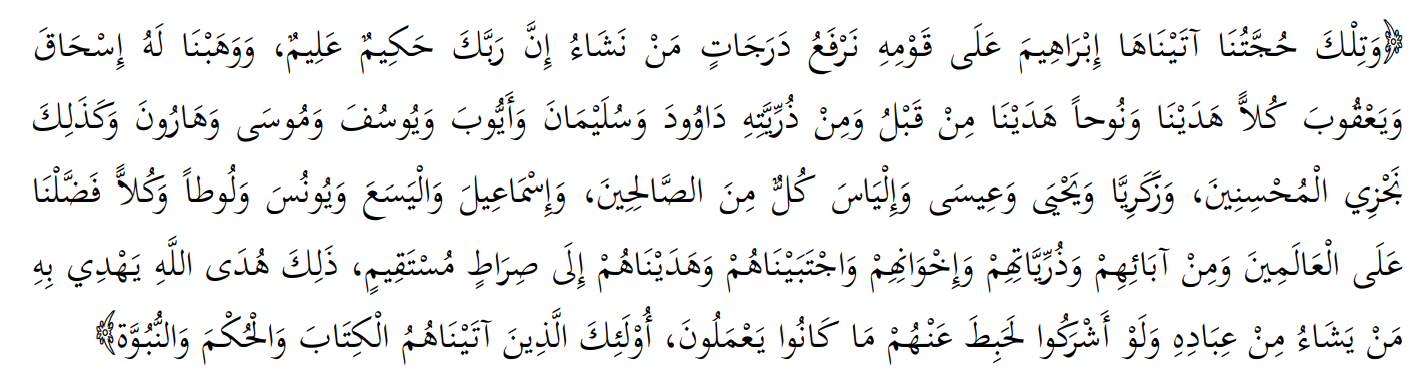
"Kuma wannan ita ce hujjarmu da muka bai wa Ibrahim a kan mutanensa. Muna ɗaga darajar wanda muke so. Lallai Ubangijinka mai hikima ne, masani. Muka ba shi Ishaƙu da Ya'aƙubu, muka shiryar da kowannensu, kuma muka shiryar da Nuhu tun kafin su, da kuma cikin zuriyarsa, Dawuda da Sulaiman da Ayyuba da Yusuf da Musa da Haruna. Haka muke saka wa masu kyautatawa. Da Zakariyya da Yahaya da Isa da Ilyasu. Dukansu daga nagarta suke. Da Isma'ila da Al-Yasa'u da Yunusa da Lūɗu, kuma kowannensu muka fifita shi a kan talikai a zamaninsa. Haka kuma wasu daga cikin iyayensu da zuriyarsu da 'yan'uwansu, muka zaɓe su, muka shiryar da su zuwa hanya madaidaiciya. Wannan ita ce shiriyar Allah; yana shiryar da wanda ya so daga cikin bayinsa. Da sun yi shirka, da duk abin da suka aikata ya ɓaci. Waɗannan su ne waɗanda muka ba su littafi da hukunci da annabci." [TMQ An’ām: 83-89]
"And this is our argument that we gave to Abraham against his people, we raise in degrees whom we please, undoubtedly, your lord is wise, knowing. And we gave him Ishaq and Yaqub, we showed the path to all of them and showed the path to Nuh before them, and of his progeny, to Daud and Sulaiman and Ayub and Yusuf and musa and Haroon, and thus we recompense the righteous. And to Zakaria, Yahya, Isa and Ilyas. These are all entitled to be our near ones. And to Ismail and Yasa and Yunus and lot, and to each one we preferred above all in his time. And also to some of their fathers and their progeny and some of their brothers, and we chose them and showed them the straight path. This is the guidance of Allah. He gives whom he will of his bondmen, and if they would have committed polytheism, then surely all that they had already done would have been destroyed. These are they to whom we gave the book and order and prophet hood" [TMQ An’ām: 83-89]
Kuma Isma'il da Idris da Dhul-Kifl dukansu suna cikin masu haƙuri, waɗanda muka shigar da su cikin rahamarmu. Lalle ne su daga cikin nagargaru suke. [TMQ Anbiya: 85-86]
"And Ismail and Idrees and Dhul-Kifl all were from the patient ones who we took into our mercy. Indeed they are from the righteous." [TMQ Anbiya: 85-86]
Kuma zuwa Madyan, mun aika musu ɗan'uwansu Shu'aib. [TMQ Araf: 85]
"And to Madyan, we sent their brother Shu'aib." [TMQ Araf: 85]
"Kuma zuwa ga Samudawa, Mun aika musu da ɗan'uwansu Salihu." [TMQ Araf: 73]
"And to Thamud, we sent their brother Salih." [TMQ Araf: 73]
"Kuma zuwa ga 'Ad, Mun aika musu da ɗan'uwansu Hud." [TMQ Araf:65]
"And to A'ad, we sent their brother Hud." [TMQ Araf:65]
"Kuma muka ce, ya Adam, ku zauna kai da matarka a Aljanna." [TMQ Baqarah: 35]
"And we said, o Adam dwell you and your wife in paradise." [TMQ Baqarah: 35]
Muhammadu manzon Allah ne ﷺ. Waɗanda ke tare da shi suna da tsauri ga kafirai, kuma suna tausayawa juna a tsakaninsu. [TMQ Fath: 29]
"Muhammad is the messenger of Allah. Those with him are severe on the Kuffar and merciful between themselves." [TMQ Fath: 29]
Dukkan annabawa da manzanni masu ba da labari ne daga wurin Allah, domin wannan ita ce ma'anar annabta da manzanci. Su masu gaskiya ne, masu gargaɗi ga halittu, don kada aikin da saƙon su su zama banza, kuma ba sa yin ƙarya ko kuskure a cikin isar da saƙon, kamar yadda ba sa aikata wani zunubi. Haka kuma babu wata hujja ta tabbatacciya [Qati] a cikin Alƙur'ani ko Sunnar Annabi ﷺ da ke bayyana cewa annabawa sun yi kuskure bayan an ba su annabta ko manzanci. Abin da aka ruwaito a kan haka ko dai yana cikin hadisai waɗanda isnadinsu ba tabbatacce ba ne [dhanni athuboot], ko kuma cikin ayoyi waɗanda shaidarsu ba ta tabbata ba [dhanni ad-dalala], kuma abin da ba shi da tabbas [dhanni] ba zai iya mamaye hujjar hankali tabbatacciya game da kariya daga kuskure ba. Game da abin da aka ambata a cikin Alƙur'ani dangane da Adam, cewa ya ci daga itacen da Allah ya hana shi ci, wannan ba ya saɓa wa buƙatar kariya daga kuskure a isar da saƙo ga mutanen duniya, domin abin da ya faru da Adam ya faru ne a Aljanna, hikimarsa kuwa Allah ne kaɗai ya sani. Don haka wannan al'amari daban ne (watau cin Adam na 'ya'yan itacen itacen), domin kariya daga kuskure tana da alaƙa da isar da saƙo ga mutanen duniya.
All the prophets and messengers were informers from Allah because this is the meaning of prophethood and messengerhood. They are truthful, admonishers to creation lest the mission and message become futile and they are infallible from lying and error in their propagation, just as they are infallible from committing any sin. Further there is no definite [Qati] textual evidence in the Qur’ān or the Sunnah of the prophet informing about the erring of the prophets after their Prophethood of Messengership. Whatever has been reported is either in the ahadith that are indefinite in their transmission [dhanni athuboot] or in the ayat that are indefinite in their evidence [dhanni ad-dalala] and the Indefinite [dhanni] cannot over ride the definite rational evidence on infallibility. As for what was revealed regarding Adam in the Qur’ān about him eating from the tree which Allah had prohibited him to eat from, this does not contradict the requirement of infallibility in the propogation of the message to the people on the earth because what happened from Adam was in the Paradise, the wisdom of which is only known to Allah . Therefore this is separate matter (i.e Adam’s eating of the fruit of the tree) because infallibility is related to the propogation of the message to the people on the earth.