14.2 Fiqhning rivojlanishi
14.2 The Development Of Fiqh
Fiqh — bu jamiyatga eng katta ta'sir ko'rsatadigan va eng muhim islomiy ilmlardan biridir. U islom madaniyatining eng muhim tarmoqlaridan biridir. Buning sababi shundaki, islom madaniyati Qur'on va Sunnatdir hamda Qur'on va Sunnatni tushunish uchun tayanilgan va belgilangan narsalarning barchasidir. Islom madaniyatiga arab tili, hadis va tafsir ilmlari kirgan bo'lsa-da, undan eng ko'zga tashlanadigan narsa hayotga bo'lgan qarash bilan bog'liq fikrlar hamda hayot muammolarini hal etuvchi yechimlardir. Boshqacha aytganda, u e'tiqodlarda ('aqoid) va Shariat hukmlarida namoyon bo'ladi, chunki ular hayot muammolariga yuzlanish uchun qabul qilingan amaliy madaniyatdir va ko'pincha e'tiqodlar haqidagi fikrlarni hamda yechimlarni, ya'ni hukmlarni o'z ichiga oladi. Fiqh esa aynan shu hukmlarning ilmidan boshqa narsa emas.
Fiqh is one of the most important Islamic disciplines having the greatest effect on society. It is one of the most important branches of the Islamic culture. That is because the Islamic culture is the Qur’ān and Sunnah and whatever is relied upon and laid down in order to understand the Qur’ān and Sunnah. Even though the Islamic culture includes the sciences of the Arabic language, hadīth and tafsīr, the most prominent thing that appears from it are the thoughts which relate to the viewpoint about life and the solutions which treat the problems of life. In other words, it appears in the beliefs (‘aqaid) and Sharī’ah rules because they are a practical culture adopted to face lifes problems which, in most cases, contains thoughts about beliefs and solutions i.e, the rules. Fiqh is nothing other than the knowledge of these rules.
Islom madaniyati va shariat hukmlarini o'rganish Payg'ambar ﷺ yuborilgan vaqtdan boshlangan. Payg'ambar ﷺ shariat hukmlari uchun yagona manba bo'lgan, chunki u odamlarga Allohning dinini o'rgatish uchun yuborilgan edi. U ﷺ shunday degan:
The Islamic culture and the learning of Sharī’ah rules began from the time the Messenger was sent. The Messenger was the only reference point for the Sharī’ah rules because he was sent to teach people Allah’s deen. He said:
Ey Rasul! Rabbingizdan sizga nozil qilingan narsani yetkazing. Agar buni qilmasangiz, Uning xabarini yetkazmagan bo‘lasiz. — ﷺ Note on rules applied: the Qur'an verse is quoted in the original as an explanatory sentence, so "(saw)" is rendered as ﷺ after the Messenger reference, not inside a verse. The rest of the text is the verse rendering. [TMQ Mā’idah: 67]
“O Messenger (saw)! Proclaim (the Message) which has been sent down to you from your Lord. And if you do not, then you have not conveyed His Message” [TMQ Mā’idah: 67]
U у aytdi:
He said:
Va Biz senga ham (ey Muhammad ﷺ) eslatmani va nasihatni (Qur'onni) nozil qildik, toki ularga aniq bayon qilib berasan. [TMQ Nahl: 44]
“And We have also sent down unto you (O Muhammad(saw)) the reminder and the advice (the Qur’ān), that you may explain clearly to them” [TMQ Nahl: 44]
Istisno Payg‘ambar ﷺ dan tashqari, hech bir musulmonning mustaqil ravishda biror qarash yoki hukm haqida o‘z fikrini bildirish huquqi yo‘q. Payg‘ambar ﷺ ularning orasida bo‘lgani sababli, biror voqea bilan duch kelganda uni unga murojaat qilib hal etish oson edi. Shunga qaramay, ularning hech biriga biror voqea yuzasidan shaxsiy fikr bildirish ruxsat etilmagan. Shu sababli, biror voqea uchrasa, nizo chiqsa yoki ulardan birida biror fikr paydo bo‘lsa, ular Payg‘ambar ﷺ ga murojaat qilar edilar. U zot ﷺ esa fikr bildirar, nizolarini hal qilar va savollariga javob berar edi, ba’zan oyat bilan, ba’zan esa hadis bilan. Payg‘ambar ﷺ zamonida ba’zi sahobalar ijtihod qilgani, ayrim nizolarda o‘z ijtihodlariga ko‘ra hukm chiqargani yoki ayrim voqealar bo‘yicha hukmni o‘z ijtihodlari orqali chiqarganlari haqida rivoyat qilinganiga kelsak, bu ijtihodlar shariat hukmlari uchun manba bo‘lmaydi. Aksincha, ular Payg‘ambar ﷺ ning buyrug‘iga muvofiq shariatni tushunishdir. Ular Qur’on va Sunnatga, o‘sha mujtahidlar tomonidan tushunilganidek tayangan holda, shariatni amalga oshirishdir. Buni ushbu ijtihodlar sodir bo‘lgan vaziyat ko‘rsatib turadi. Rivoyat qilinishicha, Payg‘ambar ﷺ Alī ibn Abu Tolibni Yamanga qozi sifatida yuborgan. U zot unga shunday degan:
With the exception of the Messenger no Muslim has the right to independently put forward an opinion regarding any viewpoint or ruling. Due to the Messenger’s presence among them referring to him regarding anything they came across was easy, It was still not permitted for any of them to give his personal opinion regarding any event. That is why, when they came across an event or a dispute arose or one of them had an idea they would refer to the Messenger . And he would give an opinion, settle their disputes and answer their questions, sometimes with an ayah and sometimes with a hadīth. As for what has been reported that certain Sahabah exercised Ijtihād in the time of the Messenger and pronounced judgements according to their own Ijtihād in certain disputes or that they deduced the rule regarding certain events through their own Ijtihād. This does not make these Ijtihāds a source for Sharī’ah rules. Rather they constitute an understanding of the Sharī’ah in accordance with the order of the Messenger . They constitute the application of the Sharī’ah, relying on the Qur’ān and Sunnah as understood by those mujtahidin. This is demonstrated by the circumstance in which these Ijtihāds took place. It has been reported that the Prophet sent ‘Ali ibn Abi Talib to Yemen as a judge. He told him:
"Alloh yuragingizni hidoyatga boshlasin va tilingizni mustahkamlasin. Ikki da'vogar huzuringizga kelganda, birinchisini tinglaganingizdek, ikkinchisini ham tinglamaguningizcha hukm chiqarmang. Bu ish sizga ma'qulroqdir, shunda haqiqat sizga aniq ravshan bo'ladi", — deb Abu Dovud Ali ibn Abu Tolib'dan rivoyat qilgan.
“May Allah guide your heart and affirm your tongue. When two disputants sit before you, do not pronounce judgment until you have listened to the latter just as you did with the former. It is more proper ( for you to does this) so that the judgment becomes manifest to you” [Reported by Abu Dawud on the authority of ‘Ali Ibn Abi Talib
Rivoyat qilinishicha, Payg‘ambar ﷺ Mu’oz ibn Jabalni Yamanga yuborgan va unga shunday degan:
It has been reported that the Prophet sent Mu’az ibn Jabal to Yemen and he said to him:
"Agar Allohning Kitobi yoki Uning Elchisining Sunnatida topa olmaydigan hukmga duch kelsangiz, qanday hukm bilan hukm qilasiz?" Mu'oz javob berdi: "Men o'z ijtihodimni ishlataman." Payg'ambar ﷺ dedi: "Allohga hamd bo'lsin, U Allohning va Uning Elchisining rozi bo'lgan narsaga Allohning Elchisi elchisining muvofiq bo'lishiga muvaffaq qildi." [Recorded by Abu Dawud]
“With what will you judge when you come upon a judgement which you do not find in the Book of Allah or the Sunnah of His Messenger. What judgment will you give? Mu’az said: ‘I will exercise my own Ijtihād The Messenger said: ’‘Praise be to Allah who has made the messenger of the Messenger of Allah to accord with what Allah and His Messenger are pleased with” [Recorded by Abu Dawud]
Rivoyat qilinadiki, ba'zi kishilar o'rtasida bir kulba (chayla) yuzasidan nizo bo'lib qolgan edi, shuning uchun ularning orasida hukm chiqarish uchun Huzayfa yuborildi. Imom Buxoriy va Imom Muslim ‘Amr ibn al-‘Os (roziyallohu anhu) rivoyatlaridan xabar beradilar: u Payg'ambar ﷺ shunday deganini eshitgan:
It is reported that some people were disputing over a hut between themselves so Hudhayfa was sent to judge between them. Bukhari & Muslim report on the authority of ‘Amr bin al-‘Aas that he heard the prophet say:
“Agar hokim hukm chiqarsa va ijtihod qilib, to‘g‘ri topsa, unga ikki ajr bor. Agar hukm chiqarib, ijtihod qilsa-yu, xato qilsa, unga bir ajr bor.”
“If the judge passes a judgment and makes ijtihaad and is right, he will have two rewards. If he passes a judgment and makes ijtihaad, and makes a mistake, he will have one reward”
Ushbu rivoyatlar va shunga o'xshash boshqa misollarning barchasi shuni ko'rsatadiki, Payg'ambar ﷺ davrida musulmonlar qilgan ijtihodlar uning amriga muvofiq bo'lgan. Demak, u ﷺ ularning manbai edi. Shunday qilib, Payg'ambar ﷺ davri butun islomiy madaniyat manbai mavjud bo'lgan davr edi. Bu holat u ﷺ yuborilgan vaqtdan to vafotigacha davom etgan, bu davr yigirma ikki yildan va bir necha oydan oshmagan, o'sha muddat ichida butun Qur'on nozil bo'lgan va oliy Sunnat to'liq bo'lib yetgan. Islomda fikr, hukm va madaniyatning manbai sifatida faqat shu matnlar e'tirof etiladi.
All of these reports and other such examples indicate that the Ijtihādat that the Muslims performed during the days of the Messenger were in accordance with his order. Therefore, he was their source. Thus, the time of the Messenger was a time in which the source of the entire Islamic culture existed. That continued from the time he was sent until his death, in a period of time not exceeding twenty two years and a few months in which the whole Qur’ān was revealed and the sublime Sunnah was completed. These are the only texts considered as the source of thoughts, rules and culture in Islam.
Elchi ﷺ vafotidan so‘ng, Hijratning o‘n birinchi yilida, Sahobalar davri boshlandi. Bu tafsir davri va matnlari bo‘lmagan masalalar bo‘yicha istinboT (xulosa chiqarish) eshiklarining ochilgan davridir. Sahobalar Qur’on va Sunnat matnlarining hammasi odamlar orasida keng tarqalmaganini, shu sababli har bir kishi uchun ulardan foydalanish imkoni yo‘qligini ko‘rdilar. Chunki Qur’on matnlari Elchi ﷺ uyida saqlanadigan va ba’zi Sahobalar uylarida asrab qo‘yiladigan maxsus varaqlarga yozilgan edi, Sunnat esa hali yozib olinmagan edi. Ular shuni topdilar: Qur’on va Sunnat matnlari hukm qilgan vaqtda sodir bo‘layotgan voqea va masalalar uchun hukm belgilagan, faqat ehtimol tariqasida yuzaga kelishi mumkin bo‘lgan voqealar uchun hukm belgilanmagan. Elchi ﷺ davrida bo‘lmagan ehtiyojlar, voqealar va masalalar musulmonlar orasida yuzaga keldi, keyinroq paydo bo‘lgan muammolar uchun esa ularning hukmini bayon qiladigan matnlar yo‘q edi. Shuningdek, ular har bir musulmon o‘zi Qur’on va Sunnat matnlariga murojaat qilib, ulardan ko‘rsatilgan hukmni tushunishga qodir emasligini ko‘rdilar, chunki oddiy xalq matnlarni faqat Islom hukmlarini ularga tushuntirib beradigan kishi orqali tushuna oladi. Shu sababli ular Sharif Qur’onni va Elchi ﷺ hadislarini musulmonlar orasida tarqatish mas’uliyati zimmalarida ekanini anglab yetdilar. Shunday qilib, ular Qur’onni jamlash mas’uliyatini o‘z zimmalariga oldilar va bu jamlamadan ko‘plab nusxalar ko‘chirib, musulmonlar orasida tarqatdilar. Sunnat rivoyatining ishonchliligi va rivoyat qiluvchilarni tekshirishdagi ishonchni ta’minlash uchun ehtiyot choralarini ko‘rdilar. Shuningdek, ular Qur’on va Sunnat matnlarining zarur izohi va tushuntirishini musulmonlarga bayon qilish zarurligini ham anglab yetdilar. Shunday qilib, ular odamlarga dinni o'rgatishni boshladilar, so'ngra ular odamlarga ularning boshidan o'tayotgan voqealar va masalalar uchun, ularda aniq matn bo'lmagan hollarda, fatvo berish kerak, deb hisobladilar. Shu tariqa ular yuz bergan masalalar uchun zarur bo'lgan hukmlarni chiqarishni boshladilar. Shu sababli ular dinning vazifasini eng yaxshi usulda bajarishni o'z zimmalariga oldilar.
ʻUmar ikkilanib qoldi: bir kishining qotilligi uchun ko‘p odamlarni o‘ldirish kerakmi? ʻAli unga dedi: agar bir guruh so‘yilgan tuyani o‘g‘irlashda qatnashib, uni o‘zaro taqsimlab olsa, sen nima deysan, ularning qo‘lini kesarmiding? U dedi: ha. ʻAli dedi: unda bu ham xuddi shunday. Shunda ʻUmar ʻAlining fikriga amal qildi va o‘z hokimiga yozdi: ikkalasini ham o‘ldiringlar, chunki agar Sanʼo aholisining hammasi bu ishda qatnashgan bo‘lsa ham, men ularning hammasini o‘ldirgan bo‘lardim.
‘Umar hesitated: are many people to be killed for the murder of one person? ‘Ali said to him: What do you think if a group participated in the theft of a slaughtered camel such that they distributed it amongst themselves. Would you cut their hands? He said: Yes. Ali said: well it is the same thing. So Umar acted upon Ali’s opinion and wrote to his ‘Amil: ‘kill them both for if the whole population of San’aa participated I would have had them killed.
Xuddi shunday, ular "birgalikdagi ulush" masalasida ixtilof qilganlarida ham: bir ayol eri, onasi, otasi bir bo'lgan aka-ukalari va onasi bir bo'lgan aka-ukalari qolgan holda vafot etdi. 'Umar erga yarmini, onaga oltidan birini, onasi bir bo'lgan aka-ukalarga esa uchdan birini berar edi. Shunday qilib, otasi bir bo'lgan aka-ukalarga hech narsa qolmas edi. Unga aytildi: "Faraz qilaylik, otamiz eshak bo'lsa ham, axir biz bir onadan emasmidikmi?" Shunda u o'z qarashini o'zgartirdi va ularga ulush berdi. Ular matn kelgan maslahatni (manfaatni), agar u matndan tushunilsa, bilib olishga intilar edilar. Yana bir misol: Alloh {...} degan joyda.
Similarly when they disagreed about the question of joint share, when a woman died leaving a husband, mother, uterine brothers and full brothers. ‘Umar used to give the husband half, the mother a sixth, and the uterine brothers a third. So nothing remained for the full brothers. It was said to him: Suppose our father was a donkey. Are we not from one mother? So he changed his view and gave them a share. They used to acquaint themselves with the maslaha (benefit) for which the text came, if it was understood from the text. Another example is when Allah said:
“Sadaqalar (zakot) faqat fuqaro (kambag‘allar), masokin (muhtojlar), ularni yig‘ishga tayinlangan xodimlar, qalblari (Islomga) moyil qilinishi kerak bo‘lganlar uchungina berilur.” [TMQ Tawba: 60]
“As-sadaqat (zakat) are only for the Fuqara (poor), and al-masakin (needy) and those employed to collect (the funds); and for to attract the hearts of those who have been inclined (towards Islam)” [TMQ Tawba: 60]
Shunday qilib, Alloh ta'olo qalblari (Islomga) ulfat topishi kerak bo'lganlarni zakot manbalaridan xarajat qildi. Ma'lum bo'lganki, Payg'ambar ﷺ qalblari Islom bilan ulfatlashgan kishilarga pul berar edilar. Rasulullohdan ﷺ keyin ‘Umar haqida rivoyat qilinadiki, u qalblari ulfatlashgan kishilarga (al-mu’allaftu qulubuhum) berishni man qildi. U ularga shunday dedi:
So Allah made those whose hearts have to be a reconciled (towards Islâm) an expenditure from the sources of zakat. It has been established that the Prophet used to give money to people whose hearts had been reconciled with Islam. After the death of the Messenger it is narrated about ‘Umar that he forbade the payment of those whose hearts had been reconciled (al-mu’allaftu qulubuhum). He told them:
"Alloh Islomni kuchli qilgan, shuning uchun Islom sizga muhtoj emas. Yo islomga yopishasiz, yo bo'lmasa siz bilan biz o'rtasida qilich bor."
‘Allah has made Islam strong and so Islam is in no need of you, either you stick to Islam or else between you and us is the sword.’
Umar was of the view that the reconciling of hearts towards Islam existed because the state was weak, and the expression itself indicates this, for the expression "reconciling hearts" (ta'leef al-qulub) implies it. For when does one reconcile hearts, except when one is in a state of need for them? Umar held the opinion that the need to reconcile hearts ended when Islam became strong, and without the need to reconcile hearts, the 'illah (legal cause) does not apply, and due to this the hukm (ruling) also does not apply.
Umar was of the view that the reconcilings of hearts towards Islam was there because the state was weak because the expression, for the expression ‘reconciling hearts’ (ta’leeful al-qulub) indicates this. For when do you reconcile hearts except when you are in a state of need for them (the people) ? Umar took the opinion that the need to reconcile hearts ended when Islam became strong, without the need to reconcile hearts, the ‘illah (legal cause) does not apply and due to this the hukm also does not apply.
Sahobalar shariat matnlari haqida, o‘zlari bilmagan masalalar yuzasidan so‘rab-surishtirardilar va ular (Alloh ulardan rozi bo‘lsin) Hijozda barcha yig‘ilib, Qur’on va Sunnatni muhokama qilardilar. Qaralayotgan masala uchun Qur’on va Sunnatda hukm topa olmasalar, ulardan qaysi biri Allohning Elchisi ﷺ bu masala yuzasidan qanday hukm chiqarganini bilishini musulmonlardan so‘rardilar. Shu sababli ular bir-biriga murojaat qilib, masalalarni muhokama qilish va ularga fikr bildirish uchun yig‘ilardilar. Abu Bakr va Umar hukmlarni chiqarib, odamlarga murojaat qilardilar. Al-Bag‘aviy o‘zining "Masobih as-Sunna" kitobida rivoyat qilgan:
The Sahabah used to investigate and ask the people about the Sharī’ah texts regarding matters they did not know and they (may Allah be pleased with them) used to be all gathered together in the Hijaz, discussing the Qur’ān and Sunnah. If they did not find a hukm in the Qur’ān and Sunnah for the issue they were looking for they would ask Muslims if any of them knew what the Messenger of Allah passed as a judgement for the issue. That is why they used to refer to each other and get together to discuss the issues and give an opinion for it. Abu Bakr and ‘Umar used to deduce rules and refer to the people. Al-Baghawi has narrated in his Masabih al-Sunnah:
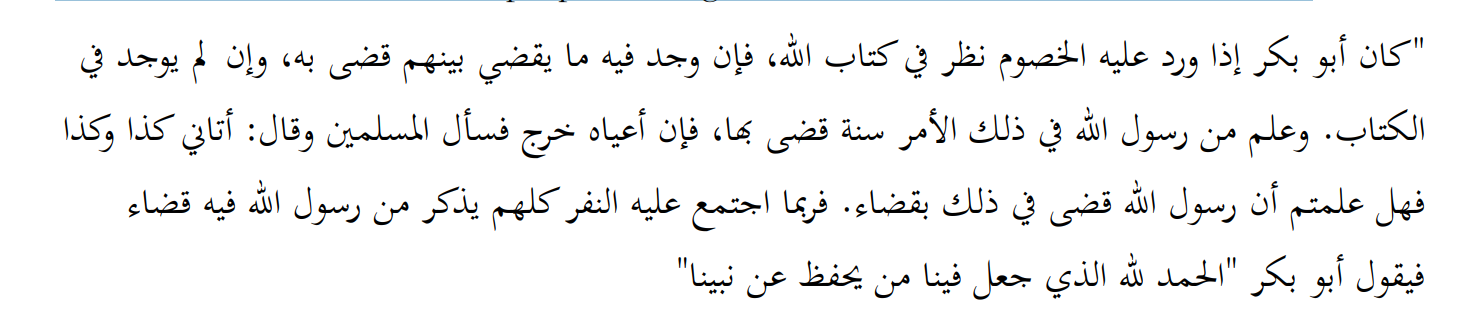
Abu Bakrga biror nizo xabar qilinganda, u Allohning Kitobiga murojaat qilar edi. Agar u ular o‘rtasida hukm chiqarish uchun biror narsa topsa, shu hukmni berar edi. Agar u Qur’onda topilmasa va bu masala bo‘yicha Allohning Elchisi ﷺ dan sunnatni bilsa, o‘sha bilan hukm chiqarar edi. Bunday bo‘lmasa, u chiqib musulmonlardan so‘rar edi: «Menga falon masala kelib tushdi, siz Allohning Elchisi ﷺ ning bu borada chiqargan biror hukmini bilasizmi?» Ko‘pincha butun guruh Allohning Elchisi ﷺ ning hukmini eslatishda bir fikrga kelar edi. Abu Bakr shunday deb aytar edi: «Allohga hamdlar bo‘lsinki, U orangizda Payg‘ambarimiz ﷺ ga oid (masalalarni) yodlab oladigan kishilarni yaratdi».
‘When a dispute was reported to Abu Bakr he used to look into the Book of Allah . If he found something to judge between them he gave that judgement and if it is not found in the Qur’ān and he knew a Sunnah from the Messenger of Allah regarding that matter he would give judgement by it. Failing that he would go out and ask the Muslims; such and such matter has come to me do you know of any judgement given by the Messenger of Allah pertaining to this?’ Probably the whole group would agree mentioning a judgment by the Messenger of Allah . Abu Bakr would say: ‘Praise be to Allah Who has made people amongst us memorise (issues) concerning our Prophet .
Agar u Rasulullah ﷺning sunnatini topa olmasa, odamlarning boshliqlarini va ularning eng yaxshilarini yig'ib, ular bilan maslahatlashardi. Agar ular biror masalada ittifoqqa kelsa, shu bilan hukm qilardi. Rivoyat qilinishicha, 'Umar fiqh bilimiga ega bo'lishiga qaramay, sahobalar bilan maslahatlashar edi, hatto biror voqea uning oldiga kelganda shunday derdi: "Menga 'Aliy ni chaqiringlar, Zayd ni chaqiringlar." U ular bilan maslahatlashar va ular ittifoq qilgan narsa bilan nizoni hal qilardi. Sahobalarning bir-biriga murojaat qilishi tufayli ular orasida ixtilof kam bo'lardi, chunki har bir sahobiy boshqa sahobiyga o'z qarashini va keltirgan dalillarini bayon qilardi. Ularning umumiy qarashi to'g'ri va to'kis bo'lib, har biri boshqasiga murojaat qilardi. Ba'zi hukmlarda ularning fikrlari turlicha bo'lsa-da, ixtiloflari kam edi va bu tushunishdagi farq edi, tushunish usulidagi emas.
If he failed to find a Sunnah of the Messenger of Allah he gathered the heads of people and the best amongst them and consulted them. If they had a consensus on a matter he would judge with that. It has been reported that ‘Umar used to consult the Sahabah despite his knowledge of fiqh to the extent that when an incident would be refered to him he would say: Call ‘Ali for me, call Zayd. He used to consult them and settle the dispute with whatever they were agreed upon. Due to the Sahabah’s reference to each other differences of opinion between them were rare because each Sahābi expressed to another Sahābi his own perspective and the evidences he educed. Their view on the whole was true and correct and each one referred to the other. And even though their views differed in certain rules but their differences were rare and it was in their understanding and not in the method of understanding.
Fتوحات кенгайганда ва Саҳобалар турли шаҳарларга тарқалиб кетиб, бу саҳобалар бир-бирлари билан учрашиш қийин бўлиб қолганда, нас (матн) бўлмаган воқеа содир бўлган ҳар бир сафар, шаҳарлар бир-биридан узоқ бўлгани ва учрашишнинг қийинлиги туфайли, шунингдек шаҳарда содир бўлган воқеага ҳукм бериш зарурати сабабли, ҳар бир саҳоба бошқаларга ифода этмасдан ва бошқаларга мурожаат қилмасдан ўз фикрини берар эди. Ҳар бир мусулмон шаҳрида бир ёки бир нечта саҳоба бор эди. Улар ҳукмлар учун таянч нуқта эдилар. Улар нас бўлмаган қоидаларни истинбот қилар, матнни аниқлаш ва изоҳлаш вазифасини ўз зиммаларига олар, худди Қуръон ва Суннатни одамларга ўргатиш масъулиятини олганлари каби эдилар. Суннат ҳали ёзиб олинмаган эди, шу сабабли битта воқеа юзасидан саҳобаларнинг фикрлари турлича бўлар, ҳар бири чиқарган далили ва берган фатвоси бор эди. Бироқ, бу фикрларнинг барчаси Шариат ҳукмлари бўлиб, ҳаммаси учун қабул қилинарли эди, чунки уларнинг ихтилофи фақат тушунишдагина эди. Ижтиҳод услубларига келсак, у Қуръон ва ҳадис матнини кўриб чиқиш, матнларни текшириш, эътиборли маслаҳатлар (манфаатлар) фақат Шариат кўрсатганлари эканини таъминлаш ва масалаларни ҳамда маслаҳатларни қиёс қилишдан иборат эди. Ижтиҳоднинг услуби бирлиги тушунишдаги фарқнинг таъсир қилишига имкон бермас эди. Аксинча, бу фиқҳнинг ўсиши ва кенгайишининг сабабларидан бири эди. Уларнинг фатволари содир бўлган воқеа ва масалаларга мувофиқ эди. Уларнинг ихтилофи доираси кенгаймас ва фуруъ (фиқҳнинг тармоқлари) чегарасидан ҳам чиқмас эди. Саҳобаларнинг фуруъдаги ихтилофи икки сабабга бориб тақалади: