9. Fan va madaniyat
9. Science And Culture
Arab tilida "‘alima" deyiladi: "ar-rajul ‘alima al-‘ilm", ya’ni odam ilmning haqiqiy mohiyatiga erishdi, degani. Biror narsa haqida "‘alima" degani uni bilib oldi, biror masala haqida xabardor bo‘ldi yoki uni yaxshi tanidi, degani. Tilda yana "thaqifa" deyiladi: ya’ni u mohir bo‘ldi, demak u ma’rifatli va madaniyatli (thaqif) bo‘ldi. "U tilni thaqifa qildi" degani esa, uni egalladi va tez tushunib oldi, degani. Bu lug‘aviy ma’nolar so‘zlarning qo‘llanishining asosidir. Lekin agar bu so‘zlar lug‘aviy ma’noga bog‘liq boshqa ma’nolarda ishlatilsa, bu ruxsat etiladi, masalan, grammatikada "fa’il" (ega) so‘zini qabul qilishda bo‘lgani kabi. Lug‘aviy ma’no ustun bo‘lgan, shuning uchun qadimgilar "‘ilm" so‘zini fanlar va sohalarni ajratmasdan barcha bilim turlariga qo‘llashgan. Keyinchalik odamlar aql va tabiat fanlarini barcha insonlarga umumiy deb hisoblay boshladilar, boshqa an’anaviy (matnga asoslangan) fanlarni esa ular o‘tkazilgan millatga xos deb bilishdi. Shundan so‘ng "‘ilm" va "thaqafa" har biri turli aniq sohalarga qarab ta’riflana boshlandi va lug‘aviy ma’nolaridan farq qiladigan terminologik ma’nolarga ega bo‘ldi. Bu terminologiyaga ko‘ra: "‘Ilm" — kuzatish, tajriba va ta’lim orqali olinadigan bilimdir, masalan, fizika, kimyo va boshqa tajribaviy fanlar. "Thaqafa" — rivoyat qilish, o‘rganish va xulosa chiqarish orqali olinadigan bilimdir, masalan, tarix, tillar, fiqh, falsafa va boshqa tajribaviy bo‘lmagan fanlar. Boshqa fanlar ham bor, ular empirik bo'lmagan bo'lsa-da, ilm ('ilm) sifatida hisoblanadi, garchi ular madaniyat (thaqafa) doirasiga kirsa ham: masalan, arifmetika, muhandislik va sanoat. Garchi ular madaniyat (thaqafa) jumlasiga kirsa ham, ilmning bir qismi sifatida qaraladi, chunki ular barcha xalqlar uchun umumiy bo'lib, hech bir millatga xos emas. Xuddi shunday, sanoatga o'xshash hunarmandchilikka oid madaniyatning har qanday jihati, masalan savdo va kemasozlik, ilmning bir qismi hisoblanadi va ular umumiydir. Rassomlik, haykaltaroshlik va musiqa kabi san'at turlariga kelsak, ular madaniyatning bir qismidir. Ular muayyan qarashga, ya'ni aniq bir madaniyatga tayanadi. Madaniyat (thaqafa) bilan ilm ('ilm) o'rtasidagi farq shundadir.
In Arabic language it is said: the man has obtained (‘alima) knowledge (‘ilm). This means that he attained the true reality of knowledge (‘ilm). He gained knowledge of a thing means he became cognisant of it, which means that he became informed of a matter or acquainted with it. Also in the language it is said: He has gained comprehension (thaqifa), which means that he has become proficient, thus he is educated and cultured (thaqif). He has understood (thaqifa) a language (means) he has mastered and understood it swiftly. These linguistic meanings are the basis of the use of words, However if these words were used to indicate other meanings that relate to the linguistic meaning then that is permitted, like in the case of the adoption of the word fa’il (subject) in grammar for example. The linguistic meaning (of the words) was prevailing and this is why the ancients used to apply the word ‘ilm on all forms of knowledge without differentiating between the sciences and disciplines. Then people began to consider intellectual and natural disciplines as being general to all people whilst other traditional (textual) disciplines were considered specific to the nation from which it was transferred. Subsequently, each of science (‘ilm) and culture (thaqafa) began to be defined according to different specific disciplines, acquiring terminological meanings which were different to their linguistic meanings. According to this terminology they have the following meaning: Science (‘ilm) is the knowledge which is acquired through observation, experimentation and education like physics, chemistry and the rest of the empirical sciences and culture (thaqafa) is the knowledge which is acquired by way of transmission, learning and deduction as in (the study of) history, languages, jurisprudence (fiqh), philosophy and the rest of the non-empirical disciplines. And there are other non-empirical disciplines which are included as sciences (‘ilm) even though they come within culture such as arithmetic, engineering and industry; even though they come under culture (thaqafa) they are regarded as part of science because they are universal to all people and not specific to any one nation. In a similar way anything from the culture related to crafts which resemble industry such as trade and shipping; they are considered to be part of science and they are universal. As for the arts such as; painting, sculpture and music they are part of culture. They follow a particular viewpoint; which is a specific culture. The difference between culture (thaqafa) and science (‘ilm)
Fan barcha millatlar uchun umumiy bo‘lib, hech bir millatga xos emas, boshqa millatni chetlatadigan darajada emas, deb bilish. Madaniyat (thaqafa) esa xos bo‘lishi mumkin: u qaysi millatdan kelib chiqqan bo‘lsa, o‘sha millatga nisbat beriladi, yoki u millatning o‘ziga xos va alohida xususiyatlaridan bo‘lishi mumkin, masalan, adabiyot, qahramonlar tarjimai holi va ularning hayot haqidagi falsafasi. Yoki u umumiy bo‘lishi mumkin, masalan, savdo, kema qatnovi va shunga o‘xshashlar. Shuning uchun fan barcha millatlardan umumiy ravishda qabul qilinadi, chunki u umumiy bo‘lib, hech bir alohida millatga xos emas. Madaniyatga kelsak, millat o‘z madaniyatidan boshlashi kerak. U o‘z madaniyatini o‘rganib, uni yaxshi anglab, u ularning ongida mustahkam o‘rnashgandan keyingina boshqa madaniyatlarni o‘rganishga o‘tishi mumkin. Musulmonlar o‘z-o‘zidan erishiladigan ilmlar bilan boshqalardan o‘zlashtiriladigan ilmlarni farqlab kelganlar. Ibn Xaldun o‘zining “al-Muqaddima” kitobida shunday deydi:
is that science is universal to all nations and not specific to any nation to the exclusion of another nation. As for culture (thaqafa) it might be specific, being ascribed to the nation from which it resulted or it may be part of the nation’s specific and particular characteristics such as literature and biographies of heroes, and their philosophy concerning life or they may be universal such as trade, shipping etc. Therefore, science is adopted universally from all nations because it is universal and not specific to any particular nation. As for culture (thaqafa) the nation should begin with its own culture, when she has studied it and is cognisant of it until it becomes focused in their minds then they can study other cultures. The Muslims used to differentiate between the sciences which a person used to attain by himself and the sciences he used to receive from others. Ibn Khaldun says in his book al-Muqaddima:
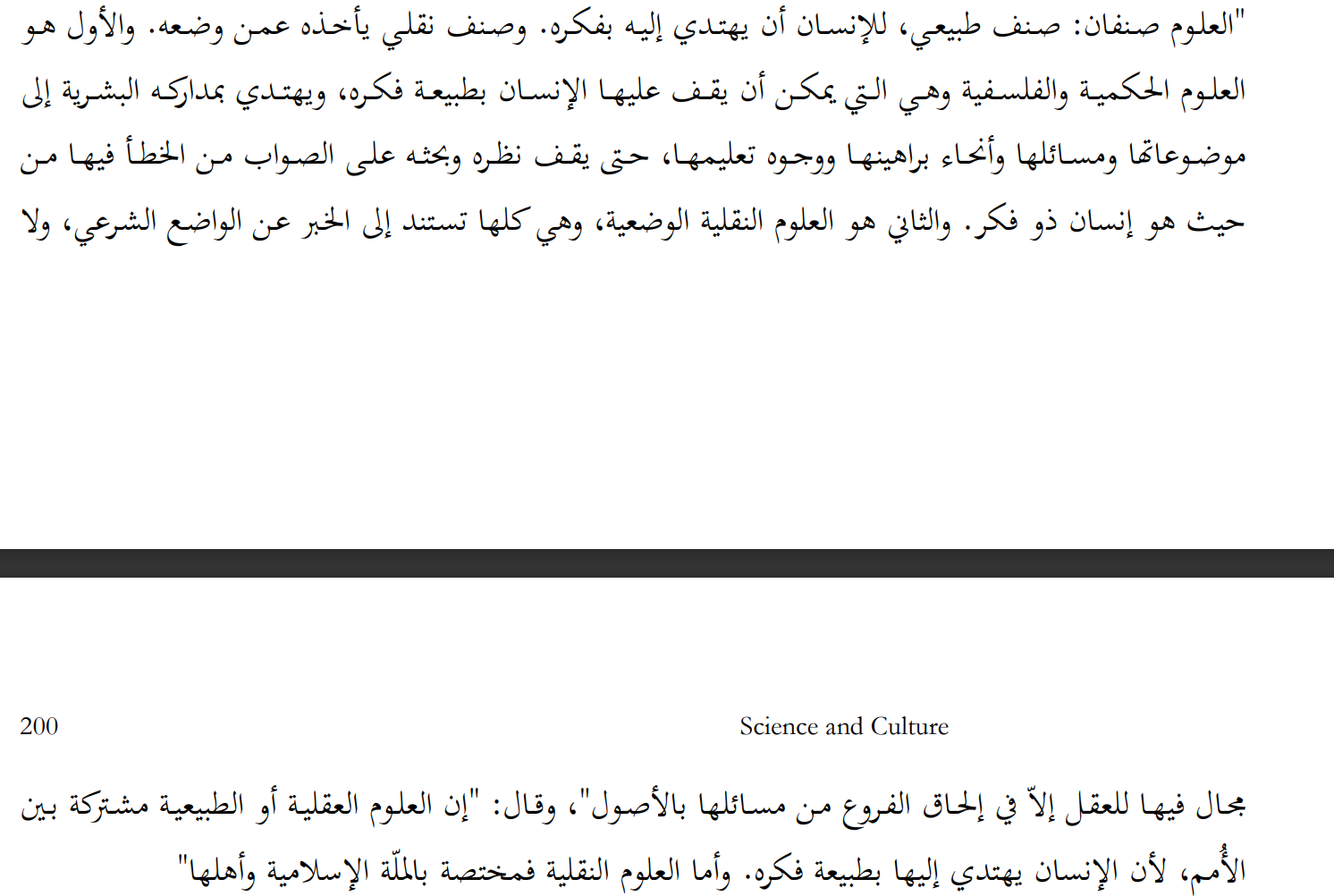
"Ilmlar ikki turga bo'linadi: birinchisi tabiiy tur bo'lib, uni inson o'z fikri orqali erishadi; ikkinchisi naqliy tur bo'lib, uni u mualliften oladi. Birinchisi falsafiy va aqliy ilmlar bo'lib, ularni inson o'z fikri bilan izlashi, inson idroki orqali o'z mavzulari va masalalariga, uning barcha hal qiluvchi dalillariga hamda ta'limotining barcha jihatlariga yo'naltirilishi mumkin. Shunday qilib, o'z idroki va tadqiqoti orqali u to'g'ri fikrni noto'g'ri fikrdan ajratadi, chunki u fikrlash qobiliyatiga ega inson sifatida shunday qila oladi. Ikkinchisi naqliy va yozma ilmlardir. Ular shar'iy manbadan kelgan rivoyatga tayanadi. Bu borada aql faqat tarmoq masalalarini usul (asos)ga bog'lashdan boshqa imkoniyatga ega emas."
“The sciences are of two types: A natural type which is for man to arrive at through his thinking and a textual type which he takes from the one who authored it. The first are the philosophical and aphoristic sciences which he can seek by his thought and be guided through the human faculties to its subjects and issues and all its decisive proofs and aspects of its teachings. So as in his discernment and study he attains the correct (opinion) from the incorrect, in his capacity as a human being possessing the faculty of thought. The second are the textual and written sciences. They depend on the report coming from a shar’i source. The mind has no scope in this regard except to relate the branch issues to the usul (foundation)”.
U ayni paytda, "aql-tabiiy ilmlar" deb atalgan ilmlar barcha xalqlarga umumiy bo‘lgan, chunki inson ularga fikrlash orqali tabiiy ravishda yetib keladi. Naql ilmlariga kelsak, ular Muslim dini va uning izdoshlariga xos bo‘lgan ilmlardir. Ko‘rinishidan, Ibn Xaldun naql ilmlarini Islom millati bilan cheklab ko‘rsatganida, bu faqat misol uchun edi, chunki islomdan boshqa xalqlarda ham o‘ziga xos naql ilmlari mavjud, masalan, ularning qonunchiligi va tili. Ibn Xaldunning bu so‘zi ilm bilan madaniyat o‘rtasida farq qilganini bildirmaydi. U faqat naql ilmlari bilan aql ilmlari o‘rtasida farq qilganini ko‘rsatadi. Uning bu izohlari musulmonlar ilm bilan madaniyatni ajratganini isbotlamaydi, balki musulmonlar faqat fanlar o‘rtasida farq qilganini isbotlaydi. Shu sababli ular fanlarni ikki bo‘limga ajratganlar. Ammo bu bo‘linish ularni egallash usuli jihatidan emas, balki umuman olganda egallash jihatidan edi. Shuning uchun ular aql orqali egallanadigan aql ilmlarini va matndan egallanadigan naql ilmlarini shunday nomlaganlar. Bugungi kunda esa odamlar fanlarni ularga erishish usuli jihatidan ajratadilar. Shunday qilib, ular "ilm" atamasini tajriba usuli orqali egallanadigan har qanday narsaga qo‘llaydilar, "madaniyat" (thaqafa) atamasini esa tajriba usulidan boshqa yo‘llar bilan egallanadigan narsaga qo‘llaydilar.
He also said “The rational or natural sciences are common to all nations since man arrives at them naturally through his thought. As for the textual sciences they are specific to the Muslim religion and its adherents.” It appears that what Ibn Khaldun meant by specifying the textual sciences with the Islamic millah was only an example because nations other than the Islamic nation as well have textual sciences specific to them such as their legislation and language. Ibn Khaldun’s statement does not indicate that he distinguished between science and culture. It only indicates that he distinguished between textual and rational sciences. His comments are not an evidence to say that the Muslims used to differentiate between science and culture rather they are an evidence to prove that the Muslims used only to differentiate between disciplines. Thus, they divided them into two sections. However their division was in terms of their general acquisition and not in terms of the manner of acquisition. So they designated them as rational sciences i.e, acquired via the mind. And textual sciences acquired from the text. However, people today differentiate between disciplines in terms of the manner in which they were received. Thus, they apply the term ‘science’ (‘ilm) on anything that is acquired through the empirical method and they apply the term ‘culture’ (thaqafa) on anything acquired by means other than the empirical method