17.9 Shar'a xalifalik uchun aniq bir shaxsni belgilab bermagan
17.9 The Shar'a Did Not Designate A Specific Person For The Khilafah
Payg‘ambarimiz (saw) ning o‘zlaridan keyin aniq bir shaxsni xalifa etib tayinlaganliklari haqidagi qarash Shariat matnlariga zid keladi. Payg‘ambarimiz (saw) ning qiyomatgacha bo‘ladigan xalifalarni nomma-nom tayinlaganliklari haqidagi gap esa Islom matnlariga yanada ziddir. Note: the rules require ﷺ after each mention of the Prophet Muhammad, and "(saw)" is an abbreviated honorific that the rules say to replace with ﷺ. Corrected version: Payg‘ambarimiz ﷺ ning o‘zlaridan keyin aniq bir shaxsni xalifa etib tayinlaganliklari haqidagi qarash Shariat matnlariga zid keladi. Payg‘ambarimiz ﷺ ning qiyomatgacha bo‘ladigan xalifalarni nomma-nom tayinlaganliklari haqidagi gap esa Islom matnlariga yanada ziddir.
The view that the Messenger (saw) designated a specific person to be the Khalifah after him contradicts the Shari’ah texts. And the statement that the Messenger (saw) nominated certain persons to be Khulafaa after him until the Day of Judgement is even more contradictory to the Islamic texts.
Rasul (s.a.v.) keyin kimnidir xalifalikka tayinlagan, degan fikrni rad etishga kelsak, bu ko'p jihatdan aniq ko'rinadi:
As for invalidating (the opinion) that the Messenger (saw) nominated the Khilafah for someone after him, this is apparent in numerous ways:
Birinchidan: Bu fikr bay’ah bilan ziddiyatga keladi, chunki birov nomzodini ko‘rsatish musulmonlarga kimning ularning Xalifasi bo‘lishini xabar qilish demakdir. Shunday ekan, Xalifa ma’lum bo‘lgan bo‘ladi va bay’ah tashri’ qilinishiga ehtiyoj qolmaydi, chunki bay’ah Xalifani tayinlash usulidir. Agar u oldindan tayinlangan bo‘lsa, uni tayinlash usulini ko‘rsatishga ehtiyoj qolmaydi, chunki aslida u allaqachon tayinlangan. Bay’ahni Xalifaga itoat bay’ahi deb ham bo‘lmaydi, chunki Shar’ Xalifaga va ulul amrga itoatni boshqa ko‘plab matnlarda, bay’ah matnidan alohida ravishda bayon qilgan. Itoat musulmonlardan aniq talab qilingan; bay’ahga kelsak, u musulmonlardan boshqa talablarda, itoat sifatida emas, balki Xilofat uchun shartnoma sifatida talab qilingan. Garchi u itoat ma’nosini ham o‘z ichiga olsa-da, bay’ah to‘g‘risidagi barcha hadislarda uning ma’nosi itoat emas, balki bay’ah qilinган kishiga yetakchilik berish va shu yetakchilikka bo‘ysunishga tayyorlanishdir. Shuning uchun bay’ahni Xilofat tayinlanishining sharti qilish Payg‘ambarimiz ﷺ ning o‘zlaridan keyin ma’lum bir shaxsni Xalifa etib tayinlashlariga zid keladi. Bundan tashqari, sahih hadislarda kelgan bay’ah so‘zlari umumiy (‘aam) ravishda, tahsissiz (takhsees) va cheklovsiz (mutlaq), har kim uchun kelgan. Agar ular ma’lum bir shaxs uchun bay’ah degan ma’noni anglatganda edi, umumiy va cheklanmagan bo‘lmas edi. Hadislarning so‘zlari:
First: This contradicts the pledge (bay’ah) since nominating a person means informing the Muslims as to who will be the Khalifah over them. Hence the Khalifah would be known so there would remain no need for legislating (tashri’) the pledge as the pledge is the method of appointing the Khalifah. So if he has already been appointed in advance, there remains no need to demonstrate the method of appointing him as, in fact, he has already been appointed. Nor can it be said that the pledge is the pledge of obedience to the Khalifah since the Shar’a has enunciated the obedience to the Khalifah and those in charge (ulu al-amr) in many other texts distinct from the text of the pledge. Obedience has been explicitly requested from Muslims; as for the pledge, it has been requested from Muslims in other request(s) not in consideration as being (merely) obedience, though it does include the meaning of obedience, but in consideration as being a contract for the Khilafah. Its meaning in all the ahadith that mentioned it is not obedience, rather it is about giving leadership to the one who is pledged and preparing to submit to this leadership. So making the pledge a condition for appointing the Khilafah contradicts the Messenger (saw) nominating a specific person to be Khalifah after him. Moreover, the words of the pledge which came in the correct (Saheeh) ahadith came in a general manner (‘aam) without specification (takhsees), and unrestricted (mutlaq) without any restriction (taqyeed), for anyone. Were they to mean the pledge for a specific person they would not have been general and unrestricted. The word(s) of the ahadith are:
“Bo‘ynida bay‘at bo‘lmagan holda vafot etgan kishi,”
“He who dies without a pledge on his neck,”
"Kimki imomga bay'at bersa,"
“Whosoever pledges an Imam,”
Va
And
Imomga bay'at qilgan kishi.
“A man who pledges an Imam.”
Payg‘ambar ﷺ tomonidan o‘ziga xos bir shaxsning o‘zidan keyin xalifa etib tayinlanganligi haqidagi fikr bay‘atning umumiyligi va cheklanmaganligiga zid bo‘lib, uni bekor qiladi. Shuning uchun bay‘at xalifani tayinlashning o‘zi ekanligini, xalifaning tayinlanishi esa bay‘atdan alohida ekanligini, shu sababli avval xalifa tayinlanib, keyin unga bay‘at berilishini aytish mumkin emas. Buni aytmaslik kerak, chunki bay‘at xalifani tayinlash usuli bo‘lib, bu uning tayinlanishi bilan aynan bir narsa ekanligini anglatmaydi. Shuningdek, avval xalifani tayinlab, uning tayinlanganini tan olish, so‘ngra unga bay‘at berish shart, deyish ham to‘g‘ri emas, chunki bu xalifani tayinlashning boshqa usuli bor, bay‘at esa faqat unga itoat uchun ekanligini anglatadi. Holbuki, bay‘at haqidagi hadislarning barchasi uning xalifani tayinlash usuli ekanligini ko‘rsatadi va boshqa yo‘l yo‘qdir. Payg‘ambar ﷺning quyidagi so‘zlarini e’tiborga oling.
The opinion that the Messenger (saw) designated a specific person to become Khalifah after him contradicts and invalidates the generality and unrestricted nature of the pledge. Therefore, it cannot be said that this means that the ba’yah is the very way of appointing the Khalifah while the appointment of the Khalifah is separate to the ba’yah, this is why the Khalifah is appointed first & then the ba’yah is given to him; one should not say this because the ba’yah is the method of appointing the Khalifah and this does not mean that it is exactly the same as his appointment. Nor should one say that it is compulsory to first appoint the Khalifah and acknowledge his appointment before giving him the ba’yah as this would mean that there is another method for appointing the Khalifah such that the ba’yah is merely for his obedience, whereas the ahadith about the ba’yah all indicate that it is the method to appoint the Khalifah and there is no other way. Consider his (saw) statement:
"Kimki bo'yniga biror bay'at bo'lmagan holda vafot etsa"
“Whoever dies without a pledge on his neck”;
Hadisda aniq ko'rsatilganidek, kim bay'at orqali o'z imomini tayinlamasdan vafot etsa, bu hech qanday holatda imomga itoat qilmasdan vafot etgan kishi degani emas. Bu shuni ko'rsatadiki, bu hadisda Payg'ambar ﷺ xalifani tayinlash usulini nazarda tutmoqda, oddiygina itoatni emas. Shuningdek, uning ﷺ quyidagi so'zlarini ham e'tiborga olish kerak:
It is quite explicit in meaning that whoever dies without appointing his Imam via the pledge and it does not mean in any way whoever dies without obeying an Imam. This indicates that in this hadith the Prophet means the method of appointing the Khalifah and does not mean mere obedience. Also consider his (saw) statement:
"Ikki xalifaga bay'at berilganda, keyingisini o'ldiringiz"
“When the pledge is given to two Khalifahs, kill the latter”;
Ushbu matnda "Khalifah" va "ba’yah" kabi atamalar ishlatilgan. Bu so‘zlar o‘zbek tilida ham shunday qoldiriladi, chunki matn ularni tarjima qilmasdan ishlatadi. Bu matnda ta’kidlanishicha, agar ikkita Xalifa tayinlansa, keyingisini o‘ldirish kerak. Shuningdek, Payg‘ambar ﷺning barcha hadislari Xalifani tayinlash usulini aniq bayon qiladi. Payg‘ambar ﷺning hadislari mutlaq itoatni yoki cheksiz itoatni anglatmaydi; aksincha, ular Xalifa sifatida tayinlangan kishiga ergashishni bildiradi va bu Xalifani tayinlash usuli ekanligini ko‘rsatadi. Bundan tashqari, rivoyat yoki ma’no jihatidan sahih bo‘lgan birorta ham hadis yo‘qki, u ba’yahdan boshqa Xalifani tayinlash usulini ko‘rsatsin.
This is explicit that if two Khalifahs are appointed, kill the later of them. Likewise all ahadith of the Prophet are explicit that it is the method of appointing the Khalifah. The ahadith of the Prophet are explicit in not meaning mere obedience or unrestricted (mutlaq) obedience; rather, they mean following the one appointed as the Khalifah with their meaning that this is the method of appointing the Khalifah. Further, there is not even one authenticated hadith, whether in narration or meaning, which demonstrates a method of appointing the Khalifah other than the ba’yah.
Ikkinchidan: Payg'ambar (s.a.v.) dan rivoyat qilingan hadislarda odamlar o'rtasida xalifalik borasida nizolar va bu lavozim uchun raqobat bo'lishi aytilgan. Agar Payg'ambar (s.a.v.) biror shaxsni tayinlash haqida aniq matn qoldirgan bo'lsa, u holda bu matn mavjud bo'lganda nizo kelib chiqmas edi yoki Payg'ambar (s.a.v.) odamlar o'sha shaxs bilan tortishishlarini aytib qo'yar edi. Holbuki, matnlar odamlarning o'zaro tortishishi haqida kelgan va bu nizoni hal qilish yo'lini hamda xalifalik masalasini yechish usulini ham bayon qilgan. Muslim o'zining "Sahih" kitobida rivoyat qiladi: Vahb ibn Baqiyyat al-Vositiy menga rivoyat qildi, Xolid ibn Abdulloh al-Juzayriy bizga Abu Nadrodan, u Abu Saiyd al-Xudriydan rivoyat qildi, u esa aytdi: Allohning Elchisi (s.a.v.) aytdilar:
Second: Ahadith have been narrated from the Messenger (saw) indicating that there will be disputes and contentions among people about the Khilafah and competition over it. If there was a text from the Messenger (saw) concerning the appointment of a (specific) person, there would not arise a dispute in the presence of that text or the Messenger (saw) would state that people would dispute with that person. Whereas the texts came saying that people would dispute between themselves and it also clarified the method to resolve this dispute and settle the issue of the Khilafah. Muslim narrated in his Saheeh: Wahab bin Baqiyyat al-Wasiti narrated to me that Khalid bin Abdullah al-Juzairi told us from Abu Nadhra from Abu Saeed al-Khudri who said: The Messenger of Allah (saw) said:
"Agar bay'at ikki xalifaga berilsa, ulardan keyingisini o'ldiring."
“If the pledge is given to two Khalifahs, kill the latter of them.”
Imom Muslim o‘zining "Sahih" asarida ham shunday rivoyat qilgan: Zuhayr ibn Harb va Ishoq ibn Ibrohim menga rivoyat qilib berdilar; Ishoq: "Bizga xabar berildi", deydi, Zuhayr esa: "Bizga Jarir rivoyat qildi", deydi. U al-A'mashdan, u Zayd ibn Vahhobdan, u Abdurrahmon ibn Abdurabb al-Ka'badan rivoyat qiladi, u shunday degan: "Men masjidga kirdim, Abdulloh ibn Amr ibn al-Os Ka'baning soyasida o'tirgan edi, atrofida odamlar to'plangan edi. Men ham ularga qo'shilib, uning yoniga o'tirdim. U aytdi: Biz Allohning Elchisi ﷺ bilan safarda edik. Bir manzilda to'xtadik, shunda Allohning Elchisi ﷺning muazzini jamoat namozi uchun azon aytdi. Shunda hammamiz Allohning Elchisi ﷺning huzurida to'planდik, u esa aytdi:"
Muslim also said in his Saheeh: Zuhayr bin Harb and Ishaq bin Ibrahim narrated to me, with Ishaq saying we were informed and Zuhayr said it was narrated to us by Jareer, from Al-‘Amash from Zaid bin Wahhab from Abdurrahman bin Abdurrabb al-Ka’aba who said: I entered the mosque and Abdullah bin ‘Amru bin al-‘Aas was seated in the shade of the Ka’aba with people gathered around him. So I joined them and sat with him. He said: We were with the Messenger of Allah (saw) in a voyage and we stopped at an encampment when an announcer (mu’adhin) of the Messenger of Allah (saw) announced the collective prayer. So we all gathered before the Messenger of Allah (saw) who said:

“Mendan oldin o‘tgan hech bir Payg‘ambar yo‘q ediki, unga o‘z ummatini o‘zi bilgan eng yaxshi narsaga yetaklash va o‘zi bilgan eng yomon narsadan ogohlantirish farz qilinmagan bo‘lsin”, — deb, to‘xtovsiz davom etib: “Kim imomga bay‘at qilib, qo‘lini va qalbining mevasini unga bersa, uni qo‘lidan kelgancha itoat qilsin. Agar boshqasi kelib, unga talashsa, o‘sha boshqasining bo‘yniga urilsin”, — dedi.
“There was no Prophet before me except that it was obligatory upon him to guide his Ummah to the best that he knew for them and warn them of the worst he knew for them until he said: Whoever pledged an Imam, giving him the clasp of his hand and the fruit of his heart, should obey him as much as he can. If another comes to dispute with him, strike the neck of the other person.”
Imom Muslim o'zining "Sahih" kitobida ham rivoyat qilgan: Muhammad ibn Bashshar bizga rivoyat qildi, Muhammad ibn Ja'far bizga rivoyat qildi, Shu'ba bizga Furrat al-Qazzoz orqali, u Abu Hazmdan rivoyat qildi, u shunday degan: "Men Abu Hurayra bilan besh yil birga bo'ldim va uning Payg'ambar ﷺ dan rivoyat qilib, shunday deganini eshitdim:"
Muslim also narrated in his Saheeh: Muhammad bin Bashar narrated to us that Muhammad bin Ja’far narrated to us that Shu’ba narrated to us from Furrat al-Qazzaz from Abu Hazm who said: I remained with Abu Hurayra for five years and heard him narrate from the Prophet (saw) who said:
Isroil o‘g‘illari orasida payg‘ambarlar ularning ishlarini siyosatchilar kabi boshqarib turardi (tasusuhum). Bir payg‘ambar vafot etsa, uning o‘rniga boshqa payg‘ambar kelardi. Lekin mendan keyin payg‘ambar bo‘lmaydi, ammo xalifalar ko‘p bo‘ladi. Ular: “Bizga nimani buyurasiz?” deb so‘radilar. U zot ﷺ dedilar: “Biatga vafo qiling, birin-ketin.”
“The children of Israel had Prophets taking care of their affairs as politicians (tasusuhum). Whenever one Prophet died, another followed him. However, there will be no Prophet after me but there will be Khulafaa who will be many. They said: What do you command us? He said: Fulfil the pledge one after the other.”
Muslim o‘zining "Sahih"ida rivoyat qiladi: Usmon ibn Abu Shayba bizga rivoyat qildi, unga Yunus ibn Abu Ya'fur o‘z otasidan, u Arfaja'dan rivoyat qildi, u shunday degan: "Men Allah Elchisi ﷺ ning shunday deganlarini eshitdim:"
Muslim narrated in his Saheeh: Uthman bin Abu Shayba narrated to us that Yunus bin Abu Ya’fur narrated to them from his father from Arfaja who said he heard the Messenger of Allah (saw) saying:
Kimki sizning ishlaringiz bitta kishi atrofida birlashgan bo'lsa-yu, o'sha paytda birovning fitna qo'zg'ash yoki birligingizni parchalash niyatida chiqqanini ko'rsangiz, uni o'ldiring.
“Whoever finds when all your affairs have been united under one man, intending to incite rebellion or divide your unity, kill him.”
Demak, xalifalik barcha musulmonlarning haqqi bo‘lib, uni istalgan kishi da’vo qilishi mumkin. Bu esa Rasululloh ﷺ o‘zlaridan keyin xalifa etib aniq bir kishini tayinlaganlari haqidagi (rivoyat) bilan ziddiyat tug‘diradi.
This means that the Khilafah is the right of all Muslims such that anyone can contend for it. This contradicts the (saying that) the Messenger (saw) nominated a specific person to be the Khalifah after him.
Uchinchidan: Xalifani bildirgan "imom" so'zi bilan kelgan hadislar bu so'zni noaniq shaklda kelgan; agar u aniq shaklda kelgan bo'lsa, u yo'nalish (jins) "al"i bilan yoki to'plam ismi bilan bog'liq holda aniqlangan. "al" bilan aniqlangan ehtimollarda, gapning mazmuni dalolatiga ko'ra, bu jins "al"i edi. Rasululloh ﷺ dedilar:
Third: The ahadith which came with the word Imam denoting the Khalifah came with this word in an unspecified form; and when it came in an specified one, it either came specified with “the” (“al”) of the species or related to a collective noun. In the possibilities which came specified with “al”, it was the “al” of species by evidence of the sentence. The Messenger said:
“Kim imomga bay'at qilsa”,
“Whoever pledges an Imam”,
"…adolatsiz imomga qarshi turdi",
“…stood against an unjust Imam”,
"Mendan keyin imomlar bo‘ladi."
“there will be Imams after me.”
Va u dedi:
And he said:
"Imom — xalq ustidan posbon (ra'iy) bo'lgan va o'z fuqarolari uchun mas'ul bo'lgan kishidir".
“The Imam is the one who is a guardian (ra’i) over the people and he is responsible for his citizens”,
Darhaqiqat, imom — ortida jang qilinadigan va u orqali himoyalanadigan qalqondir.
“Verily the Imam is a shield from behind whom they fight and by whom they are protected”
va u shunday dedi:
and he said:
"…musulmonlar imomiga",
“…to the Imam of the Muslims”,
"Sizning imomlaringizning eng yaxshisi",
“The best of your Imams”,
"…sizning eng yomon imomlaringiz."
“…the worst of your Imams.”
Shularning barchasi shuni ko‘rsatadiki, Rasululloh ﷺ o‘zlaridan keyin xalifa kim bo‘lishi masalasini aniq bir shaxsni belgilamasdan, ochiq qoldirgan. Bu, Rasululloh ﷺ xilofat uchun muayyan bir kishini tayinlamaganlari, balki buni barcha musulmonlarning huquqi sifatida qoldirganlari haqida aniq dalildir. Unga, ba’zi matnlarning jamlik (jam’u) shaklida kelganini qo‘shib qarasak, bu imomning muayyan bir shaxs bo‘lishini inkor etuvchi aniq matn bo‘lib chiqadi.
All this indicates that the Messenger (saw) left the issue concerning who would be the Khalifah after him unspecified without specifying him. This is explicit in its indication that the Messenger (saw) did not designate a specific person for the Khilafah but rather left it as a right for all Muslims. When you add to this that some texts came with the collective (jam’u) language, this becomes a clear text in negating the Imam being a specific person.
To'rtinchi: Sahobalar (roziyallohu anhum) o'z davrida ulardan kim xalifa bo'lishi haqida ixtilof qilgan edilar. Shaxslar o'rtasidagi bu ixtilof Rasululloh (ﷺ) xalifalik uchun aniq bir shaxsni tayinlamaganining dalilidir. Ixtilof qilgan kishilar orasida, ular haqida Rasululloh (ﷺ) ularning xalifaligi haqida gapirgani aytiladigan zotlar ham bor, ya'ni Abu Bakr (roziyallohu anhu) va Ali (roziyallohu anhu). Ixtiloflariga qaramay, ulardan hech biri xalifalik uning uchun ekanligi haqida Rasulullohdan (ﷺ) matn borligini da'vo qilmagan, sahobalardan hech biri ham ma'lum kishilar uchun umuman matn borligini da'vo qilmagan. Agar biron matn bo'lganida, ular bahslashgan bo'lar edilar; shuning uchun ular hech qanday matn bilan bahslashmagani xalifalik uchun aniq bir shaxs haqida matn yo'qligini bildiradi. Ularidan keyin ma'lum bo'lgan, ammo ularga yetib bormagan matn bor, deb ham aytmaslik kerak, chunki biz dinimizni sahobalardan olamiz. Ular bizga Qur'onni yetkazganlar va hadisni rivoyat qilganlardir. Shuning uchun sahobalardan matn yo'q yoki biron matn bo'lsa ham, u hech qanday tarzda tan olinmaydi. Biz ulardan kelganini qabul qilamiz, ulardan kelmaganini esa tashlab yuboramiz. Rasulullohdan (ﷺ) keyin xalifa uchun matn bo'lishi masalasiga kelsak, Abu Bakr (roziyallohu anhu) va Ali (roziyallohu anhu) ham shu jumladan barcha sahobalar istisnosiz, xalifalik uchun aniq bir shaxs haqida matn yo'qligiga ittifoq qilganlarini ko'ramiz, chunki gapirish zarurati va agar matn mavjud bo'lganida uni zikr qilish zaruriyati bo'lishiga qaramay, ular buni zikr qilmaganlar. Bu Rasulullohning (ﷺ) xalifalik uchun shaxsni tayinlashi haqiqatga to'g'ri kelmasligini ko'rsatadi. Matnni zikr qilmaslik Muslimlarning birligini saqlash ehtiyotkorligi tufayli bo'lgan, deb ham aytmaslik kerak, chunki bu Allohning hukmini yashirish va uni, ayniqsa Muslimlar uchun bunday muhim masalada, zarur bo'lgan paytda yetkazmaslik demakdir. Bu Allohning dinida yashirish (taqiya) Allohning Rasuli ﷺ ning sahobalaridan (r.a.) kelishi mumkin emas.
Fourth: The Sahabah (ra) differed in their time about the persons to be the Khalifah among them. This difference among persons is evidence that the Messenger (saw) did not designate a specific person for the Khilafah. Among the very people who differed are those of whom it is said that the Messenger enunciated upon their Khilafah, namely: Abu Bakr (ra) and Ali (ra). Despite their differences, none of them ever argued that there was a text from the Messenger (saw) that the Khilafah is for him nor did any of the Sahabah (ra) argue that there was a text for certain people in general. Were there any text, they would have argued with them; so their failure to argue using any text means that there is no text for a specific person for the Khilafah. Nor should anyone say that there is a text which was known after them but it did not reach them, because we take our deen from the Sahabah (ra). They are the ones who conveyed the Qur’an, and narrated the hadith, to us. So if there is no text or any text from the Sahabah (ra), then it is not recognised in any way. We take whatever came from them while throwing away whatever did not come from them. In relation to the issue of a text for a Khalifah after the Messenger (saw), we find that all the Sahabah (ra) without exception including Abu Bakr (ra) and Ali (ra) agreed upon the absence of any text for a specific person for the Khilafah due to their failure to mention this despite the need for speaking and the necessity for mentioning the text if it existed. This indicates the invalidity of the Messenger (saw) designating a person for the Khilafah. Nor should one say that the failure to mention the text was due to the precaution to preserve the unity of the Muslims for this means hiding a rule of Allah and not delivering it at the very time it was urgently required, particularly in such an important matter for the Muslims. This hiding in the deen of Allah is not possible to come from the Sahabah (ra) of the Messenger of Allah (saw).
“Agar men xalifa tayinlasam, albatta, mendan yaxshiroq bo‘lgan kishi ham xalifa tayinlagan, ya’ni Abu Bakr. Agar tayinlamasam, mendan yaxshiroq bo‘lgan kishi ham tayinlamagan, ya’ni Allah Elchisi ﷺ.”
“If I appoint a Khilafah, verily one better than me did appoint a Khalifah i.e. Abu Bakr. And if I do not, then one better than me did not i.e. the Messenger of Allah (saw).”
Muslim ibn Umar rivoyat qilgan: Umar ibn al-Xattob (roziyallohu anhu) aytdi:
Muslim narrated from bin Umar that Umar bin al-Khattab (ra) said:
Albatta, Alloh azza va jalla dinni saqlaydi. Agar men xalifa tayinlamasam, albatta Alloh elchisi ﷺ ham tayinlamagan edilar; agar tayinlasam, albatta Abu Bakr ham tayinlagan edi.
“Verily Allah ‘azza wa jall will preserve the deen. If I do not appoint a Khalifah, verily the Messenger of Allah (saw) did not appoint; and if I do appoint, verily Abu Bakr did appoint.”
Aniq matn shuni ko‘rsatadiki, Elchi (saw) xalifa tayinlamagan. Shuningdek, buni Umarning shaxsiy fikri deb atash ham to‘g‘ri emas, chunki sahobiy: “Elchi (saw) shunday qildi yoki qilmadi, yoki biz uning davrida shunday edik, yoki uning davrida shunday-shunday bo‘lgan”, deganda, bu shunchaki sahobiyning qarashi emas, balki dalil sifatida keltirilgan hadisdir. Bundan tashqari, Umar bu so‘zni sahobalar (ra)ning eshitishi va ko‘z o‘ngida aytgan, Ali (ra) ham hozir bo‘lgan va bu gap unga yetib borgan, lekin u unga qarshi chiqmagan. Bu esa Umar (ra) rivoyat qilgan narsaga ular o‘rtasida kelishuv borligini ko‘rsatadi.
This is a clear text that the Messenger (saw) did not appoint a Khalifah. Nor should one say that this is Umar’s opinion for when a companion says, ‘The Messenger (saw) did this or did not do this or we were in his time like this or there was in his time such and such’, this is a hadith used as evidence not merely a companion’s view. Moreover, Umar said this within the hearing and sight of the Sahabah (ra), and Ali (ra) was present and this statement reached him and he did not oppose it, which indicates their agreement upon what Umar (ra) narrated.
Bularning barchasi, Xalifalik uchun aniq bir shaxsni tayinlovchi hech qanday aniq matn mavjud emasligi nuqtai nazaridan aytilmoqda. Aniq bir shaxsni tayinlashga dalolat qiluvchi matnlar bor, deb aytuvchilarning keltirgan dalillariga kelsak, ulardan biri Payg'ambar ﷺ Abu Bakr (ra) ni o'zidan keyin Xalifa bo'lishga tayinlaganiga dalolat qilish uchun keltirilgan, boshqalari esa Payg'ambar ﷺ Ali (ra) ni o'zidan keyin Xalifa qilib tayinlaganiga dalolat qilish uchun keltirilgan. Biz ularni keltirishimiz va mazmunini tushuntirishimiz kerak.
This is all with respect to the absence of any specific text designating a specific person for the Khilafah. As for the texts brought by those who say that there are texts designating a specific person, among these texts are those brought to indicate that the Messenger appointed Abu Bakr (ra) to become Khalifah after him whereas others are brought to indicate that he appointed Ali (ra) as the Khalifah after him. We must present them and explain their contents.
Quyidagilar Abu Bakr (r.a.) ni tayinlaganini aytuvchilar keltirgan matnlarga tegishli: ular ikki qismga bo‘linadi. Bir qismida Payg‘ambar ﷺ Abu Bakr (r.a.) ni maqtaydi, lekin unda Payg‘ambar ﷺ uni tayinlaganiga dalolat qiluvchi hech narsa yo‘q. Ikkinchi qismida esa ayrimlar bu matndan Payg‘ambar ﷺ Abu Bakr (r.a.) ni tayinlaganini istidlol yo‘li bilan chiqaradi, boshqalari esa uni Abu Bakr (r.a.) ni tayinlagan deb tushunadi. Biz ularning namunasini bir nechtasini keltirish orqali taqdim etamiz, shuni e’tiborga olgan holda, ularning hech biri maqtov ma’nosidan oshmaydi.
As for the texts brought by those who say the Messenger (saw) appointed Abu Bakr (ra), they are divided into two: One portion in which the Messenger (saw) praises Abu Bakr (ra) wherein there is nothing to indicate that the Messenger (saw) appointed him. The other portion is one wherein some deduce by deduction that the Messenger (saw) appointed Abu Bakr (ra) while others deduce that he nominated Abu Bakr (ra). We will present their model by presenting some of them, noting that none of them exceed the meaning of praise.
“Albatta, suhbatim va mol-mulkim bilan menga eng ko‘p saxiylik ko‘rsatgan kishi Abu Bakrdir. Agar Rabbimdan boshqa biror kishini do‘st (xalil) qilib olganimda edi, Abu Bakrni qilib olardim, lekin (hozir) mening o‘rnimda Islom birodarligi va uning muhabbati bor. Masjidda Abu Bakrning eshigidan boshqa hech bir eshik qolmasin, barchasi yopilsin.” ﷺ
“Verily the most gracious of people to me in his companionship and wealth is Abu Bakr. Were I to take an intimate friend (khaleel) other than my Lord, I would have taken Abu Bakr (ra) but instead there is the brotherhood of Islam and its love. There should not remain in the mosque any door but that it should be closed except for the door of Abu Bakr.”
Muslim ham bu hadisni boshqacha so'zlar bilan rivoyat qilgan, garchi ma'nosi shularga o'xshash bo'lsa ham. Bu hadisda hech narsa yo'qki, u Abu Bakr (ra) ni xalifa etib tayinlaganini anglatsin. Unda faqat Rasulullah ﷺ dan Abu Bakr (ra) ga qilingan maqtov bor, Rasulullah ﷺ esa ko'plab sahobalarni ismlari bilan maqtagan. Umar (ra), Usmon (ra), Ali (ra), Sa'd ibn Abu Vaqqos (ra), Talha (ra), Zubayr ibn al-Avvom (ra), Abu Ubayda ibn al-Jarroh (ra), al-Hasan (ra) va al-Husayn (ra), Zayd ibn Horita (ra), Usama ibn Zayd (ra), Abdulloh ibn Ja'far (ra), Xadija (ra),Oisha (ra), Rasulullah ﷺ ning qizi Fotima (ra), Ummu Salama (ra), Bilol (ra) va boshqalar haqida ham maqtovli hadislar kelgan. Maqtovning o'zi hech qanday holatda xalifalikka tayinlanganlikni ko'rsatmaydi.
Muslim also narrated this hadith but with different wording, although similar to these ones. There is nothing in this hadith to make a person say that he appointed Abu Bakr (ra) as Khalifah. All that it contains is praise for Abu Bakr (ra) from the Messenger (saw), and the Messenger (saw) praised many companions by name. There have come ahadith with praise for Umar (ra), Uthman (ra), Ali (ra), Sa’d bin Abu Waqqas (ra), Talha (ra), Az-Zubayr (ra), Abu ‘Ubaydah bin al Jarrah (ra), Al-Hassan (ra) and Al-Hussein (ra), Zayd bin Haritha (ra), Usama bin Zayd (ra), Abdullah bin Ja’far (ra), Khadija (ra), Aisha (ra), Fatima (ra) daughter of the Prophet (saw), Umm Salamah (ra), Bilal (ra) and others. Praise by itself does not in any way whatsoever indicate appointment to be Khalifah.
Abu Bakr (ra) xalifaligini ba'zilar dalil qilib keltirgan hadislarga kelsak, ular to'rt hadis bo'lib, biz ularni keltirib, ularda bor barcha narsani izohlaymiz. Bu hadislar quyidagilardir:
As for the ahadith from which some deduced the Khilafah of Abu Bakr (ra), they are four ahadith which we will present and clarify all that they contain. These ahadith are:
Birinchidan: Al-Buxoriy Al-Qosim ibn Muhammad (roziyallohu anhu) dan rivoyat qildi, u shunday degan:
First: Al-Bukhari narrated from Al-Qasim bin Muhammad (ra) who said:
Oysha aytdi: "Voy, boshim!" Shunda Allohning Elchisi ﷺ dedilar: "Agar bu sodir bo'lib, men tirik bo'lsam, sendan kechirim so'rab, sen uchun duo qilgan bo'lardim." Oysha aytdi: "Bu jiddiy gap. Allohga qasamki, sen mening o'limimni istaysan, shunda sen xotinlaringdan ba'zilari bilan baxtli holda qolgan kunlaringni o'tkazgan bo'larding." Payg'ambar ﷺ dedilar: "Aksincha, og'ir bo'layotgan mening boshim. Men Abu Bakrni va uning o'g'lini chaqirtirib, unga ahd (va'da) bermoqchi edim, toki hech kim gapirmasin va hech kim orzu qilmasin. Keyin esa aytdim: Alloh rad etadi va mo'minlar bunga yo'l qo'ymaydi, yoki Alloh bunga yo'l qo'ymaydi va mo'minlar rad etadi."
“Aisha said: O my head so the Messenger of Allah (saw) said: If it were to happen and I were alive, I would ask for you to be forgiven and pray for you. Aisha said: That is a serious matter. By Allah, I believe that you would like my death so that it if happened, you would spend the rest of your days wedded happily with some of your wives. The Prophet (saw) said: Rather it is my head which is heavy. I intended or planned to send for Abu Bakr and his son so as to give him a promise (‘ahd) so that no person will speak or a wisher wish. Then I said that Allah will reject and the believers prevent that or Allah will prevent and the believers reject.”
Muslim bu hadisni Oisha (ra) dan quyidagi so'zlar bilan rivoyat qilgan: Allohning Elchisi ﷺ kasallanganlarida menga dedilar:
Muslim narrated this hadith from Aisha (ra) in this wording from her: The Messenger of Allah (saw) said to me in his illness:
"Otangiz Abu Bakrni va akangizni menga chaqiring, men kitob yozmoqchiman, chunki bir orzu qiluvchi orzu qilishidan yoki bir so'zlovchi: "Men afzalroqman" (yoki ustunroqman), deyishidan qo'rqaman. Ammo Alloh rad etadi, mo'minlar ham (rad etadilar), faqat Abu Bakrdan tashqari."
“Call for me your father, Abu Bakr, and your brother so that I write a book for I fear that a wisher will wish or a speaker say: I am better (or take precedence). But Allah will reject, and so the believers, except for Abu Bakr.”
Ikkinchidan: Al-Buxoriy Muhammad ibn Jubayr ibn Mut’imdan, u esa otasidan rivoyat qilib, shunday degan:
Secondly: Al-Bukhari narrated from Muhammad bin Jubayr bin Mut’im from his father who said:
Bir ayol Payg‘ambar ﷺ huzuriga kelib, u zot bilan biror narsa haqida gaplashdi; u zot esa unga qaytib kelishni buyurdilar. Ayol dedi: “Ey Allahning Elchisi, agar kelsam-u sizni topmasam-chi?” — u o‘lim nazarda tutdi. Shunda u zot dedilar: “Agar meni topmasang, Abu Bakrning oldiga bor.”
“A woman came to the Prophet (saw) and spoke to him about something; and he commanded her to return to him. She said: O Messenger of Allah, what if I came and did not find you—as if she meant death—so he said: If you do not find me, then go to Abu Bakr.”
Muslim bu hadisni Muhammad bin Jubayr bin Mut’im orqali, uning otasidan quyidagi so‘zlar bilan rivoyat qilgan:
Muslim narrated this hadith from Muhammad bin Jubayr bin Mut’im from his father in the words:
Bir ayol Allah elchisidan ﷺ biror narsa so‘radi, u zot unga qaytib kelishni buyurdi. U ayol: “Ey Allah elchisi, agar kelsam-u sizni topmasam-chi?” dedi — otasi aytdi: “Ya’ni vafot etgan taqdirda nazarda tutdi.” Shunda u zot ﷺ dedi: “Agar meni topmasang, Abu Bakr oldiga bor.”
“A woman asked the Messenger of Allah (saw) something and he commanded her to return to him. She said: O Messenger of Allah, what if I come and do not find you—My father said: As if she meant death—so he said: If you do not find me, then go to Abu Bakr.”
Uchinchidan: Al-Buxoriy Oisha (roziyallohu anho), mo''minlarning onasi, rivoyat qilganlar,
Thirdly: Al-Bukhari narrated from Aisha (ra), the mother of the believers,
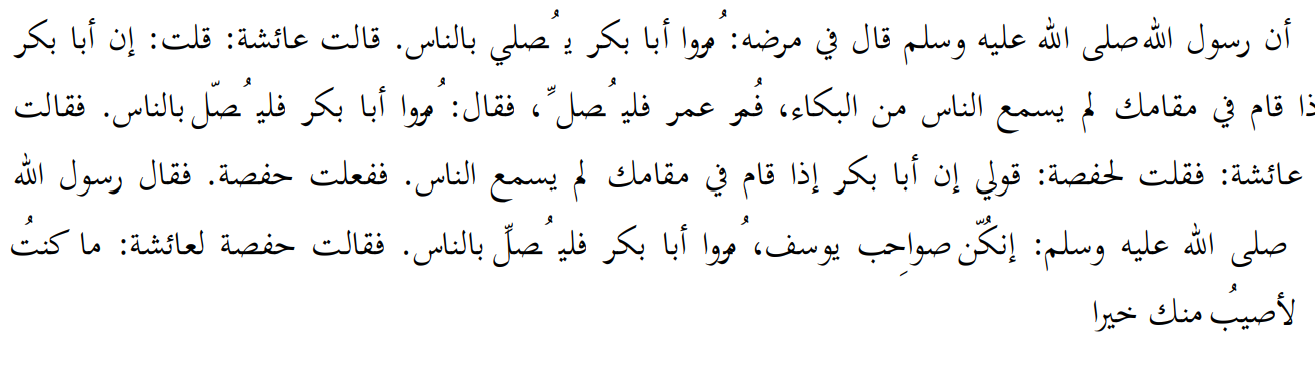
“Allohning Elchisi ﷺ menga kasalliklari paytida shunday dedilar: “Abu Bakrga buyuring, odamlarga namoz o‘qib bersin.” Oisha aytdi: “Men dedim: “Abu Bakr sizning o‘rningizda turganida, yig‘lagani sababli odamlar uning ovozini eshitmaydi, shuning uchun Umarga buyuring, namoz o‘qib bersin.” U zot dedilar: “Abu Bakrga buyuring, odamlarga namoz o‘qib bersin.” Oisha aytdi: “Men Hafsaga dedim: “Abu Bakr sizning o‘rningizda turganida odamlar eshitmaydi, deb ayting”, va u shunday qildi. Allohning Elchisi ﷺ dedilar: “Siz Yusuf sohiblari kabisiz. Abu Bakrga buyuring, odamlarga namoz o‘qib bersin.” Hafsa Oishaga dedi: “Men sendan hech qachon biror yaxshilikka erisholmayman!””
“That the Messenger of Allah (saw) told me during his illness: Command Abu Bakr to lead the people in prayer. Aisha said: I said: When Abu Bakr stands in your place, people do not hear him for his crying so command Umar to lead prayers. He said: Command Abu Bakr to lead people in prayer. Aisha said: I said to Hafsa: Say that when Abu Bakr stands in your place, the people do not hear, and she did that. The Messenger of Allah (saw) said: You are like the companions of Yusuf. Command Abu Bakr to lead the people in prayer. Hafsa said to Aisha: I will never achieve any good through you!”
To'rtinchidan: Muslim ibn Abu Mulkiyya'dan rivoyat qiladi, u shunday degan:
Fourthly: Muslim narrated from bin Abu Mulkiyya who said:

“Oisha roziyallohu anhodan so‘raganini eshitdim: Agar Allohning Elchisi ﷺ o‘zidan keyin xalifa tayinlaganida, uni kimni tayinlagan bo‘lardi? U dedi: Abu Bakr. Undan so‘rashdi: Abu Bakrdan keyin kim? U dedi: Umar. Yana so‘rashdi: Umardan keyin kim? U dedi: Abu Ubayda ibn al-Jarroh, va shu yerda to‘xtadi.”
“I heard Aisha being asked: Whom would the Messenger of Allah (saw) have appointed as Khalifah after him had he so appointed? She said: Abu Bakr. She was asked: Then whom after Abu Bakr? She said: Umar. She was then asked: Then whom after Umar? She said: Abu ‘Ubaydah bin al-Jarrah, and she stopped at that.”
Barcha bu hadislar Abu Bakr (r.a.) ning xalifa etib tayinlanganiga Payg'ambar ﷺ tomonidan dalil bo'la olmaydi. Birinchi hadis ikki sabab bilan rad etiladi: Birinchisi shuki, Payg'ambar ﷺ shunday degan edilar:
All these ahadith are not suitable evidence for the Messenger (saw) appointing Abu Bakr (ra) as Khalifah. The first hadith is rejected for two reasons: The first is that the Messenger (saw) said:
“Xohlagan yoki niyat qilgan”
“I wished or intended”
Lekin u shunday qilmagan, shuning uchun bu dalil emas. Chunki dalil Rasulullohning ﷺ so'zi, amali yoki sukuti bo'lib, bulardan boshqasi shariat dalili hisoblanmaydi. Ikkinchidan, Oisha (roziyallohu anho) Abu Bakrning (roziyallohu anhu) qizi edi, shuning uchun bu hadis mavjud bo'lganida, u Abu Bakrga (roziyallohu anhu) xabar bergan bo'lardi. Keyin Ansor o'z orasidan xalifa tayinlash uchun bay'at qilish maqsadida to'planganida, u Saqifaga borib, ular bilan bahslashganda, ushbu hadis bilan bahslashgan bo'lardi. Demak, bu hadis rad etilgan (mardud) bo'lib, Abu Bakrning (roziyallohu anhu) xalifa etib tayinlanishiga dalil bo'la olmaydi.
But he did not do so, so this is not an evidence. For the evidence is the Messenger’s (saw) saying, action or silent consent; anything other than these is not considered Shari’ah evidence. Secondly, Aisha (ra) is Abu Bakr’s daughter so were this hadith present she would have informed Abu Bakr (ra). Then he would have argued with it when he went to the courtyard (saqeefa) to contend with the Ansar when they gathered to pledge allegiance to a Khalifah amongst them. Therefore this hadith is rejected (mardud) and is unsuitable to be an evidence for the appointment of Abu Bakr (ra) as Khalifah.
Ikkinchi hadisga kelsak, u Abu Bakr (ra) ning xalifa etib tayinlanganiga dalil bo‘la olmaydi, chunki ayol: “Agar sizni topmasam”, degan. Demak, u Abu Bakrni urushda yoki boshqa biror ishda yo‘qligi sababli topa olmasligi to‘g‘ri bo‘ladi. Uning “Agar sizni topmasam” degan so‘zlari bilan vafot etganingizni nazarda tutganiga hech narsa dalolat qilmaydi. Hadisda kelgan “go‘yo u o‘limni nazarda tutgandek” degan so‘zlar Jubayrning va uning tushunchasining so‘zlaridir. Shuning uchun Rasulullah ﷺ ning ayolga, agar kelib uni topmasa, Abu Bakr (ra) ning oldiga borishni buyurishi, Rasulullah ﷺ dan keyin Abu Bakr (ra) ning xalifa etib tayinlanganiga dalil emas. Hatto biz uning tushunchasini o‘lim degan ma’noda qabul qilishga majbur bo‘lsak ham, bu so‘zlar Abu Bakrni Rasulullah ﷺ dan keyin xalifa etib belgilamaydi. Uchinchi hadisga kelsak, bu namozga imom etib tayinlashdir, boshqa narsa emas. Namozga tayinlash hukmronlikka (hukm) tayinlashni anglatmaydi. Ularning: “Rasulullah ﷺ uni din masalasida rozi bo‘ldilar, shuning uchun dunyo masalasida ham biz uni rozi bo‘lmasligimiz kerakmi?” degan so‘zlari esa ularning tushunchasidir va u xato, chunki namoz bilan hukmronlik o‘rtasida katta farq bor. Namozda imom bo‘lishga loyiq har bir kishi hukmronlikda rahbar bo‘lishga ham loyiq emas. Bundan tashqari, matn namozga xos bo‘lib, boshqa narsalarni o‘z ichiga olmaydi va matnning xosligi sababli uni boshqa narsalarga ham olib bo‘lmaydi.
As for the second hadith, it does not indicate the appointment of Abu Bakr (ra) as Khalifah because the woman said: “If I did not find you”; so it is correct that she failed to find him due to his absence in a war or any other matter. There is nothing in it to indicate that she meant by her words “If I did not find you” that you had died. The words which came in the hadith “As if she meant death” are the words of Jubayr and his understanding. So the Messenger’s command for her to go to Abu Bakr (ra) if she came and did not find him is no proof for the appointment of Abu Bakr (ra) as Khalifah after the Messenger (saw). Even if we were compelled to take her understanding to mean death, these words still would not designate Abu Bakr as Khalifah after him (saw). As for the third hadith, this is the appointment over prayer and nothing else. Appointment over prayer does not mean appointment in authority (hukm). As for their statement: “The Messenger of Allah was pleased with him in a matter of the deen, so should we not be pleased with him in a matter of the world (dunya)”; this is their understanding, and it is erroneous because there is a large difference between prayer and ruling. Not all who are suitable to become a leader (Imam) in prayer are suitable to be a leader in ruling. Moreover, the text is specific to prayer so it does not encompass other things, nor should it be taken to mean other things due to the specificity (khususiyya) of the text.

“Allohning Elchisi ﷺ aytdilar: Ertaga bayroqni (rayah) shunday kishiga beraman, uning qo‘li bilan Alloh (SWT) g‘alaba beradi.” U zot aytdilar: Shunda odamlar kechasi bilan o‘ylashib chiqdilar, uni kimga berilar ekan. Odamlar tong otganda, uning kimga berilishini umid qilib, erta bilan Allohning Elchisi ﷺ huzuriga bordilar, lekin u zot dedilar: Ali ibn Abu Solib qayerda? Ular dedilar: Ey Allohning Elchisi, uning ko‘zlari og‘riyapti. U zot dedilar: Uni yoningizga chaqiring. U kelganida, uning ko‘zlariga tupurdilar va uning uchun duo qildilar. U go‘yo hech qachon og‘rimagandek sog‘ayib ketdi va u zot unga bayroqni berdilar.
“That the Messenger of Allah (saw) said: I will give the flag (rayah) tomorrow to someone by whose hands Allah will conquer. He said: So the people spent the night thinking which one of them it would be given to. When people woke up, they went early in the morning to the Messenger of Allah (saw) hoping it would be given to them, but he said: Where is Ali bin Abi Talib? They said: His eyes are paining O Messenger of Allah. He said: Send for him to come to me. When he came, he spit in his eyes and prayed for him. He was cured as if he never had pain, and he gave him the flag.”
Muslim bu hadisni Abu Hurayra rivoyatida quyidagi so'zlar bilan rivoyat qilgan:
Muslim narrated this hadith from Abu Hurairah with the words:

Allohning Elchisi ﷺ Xaybar kuni shunday dedi: “Ushbu bayroqni Allohni va Uning Elchisini sevadigan kishiga beraman; Alloh uning qo‘li bilan fath ato etadi.” Umar ibn al-Xattob dedi: “Men bu kundan oldin hech qachon rahbarlik qilishni orzu qilmagan edim.” U dedi: “Men o‘zimni o‘sha ishga chaqirilishimni umid qilib tasavvur qilardim.” U dedi: “Allohning Elchisi ﷺ Ali ibn Abu Tolibni chaqirdi va unga bayroqni berdi.”
“The Messenger of Allah (saw) said on the day of Khayber: I will give this flag to someone who loves Allah and His Messenger by whose hands Allah will conquer. Umar bin al-Khattab said: I had never wished for leadership except for that day. He said: I visualised it hoping that i would be called for it. He said: The Messenger of Allah (saw) called Ali bin Abi Talib and gave him the flag.”
Al-Buxoriy virtues bobida, Ali (roziyallohu anhu) haqida rivoyat qilgan: Allohning Elchisi ﷺ Aliga (roziyallohu anhu) shunday degan:
Al-Bukhari narrated in the chapter of virtues of Ali (ra) that the Messenger of Allah (saw) said to Ali (ra):
“Sen mendansan va men sendanman.”
“You are of me and I am of you.”
Muslim ‘Omir ibn Sa’d ibn Abi Waqqos (roziyallohu anhu) dan rivoyat qiladi, u otasidan naql qiladi, u esa aytdi: Muoviya ibn Abu Sufyon (roziyallohu anhu) Sa’d (roziyallohu anhu)ga buyurdi: Abu Turob (roziyallohu anhu)ni so‘kishdan nima seni to‘sdi? U dedi: Men Allohning Elchisi ﷺ uning haqida aytgan uch narsani eslasam, uni hech qachon so‘kmayman. Ulardan birortasi menda bo‘lishi menga qizil tuyalardan ham sevimliroqdir. Allohning Elchisi ﷺ uni ba’zi jang yurishlarida ortda qoldirdi. ShundaAli (roziyallohu anhu) unga dedi: Ey Allohning Elchisi ﷺ, meni ayollar va bolalar bilan qoldirasizmi? Allohning Elchisi ﷺ unga dedi:
Muslim narrated from ‘Amir Bin S’ad bin Abi Waqqas (ra) from his father who said: Muawiya bin Abu Sufyan (ra) commanded S’aad (ra) saying: What has prevented you from insulting Abu Turab (ra)? He said: When I remember three (things) which the Messenger of Allah (saw) said of him, I will never insult him. That I should have even one of these is more beloved to me than red camels. The Messenger of Allah (saw) left him behind in some of his war expeditions, so Ali (ra) said to him: O Messenger of Allah (saw), have you left me behind with women and children? The Messenger of Allah (saw) said to him:
“Siz mening yonimda Muso yonidagi Horun maqomida bo‘lishdan rozi emasmisiz, faqat mendan keyin nabiy yo‘q, xolos?”ﷺ
“Are you not pleased to be in the same status next to me like the status of Harun next to Musa, except that there is no Prophet after me.”
Men ham Xaybar kuni uning bunday deganini eshitganman:
I also heard him say on the day of Khayber:
«Men bayroqni Allohni va Uning Rasulini sevadigan, Alloh va Uning Rasuli ham sevadigan kishiga beraman».
‘I will give the flag to a man who loves Allah and His Messenger, and whom Allah and His Messenger love.
U u dedi: Biz unga qarab harakat qildik, va u dedi:
He said: We moved for it and he said:
"Aliga chaqiring", shunda u olib kelindi va uning ko'zlari og'riyotgan edi. U uning ko'ziga tupurdi va unga bayroqni berdi, va Alloh uning orqali g'alaba berdi.
“Call Ali, so he was brought and he had sore eyes. He spit in his eyes and gave him the flag, and Allah conquered through him.’
Va bu oyat nozil bo‘lganda:
And when this verse was revealed:
Keling, o'g'illarimizni va o'g'illaringizni chaqiraylik [TMQ 3:61],
Say: Come and let us call our sons and your sons [TMQ 3:61],
Allohning Elchisi ﷺ Ali (ra), Fotima (ra), Hasan (ra) va Husayn (ra) ni chaqirib, dedilar:
The Messenger of Allah (saw) called Ali (ra), Fatima (ra), Hassan (ra) and Husain (ra) and said:
“Ey Alloh, bu mening oilam.”
‘O Allah, this is my family.’”
Muslim rivoyat qilgan, Sahl ibn Sa'd aytadi: Marvon avlodidan bir kishi Madinaga hokim etib tayinlangan edi. U Sahl ibn Sa'dni chaqirib, unga Ali (ra)ni haqorat qilishni buyurdi. U aytadi: Sahl rad etdi, shunda unga aytildi: Agar rad etsang, unda shunday de: Alloh Abu Turobni la'natlasin (ra). Sahl aytdi: Ali (ra)ning menga Abu Turob (ra)dan sevimliroq boshqa ismi yo'q, va u shu nom bilan chaqirilganda xursand bo'lardi. Unga aytildi: Uning nima sababdan Abu Turob (ra) deb atalganini bizga xabar bering. Shunda u aytdi: Alloh elchisi ﷺ Fotimaning uyiga keldilar, lekin uni uyda topmadilar va shunda aytdilar:
Muslim narrated from Sahl bin S’aad who said: A man from the family of Marwan was appointed (as ruler) over Madinah. He said: He called Sahl bin S’aad and commanded him to insult Ali (ra). He said: Sahl refused, so it was said to him: If you refuse, then say: Allah curse Abu Turab (ra). Sahl said: Ali (ra) has no name more beloved to me than Abu Turab (ra), and he would be pleased when called by it. It was said to him: Inform us of the incident as to why he was called Abu Turab (ra), so he said: The Messenger of Allah (saw) came to Fatima’s house and did not find him in the house, so he said:
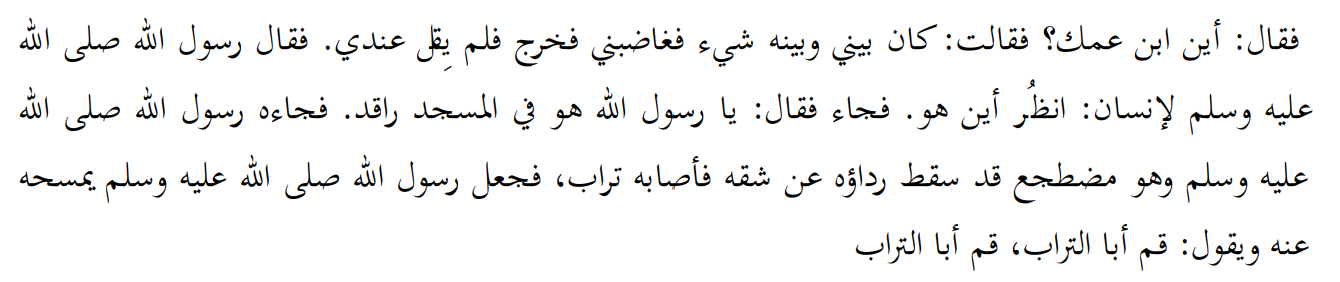
"Amakivachchangizning o'g'li qayerda?" U aytdi: U bilan mening o'rtamizda biror narsa bo'lgan edi, u meni g'azablantirdi va menga aytmasdan ketib qoldi. Shunda Allohning Elchisi ﷺ kimgadir shunday dedilar: "Borib, u qayerdaligini bilib kel." U qaytib kelib dedi: "Ey Allohning Elchisi, u masjidda dam olyapti." Shunda Allohning Elchisi ﷺ uning yoniga keldilar, u yonboshlab yotgan edi. Uning ustidagi chopon tanasidan tushib ketgan va unga tuproq yopishgan edi. Shunda Allohning Elchisi ﷺ uning ustidagi tuproqni artishga kirishdilar va shunday dedilar: "Tur, ey Abu Turob."
“Where is the son of your paternal uncle?” She said: There was something between him and me, and he made me angry and left without telling me. So the Messenger of Allah (saw) said to someone: “Go find out where he is.” He came back and said: O Messenger of Allah, he is resting in the mosque. So the Messenger of Allah (saw) came to him while he was reclining. His cloak had fallen from his body and dirt had touched him, so the Messenger of Allah (saw) began wiping it off him while saying: “Stand up, O Abu Turab.”
Muslim ‘Adiyy bin Thabit orqali Zarr dan rivoyat qiladi, u aytdi: Ali aytdi:
Muslim narrated from ‘Adiyy bin Thabit from Dharr who said: Ali said:
"Donalarni yorib, jonzotni yaratgan Zotning qasamki, Payg‘ambar ﷺ menga va’da berdilar: mendan faqat mo‘min kishi muhabbat qiladi, mendan faqat munofiq kishi kek saqlaydi."
“By Him Who split up the seed and created something living, the Prophet (may peace and blessings be upon him) gave me a promise that no one but a believer would love me, and none but a hypocrite would nurse grudge against me..”
Bu hadislarda Elchi (saw) Ali (ra) ni o‘zidan keyin xalifa etib tayinlaganini aytishga asos yo‘q. Xaybar hadisi Allah Elchisining maqtovidir. Allah Elchisining (ﷺ) Ali (ra) ga aytgan so‘zi:
There is nothing in these ahadith to make someone say that the Messenger (saw) appointed Ali (ra) to be Khalifah after him. The hadith of Khayber is praise from the Messenger of Allah. The Messenger’s (saw) statement to Ali (ra):
«Sen mendansan, men esa sendanman»
“You are of me and I am of you”
Bu Payg'ambar (ﷺ)dan kelgan maqtovdir. Sa'd haqidagi hadisga kelsak, unda aytilgan:
Is a praise from the Messenger of Allah (saw). As for the hadith of S’aad in which came:
“Sen Musoga nisbatan Horunning maqomiga ega bo‘lishdan mamnun emasmisan?”
“Are you not pleased to have the status before me as that of Harun with Musa”,
Ushbu mavzu bo‘yicha ahodislarning ikkinchi toifasida muhokama qilinadi. Unda Xaybar hadisi ham bor, bu maqtovdir, va unda Ali (ra), Fotima (ra), Hasan (ra) va Husayn (ra) uning ahli bayti ekani aytiladi, bu ham maqtovdir, shuningdek Sahl ibn Sa’d hadisi ham maqtovdir. Rasulullah ﷺ Aliyni maqtaganlari kabi, sahobalaridan boshqalarni ham maqtaganlar. Payg‘ambarning biror kishini maqtashi, hech qanday holatda uning tayinlanganini bildirmaydi.
This subject will be discussed in the second category of the ahadith on the topic. In it is also the hadith of Khayber which is a praise and in it is that Ali (ra), Fatima (ra), Hassan (ra) and Husain (ra) are his family which is a praise, and the hadith of Sahl bin S’ad is a praise. Just like the Messenger of Allah (saw) praised Ali (ra), he also praised others among his Sahabah (ra). The Messenger’s praise for a person does not in any way indicate his appointment.
Ikkinchi toifaga kiruvchi hadislar, ya'ni ba'zi kishilar Rasululloh ﷺ Alining o'zlaridan keyin xalifa bo'lishini aniq so'zlar bilan aytganlaridan xulosa chiqargan hadislar, quyidagi to'rt matnda jamlangan:- 1- Al-Buxoriy Mus'ab ibn Sa'd orqali, u otasidan rivoyat qilgan.
As for the second category of ahadith which are those from which some deduced that the Messenger (saw) stated textually that Ali would be the Khalifah after him, they are summarised in these four texts:- 1- Al-Bukhari narrated from Mus’ab bin S’ad from his father
Allohning Elchisi ﷺ Tabuk tomon yo‘l olganida Aliyni o‘rniga qoldirdi. Shunda u: “Meni ayollar va bolalar bilan birga qoldirib ketyapsizmi?” dedi. U zot ﷺ shunday dedilar: “Musoga nisbatan Horunning tutgan o‘rni menga nisbatan sen uchun bo‘lgan o‘rinda bo‘lishidan rozi emasmisan? Faqat mendan keyin nabiy yo‘q.”
“That the Messenger of Allah (saw) left for Tabuk and appointed Ali, so he said: Do you leave me behind along with women and children? He said: Are you not pleased to have the same status with me as Harun had with Musa, except that there is no Prophet after me?”
Muslim Omir ibn Sa'd ibn Abi Vaqqosdan rivoyat qiladi, u otasidan naql qilib aytadi: Allohning Elchisi ﷺ Aliga (roziyallohu anhu) dedi:
Muslim narrated from ‘Amir bin S’ad bin Abi Waqqas (ra) from his father who said: The Messenger of Allah (saw) said to Ali (ra):
"Sen menga Muso uchun Horun qanday bo'lgan bo'lsang, shunday maqomdasan, faqat mendan keyin nabiy yo'q."
“You are to me of the same status as Harun was to Musa, except that there is no Prophet after me.”
Va Muslim Ibrohim ibn Sa'd orqali Sa'd dan rivoyat qilgan: Payg'ambar ﷺ Aliga (ra) dedilar:
And Muslim narrated from Ibrahim bin S’ad from S’ad that the Prophet (saw) said to Ali (ra):
"Men bilan Muso oldida Horun tutgan o'rinda bo'lishdan rozi emasmisiz?"
“Are you not pleased to have the same relation with me as Harun had with Musa”
Ibn Ishoq rivoyat qilib aytadi: Allohning Elchisi ﷺ Ali ibn Abu Tolib (r.a.) ni oilasiga qarash va uni nazorat qilish uchun orqada qoldirdi. Munofiqlar yolg'on mish-mishlar tarqata boshladilar va unga aytdilar: U ﷺ uni faqat unga og'ir bo'lgani va uning uchun osonlashishi uchun qoldirgan. Munofiqlar shuni aytganda, Ali ibn Abu Tolib (r.a.) qurolini olib, Al-Jarfda qo'nib turgan Allohning Elchisi ﷺ ga yetguncha yo'lga chiqdi va dedi: Ey Allohning Nabiysi ﷺ, munofiqlar sizning meni orqada qoldirganingizni, chunki bu men uchun og'ir bo'lganini va meni yengillashtirish uchun ekanini da'vo qilmoqdalar. U ﷺ dedi:
Ibn Ishaq narrated by saying: The Messenger of Allah (saw) left behind Ali bin Abi Talib (ra) to look after and supervise his family. The hypocrites started spreading false rumors and said to him that: He (saw) did not leave him behind except for the reason that it was hard on him and so that it could become easy for him. When the hypocrites said that, Ali bin Abi Talib (ra) took his weapons and moved out until he met the Messenger of Allah (saw) who was encamped at Al-Jarf and said: O Prophet of Allah (saw), the hypocrites claimed that you left me behind because it was hard for me and to make it easy for me. He said:

“Ular yolg‘on gapirdi; aksincha, men seni ortimda qoldirgan narsalarim tufayli qoldirdim. Shunday ekan, mening nomimdan mening oilamni va o‘z oilangni nazorat qilgin. Ey Ali, Mусо oldida Horun tutgan o‘rinning mening oldimda senda bo‘lishidan mamnun emasmisan? Faqat mendan keyin nabiy yo‘q, bu bundan mustasno.” ﷺ
“They lied; rather I left you behind due to what I left behind me so return and supervise my family and your family on my behalf. Are you not pleased, O Ali, to have the same status before me as Harun had before Musa except that there is no Prophet after me?”
Shunday qilib Ali Madinaga qaytdi, Allah elchisi ﷺ esa o‘z safarini davom ettirdi. As-Sayyid Abd al-Husain Sharaf ud-Deen "Al-Muraja’at" kitobida quyidagilarni keltirgan: Jabir ibn Abdulloh rivoyati, u aytadi: Allah elchisi ﷺ aytdilar:
So Ali returned to Madinah and the Messenger of Allah (saw) continued on his journey. As-Sayyid Abd al-Husain Sharaf ud-Deen mentioned the following in the book “Al-Muraja’at ”: “The hadith of Jabir bin Abdullah who said: The Messenger of Allah (saw) said:
Ey Ali, albatta, masjidda menga ruxsat etilgan narsa senga ham ruxsat etilgan, sening mendan bo'lgan munosabating Horun Musoga bo'lgan munosabati kabidir, faqat mendan keyin nabiy yo'q.ﷺ
O Ali, verily it is allowed for you in the mosque what is allowed for me, and your relation with me is that of Harun with Musa except that there is no Prophet after me.”
2. Muslim Yazid bin Hayyan'dan rivoyat qiladi, u aytdi: Men Husayn bin Sabra va Umar bin Muslim bilan birga Zayd bin Arqam (ra) huzuriga bordik. Biz uning yonida o'tirganimizda, Husayn unga dedi: "Albatta, ey Zayd, sen katta yaxshilikka erishding. Sen Allahning Elchisini ﷺ ko'rding, uning hadisini eshitding, u bilan birga jihod qilding va uning orqasida namoz o'qiding. Albatta, ey Zayd, sen katta yaxshilikka erishding. Shuning uchun, ey Zayd, Allahning Elchisidan ﷺ eshitganingni bizga so'zlab ber." U dedi: "Ey birodarimning o'g'li, Allahga qasamki, men qarib qoldim va mening ajalim yaqinlashdi. Allahning Elchisidan ﷺ tushunganlarimning bir qismini unutib qo'ydim. Shuning uchun men sizga so'zlaganlarimni qabul qiling, so'zlamagan narsalarimga majbur qilmang." So'ngra u dedi: "Bir kuni Allahning Elchisi ﷺ Makka bilan Madina orasidagi Xum deb ataladigan suvlar yonida bizning oldimizda turib, nutq so'zladi. U Allohga hamd-sano aytdi, Uni ulug'ladi, nasihat qildi va eslatdi, so'ngra dedi:"
2. Muslim narrated from Yazid bin Hayyan who said: I left with Husain bin Sabra and Umar bin Muslim to Zayd bin Arqam (ra). When we sat with him, Husain said to him: “Verily, O Zayd, you met a great deal of good. You saw the Messenger of Allah (saw), heard his hadith, fought with him and prayed behind him. Verily, O Zayd, you met a great deal of good. So relate to us, O Zayd, of what you heard from the Messenger of Allah (saw). He said: O son of my brother, by Allah I have become old and my time has approached. I have forgotten some of that, which I understood from the Messenger of Allah (saw), so accept whatever I relate to you and do not force me on that which I do not relate. Then he said: The Messenger of Allah (saw) stood one day before us speaking at the waters known as Khum between Makkah and Madinah. He thanked Allah, praised Him, exhorted and reminded then said:
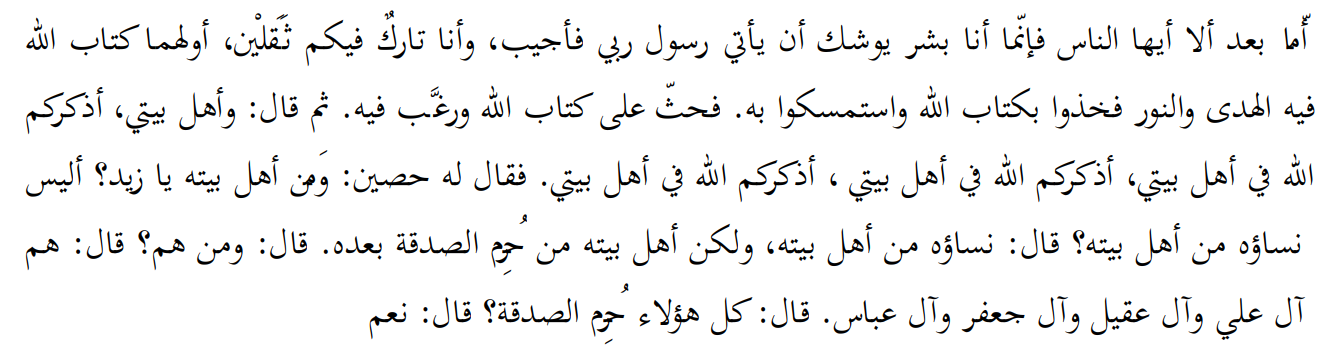
"Endi maqsadimizga o'tamiz. Ey insonlar, men ham bir insonman. Men Rabbimdan bir elchi (ya'ni o'lim farishtasi) qabul qilishga yaqinman va Allohning chaqiruviga javoban (sizlar bilan xayrlashmoqchiman), ammo orangizda ikki og'ir narsani qoldiraman: birinchisi – Allohning Kitobi, unda to'g'ri hidoyat va nur bor, shuning uchun Allohning Kitobini mahkam tutinglar va unga amal qilinglar." U (Allohning Kitobini mahkam tutishga) da'vat qildi, so'ngra dedi: "Ikkinchisi – mening Ahli baytim. Ahli baytim haqida sizlarga (vazifalaringizni) eslatib o'taman." U (Husayn) Zaydga dedi: "Uning Ahli bayti kimlar? Uning xotinlari uning Ahli baytidan emasmi?" Shunda u dedi: "Uning xotinlari ham Ahli baytidandir, ammo bu yerda Ahli bayt – ularga zakot olish harom qilingan kishilardir." U yana dedi: "Ular kimlar?" Shunda u dedi: "Ali va Alining avlodlari, Aqil va Aqilning avlodlari, Ja'farning avlodlari va Abbosning avlodlari." Husayn dedi: "Ular – zakot olish harom qilingan kishilardir." Zayd dedi: "Ha."
" Now to our purpose. O people, I am a human being. I am about to receive a messenger (the angel of death) from my Lord and I, in response to Allah's call, (would bid good-bye to you), but I am leaving among you two weighty things: the one being the Book of Allah in which there is right guidance and light, so hold fast to the Book of Allah and adhere to it. He exhorted (us) (to hold fast) to the Book of Allah and then said: The second are the members of my household I remind you (of your duties) to the members of my family. He (Husain) said to Zaid: Who are the members of his household? Aren't his wives the members of his family? Thereupon he said: His wives are the members of his family (but here) the members of his family are those for whom acceptance of Zakat is forbidden. And he said: Who are they? Thereupon he said: 'Ali and the offspring of 'Ali, 'Aqil and the offspring of 'Aqil and the offspring of Ja'far and the offspring of 'Abbas. Husain said: These are those for whom the acceptance of Zakat is forbidden. Zaid said: Yes.”
As-Sayyid Abd al-Husain Sharaf ud-Deen “Al-Muraja’at” kitobida bu hadisni At-Tabaroniy rivoyat qilgan, sanadi sahihligi bo‘yicha ittifoq mavjud bo‘lgan silsila orqali keltirgan holda, Zayd ibn Arqam (ra)dan quyidagicha naql qiladi: Allohning Elchisi ﷺ G‘adir Xum deb atalgan joyda, bir qancha daraxtlar ostida so‘zladilar va dedilar:
As-Sayyid Abd al-Husain Sharaf ud-Deen mentioned in his book “Al-Muraja’at” this hadith via the following narration which At-Tabarani narrated through a chain whose authenticity is unanimously accepted from Zayd bin Arqam (ra) who said: The Messenger of Allah (saw) spoke at Ghadeer Khum underneath some trees and said:
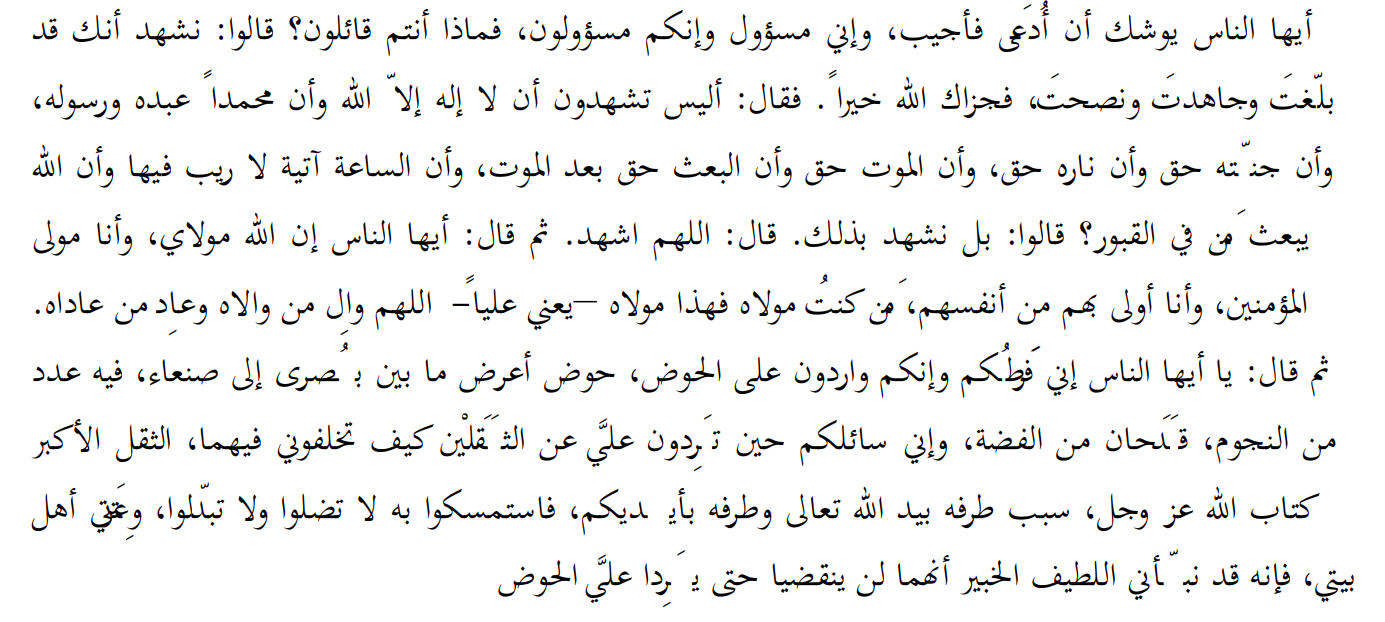
"Ey odamlar, menga chaqiriladigan va men javob beradigan vaqt yaqinlashmoqda (o'lim nazarda tutilgan). Albatta, men mas'ulman va siz ham mas'ulsiz, shunday ekan nima deysiz?" Ular dedilar: "Biz guvohlik beramiz, siz (haqiqatni) yetkazdingiz, jihod qildingiz va nasihat qildingiz, Alloh sizga yaxshi mukofot bersin." U zot dedilar: "Alloh yagona ilohdan o'zga iloh yo'qligiga, Muhammad ﷺ Uning bandasi va Rasuli ekaniga, Jannat haqq ekaniga, Do'zax haqq ekaniga, o'lim haqq ekaniga, o'limdan keyin tirilish haqq ekaniga, Qiyomat (Hisob kuni) shak-shubhasiz kelishiga va Alloh barcha kishilarni qabrlaridan tiriltirishiga guvohlik bermaysizmi?" Ular dedilar: "Ha, guvohlik beramiz." Shunda u zot dedilar: "Ey odamlar, albatta Alloh mening Mavlom (homiyim)dir va men mo'minlarning homiyisiman, ya'ni men ularga o'z nafslaridan ham ustunman. Kimki meni homiy deb bilsa, mana bu (Ali) ham uning homiyisidir." Ey Alloh, uni dўst tutgan kishini dўst tut, uni dushman tutgan kishini dushman tut. So'ng u zot dedilar: "Ey odamlar, albatta men sizlarni tark etaman va siz meni Havzda (hovuz oldida) topasiz. Bu havz Basradan Sanoagacha bo'lgan masofadan ham kengroqdir. Unda yulduzlar miqdoridagi kumush ko'zachalar bor. Albatta, siz mening huzurimga kelganingizda sizdan ikki og'ir narsa haqida so'rayman: mendan keyin ularga qanday amal qildingiz. Og'irroq va buyukroq narsa Allohning Kitobidir. Uning bir uchi Allohning qo'lida, ikkinchi uchi esa sizlarning qo'lingizdadir. Adashmaslik va o'zgartirmaslik uchun uni mahkam tutinglar. Ikkinchisi esa mening Itratim (Ahli baytim), uy ahlimdir. Albatta, Eng Mehribon va Eng Bilguvchi Zot (Alloh taolo) menga xabar berdiki, ular Havzda mening huzurimga kelguncha hech qachon bir-biridan ajralmaydilar."
“O people, it is about to be that I am called and I will respond (indicating death). Verily, I am accountable and you are accountable, so what will you say? They said: We will testify that you conveyed, struggled and advised so may Allah recompense you well. He said: Do you not bear witness that there is no deity but Allah and Muhammad is His slave and Messenger, that Paradise is true and Hellfire is true, that death is true and resurrection after death is true, that the Hour (of Judgement) will come without any doubt, and that Allah will resurrect all those in their graves? They said: Yes, we do bear witness. Then he said: O people, verily Allah is my Patron and I am the patron of the believers such that I take precedence before them over their own selves. Whoever takes me as his patron then this one is his patron—meaning Ali. O Allah, befriend whoever befriends him and take as enemy whoever takes him as an enemy. Then he said: O people, verily I will leave you and you will find me at the Cistern, a cistern wider than the distance from Basra to Sana’a. In it are tumblers of silver the number of stars. Verily I will ask you when you come before me on the two weighty things, how you took care of them after me. The weightier and greater one is the Book of Allah ‘azza wa jalla, a (sabab) of which one end is in the hands of Allah and the other in your hands. Hold tightly to it so that you do not go astray or change, and my Utra (household), the people of my house. Verily The Kind & All-Knowing (swt) has informed me that they will never seperate until they come before me at the cistern (fountain)”
(Bu As-Sayyid Abd al-Husain Sharaf ud-Deen keltirgan gapning oxiri.) Va Shayx Abd al-Husain Ahmad Al-Ameeni An-Najafiy o'zining "Al Ghadeer" kitobida quyidagilarni bayon qilgan: "U zot ﷺ hajga oid marosimlarini tugatib, yuqorida zikr qilingan odamlar guruhi bilan birga Madinaga qaytayotganda, Al-Jahfadagi G'adir Xum nomli joyga yetdilar. Bu yerda Madina, Misr va Iroq ahlining yo'llari ajraladi. Bu Zul-hijja oyining o'n beshinchi kuni edi va ishonchli Jabroil ﷺ Allohdan (SWT) unga quyidagi oyat bilan nozil bo'ldi:"
(This is the end of what As-Sayyid Abd al-Husain Sharaf ud-Deen mentioned). And Shaikh Abd al-Husain Ahmad Al-Ameeni An-Najafi stated the following in his book “Al Ghadeer”: “When he finished his rites of worship i.e. the Prophet (saw) and left for Madinah, together with the mentioned group(s) of people, he reached Ghadeer Khum in Al-Jahfa where the roads branch for the people of Madinah, Egypt and Iraq. This was the 15th day of Dhul-Hijja and Jibril, the trustworthy, descended to him from Allah (swt) with His saying:
"Ey Rasul, Rabbingiz tomonidan sizga nozil qilingan narsani yetkazing" — Note: The Qur'an verse is quoted by the user; per the rules, no ﷺ is placed here since it is inside a verse context addressing the Messenger, and the original does not name the Prophet by name. [TMQ 5:67]
‘O Messenger, deliver what was revealed to you from your Lord” [TMQ 5:67]
Va U (Alloh) unga Ali (roziyallohu anhu)ni turishga buyurdi, toki odamlar bilsin va unga uning do'stligi (valoyati) va har bir kishi zimmasidagi itoat majburiyati haqida nozil qilingan narsani xabar qilsin. Odamlarning birinchilari Al-Jahfaga yaqin edi, shuning uchun Allohning Elchisi ﷺ oldinga o'tib ketganlarni qaytishga buyurdi, o'sha joyda kechikkanlarni esa to'pladi va odamlarga besh katta daraxt ostida to'xtashni man qildi. Odamlar manzil qurib, daraxtlar ostida qolganlar zuhr namozi azon aytilguncha turganlarida, u ﷺ ularning oldiga bordi va ularning ostida namoz o'qidi. Kun jaziramali edi, shunchalik qattiq issiqda bir kishi yuzining ustiga, oyoqlari ostiga o'z ridosining bir qismini qo'ygan edi, Allohning Elchisi ﷺ esa quyosh tufayli sumra daraxti ustiga tashlangan bir kiyim bilan soyalanardi. U ﷺ namozini tugatgach, odamlarning o'rtasida tuya o'rkachida turib gapirdi, ovozini baland ko'tarib, hammaning eshitishi uchun so'zladi va dedi:
And He commanded him to cause Ali (ra) to stand to let the people know and inform what was revealed regarding his patronage and the obligation of obedience upon every one. The first of the people were close to Al-Jahfa so the Messenger of Allah (saw) commanded those who had proceeded to return and enclosed those who had delayed at that place, and he prohibited people from encamping beneath the five large trees. When the people took camp and those underneath them (the trees) stood until the dhuhr prayer was announced, he headed for them and prayed beneath them. It was a sizzling day where a man placed some of his cloak upon his face and some under his feet due to the severe heat, and the Messenger of Allah was shaded by a garment upon the sumra tree due to the sun. When he (saw) finished his prayer, he stood to speak in the middle of the people on the hump of a camel and he spoke with a raised tone with every one hearing him and he (saw) said
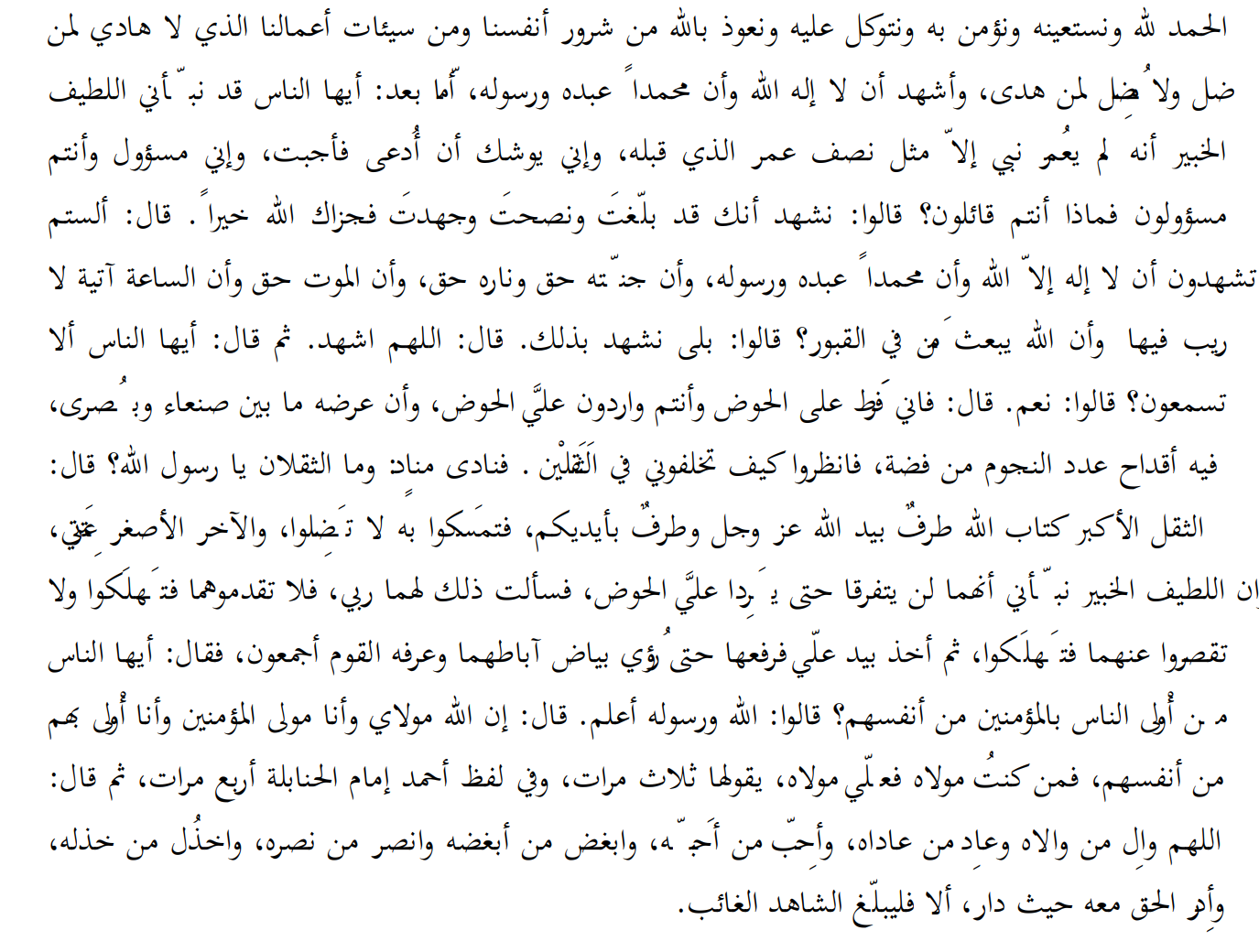
Barcha maqtovlar yolg'iz Allohga xosdir, biz Undan yordam so'raymiz, Unga iymon keltiramiz va Unga tayanamiz. Biz Allohdan nafslarimizning yomonliklari va yomon amallarimizdan Uni panoh berishini so'raymiz. Kimni Alloh hidoyat qilmasa, uni hech kim to'g'ri yo'lga boshlay olmaydi; kimni Alloh adashtirsa, uni hech kim hidoyat qila olmaydi. Men guvohlik beraman, Allohdan o'zga iloh yo'q va Muhammad ﷺ Uning bandasi va elchisidir. Bundan keyin: Ey odamlar! Albatta, Eng Mehribon va Eng Bilguvchi (swt) menga xabar berdiki, U hech bir Payg'ambarga o'zidan oldingi Payg'ambarning umrining yarmichalik umr bermaydi. Albatta, menga chaqiriq keladigan va men javob beradigan vaqt yaqin. Albatta, men mas'ulman, siz ham mas'ulsiz. Endi nima deysiz? Ular dedilar: Biz guvohlik beramizki, siz albatta yetkazdingiz, nasihat qildingiz va jihod qildingiz, Alloh sizga yaxshi mukofot bersin. U zot dedi: Allohdan o'zga iloh yo'qligiga, Muhammad ﷺ Uning bandasi va elchisi ekaniga, Uning jannati haq, Uning do'zaxi haq, o'lim haq, Qiyomat shubhasiz kelishiga va Alloh qabrdagilarni tirilishiga guvohlik bermaysizmi? Ular dedilar: Ha, biz bunga guvohlik beramiz. U zot dedi: Ey Alloh, Sen guvoh bo'l. So'ng dedi: Ey odamlar, eshitmaysizmi? Ular dedilar: Ha. U zot dedi: Albatta, men hovuz (al-Kavsar) oldiga boraman, siz esa mening oldimda hovuzga keltirilasiz. Uning kengligi Sano bilan Basra orasidagicha. Unda yulduzlar soni qadar kumush qadahlar bor. Shuning uchun mendan keyin ikki og'ir narsaga qanday munosabatda bo'lishingizga e'tibor bering. Bir chaqiruvchi: Ey Allohning elchisi, ikki og'ir narsa nima? deb nido qildi. U zot dedi: Ikkisidan kattasi Allohning Kitobidir, uning bir uchi Allohning qo'lida, ikkinchi uchi esa sizlarning qo'lingizda. Shuning uchun unga mahkam yopishing, shunda adashmaysiz. Ikkinchisi, kichikroq, mening ahli baytimdir (‘itratim). Albatta, Eng Mehribon va Eng Bilguvchi (swt) menga xabar berdiki, ular Ali hovuzga yetguncha bizdan ajralmaydilar. Men buni Rabbimdan so'radim. Shuning uchun ularning oldiga o'tib ketmang va ulardan yuz o'girmang, aks holda halok bo'lasiz. So u qo'lidan tutib, Ali ning qo'lini ko'tardi, hatto ularning qo'ltiqlari ko'ringuncha, va hamma uni tanidi. U dedi: "Ey odamlar, mo'minlarga o'zlaridan ham ustunroq kim turadi?" Ular dedilar: "Alloh va Uning Elchisi yaxshiroq biladi." U dedi: "Albatta, Alloh mening mavlamdir (homiyimdir) va men mo'minlarning homiyisiman, shunday ekanki, men ularga o'z nafslaridan ham ustunman. Kimning homiysi men bo'lsam, Ali ham uning homiysidir." U buni uch marta aytdi, Imom Ahmad, hanbaliylar imomi so'zlariga ko'ra, to'rt marta aytdi. So'ngra dedi: "Ey Allohim, kim uni do'st tutsa, unga do'st bo'l, kim uni dushman tutsa, unga dushman bo'l. Kim uni sevsa, sev, kim uni yomon ko'rsa, yomon ko'r, kim unga yordam bersa, yordam ber, kim uni tashlab ketsa, tashlab ket va haqiqat qayerda bo'lsa, u bilan birga bo'lsin. Albatta, hozir bo'lgan guvoh, yo'q bo'lganga xabar yetkazsin."
"All praise is due to Allah whom we ask for help, believe in and depend upon. We ask Allah to protect us from the evils of our souls and bad deeds, the One whom none can guide whom He causes to go astray or misguide whom He guides. I bear witness that there is no god but Allah and Muhammad is His slave and Messenger. As for what follows: O people, verily the The Kind & All-Knowing (swt) has informed me that He does not grant longevity to a Prophet except half the like of the one before him. Verily it is about to be that I will be called and I will respond. Verily I am accountable and you are accountable, so what will you say? They said: We bear witness that verily you have conveyed, advised and struggled so may Allah reward you well. He said: Do you not bear witness that there is no god but Allah and that Muhammad is His slave and Messenger that His paradise is true and His hellfire is true, that death is true, that the Hour will come without any doubt and that Allah will resurrect those in the graves? They said: Yes, we bear witness to this. He said: O Allah, do bear witness. Then he said: O people, will you not listen? They said: Yes. He said: Verily I will go to the cistern (alkauthar) and you will be presented at the cistern, whose breadth is that between Sana’a and Basra, before me. In it are cups of silver the number of which are the number of stars, so look how you take care of the two weighty things after me. An announcer announced: And what are the two weighty things, O Messenger of Allah? He said: The greater of the two weighty things is the Book of Allah, one end of which is in the hand of Allah and the other in your hands so hold fast to it and you will not go astray. The other smaller one is my household (‘utra). Verily the Kind & All-Knowing (swt) informed me that they will not go away until Ali reaches the cistern and I asked that from my Lord. So do not precede them or neglect them and if you do so you will perish. Then he took the hand of Ali and raised it until their armpits were seen and everyone recognised him and he said: O people, who takes precedence before the believers over their own selves? They said: Allah and His Messenger know best. He said: Verily Allah is my Patron (mawla) and I am the patron of the believers such that I take precedence before them over their own selves. So whoever has me as his patron then Ali is his patron. He said this three times, and in the words of Imam Ahmad, Imam of the Hanbalis, four times. Then he said: O Allah, befriend whoever befriends him and become an enemy to whoever takes him as an enemy. Love whoever loves him and hate whoever hates him, support whoever supports him and abandon whoever abandons him, and let the truth be with him wherever he is resides. Verily, let the witness who is present inform the (one who is) absent.’”
3. Ushbu so‘zlarni aytayotganlar, Rasululloh ﷺ Ali (ra)ning xalifaligini aniq e’lon qilganlar, o‘z kitoblarida hadislar rivoyat qilganlar. Biz bu hadislarni tadqiq qilish maydonini ularning rivoyatlari bilan belgilamaymiz, garchi shayxlar Al-Buxoriy va Muslim ularni rivoyat qilmagan bo‘lsalar, ular hech qanday ishonchli rivoyatchilar orqali ham naql qilinmagan bo‘lsa va ko‘pchiligi o‘ylab topilgan hadislar qatoriga kirsa ham. Biz ularning rivoyatlarini tadqiqot mavzusi qilmaymiz, ya’ni ular «Bu hadislar sizdan oldin ishonchli rivoyatchilar tomonidan naql qilinmagan, lekin bizdan oldin ishonchli rivoyatchilar tomonidan naql qilingan», deb aytib, hadisni sahih deb hisoblaganlar uni dalil sifatida ishlatsin, deyishlaridan ham tadqiq qilmaymiz. Biz tadqiqot maydonini qilmaymiz; aksincha, tadqiqot mavzusi qilib rivoyatlarda kelgan matnlarning o‘zini olamiz. Bular ular Rasululloh ﷺ Aliyni o‘zlaridan keyin xalifa etib tayinlaganiga dalil qilib olgan matnlar bo‘lib, bu hadislar «viloyat» hadislari deb ataladi. Ulardan ba’zilarini keltiramiz, qolganlari esa xuddi shu ma’noni, hatto xuddi shu so‘zlarni ham o‘z ichiga oladi.
3. Those who say that the Messenger (saw) clearly announced the Khilafah of Ali (ra) narrated ahadith in their books. As for these ahadith, we will not make the place of research in them their narrations, despite the fact that the two sheikhs Al-Bukhari and Muslim did not narrate them, nor were they narrated via any trustworthy narrators and most of them are among the fabricated ahadith. We will not make their narrations the subject of research such that they say that these ahadith were not narrated by trustworthy narrators before you but were narrated by trustworthy narrators before us so that the one for whom the hadith is authenticated uses it as an evidence. We will not make that the domain of research; rather we will make the matter of research the texts themselves as they came in the narrations. These are the texts from which they deduced that the Messenger (saw) appointed Ali to be the Khalifah after him—and these ahadith are known as the ahadith of “wilayah”—from which we will present some of them and the rest carry the same meaning and even the same wordings.
a) Abu Dovud at-Tayolisiy Ibn Abbos (ra) dan rivoyat qiladi: Allohning Elchisi ﷺ Ali ibn Abu Solib (ra) ga shunday dedilar:
a) Abu Dawud At-Tayalisi narrated from ‘Ibn Abbas (ra) that the Messenger of Allah (saw) said to Ali ibn Abi Talib (ra):
"Sen mening vafotimdan keyin barcha mo'minlarning valiysisan."
“You are the waliy of all believers after me.”
b) Kanz al-'Ammal kitobida Imron ibn Husayn (roziyallohu anhu) dan rivoyat qilinadi: Allohning Elchisi ﷺ bir qo'shin yubordi va uning ustiga Ali ibn Abu Solib (roziyallohu anhu) ni amir qilib tayinladi. U (Ali) xumsdan (beshdan bir ulushdan) o'ziga bir cho'ri tanladi, ular esa buni undan qabul qilmadilar. Ulardan to'rttasi Nabiy ﷺ ga uning ustidan shikoyat qilishga kelishib oldilar. Ular kelganlarida, ulardan biri o'rnidan turib dedi: "Ey Allohning Elchisi ﷺ, Ali (roziyallohu anhu) mana bunday-bunday qilganini ko'rmayapsizmi?" Nabiy ﷺ esa undan yuz o'girdilar. Ikkinchisi turib xuddi shuni aytdi, shunda ham u zot undan yuz o'girdilar. Uchinchisi turib xuddi shuni aytdi, shunda ham u zot undan yuz o'girdilar. To'rtinchisi esa turib, ularning aytganidek gapirdi. Allohning Elchisi ﷺ yuzlarida g'azab alomatlari ko'ringan holda ularga qarab dedilar:
b) It has been narrated in Kanz al-’Ammal from Imran bin Husain who said that the Messenger of Allah (saw) sent an expedition and appointed Ali bin Abi Talib (ra) over them. He chose for himself a slave girl from the fifth (khums) and they rejected this from him. Four of them agreed to complain about him to the Prophet (saw) so, when they came, one of the four stood and said: O Messenger of Allah (saw), do you not see that Ali (ra) did such and such, and he (saw) turned away from him. The second stood and said the same, so he turned away from him. The third stood and said the same, so he turned away from him. And the fourth stood and said the same as they had said. The Messenger of Allah (saw) turned towards them with anger visible in his face and said:
"Albatta, Ali mendan va men Alidanman va u mening vafotimdan keyin har bir mo'minning valiysidir."
What do you want for me with regards to Ali? Verily Ali is from me and I am from him, and he is the waliy of every believer after me.”
c) Ibn Abbos (roziyallohu anhu)dan rivoyat qilinishicha, u kishi aytgan: ‘Amr ibn Maymun orqali keltirilgan uzun hadisda: Allohning Elchisi ﷺ falonchini At-Tavba surasi bilan yubordi. Keyin uning ortidan Aliy (roziyallohu anhu)ni yubordi, to‘g‘rirog‘i, uni undan olib kelishi uchun, va dedi:
c) And in a long hadith from ‘Amru bin Maymun from ‘Ibn Abbas (ra) who said: The Messenger of Allah (saw) sent so and so with Surah At-Tawbah. He then sent Ali (ra) after him to take it from him and said:
"Bundan faqat mendan bo'lgan va men undan bo'lgan kishi olsin."
“No one should take it except a man who is from me and I am from him.”
d) "Kanz al-'Ammal" kitobidan, Vahhob ibn Hamza rivoyat qiladi: "Men Ali (r.a.) bilan safar qildim va undan qattiqlik ko'rdim. Shuning uchun dedim: qaytganimda bu haqda shikoyat qilaman. Qaytib kelib, Ali (r.a.) haqida Allohning Elchisi ﷺ ga aytdim, u esa dedi:"
d) IKanz al-’Ammal from Wahhab bin Hamza who said: I travelled with Ali (ra) and I saw harshness from him, so I said that when I will return I will complain about it. So I returned and mentioned Ali (ra) to the Messenger of Allah (saw) and he said:
"Buni Ali uchun aytmang, chunki u mendan keyin sizning valiyingizdir."
“Do not say this for Ali, as he is your waliy after me.”
e) Kanz al-'Ammal'da Ibn Abbos rivoyat qiladi, u aytdi: Allohning Elchisi ﷺ aytdilar:
e) In Kanz al-’Ammal from ‘ibn Abbas who said: The Messenger of Allah (saw) said:
"Kimki mening hayotimni yashashdan, mening o‘limimni o‘lishdan va Rabbim sug‘organ Adn jannatida yashashdan mamnun bo‘lsa, u holda mendan keyin Aliy bilan do‘st bo‘lsin, uni valiy sifatida tutsin."
“Whoever is pleased to live my life, die my death and to reside in the paradise of Eden irrigated by my Lord then let him befriend Ali as a waliy after me.”
f) "Muntaxab al-Kanz" kitobida Ziyod ibn Mutarrafdan rivoyat qilinadi: u dedi: Men Allohning Rasuli ﷺ aytayotganlarini eshitdim:
f) In Muntakhab al-Kanz from Zayyad bin Mutarraf who said: I heard the Messenger of Allah (saw) saying:
“Kimki mening hayotimni yashashni, mening o‘limimni o‘lishni va Rabbim menga va’da qilgan jannatga — u abadiy jannatdir — kirishni istasa, u mendan keyin Aliy va uning avlodlari bilan do‘stlashsin. Albatta, ular sizlarni hidoyat eshigidan hech qachon chiqarmaydilar va sizlarni zalolat eshigiga kiritmaydilar.” ﷺ
“Whoever would like to live my life, die my death, and enter the paradise promised to me by my Lord—and it is an eternal paradise—then let him befriend Ali and his descendants after me. Verily they will never remove you from the door of guidance nor enter you into the gate of misguidance.”
g) Ammor ibn Yosir rivoyat qilishicha, u kishi aytdi: Allohning Elchisi ﷺ aytdilar:
g) In Kanz al-’Ammal from Ammar bin Yasir who said: The Messenger of Allah (saw) said:
"Men o'zimga iymon keltirgan va menga ishonganlarga Ali ibn Abu Tolib bilan bo'lgan valoyatni vasiyat qilaman. Kim uning do'sti bo'lsa, u mening do'stim bo'libdi; kim mening do'stim bo'lsa, u Allohning do'sti bo'libdi. Kim uni sevsa, u meni sevibdi; kim meni sevsa, u Allohni sevibdi. Kim uni yomon ko'rsa, u meni yomon ko'ribdi; kim meni yomon ko'rsa, u Allohni yomon ko'ribdi."
“I bequeath whoever believes in me and trusts me with the wilayah of Ali bin Abi Talib. Whoever befriends him has befriended me and whoever befriends me has befriended Allah. Whoever loves him has loved me, and whoever loves me has loved Allah. Whoever hates him has hated me, and whoever hates me has hated Allah.”
h) Shuningdek, "Al-Kanz" kitobida Ammordan marfu' hadis sifatida rivoyat qilingan:
h) Also in Al-Kanz from Ammar it has been narrated in a marfu hadith :
“Ey Alloh, kim menga iymon keltirib, menga ishonsa, u Ali ibn Abu Tolibni do‘st tutsin. Albatta, uning valoyati mening valoyatimdir, mening valoyatim esa Alloh taolonikidir.” ﷺ
“O Allah, whoever believes and trusts in me, let him befriend Ali bin Abi Talib. Verily his wilayah is my wilayah and my wilayah is the wilayah of Allah ta’ala.”
4. Ba'zi kishilar rivoyat qilgan hadislar bor, ularda Elchi (ﷺ) Ali (ra) ning xalifaligini ochiq e'lon qilgan deyiladi. Bu hadislarni hech bir ishonchli kishi rivoyat qilmagan va ularning aksariyati to'qib chiqarilgan hadislardir. Biz ularni sanad jihatidan tekshirish uchun keltirmayapmiz, ya'ni rivoyat qiluvchilar uchun ularning sahihligini da'vo qilish maqsadida emas. Aksincha, ularni matnlari nima deyilganiga ko'ra o'rganish uchun keltiramiz. Bu hadislarda Elchi (ﷺ) ning Ali (ra) bilan birodarligi va uni o'zidan keyin voris qilib tayinlashi bayon etilgan. Biz ulardan bir nechtasini keltiramiz, qolganlari esa xuddi shu ma'noni, hatto xuddi shu so'zlarni ham o'z ichiga oladi.
4. There are ahadith narrated by those who say that the Messenger (saw) openly declared the Khilafah of Ali (ra). These ahadith have not been narrated by any trustworthy person and most of them are fabricated ahadith. We present them not to research them from the angle of their narration so that they are claimed to be authenticated for those who narrate them. Rather we present them to make the point of research their texts according to what came in their texts. These ahadith contain the brotherhood of the Messenger (saw) with Ali (ra), and making him the heir after him. We present a few of them with the remainder carrying the same meaning and even the same wordings.
a) Payg'ambar ﷺ muhojirlar o'rtasida birodarlik o'rnatdi va o'zi uchun Ali (ra)ni tanladi. Birinchi birodarlik haqidagi hadisda kelgan narsa shunday: "Shunda Ali dedi: Ey Allah Elchisi ﷺ, haqiqatan ham, boshqalarni, mendan tashqari sahobalaringizni, qilgan ishingizni ko'rganimda, jonim tanamni tark etdi va orqam sinib ketdi. Agar bu mendan g'azablanganingizning alomati bo'lsa, faqat sizga shikoyat qilaman va kechirim so'rayman." Allah Elchisi ﷺ dedi:
a) The Prophet (saw) established a brotherhood between the Muhajirin and chose Ali (ra) for himself. In what came of the hadith of the first brotherhood, “so Ali said: O Messenger of Allah (saw), verily my soul left me and my spine has been broken when I saw you do what you did with your companions other than me. If this is a sign of your anger with me, then I complain only to you and beg your pardon. The Messenger of Allah (saw) said:
Men Uni haq bilan yuborgan Zotga qasamki, men seni faqat o‘zim uchun qoldirdim. Sen menga nisbatan Horunning Musoga nisbatan tutgan o‘rniga egasan, faqat mendan keyin nabiy yo‘q. Sen mening birodarim va merosxo‘rimsan. U dedi: Men sendan nimaga meros bo‘lib olaman? U dedi: Mendan oldin o‘tgan payg‘ambarlar nimaga meros bo‘lib qoldirgan edilar? Ularning Rabbining Kitobi va payg‘ambarlarining sunnatini.
By the One who sent me with truth, I only left you for myself. You are to me of the status of Harun to Musa except that there is no Prophet after me. You are my brother and inheritor. He said: What will I inherit from you. He said: What did the Prophets inherit before me, the Book of their Lord and the Sunnah of their Prophets.”
b) Payg'ambar (ﷺ) hijratdan besh oy o'tgach Muhojirlar va Ansor o'rtasida birodarlik o'rnatdilar, lekin Ali (ra) bilan Ansorning hech biri o'rtasida birodarlik o'rnatmadilar; aksincha, ularni o'zlari uchun tanladilar. Bu haqda ikkinchi birodarlik to'g'risidagi hadisda kelgan.
b) The Prophet (saw) made a brotherhood between the Muhajirin and the Ansar five months after the hijrah, but he did not make a brotherhood between Ali (ra) and any of the Ansar; rather he chose him (Ali) for himself. It came in the hadith of the second brotherhood
“Payg‘ambar ﷺ Alига shunday dedilar: «Men Muhojirlar bilan Ansor o‘rtasida birodarlik o‘rnatganimda, sen menga g‘azablandingmi? Lekin men seni ularning birortasi bilan birodar qilmadim. Sen men uchun Muso oldidagi Horun maqomida bo‘lishdan mamnun emasmisan? Faqat mendan keyin payg‘ambar yo‘q, xolos».”
“That the Messenger (saw) said to Ali: Did you become angry at me when I made a brotherhood between the Muhajirin and Ansar but did not make a brotherhood between you and any of them? Are you not pleased to be similar to the status of Harun to Musa for me except that there is no Prophet after me”
c) Rivoyat qilinishicha, Rasulullah ﷺ bir kuni yuzi nurlangan holda o‘z sahobalari oldiga chiqdilar. Shunda Abdurrahmon ibn Avf (roziyallohu anhu) undan so‘radi, u esa aytdi:
c) It is narrated that the Messenger (saw) went out one day to his companions with his face brightened so Abdurrahman bin Awf (ra) asked him and he said:
"Menga Rabbimdan mening ukam o‘g‘li va qizim haqida xushxabar keldi: Alloh Aliyni Fotima bilan nikohlab qo‘yadi", deydi u.ﷺ Note: The honorific ﷺ was added after "the Prophet" as required by the rules, since the original's speaker is the Prophet Muhammad and the phrase "my Lord" and "my daughter" refer to him.
“Good news came to me from my Lord about my brother and paternal uncle’s son and my daughter, that Allah will marry Ali with Fatima.”
Sayyid Annisa (ayollar yetakchisi) ning munosib kuyovi uning nikohi uchun ko'rib chiqilayotganda, Payg'ambar ﷺ shunday dedilar:
When the sayyid Annisa’s (leader of the women) deserving groom for her marriage was being considered, the Prophet (saw) said:
“Ey Umm Ayman, akamni menga chaqir”, dedi. U aytdi: “U sizning akangiz-ku, siz uni (qizingizga) uylantirmoqchimisiz?” U dedi: “Ha, ey Umm Ayman.” Shunda u Aliyni chaqirdi va u keldi.
“O Umm Ayman, call my brother for me. She said: He is your brother yet you are marrying him (to your daughter)? He said: Yes, O Umm Ayman. So she called Ali and he came.”
Bir kuni Payg'ambar ﷺ u bilan uning akasi Ja'far va Zayd ibn Horis o'rtasidagi bir hukm haqida gapirib, shunday dedi:
And the Prophet (saw) spoke to him one day regarding a judgement between him, his brother Ja’far (saw) and Zayd bin Haritha (saw), saying:
“Ey Ali, sen esa mening akamsan, o‘g‘lim(ning) otasisan, va sendan va men uchun.”
“As for you, O Ali, (you are) my brother, the father of my son, and from me and for me.”
d) Elchi (saw) bir kuni Alига (ra) va'da qilib dedi: Note: per the rules, ﷺ is written after every mention of the Prophet, and the original's "(saw)" is replaced by ﷺ. Correct version: d) Elchi ﷺ bir kuni Alига (ra) va'da qilib dedi:
d) The Messenger (saw) promised to Ali (ra) one day saying:
«Sen mening akam va menga vazirimsan. Qarzlarimni sen to‘laysan, va’dalarimni sen bajarasan, mas’uliyatlarimni sen ado etasan.»
“You are my brother and my wazeer. You will repay my debts, fulfill my commitments and complete my responsbilities.”
3) Kanz al-’Ammal kitobida u zot ﷺ shunday deganlar
3) In Kanz al-’Ammal, he (saw) said
"Jannat darvozasiga yozilgan: Allohdan boshqa iloh yo‘q, Muhammad Allohning Rasuli ﷺ, Ali Allohning Rasuli ﷺ ning birodari."
“It is written on the gate of Paradise: There is no god but Allah, Muhammad is the Messenger of Allah, Ali is the brother of the Messenger of Allah.”
Bu to'rt matn — Payg'ambar (ﷺ) Alini Musoga nisbatan Horunning maqomida qilgan matn, u Allohning Kitobi va Uning Ahli baytini qoldirgan matn, valoyat matni va birodarlik matni — ba'zi musulmonlar Payg'ambar (ﷺ) Alini (ra) o'ziga xalifa etib tayinlagan, ya'ni uni o'zidan keyin xalifa qilgan deb tushungan matnlardir. Keling, ularni birma-bir ko'rib chiqaylik.
These four texts, which are the texts in which the Messenger (saw) made him (Ali) of the status of Harun to Musa, the text that he left the Book of Allah and His progeny, the text of wilayah, and the text of brotherhood, are the texts from which some Muslims deduced that the Messenger (saw) appointed Ali (ra) i.e. made him the Khalifah after him. Let us take them text by text:
Birinchi matn, ya'ni Alini Muso oldida Horun darajasiga qo'ygan matn, uning ma'nosi nozil bo'lgan vaziyatni va so'zlarining tuzilishini o'rganish orqali aniqlanadi. Vaziyatga kelsak, Payg'ambar ﷺ bu hadisni Tabuk jangi kuni aytgan. Unda Payg'ambar ﷺ o'z o'rnida Madinada musulmonlarning ishlarini nazorat qilish va hukmronlikni boshqarish uchun Muhammad ibn Maslamani (roziyallohu anhu) tayinladi, hazrat Aliyni (roziyallohu anhu) esa o'z oilasi ustiga tayinlab, ularni nazorat qilishni buyurdi. Munofiqlar uni ta'na qilib dedilar: "U uni faqat unga og'ir kelganligi uchun qoldirdi, uning yukini yengillashtirmoqchi bo'ldi". Munofiqlar shunday deganda, Ali (roziyallohu anhu) qurolini olib, Al-Jarfda qarorgoh qilgan Payg'ambar ﷺ bilan uchrashguncha yo'lga chiqdi va dedi:
As for the first text, which is the text which made Ali at the status of Harun to Musa before the Messenger (saw), its meaning is clarified though studying the occcasion in which it was said and studying its wording. As for the occasion, the Messenger (saw) said this hadith on the day of the battle of Tabuk. Therein the Messenger (saw) appointed in Madinah in his place Muhammad bin Maslamah (ra) to supervise the Muslims’ affairs and administer the rule, and appointed our master Ali (ra) over his family and commanded him to supervise them. The hypocrites shook him and said: He did not leave him behind except because it had become hard on him he wanted to make it easy for him. When the hypocrites said this, Ali (ra) took his weapon and left until he met the Messenger (saw) who was encamped at Al-Jarf and said:
“Ey Allohning Payg‘ambari, munofiqlar sizning meni ortda qoldirganingizni, men sizga og‘irlik bo‘lganim uchun va uni men uchun yengil qilmoqchi bo‘lganingiz uchun, deb da’vo qilishdi. U zot ﷺ aytdilar: ular yolg‘on gapirdilar, balki men sizni ortda qoldirganimning sababi, men ortimda qoldirganim narsadir. Shunday ekan, qayting va oilam hamda sizning oilangiz ustida mening o‘rnimni egallang. Ey Ali, siz men uchun Muso uchun Horun qanday bo‘lgan bo‘lsa, shunday martabada ekanligingizdan rozi emasmisiz? Faqat mendan keyin hech qanday Payg‘ambar yo‘q, bundan mustasno.”
“O Prophet of Allah, the hypocrites claimed that you left me behind because you found a burden on meand wished to make it light for me. He (saw) said: They lied, rather I left you behind due to what I left behind me. So return and take my place over my family and your family. Are you not pleased, O Ali, that you are of the same status to me as Harun to Musa except that there is no Prophet after me?”
Shunday qilib, Allohning Elchisi ﷺ o'z safarini davom ettirdilar. Alining (roziyallohu anhu) Payg'ambar ﷺ uchun Muso uchun Horun bilan bir xil martabada ekanligi haqidagi hadis, Payg'ambar ﷺning uni o'z oilasi ustiga tayinlaganiga oid bo'lib, bu Alining (roziyallohu anhu) o'z so'zi bilan dalil qilinadi.
So the Messenger of Allah (saw) continued on his travel. The hadith about Ali (ra) being the same status for the Messenger (saw) as Harun for Musa concern to his (saw)’s appointing him over his (saw) family by the evidence of Ali’s (ra) own statement:
“Meni ayollar va bolalar bilan qoldirib ketyapsizmi?”
“Do you leave me behind with women and children?”
Voqealarning haqiqati shundaki, u oilasi ustiga tayinlangan edi, shuning uchun bu uning xalifalik ustiga tayinlanganini anglatadi deb bo‘lmaydi, ayniqsa ma’lum bo‘lgani uchun, u ﷺ o‘rniga Muhammad ibn Maslamani hokim qilib tayinlagan va Aliy (roziyalloohu anhu)ni oilasi ustidan nazorat qilishga belgilagan, unga: “Mening oilam va sening oilang” deganida. Bundan tashqari, Rasulullah ﷺ jangga chiqqanida sahobalaridan birini hokimiyat ustiga tayinlagani, bu tayinlangan kishi uning o‘rnidagi xalifa ekanini anglatmaydi, chunki Rasulullah ﷺ jangларда ko‘plarni tayinlagan dalil bor. Al-‘Asheera jangida u Abu Salama ibn Abdul-Asadni Madina ustiga tayinladi, Safvon jangida Zayd ibn Horisani (roziyalloohu anhu) Madina ustiga tayinladi, Banu Lahyan jangida ibn Umm Maktumni (roziyalloohu anhu) Madina ustiga tayinladi va boshqalar. Rasulullah ﷺ jangidan qaytguncha Madina ustiga kimnidir hokim qilib tayinlagani uning xalifalik ustiga tayinlanganini bildirmaydi. Shunday ekan, agar u uni faqat oilasi ustiga tayinlagan bo‘lsa-chi, boshqasini esa jangdan qaytguncha hokimiyatga qo‘ygan bo‘lsa-chi?
The reality of the incident is that he was appointed over his family so it cannot be taken to mean that he was appointed over the Khilafah, particularly when it is known that he (saw) appointed Muhammad bin Maslamah as the ruler in his place and specified Ali (ra) to supervise over his family when he said to him, “my family and your family.” Moreover, the Messenger’s (saw) appointment of one of his companions over the rule when he left for battle does not mean that this appointed person is the Khalifah in his place by the evidence that the Messenger (saw) appointed many in the battles. In the battle of Al-‘Asheera he appointed Abu Salamah bin Abd al-Asad over Madinah, in the battle of Safwan he appointed Zayd bin Haritha (ra) over Madinah, in the battle Banu Lahyan he appointed ibn Umm Maktum (ra) over Madinah, and so on. The appointment by the Messenger (saw) of someone to rule over Madinah until he returns from his battles does not indicate that means his appointment over the Khilafah, so what if he appointed him only over his family while appointing another in authority until he returns from his battle.
Tayinlash bilan bog'liq holda. Payg'ambar ﷺ ning hadisi:
This is in relation to the appointment. As for the saying of the Messenger (saw):
"Musa bilan Horun o'rtasidagi maqomga o'xshash bo'lishdan mamnun emasmisiz?"
“Are you not pleased to be similar to the status of Harun with Musa?”
Sizni ko'ngli to'ldirmaydimi, sizga o'zingiz mas'ul qilib qo'yilgan narsada Horun Musa uchun nazorat qilgan narsadek bo'lishi? Bu Ali (ra) ning Horun bilan o'xshashligi, o'xshashlik yo'lidagi tayinlash, ya'ni mening sizni tayinlashim (yoki ortda qoldirishim) dagi o'xshashligingiz Musa uni tayinlagandagi Horunning o'xshashligiga o'xshaydi. Hadis so'zlarining ma'nosi shudir va bu so'zlarning boshqa hech qanday ma'nosi yo'q. Bu ma'no aniqlanadi va Alining (ra) Rasulga ﷺ aytgan so'zlari tufayli yagona ma'noga aylanadi.
The meaning of its words is: Are you not pleased that there is for you, in what you are appointed over, what Harun supervised for Musa. It is the resemblance of Ali (ra) with Harun in the way of resemblance being the appointment i.e. your similitude in my appointing you (or leaving you behind) is similar to that of Harun when Musa appointed him. This is the meaning of the words of the hadith and these words do not have any other meaning. This meaning is specified and becomes the only meaning due to Ali’s (ra) saying to the Messenger:
“Sen meni bolalar va ayollar bilan qoldirib ketyapsanmi?”
“Do you leave me behind with children and women?”
Rasulning ﷺ bu so‘zi bilan:
With the Messenger’s statement:
"Mening bilan Muso va Horun o‘rtasidagi munosabatga o‘xshash munosabatda bo‘lishdan rozi emasmisiz?"
“Are you not pleased to be related to me similar to the status of Harun with Musa?”
Bu, Ali (ra) ning savoliga va uning bayonotiga javob sifatida kelgan. Ushbu hadisning ma'nosini tushunish uchun Musaning Horunni tayinlashi masalasida Qur'oni Karimga murojaat qilish kerak. Qur'oni Karimga qaytib, bu voqea Qur'onda quyidagi matnda zikr etilganini ko'ramiz:
This came in response to this question of Ali (ra) and as a response to his statement. To understand what is meant by this hadith one must return to the Glorious Qur’an to see within the issue of Musa’s appointing Harun to see what it is. Returning to the Glorious Qur’an, we find that this event is mentioned in the Qur’an in the following text:
{"Biz Mûsâ (Muso) bilan o‘ttiz kecha va’da qildik hamda uni o‘n kecha bilan to‘ldirdik. Shunday qilib, Uning Rabbi belgilagan muddat – qirq kecha to‘ldi. Mûsâ (Muso) akasi Hârûn (Horun)ga dedi: “Mening o‘rnimda xalqim orasida bo‘lgin, to‘g‘ri yo‘lda ish tutgin (xalqqa Alloh’ga itoat etishni va Uning Yolg‘iz O‘ziga ibodat qilishni buyur) va fasodchilarning yo‘liga ergashma”}
“And we appointed for Mûsâ (Moses) thirty nights and added (to the period) ten (more), and he completed the term, appointed by his Lord, of forty nights. And Mûsâ (Moses) said to his brother Hârûn (Aaron): "Replace me among my people, act in the right way (by ordering the people to obey Allâh and to worship Him Alone) and follow not the way of the Mufsidûn (mischief-makers)” [TMQ 7:142].
Demak, hadisning ma'nosi quyidagicha bo'ladi: "Sen menga nisbatan Muso (a.s.) Horunni o'z qavmi ustidan tayinlagani kabi, mening oilam ustidan tayinlanishimdan xursand emasmisan? Shu tayinlash tufayli sen men uchun Muso uchun Horun maqomida bo'lishingni xohlamaysanmi?" Shunday ekan, bu hadisning maqsadi Ali (r.a.) ko'ngli tinchitish bo'lib, u bu tayinlovdan noxush bo'lib qolgan edi. Shu bilan birga, u Ali (r.a.) ga Payg'ambar ﷺ g'oyib bo'lganlarida oilalari ustidan Ali (r.a.) o'rnini egallashini bildiradi, xuddi Horun Muso g'oyib bo'lganida uning qavmi ustidan uning o'rnini egallagani kabi. Uning gapiga kelsak:
So the hadith’s meaning becomes: Are you not pleased that I appoint you over my family like Musa appointed Harun over his people, so that you become before me of the status of Harun to Musa due to the appointment? So the hadith’s intent is to pacify our master Ali’s heart as he came displeased by this appointment, and at the same time it informs Ali (ra) that he will take his (saw) place over his family when he is absent just like Harun took Musa’s place over his people when he was absent. As for his saying:
"Mendan keyin hech qanday Payg'ambar yo'q" istisnosidan tashqari
“Except that there is no Prophet after me”
Bu, Horun nubuvvatga ega bo‘lgan payg‘ambar bo‘lgani uchun, o‘zga payg‘ambar (ﷺ) g‘oyib bo‘lgan paytda uning o‘rnini bosgan payg‘ambar (ﷺ) edi, degan ma’noni bekor qiladi. Shu sababli Payg‘ambar (ﷺ) nubuvvatni istisno qildi, toki uning nubuvvat darajasida ham o‘xshash ekanligi haqida hech qanday tasavvur qolmasin. Shuningdek, uning quyidagi so‘zini ham shunday deb bo‘lmaydi:
This negates the resemblance of Prophethood because Harun was a Prophet (saw) so he was a Prophet (saw) taking the place of another Prophet (saw) when he was absent. So the Messenger (saw) excluded Prophethood to remove any imagination that he is of the same status in Prophethood. Nor should one say that his statement,
"Mendan keyin hech bir Payg'ambar yo'q"
“No Prophet after me”
"after my death" ma'nosida emas, chunki bu so'zlar Harun va Muso o'rtasidagi tayinlash hayotlik davrida bo'lganini bildiradi. Harun Muso bilan birga Payg'ambar edi, va Muso g'oyib bo'lgan paytida, uning hayoti davomida, o'z qavmi ustida uning xalifasi (o'rinbosari) edi, vafotidan keyin emas. Shuning uchun Rasululloh ﷺ faqat: "Mendan keyin hech qanday payg'ambar yo'q, faqat..." degan so'zni aytdilar, chunki Harun Muso g'oyib bo'lgan paytda, u hayot ekan, payg'ambar edi. Shu sababli u bu so'zni Ali (roziyallohu anhu) dan payg'ambarlikni inkor etish uchun aytdi. Bundan tashqari, Rasululloh ﷺ Al-Hokim rivoyat qilgan sahih hadisda Harunning Muso hayotligida vafot etganini xabar berganlar. Shuning uchun Harun va Muso, ya'ni o'xshatish qilinganlar orasida vafotdan keyingi tayinlash masalasi mavjud emas edi, demak u Payg'ambar ﷺ va Ali (roziyallohu anhu) da, ya'ni o'xshatuvchilarda ham mavjud emas.
Means after my death as the words are related to appointment during his life. This is because Harun was a Prophet along with Musa during his life not after his death; he was his deputy (khalifa) over his people while he (Musa) was absent during his life not after his death. So the Messenger only made his statement: “Except that there is no Prophet after me” because Harun was a Prophet during Musa’s absence while he lived; so he made this statement in order to negate Prophethood from Ali (ra). Moreover, the Messenger of Allah (saw) informed us in an authenticated hadith narrated by Al-Hakim that Harun died during Musa’s life. So there does not raise the issue of appointment after death as it did not exist in Harun and Musa, who are those with whom resemblance is made, thus it does not exist in the Prophet (saw) and Ali (ra) who are the resemblers.
Bu hadisning ma'nosi xalifalikka tayinlashga hech qanday ishora qilmaydi, va Payg'ambar ﷺ bu hadis orqali Ali (ra)ni o'zlarining vafotlaridan keyin musulmonlar ustidan xalifa etib aniq belgilashni niyat qilganlarini hech qanday tarzda tushunib bo'lmaydi. Muhokama qilinayotgan hadis Tabuk jangi sababli Payg'ambar ﷺ g'oyib bo'lganlarida, Ali (ra)ni Payg'ambar ﷺ oilasi ustiga tayinlash bilan bog'liq. Ushbu hadisda kelgan qolgan rivoyatlarga kelsak, ya'ni uning ﷺ so'zi:
This is the hadith’s meaning nor does it contain any indication to appointment for the Khilafah nor can it be understood in any way that the Messenger (saw) intended by this hadith to clearly state and make Ali (ra) the Khalifah over the Muslims after the Messenger’s (saw) death. The hadith discussed is related to the appointment of Ali (ra) over the Messenger’s (saw) family during his absence due to the battle of Tabuk. As for the remaining narrations which came in this hadith i.e. his (saw) saying:
"Sen menga nisbatan Muso oldidagi Horun maqomida bo'lishdan mamnun emasmisan?"
“Are you not please to be before me of the status of Harun with Musa?”
Ba'zilari Al-Buxoriy va Muslim o'zlarining hadis to'plamlarida 'Omir va Ibrohim, Sa'dning ikki o'g'li orqali rivoyat qilgan ishonchli rivoyatlar, boshqalari esa ishonchli bo'lmagan rivoyatlardir, ammo barchasi bir xil matn bilan kelgan. Bu hadis Tabukda va boshqa vaqtlarda aytilgan degani. Bunga javob shuki, ishonchli rivoyatlar voqeaning bir qismi, ya'ni Payg'ambar ﷺ ning so'zlari voqeadan ajratilgan holda kelgan rivoyatlardir va bu Tabuk voqeasidan boshqa voqea ekanligini anglatmaydi. Hadis rivoyat qiluvchilari va to'plovchilari ko'pincha hadisning yoki voqeaning bir qismini dalil o'rnida keltirib, qisqartirib rivoyat qiladilar. Agar hadis faqat Tabuk voqeasi haqida bo'lmay, Tabukda va boshqa vaqtlarda aytilgan deb qabul qilsak ham, bu Payg'ambar ﷺ ning Tabukda va boshqa vaqtlarda Ali (roziyallohu anhu) ni oilasi ustidan doimiy ravishda hokim qilganini anglatmaydi. Shuningdek, bu Payg'ambar ﷺ vafotidan keyin uning (Alloh yuzini ulug'lasin) xalifalik ustiga tayinlanganini ham anglatmaydi. Hadis so'zi va ma'nosining sharhi faqat shuni ko'rsatadi: "Sen mening g'oibligimda oilam ustidan hokim bo'lishingdan rozi emasmisan? Xuddi Horun Muso g'oibligida uning o'rnida qolgani kabi. Faqat shu farqki, Horun payg'ambar edi, sen esa payg'ambar emassan, chunki mendan keyin payg'ambarlik yo'q." Bu Muslimning Omir ibn Sa'd orqali, u otasidan rivoyat qilgan hadisida kelgan.
Some of them are authenticated narrations like those by Al-Bukhari and Muslim in their hadith from ‘Amir and Ibrahim, the two sons of S’ad, while others are not authenticated, but all of them came with the same text. This means that the hadith was said in Tabuk and at other times. The response to this is that the authentic narrations are a narration which is a part of the incident i.e. narrations with the Messenger’s (saw) words alone separated from the incident which does not mean that it is an incident other than the incident of Tabuk. Narrators and collectors of hadith frequently narrate a part of a hadith or a part of an incident, shortening it to the place of evidence. Even if we accept that the hadith was not only about the incident of Tabuk but was said in Tabuk and other times, then this would mean that the Messenger (saw) appointed our master Ali (ra) over his family permanently during Tabuk and at other times; nor would it mean his appointment (may Allah ennoble his face) over the Khilafah after the Messenger’s (saw) death. All that the explanation of the hadith’s word and meaning indicate is: Are you not pleased that I appointed you over my family during my absence just like Harun supervised for Musa during his absence, except that Harun was a Prophet and you are not a Prophet because there is no Prophet after my Prophethood. This came in Muslim’s narration from Amir bin S’ad from his father:
“Mendan oldin Muso bilan Horun o‘rtasidagi martaba kabi bo‘lishingiz sizga yoqmaydimi? Faqat mendan keyin nabiy yo‘q.” ﷺ
“Are you not pleased that you become before me of the status of Harun with Musa except that there is no Prophet after me”
i.e. after my Prophethood. Bu, Ali (ra)ning Paygʻambar ﷺ bilan munosabatidagi holati Horun (a.s.)ning Muso (a.s.) bilan munosabatiga o‘xshatilganining o‘xshashligidir, ya’ni tayinlash va boshqa hech narsa emas, uning (ﷺ) gʻoyib bo‘lgan vaqtida tayinlash va boshqa hech narsa emas, hamda uning oilasi ustidan tayinlash — hadisning matnida to‘liq kelganidek. Hadisning qancha marta takrorlanishi uning ma’nosini o‘zgartirmaydi va unga boshqa ma’no berilmaydi. Shunday ekan, Tabuk voqeasidagi tayinlash faqat Paygʻambarning (ﷺ) oilasi ustidan bo‘lgan, bu shubhasiz isbotlangan. Tabuk voqeasidan tashqari boshqa rivoyatlar esa xuddi Tabukdagi matnni so‘zi va ma’nosi bilan bayon qilgan, lekin Tabuk voqeasidagi cheklovni — ya’ni oilani — zikr qilmagan. Balki ular hech qanday cheklovni zikr qilmagan. Shuning uchun biz ularni Tabuk rivoyatida zikr qilinganiga qarab o‘lchaymiz. Bunga sabab shuki, Tabuk rivoyati oilaga cheklangan, boshqa rivoyatlar esa tayinlashda hech qanday cheklovsiz kelgan, shuning uchun cheklanmaganini cheklanganiga qarab o‘lchaymiz. Shuningdek, boshqa rivoyatlarni umumiy deb aytish ham to‘g‘ri emas, chunki hadisning so‘zlari umumiy so‘zlardan emas. Barcha rivoyatlarning matni — “Sen rozi emasmisan?”, yoki “Albatta sen”, yoki “Sen” kabi rivoyatlar hamda Horunning Muso bilan mavqeiga o‘xshash boshqa so‘zlar — barchasi Horunning Muso bilan bo‘lgan aniq mavqeiga xoslangan, umumiy mavqega emas. Faqat Horunning Musoga bo‘lgan mavqei ba’zi rivoyatlarda hech qanday cheklovsiz kelgan, ba’zilarida esa oilaga cheklangan. Shuning uchun cheklanmagan rivoyatni cheklangan rivoyatga qarab o‘lchaymiz, natijada barcha rivoyatlar oilaga cheklangan bo‘ladi.
i.e. after my Prophethood. This is the similitude with which the Messenger (saw) compared Ali (ra) in relation to him just like Harun in relation to Musa i.e. the appointment and nothing else, appointment during his absence and nothing else, and appointment over his family as came in the hadith’s text in its entirety. The frequency with which a hadith is repeated does not change its meaning to give it an alternative meaning. So the appointment in Tabuk was only over the Messenger’s (saw) family as is proven without doubt, while the other narrations in other than Tabuk conveyed the same text mentioned in Tabuk in words and meaning without mentioning the restriction in the incident of Tabuk i.e. the family. Rather, they do not mention any restriction at all thus we measure them upon what was mentioned in the narration of Tabuk. This is because the narration of Tabuk is restricted to the family while the other narrations are free of any restriction in the appointment so we measure the unrestricted upon the restricted. Nor should one say that the other narrations are general as the words of the hadith are not from the general words as the texts of all the narrations whether the narration: “Are you not pleased” or the narration: “Verily you” or the naration: “You” and the similar which is of the weightage of Harun with Musa; all these words are specific to a specific status which is of the status of Harun with Musa which is not of the general status. Except that the status of Harun to Musa came unrestricted in some of the narrations which were not restricted by any restriction, while they were restricted to the family in some of the narrations so we measure the unrestricted upon the restricted such that all the narrations are restricted to the family.
“Va menga oilamdan bir yordamchi tayinla — birodarim Horun (Horun, alayhissalom)ni. Uning bilan mening kuchimni mustahkamla, Va uni ishimda (Allohning xabarini va payg‘ambarlikni yetkazishda) sherigim qil.” [TMQ 20:29]
“And appoint for me a helper from my family, Hârûn (Aaron), my brother. Increase my strength with him, And let him share my task (of conveying Allâh's Message and Prophethood” [TMQ 20:29].
Harun maqomi va Musoga nisbatan uning o'rni, shuningdek, uni xalifa etib tayinlash masalasiga bu gap daxl qilmaydi, chunki bu Musoning Allohga qilgan duosidir: u akasini o'ziga yordamchi qilishni va uni o'zi bilan birga payg'ambarlik bilan ta'minlashni so'ragan. Musa Allohdan (SWT) Horunni o'z ishiga sherik qilishni so'ragan narsalar payg'ambarlik va risolat bo'lgani uchun, sherik qilish faqat shu ishlardagina bo'lgan, hukmronlikda emas, chunki Musa hukmdor emas, balki faqat payg'ambar bo'lgan. Bundan tashqari, bu so'rov unga yordam berish va uni o'z ishiga sherik qilishni so'rash edi, uni (hokimiyatga) tayinlash haqida so'rov emas edi.
There is no place for them in relation to the status of Harun to Musa nor the appointment as the Khalifa since it is a prayer which Musa Made to Allah to make his brother an assistant to him and to give him the Prophethood along with him because the matters which Musa prayed to Allah (swt) to associate Harun with him upon were Prophethood and the Message so the association was only in these matters not the rule, as Musa was not a ruler but only a Prophet. Moreover, the request was a request for assistance for him and associating him in his matter, not a request for his appointment (in rule).
Bundan tashqari, bu gaplar Muso alayhissalomning Horunga bo‘lgan martabasiga ishora emas; balki Muso alayhissalomning Horunga bo‘lgan martabasiga ishora uni o‘zi yo‘q paytida qavmi ustiga tayinlaganidadir. Demak, uning oldidagi martabasi shundan iboratki, u o‘zi yo‘q paytida qavmiga g‘amxo‘rlik qilgan. Payg‘ambarlikda yordam va sherikchilik ma’nosi bo‘lishi haqida Rasulullohning ﷺ "Horunning Musoga bo‘lgan martabasi kabi" degan so‘zlarida hech qanday asos yo‘q; aslida bu ma’no qavmga tayinlash bilan cheklanadi va matnlar bundan boshqa hech qanday ma’noni ko‘tarmaydi.
Above all this, these matters are not an indication to the status of Musa to Harun; rather an indication for the status of Musa to Harun is his appointing him over his people during his absence; so his status before him is that he took care of his people during his absence. There is no existence for assistance and association in the Prophethood in the statement of the Messenger: “of the status of Harun to Musa” infact the meaning is restricted to the appointment over the people and the texts do not carry any meaning other than this.
Musо ҳукмдор бўлган, деб айтилган, чунки унга ҳукм қилиш учун шариат нозил қилинган, унда ечимлар ва жазолар мавжуд бўлган, ва у Байт ал-Мақдисни эгаллашни niyat қилган қўшин сардори бўлган, шу пайтда унинг қавми унга айтган:
It has been said that Musa was a ruler because a Shari’ah was revealed to him to rule by ,as there are solutions and punishments within it, and he was a leader of an army which intended to occupy Bait al-Maqdis when his people said to him:
"Sen va Robbing borib urushinglar" [TMQ 5:24],
You and your Lord go and fight” [TMQ 5:24],
Demak, uning Horunni o‘z qavmi ustiga tayinlashi payg‘ambarlik va hokimiyat bo‘yicha tayinlash edi. Bunga javob shuki, Muso hokim bo‘lmagan, Qur’onda yoki boshqa joyda uning Bani Isroil ustidan hukm kuch va hokimiyat bilan ijro etgani yoki ularning hokimi bo‘lgani rivoyat qilinmagan. Bani Isroilni Musoning shariati bilan boshqargan kishilar Muso o‘zi yoki uning hayoti davrida emas, balki undan keyin kelgan payg‘ambarlar, masalan, Dovud, Sulaymon va boshqa podshohlar edi. Muso qo‘shinlar ustidan rahbarlik qilishiga kelsak, bu hech qachon bo‘lmagan. Moida surasining 19-oyatidan 26-oyatigacha bo‘lgan oyatlarda Muso qo‘shin boshlig‘i ekanligini ko‘rsatadigan hech narsa yo‘q; aksincha, ularda Musoning qavmini Muqaddas yurtga kirishga chaqirgani bayon qilingan. Ular rad etib, u yerda zolim va jabbor xalq borligini, ular chiqib ketmagunicha hech qachon kirmasliklarini aytdilar, ular Musodan va Rabbisidan borib jang qilishni so‘radilar, lekin u bormadi. Natijada ular qirq yil davomida cho‘lda sarson bo‘lib qoldilar. Shariatning, jazolar va yechimlar bilan birga, Musoga vahiy qilinishiga kelsak, bu Musoning shu shariat bilan hukm yuritganini anglatmaydi; haqiqatda u uni olib kelib, Bani Isroilga yetkazgan. U ularni Bayt al-Maqdisga olib bormoqchi bo‘ldi, lekin ular cho‘lda adashdilar va uning davri tugaguncha barqarorlashmadilar. Surgun jazosi tugagach, ular ko‘chib, orasidagi podshohlar va payg‘ambarlar tomonidan Musoning shariati bilan boshqarildilar, buni Qur’on bir necha surada bayon qilgan. Bundan tashqari, Horun tayinlangan oyatlar aniq ko‘rsatadiki, bu Muso Allohu taolo bilan uchrashish uchun ketganda, uning nomidan payg‘ambarlik bo‘yicha tayinlash edi. Bu A’rof surasining 141-oyatidadir.
So his appointment of Harun over his people was an appointment in Prophethood and also in authority. The response to this is that Musa was not a ruler, nor is it narrated in the Qur’an or elsewhere that he would execute the rules upon the children of Israel (Banu Israil) by strength and the authority or that he was a ruler over them. Those who ruled Banu Israil with the Shari’ah of Musa were not Musa himself or in his lifetime, rather it was those Prophet who came after him like Dawud, Sulayman and other kings. As for Musa’s leadership over the armies, it never occurred. The ayaat which are in Surah Al-Maidah from ayah 19 to ayah 26 do no have anything within them which indicates Musa’s leadership over the army; rather what is within them is that Musa (as) requested his people to enter the Holy Land. They refused and said to him that there are giant aggressive people within it so they would never enter until these giants left; they asked him and his Lord to go and fight but he did not go so the result was their exile for fourty years in the wilderness. As for the revelation of the Shari’ah to Musa (as) with solutions and punishments, this does not mean that Musa (as) ruled with these; rather the reality is that he came with it and conveyed it to Banu Israil. He tried to take them to Bait al-Maqdis but they strayed in the wilderness and they did not stabilise until his period had ended. After their punishment with the exile ended, they moved and were ruled by kings and Prophets among them by the Shari’ah of Musa, which is stated by the Qur’an in more than one Surah. Moreover, the ayaat in which Harun was appointed are explicit that it was an appointment on behalf of Musa in Prophethood when Musa went to meet Allah (swt), which is in Surah Al-‘Araf from ayah 141:
{"Biz Mûsâ (Muso) bilan o‘ttiz kecha va’da qildik hamda uni o‘n kecha bilan to‘ldirdik. Shunday qilib, Uning Rabbi belgilagan muddat – qirq kecha to‘ldi. Mûsâ (Muso) akasi Hârûn (Horun)ga dedi: “Mening o‘rnimda xalqim orasida bo‘lgin, to‘g‘ri yo‘lda ish tutgin (xalqqa Alloh’ga itoat etishni va Uning Yolg‘iz O‘ziga ibodat qilishni buyur) va fasodchilarning yo‘liga ergashma”}
“And we appointed for Mûsâ (Moses) thirty nights and added (to the period) ten (more), and he completed the term, appointed by his Lord, of forty nights. And Mûsâ (Moses) said to his brother Hârûn (Aaron): "Replace me among my people, act in the right way (by ordering the people to obey Allâh and to worship Him Alone) and follow not the way of the Mufsidûn (mischief-makers)” [TMQ 7:142].
"Va Muso o'z qavmidan yetmish kishini tanladi" [TMQ 7:155].
“And Musa chose from his people seventy men” [TMQ 7:155].
Bularning barchasi Payg'ambarlik va unga tayinlash, lavhalarni (Muso tomonidan) tashlab yuborishi, Bani Isroilning buzoqqa sig'inishga kirishgani va shunga o'xshash masalalarga tegishli; ularning hech birida hukmronlik va hokimiyat bilan eng oz aloqasi bo'lgan narsa yo'q. Ularning hokimiyat bilan bog'liq ekanligiga shubha qilish mumkin emas, shuning uchun Muso hukmdor bo'lganligiga dalil yo'q va u Horunni hukmronlikka hech qachon tayinlamagan.
All of these are related to the Prophethood and appointment in it, and the throwing of the tablets (by Musa), and the Banu Israil taking to worship the calf and the like; there is nothing within them with the slightest relationship to rule and authority. It is not possible to suspect that it is related with the rule and authority, so there is no evidence that Musa was a ruler and he never appointed Harun in the rule at all.
Bu barcha nozil bo‘lgan hadislarning ma’nosi — ular sabab bilan kelgan bo‘lsin, masalan Tabuk voqeasi, yoki sababsiz kelgan bo‘lsin — shuni ko‘rsatadiki, Payg‘ambar ﷺ o‘z hayotlik vaqtlarida g‘oyib bo‘lganlarida Ali (roziyallohu anhu)ni oilasi ustidan nazoratchi qilib qoldirgan, худди Muso Horunni o‘z qavmi ustidan g‘oyib bo‘lganida nazoratchi qilgani kabi. Bu ish, ya’ni Payg‘ambar ﷺning Ali (roziyallohu anhu)ni tayinlashi bilan, Ali Payg‘ambar ﷺ uchun Muso uchun Horunning mavqeiga o‘xshash mavqega ega bo‘ldi. Bu hadislarda Payg‘ambar ﷺ Ali (roziyallohu anhu)ning Allohning Elchisi ﷺ vafotidan keyin musulmonlar ustidan hukmronlikda Xalifa bo‘lishini aytganiga dalolat qiluvchi hech narsa yo‘q.
This is the meaning of all the revealed ahadith whether they came with a cause like the incident of Tabuk or without any cause, which indicate that the Messenger (saw) made Ali (ra) supervise his family while he was absent during his lifetime similar to how Musa made Harun supervise his people while he was absent during his lifetime. With this action i.e. the Messenger’s (saw) appointment of Ali (ra), Ali became to the Messenger (saw) comparable to the status of Harun to Musa. There is no indication in these ahadith that the Messenger (saw) stated that Ali (ra) would become the Khalifah over the Muslims in ruling after the Messenger of Allah (saw)’s death.
Ikkinchi matn va G‘adir Xum hadisiga kelsak, Muslim rivoyatida ishonchli tarzda kelgan naql Muslimlarni Allohning Kitobiga va Uning Payg‘ambari ﷺ uyining ahliga mahkam yopishishga, ularga iltifot ko‘rsatishga, ularni hurmat qilishga va ularga ozor bermaslikka da’vat etadi. Unda Payg‘ambar ﷺ o‘z oilasini xalifalik ustiga tayinlaganini ko‘rsatadigan hech narsa yo‘q. Hadisda shunday deyilgan: “Mening uyimning ahliga kelsak, men sizlarni Alloh oldida uyimning ahli to‘g‘risida ogohlantiraman”. Bu so‘zlarda Payg‘ambar ﷺ uy ahlini o‘limlaridan keyin xalifalik orqali odamlar ustidan hukm yuritadigan xalifalar qilganini bildiradigan hech narsa yo‘q. Bu so‘zlar o‘zining aniq matni (mantuq) va ma’nosi bilan shunchalik ravshanki, Payg‘ambar ﷺ uy ahlini yoki ulardan birortasini o‘zidan keyin xalifalik orqali Muslimlarni boshqarishga tayinlagan deb hech qachon tushunib bo‘lmaydi. Ikkinchi va uchinchi rivoyatlarga hamda ularga o‘xshash barcha rivoyatlarga kelsak, ular ichida kelgan narsani o‘zgartirmaydi. Bu rivoyatlarda ikki masala bor. Birinchisi, Allohni Uning so‘zida homiy qilib olish.
Albatta, Alloh mening homiyim, men esa mo'minlarga ularning o'z jonlaridan ham aziz bo'lganman. Kimning men homiysi bo'lsam, bu uning homiysi, ya'ni Ali ﷺdir. Ey Alloh, unga do'st bo'lgan kishini do'st tut va unga dushman bo'lgan kishiga dushman bo'l.
“Verily Allah is my Patron, and I am the patron of the believers such that I am dearer to them than their own souls. So the one for whom I am his patron, then this is his patron meaning Ali. O Allah, befriend whoever befriends him and be an enemy to whoever is an enemy to him.”
Ikkinchi masalaga kelsak, u o'z avlodlariga yaxshi amallarni qilishni tavsiya qilib, shunday degan:
As for the second matter, this is that he advised his progeny to undertake good deeds by saying:
"Va mening zurriyatim, ahli baytim haqida: Albatta, Mehribon va Hammasini biluvchi Zot menga xabar berdi, ular hovuzga yetib kelguncha hech qachon ajralmaydilar."
“And my progeny, the people of my house, for verily the kind and All knowing informed me that they will never end until they arrive at the cistern.”
Ushbu ko‘plab va turlicha rivoyatlarga qaramay, bu hadislarning barchasida bu ikki masaladan boshqa hech narsa yo‘q. Birinchi masala, ya’ni do‘stlik masalasi, bu matndan so‘ng to‘g‘ridan-to‘g‘ri (wilayat) haqidagi hadislar muhokamasida ko‘rib chiqiladi. Ikkinchi masala esa Muslimonlarga Payg‘ambarning avlodi, ya’ni uning ahli bayti bilan yaxshi munosabatda bo‘lish, ularga mehribon bo‘lish, ularni hurmat qilish va ularni ranjitmaslik haqida nasihat berishdan farq qilmaydi, chunki ular ular haqida so‘raladilar. Shuningdek, uy ahli va Allohning Kitobi (swt) Qiyomat kunigacha bir-biriga bog‘langan bo‘lib qoladi. Ushbu hadis va G‘adir Xum hadisi ichida Muslimonlarga Payg‘ambarning avlodiga yaxshilik qilishni nasihat qilishdan ortiq narsa yo‘q; unda Alining (ra) yoki uning ahli baytining Rasulullohning (saw) vafotidan keyin xalifalikka tayinlanganini ko‘rsatadigan hech narsa yo‘q. G‘adir Xum hadisida keltirilgan barcha oldingi rivoyatlarga ko‘ra, Payg‘ambarning (saw) so‘zlarida tayinlash qayerda?
There is nothing other than these two matters in all these ahadith, despite all their number and differing narrations. As for the first matter, which is the friendship, we shall discuss it during the discussion upon the ahadith of (wilayat) directly after this text. As for the second matter, it does not differ from being an advice to Muslims to be good to his progeny,, the people of his house, by being gracious to them, honouring and not annoying them as they will be questioned about them. Also that the family of the house and the Book of Allah (swt) will remain linked until the Day of Judgement. There exists nothing in this ahadith and the ahadith of Ghadeer Khum more than advising Muslims to do good to his progeny; there is nothing within in it indicating the appointment of Ali (ra), or the people of his house, over the Khilafah after the death of the Messenger of Allah (saw). Where is the appointment in the Messenger’s (saw) statement according to all previous narrations narrated in the hadith of Ghadeer Khum:
"Albatta, siz mening huzuriga kelganingizda, ikki og'ir narsa haqida – Allohning Kitobi va mening (‘itra) bo'lgan, uy ahlim bo'lgan avlodim haqida sizlardan so'rayman" ﷺ
“Verily I will question you when you reach me about the two weighty matters, the Book of Allah and my (‘utra), the family of my house”
Yoki uning (ﷺ) so'zi:
Or his statement:
“Albatta, men sizlar uchun ikki og‘ir narsani qoldirdim: Allohning Kitobi va mening avlodim (itratim)”
“Verily I have left for you two weighty matters, the Book of Allah ta’ala and my progeny (‘utra)”
Yoki
Or
"Albatta men sizlar uchun ikki og'ir narsani qoldiraman: Allohning Kitobi va mening avlodim (itratim), uy ahlim."
“Verily I leave for you two weighty things, the Book of Allah and my progeny (‘utra), the family of my house”
Yoki:
Or:
"Ikki masalada mening o‘rnimni egallashda ehtiyot bo‘ling"
"Be careful how you take my place over the two matters”
Yoki:
Or:
"Ulardan oldinga o'tmanglar, shunda halok bo'lasizlar, va ulardan orqada qolmanglar, shunda ham halok bo'lasizlar."
“Do not go ahead of them so that you perish nor neglect them so that you perish.”
Hadislarda bu matnlardan Payg'ambar ﷺ ning avlodlari haqida eslatish va ularga yaxshi munosabatda bo'lishga da'vat qilishdan boshqa narsa bormi? Shunday bo'lsa, bu ularning Rasulullah ﷺ vafotidan keyin musulmonlar ustidan hukm yuritishdagi xalifalar ekanligini anglatadi, deb kimdir tushunadimi? Bu qayerdan olingan? Matnda aytilgan so'zlardanmi yoki ularning ma'nolaridanmi? Demak, G'adir Xum hadisida Ali (roziyallohu anhu) yoki uning oila a'zolarini xilofatga tayinlash uchun dalil yo'q; shuning uchun undan xulosa chiqarish o'z kuchini yo'qotadi.
Is there more in these texts than reminding the Muslims about his progeny (saw) and exhorting them to be good to them? Does anyone understand from this that this means that they are the Khulafaa in ruling over Muslims after the Messenger of Allah (saw)’s death? From where is this taken? From the stated text of the words or their meanings? Thus there is no evidence in the hadith of Khum for the appointment of Ali (ra), or the people of his family, over the Khilafah; so deducing through it fails.
Uchinchi matnga kelsak, ya'ni "wilayah" haqidagi hadislar — bu hadislar aynan shu so'zlar bilan ikki shayx, Al-Buxoriy va Muslim tomonidan rivoyat qilinmagan. Bundan tashqari, agar bu hadislar Aliy tayinlanishiga dalil sifatida ularga tayanuvchilar oldida sahih deb tasdiqlansa ham, ular keltirgan matnlardan bunday tayinlanishni xulosa qilish mumkin emas. Ularning barcha so'zlari esa faqat...
As for the third text, which is the ahadith of (wilayah), these ahadith by these words were not narrated by the two Sheikhs Al-Bukhari and Muslim. Moreover, even if these ahadith are authenticated before those who rely upon them as evidence for Ali’s appointment, the texts they present cannot possibly be used to deduce such appointment. All their words are no more than
"Mendan keyin har bir mo‘minning valiysi" ﷺ
“The waliy of every believer after me”,
"Mening vafotimdan keyin sizning valiyingiz",
“Your waliy after me”,
"Sizlar har bir mo'min uchun mening vafotimdan keyin ham valiysizlar"
“You are the waliy of every believer after me”,
“Mendan keyin mo‘minlarning valiysi”,
“The waliy of the believers after me”,
"Albatta, u mening vafotimdan keyin sizning valiyingizdir",
“Verily he is your waliy after me”,
"Mendan keyin Aliyni valiy qilib olsin", —
“Let him take Ali as waliy after me”,
"Mening vafotimdan so'ng uni Ali va uning avlodlarini valiy sifatida qabul qilsin", —
“Let him take Ali and his descendants as waliy after me”,
"Kimki uni valiy qilib olsa, u meni valiy qilib olgan bo‘ladi"
“Whoever takes him as waliyy has taken me as waliy”,
"Albatta, uning valoyati mening valoyatimdir",
“Verily his wilayah is my wilayah”,
"Unga do‘st bo‘lgan kishi bilan do‘stlashing."
“Befriend whoever befriends him.”
Barcha qolgan rivoyatlardagi bu va shunga o'xshash so'zlar al-waliyy, al-mawla va al-muwalat so'zlaridan farq qilmaydi; shuning uchun ular "al-wilayah" hadisi deb ataladi. Ularning barchasining tafsiri G'adir Xum hadisidadir.
All these words and their like from all the rest of the narrations do not differ from the word al waliyy, al-mawla and al-muwalat; so they are known as the hadith of (al-wilayah). The interpretation of all of them is in the hadith of Ghadeer Khum:
"Ey Alloh, unga do'st bo'lganlarga Sen do'st bo'l, unga dushman bo'lganlarga Sen dushman bo'l."
“O Allah, be a waliyy for those who take him as waliy, and be an enemy for those who take him as an enemy.”
Bu yerda maqsad ularning yordami, ular bilan birga bo‘lish va ularga do‘stlik (al-vало) hamda muhabbat bilan munosabatda bo‘lishdir. Qur’oni Karimda “waliyy” va “tawallaa” so‘zlari kelgan. Alloh (SWT) shunday degan:
The meaning here is their support and that they be with him and bear friendship (al-wala) and love for them. The word “waliyy” and “tawallaa” have come in the Qur’an. Allah (swt) said:
U Ollohu taolo (SWT) solihlarni himoya qiladi (yatavalla) — Ollohu taolo solihlarning do'stidir. Wait, I need to correct that: the translation should be faithful and not add anything. Corrected: "U (SWT) solihlarni himoya qiladi (yatavallo)." [TMQ 7:196]
“He (swt) protects (yatawalla) the righteous (as-saliheen)” [TMQ 7:196]
Va:
And:
Kim Allohni, Uning Rasulini va iymon keltirganlarni o‘ziga do‘st (yatawalla) tutsa, albatta, Allohning hizbi g‘olib bo‘luvchilardir.
“And whoever protects (yatawalla) Allah and His Messenger and the beleivers, verily the party of Allah are the victorious”
Va:
And:
Albatta, sizning yagona valiyingiz Allohdir, Uning Rasulidir va iymon keltirganlardir. [TMQ 5:55]
“Verily your only waliy is Allah and His Messenger and those who believe” [TMQ 5:55]
Va:
And:
"Uning (shaytonning) hokimiyati faqat uni valiy qilib olganlar ustidadir" [TMQ 16:100]
“His (Satan) only authority is over those who take him as waliy” [TMQ 16:100]
Va:
And:
Alloh mo'minlarning valiysidir. [TMQ 2:257]
“Allah is the waliy of the believers” [TMQ 2:257]
Va:
And:
«Ular Unga qarshi hech qanday valiy topa olmaydilar» [TMQ 6:70]
“They do not have against Him any waliy” [TMQ 6:70]
Va:
And:
"Kim Shaytonni valiy (do'st) qilib olsa" [TMQ 4:119]
“And whoever takes Satan as his waliy” [TMQ 4:119]
Va:
And:
“Yahudiy va nasroniylarni avliyo qilib olmanglar” [TMQ 5:51]
“Do not take the Jews and Christians as awliyaa” [TMQ 5:51]
Va:
And:
Albatta, Biz uning valiyisi uchun bir yo‘l belgiladik. [TMQ 17:33]
“Verily We have ordained for his waliy a way” [TMQ 17:33]
Va:
And:
Albatta mening valiyim Allohdir [TMQ 7:196]
“Verily my waliy is Allah” [TMQ 7:196]
Va:
And:
Bu, Alloh iymon keltirganlarning valiysi bo'lgani va kofirlarning esa hech qanday valiysi yo'qligi sabablidir [TMQ 47:11].
“That is because Allah is the waliy of those whose believe and the disbelievers had no waliyy” [TMQ 47:11].
Arab tilida: al-waliyy (do'st) dushmanga qarama-qarshidir, shuning uchun aytiladi: u uni do'st qilib oldi. Al-mawla – yordamchi va ega (as-sayyid). Do'stlik dushmanlikka qarama-qarshidir. Va al-waliyy: voyaga yetmaganlarning ishlariga, masalan, ota va bobo kabi, g'amxo'rlik qiluvchi kishi. Nikoh shartnomasining, mol-mulkning va yetim ishining waliysi – ishga g'amxo'rlik qilib, uning homiysi bo'lgan kishidir. "Lisan al-'Arab" lug'atida (arab tilining lug'ati) shunday deyilgan: "Al-waliy Allohning (SWT) ismlaridan biri bo'lib, U An-Nosir (yordamchi)dir va U koinot va barcha mavjudotlarning ishlarini boshqaruvchi (Al-Mutawalli) hamda ularning ustidan nazorat qiluvchi (Al-Qoim)dir." Shuningdek, aytilgan: "Al-waliy – rostgo'y (as-siddiq), yordamchi, ergashuvchi (at-tab'iy) va sevimli kishidir." Abu al-Abbos Payg'ambarning (ﷺ) so'zi haqida aytgan: "Kimning men mavlosiman, uning mavlosi Aliydir", ya'ni kim meni sevsa va do'st tutsa, u ham Aliyni do'st tutishi kerak. Bularning hech biri hukm va hokimiyat ma'nosini bildirmaydi. Bu hadisning sharhlovchilari orasida ham, uni Ali (roziyallohu anhu)ning xalifaligi uchun aniq matn deb aytganlar ham, "mawla" so'zi tilshunoslik jihatidan hukm va hokimiyat ma'nosini anglatadi, deb aniq dalil keltira olmaydilar. Masalan, Shayx Abd al-Husayn Ahmad al-Amiyniy an-Najafiy o'zining "Al-G'adir" kitobida G'adir hadisini sharhlab shunday deydi: "Bu o'rinda tadqiqotchi uchun 'mawla' so'zi eng munosib kishi degan ma'noda kelgan, degan fikrdan boshqa panoh qolmaydi, hatto biz uning bu ma'nolardan biri ekanini tan olsak ham va tilshunoslikda bu so'zning bir necha ma'nosi borligini inobatga olsak ham." "Mawla" so'zi yigirma yetti ma'noda kelgan, ularning orasida hukm va hokimiyat ma'nosi tilga olinmagan. U dedi: "Mavlo" so'zining yigirma yetti ma'nogacha yetadigan ma'nolarini bilganimizdan keyin, hadisda uning o'z ma'nosiga mos keladigan ma'nodan boshqasi bilan kelishi mumkin emas, (va bu ma'nolar) quyidagilardir:
In the (Arabic) language: the friend (al-waliyy) is opposite to the enemy so it is said: He took him as a friend. The (mawla) is the supporter and the master (as-sayyid). Friendship is opposite to enemity. And the waliy: One who takes care of affairs of the minor like the father and grandfather. The waliy of the marriage contract, the properties and the orphan is the one who takes care of the affair and becomes his sponsor. In the Mu’jam Lisan al-‘Arab (an Arabic dictionary): “Al-waliy is among the names of Allah (swt) who is the Helper (An-Nasir) and he is the One in Charge (Al-Mutawalli) of the affairs of the universe and all creatures, the Supervisor (Al-Qaim) over them.” And it said: “The waliy is the truthful (as-siddiq), the Helper, the follower (at-tab’i) and the beloved.” Abu Al-‘Abbas said about his statement (saw): “The one for whom I am his (mawla), then Ali is his (mawla)”i.e. whoever loves and befriends me should befriend him. None of this is the meaning of rule (hukm) and authority (sultan). Even the interpreters of this hadith who say that it is a clear text for the Khilafah of Ali (ra) are unable to come with any clear meaning in the language that the word “mawla” means the rule and authority linguistically. For example, Sheikh Abd al-Husain Ahmad Al-Amini An-Najafi says the following in his book “Al Ghadeer” in explaining the hadith of Al-Ghadeer: “At this point there no longer remains for the researcher any refuge from committing suicide that “mawla” came with the meaning of the foremost suitable in something even if we condescend that this is one of its meaning and that linguistically it is a word with several meanings.” The word “mawla” came with twenty seven meanings without mentioning the rule and authority among them. He said: After we know about the meanings of “mawla” which reach up to twenty seven meanings, it is not possible that it comes with a meaning in the hadith except with that which conforms to it in meaning, (and these meanings) are:
Darhaqiqat, bu masalada tilning keng qamrovli manbalarini, adabiyot lug'atlarini va arab lug'atlarini tadqiq qilganimizdan keyin biz shunga ishonchimiz komilki, "al-mavlo" so'zining haqiqiy ma'nosi bu ma'nolarning barchasini o'zida jamlagan va ularning har biridan diqqat bilan olingan narsaga eng mos keladiganidir.
“Verily that which we consider in this specific issue after researching in the deluge of the language, the dictionaries of literature and the dictionaries of Arabic is that the reality of the meaning of “al-mawla” cannot be but the foremost suitable in something which collect these meanings collectively and is taken from each one of them with a manner of attention.”
Demak, bundan ko'rinadiki, "vali" so'zi hukmdor ma'nosida kelmagan va "al-muvalat" so'zi ham Qur'onda, hadisda yoki tilda hukmronlik ma'nosida kelmagan. So'zlar yo lug'aviy, yo shar'iy ma'nosi bilan izohlanadi. Unda bu hadislarning "vali" va "muvalat" so'zlari Ali (r.a.) va uning oilasiga xalifalik berilishini bildiradi, degan izoh qayerdan olingan? Bu hadislardan "vali" yoki "muvalat" so'zlarining qaysi ma'nosini olib ko'rsak ham, matnlarning birortasida hukmronlikni nazorat qilish ma'nosi chiqmaydi. To'g'ri, agar "vali" so'zini "amr" so'zi bilan bog'lasak, uning ma'nosi hukmdor bo'ladi va "waliyyu-l-amr" deyiladi. Ammo "al-wilayah" hadisi deb ataladigan hadislarda "vali" so'zi hech bir rivoyatda, boshqa rivoyatlarda ham "amr" so'zi bilan birga kelmagan. Bu esa hadislardan Rasululloh ﷺ dan keyin xalifalikni boshqarish ma'nosini inkor etadi.
So it is apparent from this that the word did not come with the meaning of ruler and that “al muwalat” did not come with the meaning of rule, neither in the Qur’an or Hadith or the language. Words are interpreted either by their linguistic or Shari’ah meanings, so from where was the explanation of this ahadith taken that the “waliy” and “muwalat” means giving the Khilafah to Ali (ra) and his family? When we follow those who deduced by these ahadith in any of the meanings of “waliy” and “muwalat”, there never comes the meaning of supervising the rule in any of the texts. It is true that if we relate the word “waliy” with the word “amr”, then its meaning becomes the ruler and it is said “waliyy al-amr”. In the ahadith which they call the ahadith of “al-wilayah”, the word “amr” never comes together with the word “waliy” in any of their narrations, or any other narrations, which negates the meaning of taking care of the Khilafah after the Messenger of Allah (saw) from the ahadith.
Haqiqatan ham, “wilayah” so‘zi o‘zi bilan, ya’ni “mawla”, “waliy” yoki “muwalat” so‘zlaridan farqli o‘laroq, ko‘p ma’noli so‘z bo‘lib, unga yordam (nusra) va hokimiyat, ya’ni boshqaruv ma’nolari ham kiradi. Shu sababli, Kanz al-‘Ammal kitobida kelgan, “wilayah” so‘zi bilan kelgan hadisga tayanib, til ma’nosiga ko‘ra bu so‘z boshqaruv degan ma’noni anglatadi, deyish mumkin. Ammo bunga javob shuki, bu so‘z hadisda do‘st tutish ma’nosida kelgan, buni hadisning matni ko‘rsatib turibdi. Uni dalil sifatida keltirayotganlar naql qilgan matni quyidagicha:
It is true that the word “wilayah” alone not the words “mawla” or “waliy” or “muwalat” is a word with many meanings including support (nusra) and authority i.e. the rule. In the ahadith which they narrated is the hadith mentioned in Kanz al-’Ammal which came with the word “wilayah” so one may say this means rule according to what the language states. The response is that this word came in the hadith by the meaning of taking as a friend which is indicated by the hadith’s text. Its text, according to what is narrated by those who use it as evidence, is:
“Ey Alloh, kim menga iymon keltirsa va menga ishonsa, u Ali ibn Abu Solib bilan do‘stlashsin, chunki uning valoyati mening valoyatimdir, mening valoyatim esa Alloh taolonikidir.”
“O Allah, whoever believes in me and trusts me, let him befriend Ali bin Abi Talib for verily his wilayah is my wilayah and my wilayah is the wilayah of Allah ta’ala.”
Ushbu matnda aytilishicha, bu so'z ma'nosi yordam berish bo'lib, Payg'ambar ﷺ o'ziga iymon keltirgan har bir kishidan Ali (r.a.)ga do'st bo'lishni so'ragan, chunki kim unga yordam bersa, u Payg'ambarga ﷺ yordam bergan bo'ladi va kim Payg'ambarga ﷺ yordam bersa, u Allohga (SWT) yordam bergan bo'ladi. "Wilayah" so'zining ma'nosi ana shudir va shu sababli u "fa" harfi bilan ifodalangan.
This text specifies that its meaning is support as the Messenger (saw) requested that whoever believes in him (saw) to befriend Ali (ra) because whoever supports him supports the Messenger (saw) and whoever supports the Messenger (saw) supports Allah (swt). This is the meaning of the word “wilayah” and this is why it was expressed by the word “faa”:
Albatta, uning vilоyati mening vilоyatimdir.
“For verily his wilayah is my wilayah.”
Hokimiyatni unga berish (sulton) menga berish bilan bir xil deb tushunish mumkin emas; aksincha, yagona tushuncha shuki, kim unga yordam bersa, u menga yordam bergan bo‘ladi. Shunday ekan, ravo bo‘lgan barcha hadislar – unda Ali (roziyallohu anhu) Payg‘ambardan (ﷺ) keyin har bir mo‘minning “waliy”si va “mavlo”si ekani, shuningdek, unga “muvalat” ko‘rsatish va do‘st tutish lozimligi, chunki uning “wilayah”si “wilayah”dir – aytilgan bu hadislar til va Qur’on matnlariga ko‘ra, yuqorida zikr etilgan hadislarda kelgan so‘zning ma’nosi yoki jumladagi o‘rni jihatidan hokimiyatni boshqarishni anglatishi hech qanday tarzda mumkin emas. Demak, bular Payg‘ambar (ﷺ) Aliyni o‘zidan keyin xalifalikka tayinlaganining dalili emas, shuning uchun ularni dalil qilib bahslashish o‘z kuchini yo‘qotadi. Bu yerda ikki masalaga e’tibor berish kerak. Birinchisi: so‘z bir aniq asosdan tuzilgan bo‘lishi, lekin bu asosning barcha tuslanmalari ma’nodosh bo‘lib, ulardan biri boshqasining ma’nosini olishi shart emas. Tilda bir ma’no uchun bir necha so‘z bo‘lishi mumkin yoki so‘zga arablar belgilagan yagona ma’no berilib, uni boshqa so‘zga bermasligi mumkin. So‘zlarning tuslanmalari o‘xshash bo‘lishi ma’nosining o‘xshashligini bildirmaydi; aksincha, so‘z tuslanish asosiga qaramay, arablar unga belgilagan ma’noni oladi. “Ja’a” va “aja’a” so‘zlari bir asosdan; shunga qaramay, “ja’a” ning ma’nosi “keldi”, “aja’a” ning ma’nosi esa “panoh berdi” (alja’a)dir. “An-nadhuv” so‘zining “nun” harfi kasra bilan o‘qilsa, “ozg‘in tuya” degani, “nun” harfi damma bilan o‘qilsa, “kiyim” degani. "Mavla" so'zi haqida aytadigan bo'lsak, uning "hokim" ma'nosini bildirmasligi, chunki uning ma'nolaridan biri "ishning ijrochisi" va "ishni boshqaruvchi" hamda odamlarning eng ustuni ekani, bu esa hokimiyat va boshqaruvni anglatadi, degani emas. Sababi, "waliy al-amr" so'zi ham xuddi shu tuslanish tufayli hokimiyat va boshqaruvni anglatadi. "Mavla" esa "waliy al-amr"dan ma'no jihatidan xuddi ishning ijrochisi va ishni boshqaruvchi "waliy al-amr"dan farq qilganidek farq qiladi. "Waliy al-amr" aniq hokimga xos, "mavla" esa ko'p ma'nolarga ega bo'lib, ularning hech biri hokim emas. Ishlardagi "ijrochi" har bir ishni boshqaruvchi degani bo'lib, aniq hokim degani emas, va hokimlik undan tushunilmaydi, chunki til bu ma'noni unga qo'ymagan. Masala, kishilarning bir so'zdan yoki turli ishoralardan nimani tushunishiga emas, balki arablar so'z uchun qo'yganiga ko'ra qabul qilish masalasidir. Shuning uchun arablar "mavla" so'zini hokimiyat va boshqaruv ma'nosida ishlatishni qo'ymagan ekan, uni hech qachon shunday talqin qilib bo'lmaydi. Bu birinchisi. Ikkinchisi esa umumiy kontekstual ishoralardir. Ammo ular arablar o'z ochiq nutqida qo'ymagan ma'noni so'zga bera olmaydilar. Ishoralar jamoaviy so'zning ma'nolaridan birini aniqlashtiradi yoki so'zga zid bo'lgan ma'noni chetga surib, boshqasidan burib qo'yadi, lekin bu so'zga arablar qo'ymagan yangi ma'no yaratmaydi. "Mavla" so'zi "ikki og'ir narsa" hadisida, yoki Xum hadisi deb ataladigan rivoyatda kelgan va jumladagi ishoralar musulmonlarni Payg'ambar ﷺ ga bo'lgan ishonchlari asosida bir-biriga ishonishga undashni ko'rsatadi. Ammo bu, Ali (r.a.) Payg'ambar ﷺ dan keyin hokim bo'ladi, degan yangi ma'noni bermaydi, chunki til unga bu ma'noni qo'ymagan. Shundan ayonki, Ğadir Xum hadisi va "mavlo" hamda "valiy" so'zlari bilan kelgan boshqa hadislardan Ali (roziyallohu anhu)ning xalifa ekanligi xulosasini chiqarib bo'lmaydi, chunki arablar bu so'zga bunday ma'noni aniq belgilab qo'ymaganlar.
"Sen mening birodarim va merosxo'rimsan",
“You are my brother and inheritor”,
"Mening akam va amakimning o‘g‘li",
“My brother and paternal uncle’s son”,
"Mening akam va o'g'limning otasi",
“My brother and father of my son”,
"Mendan va men uchun",
“From me and for me”,
“Mening birodarim va yordamchim (vazir), qarzlarimni to‘laydigan, va’damni bajaradigan hamda meni mas’uliyatlarimdan xalos etadigan kishi”
“My brother and assistant (wazeer) who repays my debts, fulfills my promise and frees me from by responsibilities”
Ali Allohning Elchisining ﷺ akasi.
“Ali is the brother of the Messenger of Allah.”
Bularning hech biridan ulardan birini ham, ya'ni tayinlashni ham chiqarib bo'lmaydi. Chunki bular juft orasidagi bog'liq masalalardan tashqariga chiqmaydi: birinchisi (ya'ni uning birodari ekanligini aytish) ikkinchisining unga nihoyatda yaqinligini ifodalaydi. Payg'ambar ﷺ Aliy (r.a.) ga bo'lgan nihoyatda yaqinligini uni o'z birodari deb atash, undan ekanligini aytish, uning yordamchisi bo'lishi va qarzlarini to'lashi bilan bildirgan. Bu hech qanday umumiy masala emas va hokimiyat yoki xalifalikka aloqador ham emas. Aliy (r.a.) Payg'ambar ﷺ ning birodari yoki o'g'li ekanligini biz qat'iy deb olsak ham, bu uning Payg'ambar ﷺ dan keyin xalifa ekanligini anglatmaydi. Payg'ambarning ﷺ Aliyga aytgan so'zi:
All of these are words and sentences from which one cannot possibly deduce the appointment in any way. This is because they do not go beyond matters linked between a pair, the first expressing the extreme closeness of the second to him by (saying he is) his brother. The Messenger (saw) expressed his extreme closeness to Ali (ra) to him by calling him his brother and saying that he is from him, is his assistant and repays his debts. This is not any general matter nor does it relate to the rule or Khilafah. Even if we insist that Ali (ra) is the Messenger’s (saw) brother or his son, this does not indicate its meaning to be that he is the Khalifah after him. His statement to Ali that:
"Sen mening akam, o'g'lim yoki yordamchimsan."
“You are my brother or son or assistant”
yoki boshqa shunga o‘xshash narsalar Xalifalikka tayinlash bilan bog‘liq hukm yoki ishora bilan na tilda va na shariatda hech qanday aloqasi yo‘q. Bu hadislar Payg‘ambar (ﷺ) Ali (r.a.) ga o‘zidan keyin Xalifalikni va’da qilganiga dalil bo‘la olmaydi, shu sababli ular dalil sifatida yaroqsiz. Uchinchi turga kelsak, unda Payg‘ambar (ﷺ) Ali (r.a.) ni o‘zidan keyin Xalifa bo‘lishga tayinlaganini aniq matnlar bayon qiladi. Bular ikkita hadisdir: birinchisi “Al-G‘adir” kitobi muallifining bir rivoyatidagi G‘adiri Xum hadisi, ikkinchisi esa ular “uy hadisi” deb ataydigan hadisdir. “Al-G‘adir” kitobi muallifining rivoyatiga kelsak, u kitobining boshida “mening vorisim va xalifam” so‘zlarini zikr qilmasdan bir rivoyatni keltirgan, so‘ngra keyinroq at-Tabariy ga nisbat bergan boshqa bir rivoyatni keltirgan, unda “mening vorisim va xalifam” so‘zlari aniq kelgan. Shunday qilib, “Al-G‘adir” kitobining muallifi, shayx Abdulhusayn Ahmad al-Amiyniy an-Najafiy o‘z kitobida “Kitobi Aziz’dagi G‘adir” bobi ostida shunday degan: “Hofiz Abu Ja’far Muhammad ibn Jarir at-Tabariy, u 310 hijriy yilda vafot etgan, “al-Wilayah” kitobidagi rivoyatida G‘adiri hadisining isnodlari orasida Zayd ibn Arqam (r.a.) dan rivoyat qilib aytadi: “Payg‘ambar (ﷺ) vido haj safaridan qaytayotganda G‘adiri Xum’da to‘xtaganlarida, quyosh juda issiq bo‘lgan choshgoh vaqtida, u (ﷺ) yig‘ilgan baland daraxtlar atrofiga chodirlarni yig‘ishni buyurdi. U jamoat namozi uchun chaqirdi va biz yig‘ildik. U uzun xutba so‘zladi va dedi: “Albatta, Alloh (subhanahu va taolo) menga vahiy qildi:
Or other similar things have no relationship in any way whatsoever, either in the language or the Shari’ah, to the rule or carry any indication relating to the appointment over the Khilafah. These ahadith are not suitable to be evidence that the Messenger (saw) promised Ali (ra) the Khilafah after him, and accordingly they do not fulfil as evidence. As for the third type in which clear texts(s) came that the Messenger (saw) appointed Ali (ra) to become Khalifah after him, they are two ahadith: the first is one of the narrations of the hadith of Ghadeer in one narration by the writer of the book “Al-Ghadeer” and the second is the hadith which they call the hadith of the house. As for the narration of the writer of the book of “Al Ghadeer”, he mentioned a narration in the beginning of his book without mentioning the words “my heir and Khalifah” and then mentioned another later narration which he ascribed to At Tabari which came with the words “my heir and Khalifah” explicitly. So he, Sheikh Abd al Husain Ahmad Al-Amini An-Najafi, the writer of the book “Al-Ghadeer” said in his book under the chapter “Al-Ghadeer in the Book of Al-‘Aziz”: “Al-Hafidh Abu Ja’far Muhammad bin Jareer At Tabari who died in 310 Hijri narrated in his narration in the book of “Al-Wilayah” among the chains of the hadith of Al-Ghadeer from Zayd bin Arqam (ra) who said: ‘When the Prophet (saw) stopped at Ghadeer Khum in his return from the farewell pilgrimage at the time of forenoon when the sun was very hot, he commanded to assemble the tents around the lofty trees which were assembled. He called for the collective prayer so we gathered. He gave a lengthy khutbah and said: “Verily Allah (swt) revealed to me:
"Rabbingizdan sizga nozil qilingan narsani yetkazing, agar buni qilmasangiz, Uning risolatini yetkazmagan bo‘lasiz. Alloh sizni odamlardan saqlaydi." [TMQ 5:67]
‘Convey what has been revealed to you from your Lord And if you don’t then you have not delivered his message and Allah will protect you from the people’ [TMQ 5:67]
Jabroil menga Rabbim nomidan shu guvohlik nuqtasida turib, barcha oq va qora kishilarga (ya'ni barcha odamlarga) xabar berishni buyurdi: "Ali ibn Abu Tolib mening birodarim, vorisim, xalifam va mendan keyingi imomdir."
Jibril commanded me ob behalf of my Lord that I stand at this witness point and inform all white and black persons (i.e. all people) that Ali bin Abi Talib is my brother, heir, Khalifah and the Imam after me.’”
Bu G‘adir Xum hadisining rivoyatlaridan biridir va uning matnidagi ma’noga ko‘ra, unda aytilgan Payg‘ambardan keyingi vasiyat, tayinlash va rahbarlik haqidagi gaplar asossiz bo‘lib, bir qancha sabablarga ko‘ra rad etiladi, masalan:
This is one of the narrations of the hadith of Ghadeer Khum, and due to the meaning of its text it is rejected so that what is said within it of the bequest, appointment and leadership after the Messenger is void without any basis for many causes such as:
1. Bu oyat Vido haji paytida nozil bo'lmagan, aksincha u Hudaybiya yilida Surat al-Fath'dan keyin nozil bo'lgan. Bu oyat Surat al-Fath'dan keyin nozil bo'lgan Surat al-Moida'dandir, Surat al-Fath esa Hudaybiya sulhidan qaytayotganda nozil bo'lgan. Mushafga bir nazar tashlansa, "Ey Payg'ambar, sizga nozil qilingan narsani yetkazing" degan oyatning nozil bo'lish vaqti aniq ko'rinadi va u Fath'dan keyin nozil bo'lganini ko'rsatadi. Demak, bu oyat Vido hajidan to'rt yil oldin nozil bo'lgan va G'adir Xum hadisi bilan hech qanday aloqasi yo'q, chunki G'adir Xum hadisining barcha rivoyatlari uning Vido haji paytida sodir bo'lganini aytadi. Bu o'zi hadisni rad etish va unda da'vo qilingan vasiyat hamda tayinlash haqidagi narsalarning noto'g'riligini tasdiqlash uchun kifoya qiladi.
1. This ayah was not revealed in the farewell pilgrimage, rather it was revealed after Surah Al Fath in the year of Hudaybiyya. This ayah is from Surah Al-Maidah which was revealed after Surah Al-Fath, and Surah Al-Fath was revealed during his (saw) return from the Treaty of Hudaybiyya. One glance to the Mushaf shows clearly the time of the revelation of the ayah: “O Prophet, convey what has been revealed to you” and shows it was revealed after Al-Fath. So the ayah was revealed four years before the farewell pilgrimage and has no relationship with the hadith of Ghadeer Khum in all the narrations since all narrations of the hadith of Ghadeer Khum say that it happened in the farewell pilgrimage. This alone is enough to reject this hadith and certify its invalidity of what is claimed within it about the testament and appointment.
2. Ayatning ma'nosi uning aytilgan matnida aniq bo'lib, Payg'ambar Rabbidan unga nozil qilingan narsani yetkazishga buyurilgani va Rabbidan unga nozil qilingan narsa Islom xabari ekanligi ayondir. Buni shu ayatdagi Uning so'zi belgilab, yagona ko'zda tutilgan ma'no qilib qo'yadi, boshqa hech narsa emas: "Agar qilmasang, u holda Uning xabarini yetkazmagan bo'lasan", ya'ni agar sanga nozil qilingan narsani yetkazmasang, haqiqatan sen Uning xabarini yetkazmagan bo'lasan. Bu "Sanga nozil qilingan narsa" iborasining niyati Allohning xabari ekanligi va boshqa hech narsa emasligiga aniq dalildir. Bundan tashqari, Qur'onda "yetkazmoq" (ballig) so'zi qayerda kelgan bo'lsa, u Allohning (subhanahu va taolo) xabarini yetkazishni anglatadi va Qur'onda u hech qachon boshqa ma'noda kelmagan. Alloh (subhanahu va taolo) aytdi:
Ular Allohning xabarini yetkazdilar. [TMQ 33:39]
“And they conveyed the message of Allah” [TMQ 33:39]
Va:
And:
“Men sizlarga Rabbimning xabarini yetkazaman” [TMQ 7:62]
“I convey to you the message of my Lord” [TMQ 7:62]
Va:
And:
«Men Rabbimning xabarini yetkazaman». [TMQ 72:28]
“I convey the message of my Lord” [TMQ 72:28]
Iltimos, tarjima qilinadigan matnni yuboring. Hozircha faqat "Also, whenever the words" iborasi keldi, u to'liq jumla emas. Matnning davomini yuboring, men uni o'zbek tiliga tarjima qilaman.
Also, whenever the words
"Sizga nozil qilingan narsa" [TMQ 5:64]
“What was revealed to you” [TMQ 5:64]
Bu oyatlar Qur’onda nozil qilingan, maqsad Shariat bo‘lib, ular Qur’onda boshqa hech qanday ma’noga ega emas. Alloh (SWT) aytdi:
These ayat were revealed in the Qur’an, the purpose is the Shari’ah and it does not come with any other meaning in the Qur’an. Allah (swt) said:
Sizga nozil qilingan narsaga va sizdan oldin nozil qilingan narsaga iymon keltirganlar. [TMQ 2:4]
“And those who believe in what was revealed to you and what was reveeld before you” [TMQ 2:4]
Va:
And:
“Biz sizga nozil qilinganiga iymon keltiramiz” [TMQ 2:91
“We believe in what was revealed to you” [TMQ 2:91
Va:
And:
Biz Allohga va bizga nozil qilinganiga hamda Ibrohimga nozil qilinganiga iymon keltirdik [TMQ 2:136]
“We believed in Allah and what was revealed to us and what was revealed to Ibrahim” [TMQ 2:136]
Va:
And:
Kitob ahlidan shunday kishilar ham borki, ular Allohga va sizga nozil qilingan narsaga hamda ilgari nozil qilingan narsaga ishonadilar. [TMQ 3:199]
“And verily among the people of the Book are those who believe in Allah and what was revealed to you and what was revealed” [TMQ 3:199]
Va:
And:
"Biz Allohga va bizga nozil qilingan narsaga hamda ilgari nozil qilingan narsaga iymon keltirganimiz uchun bizdan boshqa narsa sababli g'azablanyapsizmi?" [TMQ 5:59]
“Are you angry with us except that we believed in Allah and what was revealed to us and what was revealed earlier?” [TMQ 5:59]
Va:
And:
"Agar ular Tavrot va Injilni hamda Rabbilaridan ularga nozil qilingan narsalarni o'z o'rnida tutganlarida edi..." [TMQ 5:66]
“If only they had established the Torah and Gospel and what was revealed to them from their Lord” [TMQ 5:66]
Va:
And:
Siz to'g'ringizcha, quyidagi matn Qur'on oyatining tarjimasi bo'lib, { } ichida emas, shuning uchun ﷺ talab qilinmaydi (oyat matni Allohning so'zi). Ammo bu oyat "Sizga Rabbingiz tomonidan nozil qilinganlar" deb murojaat qilganda Payg'ambarga qaratilgan, lekin ism zikr qilinmagan, shuning uchun ﷺ qo'yilmaydi. "Tavrot va Injilni hamda Rabbingiz tomonidan sizga nozil qilingan narsani to'liq amalga oshirmaguningizcha, (siz hech narsaga tayanmaysiz). Lekin Rabbingiz tomonidan sizga nozil qilingan narsa ularning ko'pchiligining ortiqcha tajovuzi va kufrini yanada oshirадi." [TMQ 5:68]
“Until you establish the Torah and Gospel and what was revealed to you from your Lord. But what was revealed to you from your Lord will only increase the excess and disbelief of many of them” [TMQ 5:68]
Va:
And:
Rasulga nozil qilingan narsani eshitganlarida, ularning ko'zlari yosh bilan to'lib oqayotganini ko'rasiz. [TMQ 5:83]
“When they heard what was revealed to the Messenger you see their eyes flowing with tears” [TMQ 5:83]
Va shunga o‘xshab Qur’onning barcha oyatlarida. Oyatga kelsak:
And so in all the ayat of the Qur’an. As for the ayah:
"Sizga nozil qilingan narsani yetkazing" [TMQ 5:67],
“Convey what was revealed to you” [TMQ 5:67 ],
Oldingi oyat va keyingi oyatda "nima nozil qilingan" degan so'zlar bir xil ma'noda, ya'ni Shariat ma'nosida zikr qilingan. Hatto keyingi oyatdagi so'zlar ham xuddi shunday.
In the ayah before and in the ayah after it was mentioned the words “what was revealed” with one meaning i.e. the Shari’ah. Even the words in the following ayah are the same:
“Rabbingizdan sizga nozil qilinganni” [TMQ 5:67].
“What was revealed from your Lord” [TMQ 5:67].
Bularning barchasi Uning: "Sizga nozil qilinganni yetkazing" [TMQ 5:67] degan so'zidagi "sizga nozil qilingan" iborasining ma'nosini Islom shariati ekanligini aniqlash uchun keltirilmoqda. Bu "yetkazing" va "sizga nozil qilingan" degan ikki so'zni Qur'onning barcha oyatlarida kuzatgan kishilarga aniq bo'ladi.
All this goes to specify the meaning of “what was revealed to you” in His saying: “Convey what was revealed to you” [TMQ 5:67] to be the Islamic Shari’ah. This is clear to all who follow these two words, “convey” and “what was revealed to you”, in all the ayat of the Qur’an.
3. "Revealed" in His saying "what was revealed to you" is a past participle verb formed in the passive voice (fi'l madhi mabni li-l-majhul), which means that what is intended is conveying everything that has already been revealed to him from his Lord, i.e., what came to him as revelation and was revealed to the Messenger (ﷺ). Thus Allah (SWT) commands the Messenger (ﷺ) to convey to the people what had previously been revealed to him. So the meaning is conveying something revealed before the revelation of this ayah, not a specific matter that came with the revelation of the ayah, such that the ayah was revealed because of it and he was commanded to convey it. The Messenger (ﷺ) therefore interpreted it as referring to the testament and the appointment. Accordingly, it is not possible to make the hadith an explanation of the ayah, since the hadith that became the cause of the ayah's revelation says that the ayah was revealed upon the incident mentioned in the hadith, meaning it was revealed upon something at the time of its occurrence, whereas the ayah explicitly states that it is the conveyance of something that occurred before the ayah was revealed. Therefore the hadith is not suitable to be the cause of the revelation.
3. The word “revealed” in His saying: “what was revealed to you” is a past participle verb built upon an ambigous (f’il madhi mubni li al-majhul) which means that what is intended from him is to convey all that has already been revealed to him from his Lord i.e. what came to him from the revelation and revealed to the Messenger (saw); so Allah (swt) commands the Messenger (saw) to convey to the people what has previously been revealed to him. So the meaning becomes to convey something revealed before the ayah’s revelation not to convey a specific matter which came with the ayah’s revelation such that the ayah was revealed because of it and he was commanded to convey it so the Messenger translated it to mean the testament and appointment. Therefore it is not possible to make the hadith an explanation for the ayah as the hadith which became the cause of the ayah’s revelation says that the ayah was revealed upon the incident mentioned by the hadith, so it was revealed upon something at the time of its happening. Whereas the ayah is explicit that it is the conveyance of something that occurred before the ayah was revealed. Therefore the hadith is not suitable to be the cause of the revelation.
4. Ayatdagi „what (ma)” so‘zi: „Sizga nima nozil qilingan bo‘lsa” degan iborada, u ism mavsul (bog‘lovchi ism) yoki maqsad qilingan noaniq ism (nakira maqsuda) bo‘lib, bu esa „sizga nozil qilingan narsa” bir masala va bir hukm, yoki ko‘p masalalar va ko‘p hukmlar bo‘lishi mumkinligini ko‘rsatadi. Ya’ni uning ma’nosi sizga nozil qilingan bitta hukmni yetkazish yoki Biz (SWT) sizga nozil qilgan turli masala va hukmlarning hammasini yetkazish bo‘lishi mumkin. Bu ikki ma’nodan birini aniqlab beruvchi narsa kontekstual ma’nodir. Oyatni oddiygina o‘qish, uni tekshirib ko‘rish esa bir yo‘la aniq qiladiki, Uning („Agar shunday qilmasangiz, Uning xabarini yetkazmagan bo‘lasiz”) degan so‘zidagi „Uning xabari” iborasi „what”ning ma’nosi sizga nozil qilingan hammasi, ya’ni Allohning (SWT) xabari ekanini bildiradi. Bu esa „what” sizga nozil qilingan bitta hukm degan ma’noni qat’iy rad etadi; bundan tashqari, „Uning xabari” so‘zi „sizga nozil qilingan narsa”ning Allohning xabari ekanini aniqlab bergan.
Alloh sizni odamlardan saqlaydi. Albatta, Alloh kofir bo'lgan qavmni hidoyatga yetaklamaydi. [TMQ 5:67]
“Allah will protect you from the people. Verily Allah does not guide the disbelieving folk” [TMQ 5:67]
Bu Allohdan Rasulga (saw) berilgan kafolat va uning Uning (SWT) xabarini yetkazish natijasida unga yetadigan zararlardan himoyadir. Bu kafolat bitta hukmni yetkazganligi uchun unga yetadigan zarar sababli emas, balki butun xabarni kofirlarga yetkazganligi sababli beriladi, ayniqsa uni yetkazish jang bilan birga kelganda. Oyatning oxiridagi ma'no shuki, Alloh sizni jihod orqali bu xabarni yetkazishda odamlarning zararidan saqlaydi, chunki oyat nozil bo'lganda xabarni yetkazish usuli jihod, ya'ni qilich bilan jang qilish edi. Uni Oli (ra) uchun xalifalik berilishiga hasad qilganlardan, ya'ni ularning fikricha Abu Bakr (ra), Umar (ra), Usmon (ra) va ularga o'xshaganlardan saqlash, deb tushunish mumkin emas, chunki oyatdagi himoya "odamlar"dan, mo''minlardan emas. "Odamlar" so'zining ma'nosi oyatning yakunidagi Uning (SWT) so'zi bilan kofirlar ekani aniqlanadi.
Is an assurance from Allah to the Messenger (saw) and safety to him from the harm which will affect him as a result of delivering His (swt) message. This assurance is not because of harm which will affect him from delivering one rule, rather from conveying the entire message to the disbelievers and particularly where its conveyance is accompanied by fighting. The meaning of the end of ayah is that Allah will protect you in conveying this message by jihad from the harm of the people because when the ayah was revealed, the method of delivering the message was jihad i.e. fighting with swords. It is not possible that it is meant that He (swt) will protect you from those envious of Ali (ra) in making the Khilafah for him i.e. protect you according to their view from Abu Bakr (ra), Umar (ra), Uthman (ra) and their like as the protection in the ayah is from the people not believers. The meaning of “the people” is specified to be the disbelievers by His statement in concluding the ayah:
"Albatta, Alloh kofir qavmni hidoyat qilmaydi" [TMQ 5:67].
“Verily Allah will not guide the disbelieving folk” [TMQ 5:67].
Shunday qilib, Alloh (SWT)ning O‘z Elchisi (ﷺ)ga, U zotni kofirlarning zararidan himoya qilib saqlashi haqidagi va’dasi, ohirida Unga nozil qilingan narsani yetkazishi haqidagi ayatdagi yetkazish ma’nosi Islom xabarini yetkazish ekanligini belgilaydi. Aytilganki, Allohning: “Sizga nozil qilingan narsani yetkazing”, degan so‘zida Elchi (ﷺ) amalda yetkazib turgan bir paytda hech qanday ma’no yo‘q. Bunga javob shuki, bu yetkazish buyrug‘i ikki narsadan holi emas: yoki Elchi (ﷺ) xabarni yashirgan va yetkazmagan, yoki shunday odamlar bordirki, ularga xabar yetkazilmagan, shuning uchun ularga yetkazilmagan bo‘lish dunyoga yetkazilmagan bo‘lish hisoblanadi. Bu buyruqning Unga nozil qilingan muayyan bir hukmni yashirishi yoki xabarni to‘liq qilish uchun zarur bo‘lgan bir hukmni yetkazishi degan ma’noni anglatishi mumkin emas. Chunki bitta hukmni yashirish ham, butun xabarni yashirish kabi, Elchining (ﷺ) payg‘ambarligini va xabarini obro‘sizlantiradi. Shuning uchun u muayyan bir hukmni yashirish ma’nosini anglata olmaydi. Shuningdek, ayatda aytilgan:
So this promise from Allah (swt) to His Messenger (saw) to protect and preserve him from the harm of disbelievers in conveying what was revealed to him specifies that the meaning of the conveyance in the ayah is the conveyance of the message of Islam. It has been said that there is no meaning in His statement: “Convey what was revealed to you” while he is conveying in practice. The response to this is that this command to convey does not depart from one of two matters: Either the Messenger has concealed the message without conveying it, or there are people to whom the message has not been conveyed so the absence of conveyance to them is considered the absence of conveyance to the world. It is impossible for this command to mean his concealing a specific rule revealed to him which he did not convey or conveyance of one rule without which the message is not complete because the concealment of one rule will denigrate the Messenger’s (saw) Prophethood and his message like the concealment of the entire message, so it is impossible for it to mean the concealment of one specific rule. Also the ayah says:
"Agar shunday qilmasang, U zotning xabarini yetkazmagan bo'lar eding" [TMQ 5:67].
“Then you would not have conveyed His message” [TMQ 5:67].
Bu inkor etish (tabligh) ni bekor qilmaydi, ya'ni u xabarni yetkazmagan degani emas, balki muayyan bir hukmni yetkazmagan degani. Xususan, bitta hukmning yetkazilishi xabarning yetkazilishi hisoblanadi. Payg'ambar ﷺ birinchi kundan boshlab hukmlarni ularning nozil bo'lishiga ko'ra yetkazgan, shu sababli har bir hukmning yetkazilishi tabligh hisoblangan. Demak, ma'no muayyan bitta hukmni yetkazmaslik bo'lishi mumkin emas; balki gap xabarning o'zini yetkazmaslik haqida bormoqda. Payg'ambar ﷺ xabarni yetkazmasligi mumkin emasligi va oyatdan oldin ham tabligh qilayotgani isbotlangani uchun, oyat nozil bo'lishining ma'nosi shuki, shunday odamlar borki, ularga xabar yetib bormagan, ularga yetkazilmaslik dunyoga yetkazilmaslik hisoblanadi. Xabarning yetkazilishi esa faqat dunyoga yetkazilgan bo'lsagina tabligh hisoblanadi. Shu sababli Alloh ﷻ unga xabar yetib bormagan odamlarga xabarni yetkazishni buyurdi, ya'ni uni tabligh hisoblanguncha dunyoga yetkazishni va bu yetkazish jihod yo'li bilan bo'lishini buyurdi. Bu ma'noni oyatning Hudaybiya sulhidan keyin Payg'ambarga ﷺ nozil bo'lgani mustahkamlaydi. Quraysh o'sha paytgacha da'vatni tarqatishda Payg'ambar ﷺ kurashgan asosiy dushman edi, shu sababli ular bilan sulh tuzilishi jihod orqali tabligh to'xtatilgani haqida tushuncha berishi mumkin edi. Shuning uchun Alloh ﷻ unga arablar, rumliklar, forslar, qiptiylar va boshqalar orasidagi, unga yetib bormagan qolgan odamlarga jihod yo'li bilan tabligh qilishni davom ettirishni buyurdi, shunda uning tabligh qilishi xabarning dunyoga yetkazilishi bo'lib, bu xabarning yetkazilishi umumiy hisoblanadi. Amalda ham shunday bo'ldi. Ushbu oyat nozil bo‘lganidan keyin Rasululloh ﷺ Xaybarda yahudiylar bilan urushdi, Mu’ta jangiga tayyorgarlik ko‘rdi, katta qo‘shin bilan Tabukka bordi va u yerda qoldi, Makkani fath qildi va Fors shohlariga, qibtiylarga, Rum va boshqa shohlarga xat yozdi. Bular Uning: {…} degan so‘zining ma’nosini Rasulullohdan aniqlab berdi.
This negates the conveyance which means that he has not delivered the message not that he has not conveyed a specific rule, in particular the conveyance of one rule is considered the conveyance of the message. The Messenger (saw) from the first day onwards conveyed the rules according to their revelation such that the conveyance of each rule was considered the conveyance. Thus it is impossible for the meaning to be not conveying one specific rule; rather the sentence’s meaning is that he has not conveyed the message. Since it is impossible for him to not convey the message, and it has been proven that before the ayah he was (already) conveying, the meaning of the ayah’s revelation becomes that there are people to whom the message has not been conveyed such that the absence of conveyance to them is considered absence of conveyance to the world. And the message’s conveyance is not considered conveyance except if it is conveyance to the world. Due to this Allah (swt) commanded him to convey the message to the people whom it has not reached i.e. convey it to the world until it is considered conveyance and that this conveyance be by the method of jihad. This meaning is strengthened (by the fact) that the ayah was revealed to the Messenger (saw) after the Treaty of Hudaybiyya. Quraysh used to be the chief enemy whom the Messenger (saw) fought with in spreading the da’wa until that time, so the treaty with them would perhaps lead one to understand the stopping of conveyance via jihad. So Allah commanded him to continue the conveyance via the method of jihad to the rest of the people whom he has not conveyed to among the Arabs, Romans, Persians, Copts and others such that his conveyance becomes conveyance of the message to the world so that the conveyance of this message is considered universal. This is what occurred in practice. After the revelation of this ayah the Messenger (saw) fought the Jews at Khayber, prepared the battle of Mu’tah, went with a large army to Tabuk and remained there, conquered Makkah, and wrote to the kings of Persia, the Copts, Rome and other kings which clarified from him the meaning of the revelation of His statement:
«Sizga nozil qilingan narsani yetkazing» [TMQ 5:67].
“Convey what was revealed to you” [TMQ 5:67].
Va:
And:
"Agar shunday qilmasang, U zotning xabarini yetkazmagan bo'lar eding" [TMQ 5:67].
“Then you would not have conveyed His message” [TMQ 5:67].
Va:
And:
"Alloh sizni odamlardan saqlaydi" [TMQ 5:67].
“Allah will protect you from the people” [TMQ 5:67].
Va:
And:
“Albatta, Alloh kofir qavmni hidoyat qilmaydi”. [TMQ 5:67].
“Verily Allah will not guide the disbelieving folk”. [TMQ 5:67].
Ҳадиси дор ҳақида, Канз ал-‘Аммолда ривоят қилинганидек ва Наҳж ал-Балоғада шарҳ этилганидек, у қуйидагича хулосаланади: Қачонки
As for the hadith of the house as narrated in Kanz al-‘Ammal and as explained in Nahj al-Balagha, it is summarised as followed: When
"Va yaqin qarindoshlaringizni ogohlantiring" [TMQ 26:214]
“And warn your nearest kinsfolk" [TMQ 26:214]
...nazil bo'ldi. Elchi ﷺ Aliy (ra)ni ovqat tayyorlashga va Abdulmuttalib avlodlarini chaqirishga buyurdilar, Aliy (ra) bu buyruqlarni bajardi. Odamlar to'yib, tinchlangandan so'ng, Payg'ambar ﷺ ularning oldida turib so'zlay boshladilar:
was revealed, The Messenger (saw) called Ali (ra) to prepare food and call the family of Abd al-Muttalib so Ali (ra) executed these commands. After the people had become satisfied and relaxed, the Messenger stood before them speaking:
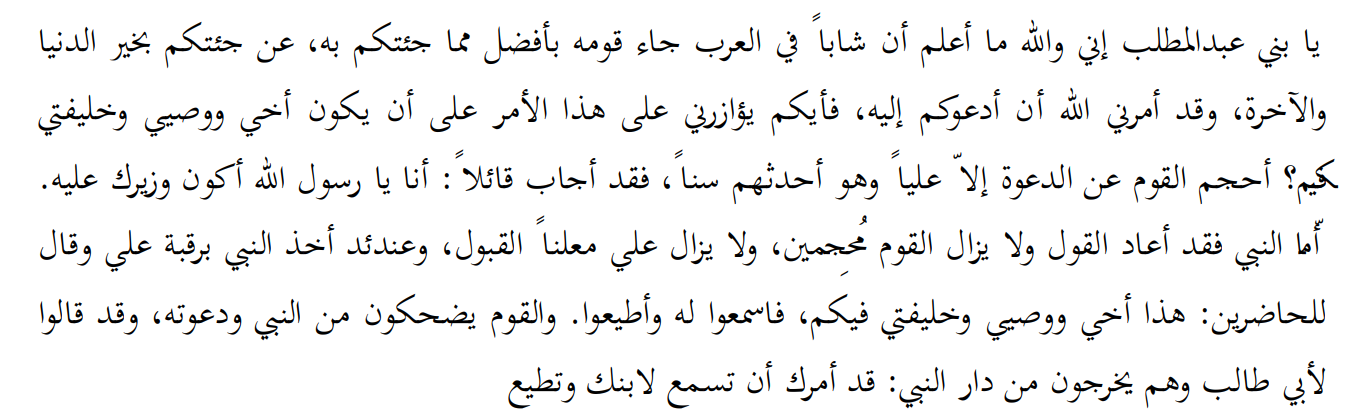
"Ey Bani Abdulmuttalib, Alloh haqqi uchun aytаman, men arablar orasida o'z qavmiga siz olib kelgan narsadan yaxshiroq narsa olib kelgan biror yigitni bilmayman. Men sizga bu dunyo va oxiratning yaxshiligini olib keldim. Alloh meni Unga da'vat qilishga buyurdi. Shunday ekan, bu ishda kim menga yordam beradi, shunda u mening birodarim, vorisim va orangizdagi xalifam bo'ladi?" Odamlar da'vatdan yuz o'girdilar, faqat ulardan eng yoshi bo'lgan Ali javob berib dedi: "Men, ey Alloh Elchisi, bu ishda sizga yordamchi bo'laman." Elchi ﷺ o'z gapini takrorladi, odamlar yana yuz o'girdilar, Ali esa o'z roziligini aytishda davom etdi. Shunda Elchi ﷺ Alining bo'yniga qo'l qo'yib, hozir bo'lganlarga dedi: "Bu mening birodarim, vorisim va orangizdagi xalifam. Shunday ekan, uni tinglanglar va itoat qilinglar." Odamlar Payg'ambar ﷺ va uning da'vatiga kulishdi va Elchining uyidan chiqayotib Abu TOlibga dedilar: "U senga o'g'lingni tinglab, unga itoat qilishni buyuryapti."
O Banu Abd al-Muttalib, by Allah I do not know any youth among the Arabs who has come to his people with a thing better than what I have come to you with. Verily I have come to you with the good of this world and the Hereafter. Allah has commanded me to call you to Him, so which one of you will assist me in this matter so that he may become my brother, inheritor and my Khalifah among you? The people kept away from the da’wa except Ali, the youngest among them, who responded saying: I, O Messenger of Allah, will be your assistant upon this matter. The Messenger repeated his statement and the people remained away while Ali continued announcing his acceptance. So the Messenger took the neck of Ali and said to those present: This is my brother, inheritor and my Khalifah among you so listen to him and obey. The people laughed at the Prophet and his invitation, and said to Abu Talib while leaving the Messenger’s house: ‘He has commanded you to listen to your son and obey him.’”
Bu hadisning mazmuni haqidagi xulosa, uni dalil sifatida qabul qilganlar tomonidan rivoyat qilinganidek.
This is the summary of the hadith of the house as narrated by those who depend upon it as evidence.
Al-Buxoriy rivoyat qilgan voqea — o‘sha kun haqida, qachonki
Al-Bukhari narrated the incident of the day when
"Va eng yaqin qarindoshlaringizni ogohlantiring" [TMQ 26:214]
“And warn your nearest kinsfolk” [TMQ 26:214]
Bu oyat nozil bo‘lganda, Payg‘ambar ﷺ Safo tepaligiga chiqqani haqida xabar berilgan, ammo taom tayyorlash haqida zikr qilinmagan. Imom Ahmad ibn Hanbal o‘zining "Musnad" kitobida ikkita hadisni rivoyat qilgan: biri taom tayyorlash haqida, ammo "Va yaqin qarindoshlaringizni ogohlantiring" oyati nozil bo‘lgan kun zikr qilinmagan; ikkinchisida esa taom tayyorlash oyat nozil bo‘lgan kunda bo‘lgani aytilgan. Avval ushbu matnlarni keltiramiz, so‘ngra ularda nima borligini izohlaymiz.
Was revealed (saying) that the Messenger (saw) stood upon (Mount) Safa, without mentioning the preparation of food. Ahmad bin Hanbal narrated in his Musnad two hadiths, one about the preparation of food without mentioning it was the day in which “And warn your nearest kinsfolk” was revealed and another mentioning that the preparation of food was on the day the ayah was revealed. We will show these texts first then explain what they contain.
Al-Bukhariy Ibn ‘Abbosdan (ra) rivoyat qilgan, u shunday degan: Qachonki
Al-Bukhari narrated from Ibn ‘Abbas (ra) who said: When
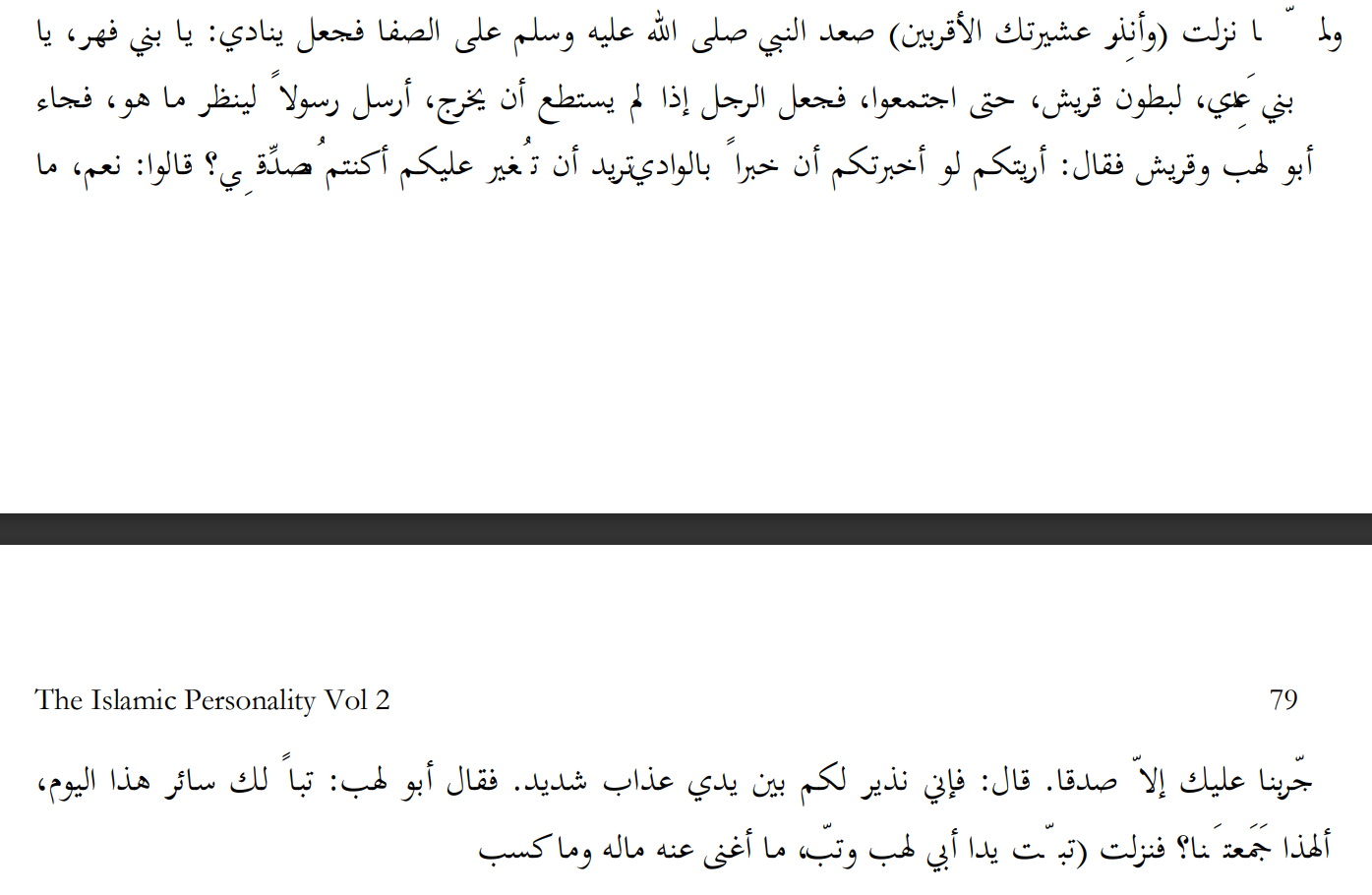
"Va qarindoshlaringni ogohlantir" degan oyat nozil bo'lganda, Rasul ﷺ Safo tepaligiga chiqib, nido qila boshladi: "Ey Bani Fihr, ey Bani Adiy!" — Quraysh qabilalarining hammasini chaqirib, ular to'planguncha. Kela olmagan kishilar esa voqea nima ekanini bilish uchun o'z elchisini yuborar edi. Abu Lahab va Quraysh kelganda, u (ﷺ) dedi: "Agar sizlarga aytsam, vodiyda sizlarga tong payti to'satdan hujum qilmoqchi bo'lgan otliqlar (odamlar) bor, menga ishonasizlarmi?" Ular dedilar: "Ha, sizni hech narsada yolg'onchi deb bilmaganmiz, faqat rost gapirganingizni ko'rganmiz." U dedi: "Albatta, men sizlarni qattiq azobdan oldin ogohlantiruvchiman!" Abu Lahab dedi: "Kun bo'yi halokatga uchrading! Shu uchun bizni to'pladingmi?" Shunda "Abu Lahabning ikki qo'li halok bo'lsin va o'zi ham halok bo'lsin! Uning boyligi va farzandlari unga foyda bermaydi!" [TMQ 111:1-2] oyati nozil bo'ldi.
“And when And warn your nearest kinsfolk was revealed, the Messenger stood upon Safa and started announcing: O Banu Fihr, O Banu Adiyy for all the (butun) of Quraysh until they gathered together. Whoever was unable to go had sent a messenger to see what was happening. Abu Lahab and Quraysh came and he said: ‘If I told you there were horses (men) in the valley intending to attack you suddenly, would you believe me?’ They said: Yes, we have not tried you in anything except to find you saying the truth. He said: Verily, I am a warner to you before a severe punishment! Abu Lahab said: Woe be upon you for the rest of the day. Is it because of this that you gathered us? So “Perish the two hands of Abû Lahab (an uncle of the Prophet [sal-Allâhu 'alayhi wa sallam]) and perish he!, His wealth and his children will not benefit him!” [TMQ 111:1-2] was revealed”
Bu shuni ko'rsatadiki, taom tayyorlash voqeasi "Va yaqin qarindoshlaringni ogohlantir" oyati nozil bo'lgan kunda bo'lmagan, chunki bu hadis matnida bayon etilgan voqea bilan mos kelmaydi. Ahmad ibn Hanbal o'zining "Musnad" kitobida shunday rivoyat qilgan: "Affon bizga rivoyat qildi: Abu Avona bizga rivoyat qildi: Usmon ibn al-Mug'iro'dan, u Abu Sodiqdan, u Rabi'a ibn Najidhdan, u Aliy (roziyallohu anhu)dan rivoyat qilib dedi: Allohning Elchisi ﷺ Banu Abdul-Muttalibni barcha guruhlari bilan yig'di yoki chaqirdi, ular yeb-ichishsin deb. U ular uchun miqdori ko'p taom tayyorladi, ular to'yguncha yedilar. U dedi: Taom xuddi hech qo'l urilmagandek qoldi. Keyin u za'faron sharbati keltirishni buyurdi, ular to'yguncha ichdilar, va sharbat ham xuddi hech qo'l urilmagandek qoldi. Shundan so'ng ﷺ dedi:"
This indicates that the incident of the preparation of food was not on the day in which “And warn your nearest kinsfolk” was revealed as it does not concur with what occurred in the hadith’s text. Ahmad bin Hanbal said in his Musnad: ‘Affan related to us that Abu Awana related to us from Uthman bin al-Mughira from Abu Sadiq from Rabi’a bin Najidh from Ali (ra) who said: The Messenger of Allah (saw) gathered or called Banu Abd al-Muttalib in all their groups to eat and drink. He prepared for them a quantity of food which they ate until they were satisfied. He said: The food remained as if it had not been touched. Then he called for a saffron drink which they drank until they will full, and the drink remained as if it had not been touched. Then he (saw) said:

"Ey Abd al-Muttalib o'g'illari, men aynan sizlarga va umuman insoniyatga yuborilganman. Siz endi bu belgidan (oyatdan) ko'rganingizni ko'rdingiz, shuning uchun sizlardan qaysi biriniz menga birodar va hamroh bo'lish uchun ahd (va'da) beradi?" U aytdi: Ulardan hech kim o'rnidan turmadi, shunda men, guruhning eng yoshi bo'lishimga qaramay, unga o'rnimdan turdim. U esa: "O'tir!" dedi. U buni uch marta takrorladi; shundan keyin men unga o'rnimdan turdim, u esa "O'tir!" dedi, uchinchi marta esa qo'lini mening qo'linga urdi.
“O Banu Abd al-Muttalib, I have been sent specifically to you and to humanity in general. You have now seen of this sign (ayah) what you saw, so which one of you will give me a pledge in order to become my brother and companion?’ He said: None of them stood, so I stood for him though I was the youngest of the group and he said: Sit down. He repeated it three times following which I stood for him and he said ‘Sit down’, until the third time he struck my hand with his hand.”
Bu shuni aniqlaydiki, bu voqeada "Yaqin qarindoshlaringizni ogohlantiring" oyatining nozil bo'lish lahzasi yo'q va Payg'ambar (saw) ularga Islomni taklif qildi, shunda kim Musulmon bo'lsa, u uning birodari va hamrohi bo'ladi, hamda u Aliy (ra) ga hech narsa demadi.
This clarifies that there is no moment in this incident of the revelation of “And warn your nearest kinsfolk”, and that the Messenger (saw) offered Islam to them so that whoever became a Muslim would become his brother and companion and that he did not say anything to Ali (ra).
Ikkinchi rivoyatga kelsak, Ahmad ibn Hanbal o‘zining "Musnad" kitobida rivoyat qilgan: "Aswad ibnOmir bizga rivoyat qildi: Sharik bizga rivoyat qildi, u al-A‘mashdan, u al-Minhaldan, u Ibod ibn Abdulloh al-Asadiydan, u Alidan rivoyat qilib, dedi: "Yaqin qarindoshlaringni ogohlantir" oyati nozil bo‘lganda, Rasulullah ﷺ uy ahlini to‘pladilar. O‘ttiz kishi to‘plandi; ular yedilar va ichdilar, so‘ngra u zot ﷺ ularga dedilar:
As for the second narration, Ahmad bin Hanbal narrated in his Musnad: “Aswad bin Amir related to us that Shareek related to us from Al-‘Amash from Al-Minhal from ‘Ibad bin Abdullah al Asadi from Ali who said: When the ayah “And warn your nearest kinsfolk” was revealed, the Messenger (saw) gathered the family of his house. Thirty people gathered; they ate and drank then he (saw) said to them:
"Kim mening qarzlarim va va'dalarimga kafil bo'ladi, shunda u men bilan Jannatda bo'ladi va mening oilam ustidan mening xalifam bo'ladi?" Shariq ismini aytmagan bir kishi dedi: "Ey Allohning Elchisi ﷺ, siz bahr (dengiz) edingiz, bu ishni kim o'z zimmasiga oladi?" So'ng yana bir kishi (xuddi shunday?) dedi. U bu ishni uy ahlining oilasiga taklif qildi, shunda Ali (RA) dedi: "Men (kafil bo'laman)."
"Which one will guarantee my debts and promises so as to be with me in Paradise, and he will be my Khalifah over my family? A man, whom Shareek did not name, said: O Messenger of Allah, you were an ocean (bahr) so who could take care of this? Then another said (the same?). He offered that to the family of his house, so Ali (RA) said: I (will).”
Ushbu ikki matnda "voris" yoki "xalifa" so‘zi hech qanday shaklda uchramaydi. Aksincha, faqat "xalifa" so‘zi uchraydi, u esa oila a’zolariga nisbatan qo‘llangan, va oila ustidagi xalifalik hukmronlik yoki rahbarlik lavozimidagi xalifalik emas, uning bilan hech qanday aloqasi yo‘q. Bular Sahih kitoblarda kelgan matnlar bo‘lib, ular o‘xshash so‘zlar va birlashgan ma’noda ko‘plab rivoyatlarda kelgan, va ularning hech birida "voris" yoki "xalifalik" so‘zlari uchramagan. Sahih kitoblarning tuzuvchilari yoki ishonchli roviylarning hech biri orqali, Ali yoki boshqa biror kishiga nisbatan, hatto bitta hadisda ham "voris" yoki "xalifa" so‘zlari hech qanday shaklda kelmagan. Shuning uchun Sahih kitoblarda bunga hech qanday dalil yo‘qligi sababli, bu da’vo dalilsiz qoladi.
The word inheritor or Khalifah does not appear in these two texts in any way at all. Rather it is only the word Khalifah which appears restricted to his family, and the Khilafah over the family is not the Khilafah in the post of rule or leadership nor does it have any relationship with that. These are the texts which came in the Saheeh books, and they came in numerous narrations with similar wordings and unified meanings, and there did not appear in any of them the words inheritor or Khilafah. There has never appeared, either via any of the compilers of the Saheeh (books of ahadith) or any of the trustworthy narrators, in even one hadith the word(s) inheritor of Khalifah in any way at all either in relation to Ali or anyone else, so the evidence falls due to the absence of any evidence for it in the Saheeh books.
Ali tayinlanishi haqida tortishuvchilar nomlagan, "uy hadisi" deb atalgan matn esa, bu rivoyat (riwayah) bo'yicha, ma'nosi (dirayah) jihatidan rad etilgan. Hadis dirayah bo'yicha uning ma'nosiga qarab, riwayah bo'yicha esa isnodiga qarab rad etiladi. Shunday ekan, agar u isnod yoki ma'no jihatidan rad etilgan bo'lsa, uni e'tiborga olib bo'lmaydi va dalil sifatida qabul qilinmaydi. Uning ma'nosini rad etish esa ko'plab sabablarga ko'ra bo'lib, ulardan biri:
As for the text narrated by those who contend about the appointment of Ali which they named the hadith of the house, this text with this narration (riwayah) is rejected in its meaning (Dirayah).A hadith is rejected in its dirayah based on its meaning, and its narration based on its chain. So if it is rejected in its chain or meaning then it cannot be considered and it falls as evidence. As for rejecting its meaning, this is due to many reasons including:
Birinchidan: Bu hadisda ko'rinishicha, Rasululloh ﷺ da'vatida Abdulmuttalib avlodidan yordam so'ragan, va buning sharti sifatida hokimiyat ulardan keyin ularniki bo'lishi kerak bo'lgan. Bu ikki jihatdan batil: birinchidan, bu Rasulullohning ﷺ shunday bir voqeadagi so'zi va amali bilan zid keladi, ya'ni u qabila Islomni qabul qilsa, hokimiyat undan keyin ularniki bo'lishi haqidagi talabni rad etgan va shunday javob bergan:
"Hokimiyat Allohning ishi bo'lib, U (SWT) uni xohlagan joyiga qo'yadi."
“Authority is a matter which belongs to Allah, and He (swt) will place it where He wishes.”
Ibn Hishom o‘zining "As-Sira" kitobida Ibn Ishoq shunday degani haqida rivoyat qiladi: az-Zuhriy rivoyat qildi, u Banu Omir ibn Sa'sa'aga uchrab, ularni Alloh azza va jall dinига da'vat qildi va o‘zini ularga taklif qildi. Ular orasidagi bir kishi, uni Bayjirat ibn Furra deb atashardi, unga dedi: "Alloh haqi, agar men Quraysh yigitini olsam, uning orqali arablarni yeb yuboraman (ya'ni ularni zabt etaman)". So‘ng u dedi: "Agar biz sizning ishingizni qo‘llashga va'da bersak-u, Alloh sizga qarshi chiqqanlar ustidan g‘alaba bersa, siz vafot etganingizdan keyin hokimiyat bizda bo‘ladimi?" U dedi: "Hokimiyat Allahniki, U uni xohlagan joyiga qo‘yadi". U unga dedi: "Biz sizning uchun bo‘ynimizni fido qilaylikmi, keyin Alloh (swt) sizga g‘alaba bergach, hokimiyat boshqa birovniki bo‘lsinmi? Unda bizga sizning ishingiz kerak emas", va ular uni rad etishdi. Qanday qilib Rasulullah ﷺ "Ish Allahniki, U uni xohlagan joyiga qo‘yadi", ya'ni xalifalik va undan keyingi hokimiyat ishi haqida shunday deya oladi-yu, Banu Abd al-Muttalibga esa shunday deydi:
Ibn Hisham narrated in his book of the Sirah of the Prophet (saw): Ibn Ishaq said that Az-Zuhri narrated that he met Banu Amr bin Sa’sa’ah so he invited them to Allah ‘azza wa jalla and offered himself to them. One man among them, whom they called Bayjirat bin Furra, said to him: By Allah, if I were to take this youth from the Quraysh, I will eat (i.e. conquer) the Arabs through him. Then he said: What if we were to pledge to support your matter then Allah will grant you victory over those who oppose you. Will the rule be with us after you? He said: “The rule is for Allah and He places it where He wills.” He said: So he said to him: Will we sacrifice our throats for you, then when Allah (swt) grants you victory the rule becomes for someone else? Then we have no need of your matter, and they rejected him.” How can the Messenger (saw) say: “The matter belongs to Allah and He will place it where He wills” i.e. the matter of the Khilafah and the rule after him, yet he says to Banu Abd al-Muttalib:
“Sizlardan kim bu ishda menga yordam beradi, shunda u mening birodarim, vorisim va sizlar orasidagi xalifam bo‘lsin?”
“Which one of you will assist me upon this matter so that he may become my brother, inheritor and Khalifah among you?”
Bu aniq ziddiyat emasmi? Zarurat yuzasidan, bu ikki gapdan birini rad etish lozim. Chunki uy hadisi haqida aytilishicha, u ... bo'lgan paytda yuz bergan.
Is this not a clear contradiction? Inevitably, it is necessary that one of these two statements be rejected. Since it is said of the hadith of the house that it occurred when
"Eng yaqin qarindoshlaringizni ogohlantiring" [TMQ 26:214]
“Warn your nearest kinsfolk” [TMQ 26:214]
"Nozil bo'lgan", ya'ni Payg'ambarlik (risolat) ning uchinchi yilida, va hadis:
Was revealed i.e. the third year of the messenger ship and the hadith:
"Ish Allohga tegishli, U uni xohlagan joyiga qo'yadi."
“The matter belongs to Allah and He places it where He wills”
Qachonki Elchi (saw) qabilalarga o'zini taklif qilgan paytda, ya'ni payg'ambarlikning o'ninchi yilida, ya'ni "uy hadisi"dan keyin; demak, rad etilayotgan aynan uy hadisidir. Ikkinchi jihatga kelsak, bu hadisda Elchi (saw) kofirlarga ularning Islomga kirishi uchun biror narsa taklif qilgan, balki ularning Islomga kirishi evaziga ularga eng buyuk narsani – uning vafotidan keyin barcha musulmonlar ustidan xalifalikni taklif qilgan. Bu esa Elchining (saw) da'vatidagi amali hamda Shariat qoidalariga zid keladi. Elchi (saw) odamlarni Islomga chaqirar edi, chunki bu to'g'ri din edi, va hech qachon u zotdan, hatto zaif hadis orqali ham, kofirga uning Islomga kirishi evaziga kichik yoki katta biror narsa taklif qilgani rivoyat qilinmagan. Qalblari yumshatiladiganlarga kelsak, ular zakotdan beriladigan musulmonlardir, ular orqali Davlatni mustahkamlash maqsad qilinadi, Islomga kirishi uchun beriladigan kofirlar emas. Kofirga uning Islomga kirishi evaziga biror narsa berish ham joiz emas.
when the Messenger (saw) offered himself to the tribes i.e. in the tenth year after the messenger ship and therefore after the hadith of the house; so it is the hadith of the house which is rejected. As for the second side, it is that the Messenger (saw) in this hadith offered something to the disbelievers so that they may become Muslims, rather he offered them the greatest thing which is the Khilafah after him over all Muslims as the price for their entering into Islam. This contradicts the Messenger’s action in his da’wa and the Shari’ah rules. The Messenger would invite people to Islam because it is the correct deen and it has never been narrated from him, even through a weak hadith that he offered anything whether small or large to a kafir in exchange for his entering into Islam. As for those whose hearts are to be reconciled, they are Muslims who are given from the zakat in order to strengthen the State through them, not kuffar who are given so that they enter Islam. Nor is it allowed to give something to kuffar in exchange for their entering Islam.
Ikkinchidan: Hadisda aytilishicha, Rasulullah (saw) kofirlarni Islomga da'vat qilish maqsadida to'y ziyofati va ovqat tayyorladi va ular Islomga kirishi uchun ularni ovqat atrofiga to'pladi, lekin Islomni qabul qilgan Ali (ra) uchun ovqat tayyorlamadi. Demak, agar bu odamlar Islomni rad etsa va uning evaziga hokimiyat ular uchun uning vafotidan keyin bo'lishini rad etsa, u yerda Ali (ra) uchun uning roziligini bildirishiga joy yo'q, chunki u Islomga da'vat etilmayapti, sababi u allaqachon musulmon va unga qaratilgan hech qanday nutq yo'q. Shu sababli bu majlisda unga shunday deyiladigan joy yo'qdir:
Secondly: The hadith mentions that the Messenger (saw) prepared a wedding feast and meal for kuffar in order to invite them to Islam, and he gathered them around a meal so that they may enter Islam and he did not prepare food for Ali (ra) who had already accepted Islam. So if these people reject Islam and reject that the rule becomes theirs after him in exchange for Islam, there is no place there for Ali (ra) for giving his acceptance as he is not being invited to Islam because he is already a Muslim, and there is no speech addressed to him. This is why there is no place in this gathering such that he says to him:
"Bu mening birodarim, vorisim va sizlar orasidagi xalifam. Shuning uchun unga quloq soling va itoat qiling."
“This is my brother, inheritor and my Khalifah among you so listen to him and obey”
Chunki u murojaat qilinayotgan yoki muzokara qilinayotgan tomon emas. Uchinchidan: hadisda aytilishicha, bu guruh Islomni rad etgan va u takror taklif qilganiga qaramay, ular Islomni rad etishda davom etgan hamda uning o'ridan keyin hokimiyat ularniki bo'lishini Islomga kirish evaziga qabul qilishni inkor etgan. Ular kofir bo'lib qolishdi, unday bo'lsa Payg'ambar ﷺ ularga murojaat qilib qanday qilib shunday deya oldilar:
Since he is not the target of the address or the negotiation. Thirdly: The hadith mentions that the group rejected Islam, and despite him repeating his offer they persisted in rejecting Islam and rejecting that the rule becomes theirs after him in exchange for entering Islam. They remained kuffar so how could the Messenger (saw) say to them in addressing them:
"Bu mening sizlar orasidagi xalifam."
“This is my Khalifah among you”
Kofirlarga uning so'zini eshitish va itoat qilishni buyurgan holda, ular kofir ekanini bilib turib turibdimi? Ular kofir bo'lsa, u qanday qilib ularning orasida xalifa bo'la oladi?
Commanding them with hearing and obeying him while he knows they are kuffar who have rejected Islam? And how could he be the Khalifah among them while they are kuffar?
Тўртинчидан: Улар ривоят қиладиган ривоят шундай дейди:
Fourthly: The narration they narrate says:
"Bu mening birodarim, vorisim va sizlar orasidagi xalifam. Shuning uchun unga quloq soling va itoat qiling."
“This is my brother, inheritor and my Khalifah among you so listen to him and obey”
Bu Abd al-Muttalib avlodiga qaratilgan xitobdir, chunki gap "Ey Banu Abd al-Muttalib" deb boshlangan. Shu sababli u ularga xos bo'lib, u ularning ustidan xalifa qilingan, ya'ni Abd al-Muttalib avlodi ustidan, musulmonlarning xalifasi emas, chunki u "va sizlar ustidan mening xalifam" degan. Shunday ekan, aniq matn ko'rsatganidek, u musulmonlar uchun xalifa emas. Bu yerda hukmning matnning umumiyligi bilan, sabab (sabab) ning xususiyligi bilan emas, deb aytib bo'lmaydi, chunki bu sabab emas, balki xos bir voqeadir. Shuningdek, bu so'zlar ham umumiy emas, balki xosdir: "Ey Banu Abd al-Muttalib", "sizlar orasidagi mening xalifam". Shuning uchun bu voqeaning xos bo'lgani sababli va umumiy so'zlarning yo'qligi sababli, hukmni xoslash talab qilinadi.
This is an address to the family of Abd al-Muttalib since the words started with his saying “O Banu Abd al-Muttalib.” So it is specific to them as he made him a Khalifah over them i.e. over the family of Abd al-Muttalib not the Khalifah of the Muslims since he said, “and my Khalifah over you.” Thus he is not the Khalifah for the Muslims as is depicted by the explicit text. Nor can one say here that the lesson is by the generality of the text not the specificity of the cause since this is a specific incident not a cause (sabab) not mentioning that the words are also specific and not general: “O Banu Abd al-Muttalib”, “my Khalifah among you” so the specification is demanded due to this being a specific incident not a cause, and also due to the absence of general words.
Bu to'rtta narsadan birortasi ham ushbu hadisning yolg'onligini va uning ziddiyatini ochib berish uchun kifoya qiladi hamda uning rivoyatini (dirayatan) rad etish vojibdir. Shuning uchun aniqlanadiki, Rasulullah (saw) Alini (ra) o'zlaridan keyin xalifa qilishni ochiq-oydin aytmaganlar. Bularning barchasidan ayon bo'ladiki, Rasulullah (saw) o'zlaridan keyin xalifalikka biror kishini tayinlaganini aytuvchilarning hadislari rad etilgan hadislardir, ularga dalil sifatida tayanish mumkin emas, shuning uchun ular o'z-o'zidan barbod bo'ladi. Rasulullah (saw) o'zlaridan keyin xalifalik ishini kimgadir topshirganliklariga hech qanday dalil qolmaydi; aksincha, bunga qarshi dalil sobit bo'lgan, ya'ni Rasulullah (saw) bu masalani musulmonlarga qoldirib, ular xohlagan kishini tanlashlarini ixtiyorlariga topshirgan, faqat xalifani tayinlash usulini ularga bayon qilib bergan.
Just one of these four matters suffices to reveal the falsehood of this hadith and its contradiction, and it is obligatory to reject its narration (dirayah). Therefore it is clarified that the Messenger (saw) did not explicitly state making Ali (ra) the Khalifah after him. From all this it becomes clear that the ahadith narrated by those who argue that the Messenger (saw) designated a person for the Khilafah after him are rejected ahadith unsuitable to depend upon as evidence so they fall. There remains no evidence that the Messenger (saw) designated anyone to be in charge of the Khilafah after him; rather the evidence has been established contrary to that i.e. that the Messenger (saw) left the matter to the Muslims to choose whom they want in relation to the person but he specified for them the method for appointing the Khalifah.