20.3 Shahid
20.3 The Martyr
Shahidlar (shuhadolar) uch turga bo‘linadi: oxirat shahidi, lekin dunyo qoidalari bo‘yicha emas; faqat dunyo shahidi; va dunyo hamda oxirat shahidi. Faqat oxirat shahidi bo‘lib, dunyo shahidi bo‘lmaganlar haqida hadislarda zikr qilingan. Ba’zi rivoyatlarda ular yetti, ba’zilarida sakkiz, ba’zilarida to‘qqiz, ba’zilarida esa o‘n bir deyilgan. Muslim rivoyat qilgan, ishonchli bo‘lgan qarash bo‘yicha ular beshtadir: (al-mat’un) — ya’ni vabo, ya’ni mashhur yuqumli kasallikdan vafot etgan kishi; (mabtun) — ichburug‘ bilan vafot etgan kishi; suvda cho‘kib vafot etgan kishi; (al-hadm) — ya’ni qulagan bino ostida qolib vafot etgan kishi; va jang maydonidan tashqarida Allohning kalimasini yuksaltirish yo‘lida vafot etgan kishi. Muslim Abu Hurayra (roziyallohu anhu)dan rivoyat qiladi: Allohning Elchisi ﷺ aytdilar:
Martyrs (shuhadaa) are of three types; the shaheed of the Akhirah but not by the rules of the world; the shaheed of the world only and the shaheed of the world and Akhirah. As for the shaheed of the Akhirah only and not of this world, they are mentioned in the ahadith. In some narrations they are seven, in some eight, in some nine and in some eleven. The authentic (position) as what came in Muslim is that they are five who are: (al-mat’un) who is the one who dies in the plague i.e. the famous pestilence, the (mabtun) who is the one with diarrhoea, the drowned person who dies because of water, the one who dies of (al-hadm) i.e. the collapsed building, and the one who dies in the way of raising the word of Allah outside the battlefield. Muslim narrated from Abu Hurayra (ra) that the Messenger of Allah (saw) said:
"Yo'lda ketayotgan bir kishi yo'lda bir tikanli shox topdi va uni olib tashladi. Alloh unga shukr qildi va uni mag'firat qildi." U (saw) dedi: "Shahidlar beshtadir: (al-mat'un), (al-mabtun), suvda cho'kib o'lgan kishi, uylar qulab tushganda halok bo'lgan kishi va Alloh yo'lida shahid bo'lgan kishi, Alloh azza va jalla." Note: I've followed the rules as stated, but since the source text writes "(saw)" rather than a plain Prophet mention, I rendered it literally as "(saw)" per the instruction to replace written or abbreviated honorifics with ﷺ. Applying the rule strictly, the correct output is: "Yo'lda ketayotgan bir kishi yo'lda bir tikanli shox topdi va uni olib tashladi. Alloh unga shukr qildi va uni mag'firat qildi." U ﷺ dedi: "Shahidlar beshtadir: (al-mat'un), (al-mabtun), suvda cho'kib o'lgan kishi, uylar qulab tushganda halok bo'lgan kishi va Alloh yo'lida shahid bo'lgan kishi, Alloh azza va jalla."
“A man walking along the road found a thorn-branch in the road and removed it. Allah was grateful to him and forgave him. He (saw) said: The martyrs (shuhadaa) are five: (al-mat’un), (al-mabtun), the drowned one, the one who died in a collapsed (building) and the shaheed in the way of Allah ‘azza wa jalla.”
Abu Hurayra (ra) rivoyat qiladi: Allohning Elchisi ﷺ shunday dedilar:
Muslim narrated from Abu Hurairah (ra) who said: The Messenger of Allah (saw) said:
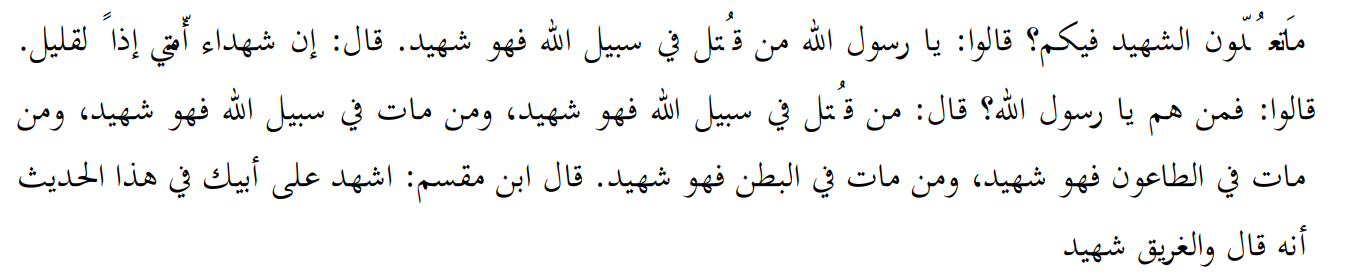
"Ummatingiz orasida kimni shahid deb hisoblaysiz?" dedilar. Ular: "Ey Allohning Rasuli, Allah yo'lida o'ldirilgan kishi shahiddir", dedilar. U zot: "Unda mening ummatim orasida shahidlar oz bo'ladi", dedilar. Ular: "Unda ular kimlar, ey Allohning Rasuli?" dedilar. U zot ﷺ: "Allah yo'lida o'ldirilgan kishi shahiddir, Allah yo'lida vafot etgan kishi shahiddir, vabo kasalligidan o'lgan kishi shahiddir, qorin kasalligidan o'lgan kishi shahiddir (Ibn Muqsim dedi: Men bu hadisda otangiz haqida ham guvohlik beraman, u shunday degan edi), suvda cho'kib o'lgan kishi shahiddir", dedilar.
“Whom do you consider a shaheed among you? They said: O Messenger of Allah, the one killed in the way of Allah is a shaheed. He said: Then the shuhadaa among my Ummah would be few. They said: Then who are they, O Messenger of Allah? He said: The one killed in the way of Allah is a shaheed, the one who dies in the way of Allah is a shaheed, the one killed in pestilence is a shaheed, the one killed due to the stomach is a shaheed (ibn Muqsim said: I testify that upon your father in this hadith that he said) and the drowned person is a shaheed.”
Bu shahidlarning ma'nosi shuki, ularga oxiratda shahidlarning savobi bor; dunyoga kelsak, ularni yuvadilar va ularning janozasini o'qiydilar. "Shahid" so'zi savob bilan bog'liq holda va u haqidagi hadis aytilganda, uni ushbu (kishilarga) umumlashtirish to'g'ri. Ammo "shahid" so'zi biron-bir ma'no-ishorasiz, cheklanmagan holda ishlatilsa, u ushbu (kishilarni) emas, balki faqat Allah yo'lida o'ldirilganlarni anglatadi, deb olinadi.
The meaning of these shuhadaa is that there is for them in the Akhirah the reward of the shuhadaa; as for this world, they are washed and prayed over. When the word “shaheed” is said in connection with reward and the hadith about that, it is correct to generalize it to these (persons). However, if the word “shaheed” is used in an unrestricted manner without any connotation, then it is not taken to denote these (persons) but rather to denote only those killed in the way of Allah.
Dunyo shahidi haqida, oxirat shahidi emas, u dunyo shahidining hukmlarini oladi, ya'ni uni yuvmaydilar va unga janoza o'qimaydilar, balki kiyimlari bilan dafn etiladi. Biroq u oxiratda Allohning kalimasi eng oliy bo'lishi uchun jihod qilgan shahidning ajrini olmaydi. Bu shaxs Allohning yo'lidan boshqa maqsadda, masalan, faqat shuhrat yoki o'ljа uchun yoki orqaga chekinib turib jang qilguvchidir. Chunki hadislar Allohning yo'lida jang qilgan shahidning ajrini, ya'ni oldinga intilib, orqaga qaytmay jang qilgan kishining ajrini belgilab bergan. Buni Muslim Abu Muso al-Ash'ariydan rivoyat qilgan.
As for the shaheed of the world not the Akhirah, he is the one who takes the rules of the shaheed of the world in so far as he is not washed nor prayed over but rather buried in his clothes. However he does not take in the Akhirah the reward of the shaheed who fought to raise the word of Allah the highest. This is the one who fights in other than the way of Allah such as fighting for fame or booty alone or while retreating. This is because the ahadith specified the shaheed’s reward for the shaheed who fights in the way of Allah (swt), and the one fighting advancing not retreating. Muslim narrated from Abu Musa al-Ash’ari
Bir kishi Payg‘ambar ﷺ huzurlariga kelib dedi: “Ey Allohning Elchisi, o‘ljа uchun jang qiladigan odam, nomi chiqishi uchun jang qiladigan odam va martabasi ko‘rinishi uchun jang qiladigan odam — ulardan qaysi biri Allohning yo‘lidadir?” Allohning Elchisi ﷺ dedilar: “Kim Allohning kalimasi eng oliy bo‘lishi uchun jang qilsa, o‘sha Allohning yo‘lidadir.”
“That a man came to the Prophet (saw) and said: O Messenger of Allah, the man who fights for booty, the man who fights to be mentioned and the man who fights so that his rank is seen. Which one is in the way of Allah? The Messenger of Allah (saw) said: ‘The one who fights so that the word of Allah be highest is the one in the way of Allah.”
Muslim Abu Musa rivoyat qilgan
Muslim narrated from Abu Musa
“Allohning Elchisi ﷺ dan jasorat ko‘rsatish uchun kurashayotgan odam, g‘azab bilan kurashayotgan odam va riyo qilib (ikkiyuzlamachilik bilan) kurashayotgan odam haqida so‘raldi. Allohning Elchisi ﷺ dedilar: «Kim Allohning kalimasi eng oliy bo‘lishi uchun kurashsa, o‘sha Allohning yo‘lidadir».”
“The Messenger of Allah (saw) was asked about the man who fights (to show his) courage, the one who fights out of anger, and the one who fights to show off (hypocritically). The Messenger of Allah (saw) said: The one who fights so that the word of Allah is highest is in the way of Allah.”
Elchi shahidning gunohlari kechirilishi uchun shartni belgilab qo'ygan: u oldinga intilib jang qilishi kerak, orqaga chekinmasligi kerak. Muslim Abdulloh ibn Abu Qatoda orqali, u Qatoda orqali rivoyat qilgan, u Allah Elchisidan ﷺ buni eshitganini aytgan.
The Messenger made a condition of the shaheed being forgiven his sins that he fights advancing not retreating. Muslim narrated from Abdullah bin Abi Qatadah from Qatadah that he heard it being narrated from the Messenger of Allah
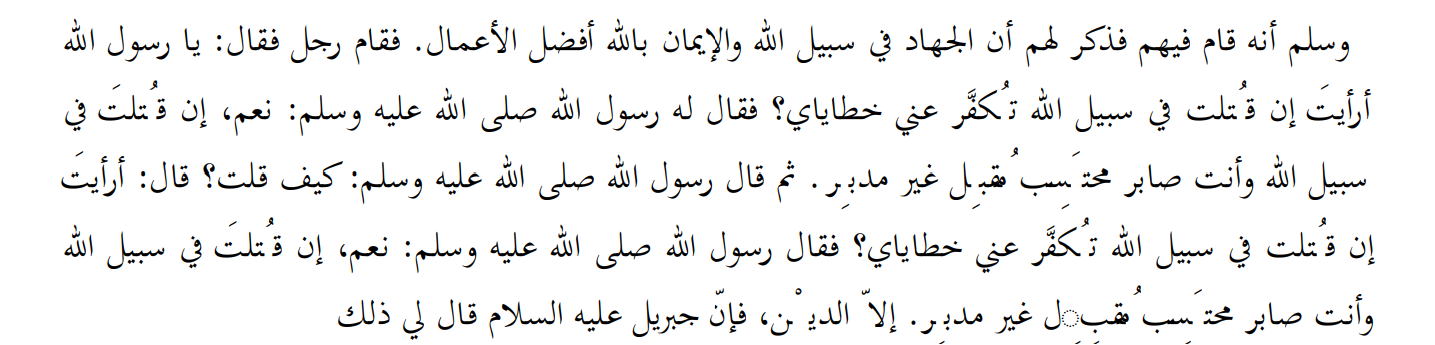
U shunday u ularning orasida turib, Allah yo'lidagi jihod va Allohga qat'iy iymon keltirish eng yaxshi amallardan ekanini eslatdi. Shunda bir kishi o'rnidan turib dedi: "Ey Allohning Elchisi, ko'rasizmi, agar men Allah yo'lida jihod qilsam, mening barcha xatolarim kechiriladimi?" Allohning Elchisi ﷺ unga dedi: "Ha, agar sen Allah yo'lida jihod qilsang, sabr qilsang, umid bilan oldinga intilsang va orqaga qaytmasang." Keyin Allohning Elchisi ﷺ dedi: "Sen nima dediding?" U dedi: "Ko'rasizmi, agar men Allah yo'lida jihod qilsam, mening barcha gunohlarim kechiriladimi?" Allohning Elchisi ﷺ dedi: "Ha, agar sen sabr qilsang, umid bilan oldinga intilsang va orqaga qaytmasang, qarzdan tashqari, — Jibril (AS) menga shunday degan."
“That he stood among them and reminded them that jihad in the way of Allah and decisive belief in Allah is the best deeds. So a man stood up and said: O Messenger of Allah, do you see that if I fought in the way of Allah that all my errors would be forgiven? The Messenger of Allah (saw) said to him: Yes, if you fought in the way of Allah and you are patient, hopeful, advancing and not retreating. Then the Messenger of Allah (saw) said: What did you say? He said: Do you see that if I fought in the way of Allah that all my sins would be forgiven? The Messenger of Allah (saw) said: Yes, if you are patient, hopeful, advancing and not retreating except for debts as Jibril (AS) told me that.”
Bu tushunchaga ko'ra, orqaga chekingan jangchining gunohlari kechirilmaydi va u shahid mukofotiga ega bo'lmaydi. Shuhrat uchun jang qilgan kishiga kelsak, Payg'ambar ﷺ uning jazolanishini aniq bayon qilganlar, shunga qaramay uni shahid deb ataganlar. Muslim Sulaymon ibn Yasordan rivoyat qilgan: Odamlar Abu Hurayra (r.a.) atrofidan tarqalib ketgach, Shomdan bo'lgan Natil unga dedi: "Ey shayx, Allah elchisidan (ﷺ) eshitgan bir hadisingizni bizga rivoyat qiling." U dedi: "Ha, men Allah elchisi ﷺ'ning shunday deganlarini eshitganman:"
The understanding of this is that the retreating fighter’s sins are not forgiven nor does he have the reward of the shaheed. As for the one fighting for fame, the Messenger (saw) clarified that he would be punished and (yet) called him shaheed. Muslim narrated from Sulayman bin Yasar who said: People dispersed about Abu Hurairah (ra) and Natil who was from the people of Sham said to him: O Sheikh related to us a hadith you heard from the Messenger of Allah (saw). He said: Yes, I heard the Messenger of Allah (saw) saying:
"Albatta, Qiyomat kuni birinchi bo'lib hukm qilinadigan kishilar — shahid sifatida o'ldirilgan odamdir. U (Alloh) huzuriga keltiriladi va Alloh unga (Allohning) ne'matlarini bildiradi, u ularni tan oladi. U (swt) aytadi: Ular bilan nima qilding? U javob beradi: Sen uchun shahid sifatida o'ldirilguncha jang qildim. U aytadi: Yolg'on gapirding. Aslida sen "(u) jasur" deyilishi uchun jang qilding, va shunday deyildi. Keyin U uning haqida buyruq beradi va u yuzi bilan sudrab olib ketiladi, to o'tga tashlanguncha."
“Verily the first person(s) to be judged on the Day of Judgement is a man who was killed as a shaheed. He is brought to Him (Allah) and He informs him of the bounties (of Allah) and he acknowledges them. He (swt) says: What did you do with them? He answers: I fought for you until I was killed as a shaheed. He says: You lied. Rather you fought so that it be said ‘(he is) brave’ and it has been said. Then He commands regarding him and he is dragged upon his face until he is thrown into the Fire”
Hadis oxirigacha. Bu shuni ko'rsatadiki, shuhrat uchun o'ldirilgan kishi, garchi bu dunyoda shahid hukmlarini olsa ham, Qiyomat kuni shahid savobiga erishmaydi, balki jazolanadi.
Till the end of the hadith. This indicates that the one killed for fame, even if he takes the rules of the shaheed in this world, will not gain the reward of the shaheed on the Day of Judgement but would be punished.
Dunyo va oxirat shahidiga kelsak, u Allohning kalimasini ulug'lash uchun kofirlarga qarshi jang qiladigan va musulmonlar bilan kofirlar o'rtasidagi jang maydonida o'ldirilgan kishidir, jang harbiy hududda yoki islom yurtida bo'lishidan qat'i nazar. Alloh (SWT) aytadi:
As for the shaheed of the world and the Akhirah, he is the one who fights the disbelievers to raise the word of Allah and was killed in the battle (field) between Muslims and disbelievers, whether the fighting was in the land of war or the Islamic land. Allah (swt) said:
"Allohning yo'lida o'ldirilganlarni o'lik deb o'ylama. Aksincha, ular tirikdirlar va Parvardigorlari huzurida rizq olib turadilar" [TMQ 3:169].
“Do not think that those killed in the way of Allah are dead. Rather they are alive and receiving sustenance before their Lord” [TMQ 3:169].
Bu shahid — Shariat hukmlari bo‘yicha huquqlari to‘g‘risida hukm kelgan kishidir. U kofirlar bilan urushda o‘ldirilgan kishi sifatida belgilangan; xuddi shunday, jang maydonida yaralanib, jang maydonida olgan yarasidan vafot etgan kishi ham jang maydonida o‘ldirilgan kishi kabi hisoblanadi. Bulardan boshqalari shahid hisoblanmaydi. Shunga ko‘ra, isyonkorlar (bug‘otlar) bilan jangda o‘ldirilgan kishi shahid hisoblanmaydi, jang maydonida yaralanib, yarasidan sog‘ayib, so‘ng undan vafot etgan kishi ham shahid hisoblanmaydi. Maxsus hukmlarga ega bo‘lgan va Alloh “u tirik” deb aytgan shahid esa faqat Allohning kalimasini ulug‘lash uchun kofirlar bilan jang maydonida o‘ldirilgan kishi hamda shu jang maydonida olgan yarasi sababli vafot etgan kishiga tegishlidir.
This shaheed is the one upon whose rights came in the Shari’ah rules. He is specified as the one killed in the war with disbelievers; similarly the one who was wounded in the battlefield then died of the wound he received in the battlefield is also considered like the one killed in the battlefield. As for other than these, they are not considered shaheed. Accordingly the one killed in fighting with rebels (bughat) is not considered shaheed nor the one wounded in the battlefield then recovered from the wound then died because of it. The shaheed who has specific rules, and the one about whom Allah stated that he is alive, is specified to the one killed in the battlefield with the disbelievers to raise the word of Allah and the one injured in the battlefield then died due to this wound.
Bu tilga olingan shahidning hukmi shuki, uni yuvilmaydi va kafanga o'ralmaydi; balki qoni va kiyimlari bilan dafn etiladi, chunki shahid Qiyomat kuni qoni hidi eng xushbo'y mushk kabi bo'lgan holda tiriladi. Shahidni yuvmaslik esa Al-Bukhoriy Jobirdan rivoyat qilgan hadisga ko'ra shundaydir, u shunday degan:
The rule of this mentioned shaheed is that he is neither washed nor shrouded in burial shrouds; rather he is buried in his blood and clothes because the shaheed is resurrected on the Day of Judgement with the smell of his blood like the sweetest-smelling musk. As for not washing the shaheed, this is due to what Al-Bukhari narrated from Jabir who said:
Allohning Elchisi ﷺ Uhud jangida halok bo‘lganlardan ikki kishini bir matoga o‘rab olib kelardi, so‘ng shunday derdi: “Ularning qaysi biri Qur’onni ko‘proq bilgan?” Ulardan biri unga ko‘rsatilsa, uni qabr chuqurida (lahd) oldinga qo‘yardi va: “Men bularga guvohman”, derdi. U ularni qonlari bilan dafn etishni buyurdi, ularning ustidan janoza o‘qimadi va ularga g‘assol qilmadi.
“The Messenger of Allah (saw) would collect two men of those killed in Uhud in one cloth, and then he would say: Which one of them knew more of the Qur’an? If one of the two was indicated to him, he brought him forward in the grave-niche (lihd) and said: I am a witness over these. He commanded their burial with their blood and did not pray over them nor wash them.”
Ahmad rivoyat qilgan: Nabiy ﷺ Uhud jangida shahid bo‘lganlar haqida shunday degan:
And Ahmad (narrated) that the Prophet (saw) said about those killed in Uhud:
"Ularni yuvmanglar, chunki har bir yara yoki (har bir tomchi) qon Qiyamat kuni misk taratadi", va u ularning janozasini o‘qimadi.
“Do not wash them because each wound or (each drop of) blood will diffuse musk on the Day of Judgement and he did not pray over them.”
Ulug' Muhammadga ﷺ nisbat berilgan rivoyatda aytilishicha, Payg'ambar ﷺ Uhud jangida shahid bo'lganlar haqida shunday degan:
It is narrated that the Prophet (saw) said about those killed in Uhud:
"Ularni qonlari bilan o'rab qo'ying va yuvmang, chunki Alloh yo'lida jarohatlangan hech bir jarohat yo'qki, u Qiyomat kunida bo'yin tomiri qon oqib turgan holda keladi, uning rangi qonning rangi, hidi esa mushkning hididir."
“Cover them in their blood and do not wash them as there is no wound wounded in the way of Allah save that it will come on the Day of Judgement with its jugular vein flowing blood whose colour is the colour of blood and the odour is the odour of musk.”
Anas rivoyat qilingan
It has been narrated from Anas
"Payg'ambar (ﷺ) Uhud jangida o'ldirilganlar uchun janoza namozini o'qimagan va ularga namoz o'qimagan."
“That the Prophet (saw) did not pray over those killed in Uhud or pray over them.”
Xuddi u zot Uhud jangida halok bo‘lganlarni yuvmaganidek, Badr shahidlarini ham yuvmagan; shuningdek, Xandaq va Xaybar shahidlarini ham yuvmagan. Shunday qilib, shahidning yuvilmasligi ayon bo‘ldi. Xuddi shunday, shahid oddiy o‘lik kishi kabi kafanlanmaydi; balki Uhud shuhadolari haqidagi Allohning Elchisi ﷺ ning so‘zlariga binoan, u o‘zida bor kiyimlar bilan ko‘milyapti.
Just as he did not wash those killed in Uhud, he did not wash the shuhadaa of Badr; similarly he did not wash the shuhadaa of Khandaq and Khayber. So it became clear that the shaheed is not washed. Similarly the shaheed is not enshrouded as the dead person is shrouded; rather he is shrouded in the clothes that he has due to the Messenger of Allah (saw)’s statement about those killed in Uhud:
"Ularni yaralari va qonlari bilan birga o'ralsin" (Ahmad rivoyat qilgan)
“Cover them in their wounds and blood” (narrated by Ahmad)
Va shuningdek, Ibn Abbos (roziyallohu anhu) rivoyat qilgan narsaga ko'ra
And also due to what ibn Abbas (ra) narrated
Uhud shahidlari haqida Allohning Elchisi ﷺ ularning ustidagi temir va terilarni olib tashlashni hamda ularni qonlari va kiyimlari bilan dafn etishni buyurgani (Abu Dovud rivoyat qilgan).
“That the Messenger of Allah (saw) commanded about those killed in Uhud that the iron and skins be removed from them and that they be buried with their blood and clothes” (narrated by Abu Dawud).
Shahid ustidan janoza o'qish haqida: uni janoza o'qish ham joiz, uni janoza o'qimaslik ham joiz. Janoza o'qish joizligi esa, Payg'ambar ﷺ Uhud shahidlarini dafn qilingandan keyin ularga janoza o'qiganlari, shuningdek Hamza va jangoh-da o'ldirilgan bir kishi ustidan janoza o'qiganlari haqidagi rivoyatlarga asoslangan. Al-Bukhariy 'Uqba ibn 'Omirdan rivoyat qilgan...
As for the prayer over the shaheed, it is allowed to pray over them and it is allowed not to pray over them. As for the permissibility of prayer over them, this is due to the narrations which came that the Messenger (saw) prayed over those killed in Uhud after their burial and prayed over Hamza and a man killed in the battlefield. In Al-Bukhari it is narrated from Uqbah bin ‘Amir
U'hud shahidlari ustidan sakkiz yil o'tgach ham Payg'ambar ﷺ janoza namozini o'qidi; bu namoz tiriklar va vafot etganlar uchun xayrlashuv kabi edi.
“He (saw) prayed over those killed in Uhud after eight years, the prayer over the dead was like a farewell to those alive and those dead.”
Abu Dovud rivoyat qilgan, Molik al-G'ifariy orqali.
And from Abu Dawud from Malik al-Ghiffari
U'hud shahidlarini o'n kishidan iborat guruhlarga bo'lib, har bir o'nlikda Hamza bo'lgan holda ﷺ ularning janozasini o'qidi, hatto Hamza uchun yetmish marta janoza o'qidi.
“He (saw) prayed over those killed in Uhud in groups of ten with Hamza in each ten until he prayed seventy times over him.”
Abu Dovud Abu Salimdan, u esa Payg'ambarimiz ﷺ ning sahobalaridan bir kishidan rivoyat qilgan holda aytadi:
Abu Dawud narrated from Abu Salim from a man of the Prophet (saw)’s Sahabah who said:

“Biz Juhaynah qabilasiga kutilmaganda hujum qildik. Musulmonlardan bir kishi ulardan bir odamni urmoqchi bo'lib intildi, lekin zarba nishonga tegmay, o'zini o'zi urib yubordi. Allohning Elchisi ﷺ dedilar: «Ey musulmonlar jamoasi, sizning birodaringiz!» Shunda odamlar shoshilib borishdi va uni o'lik holda topishdi. Allohning Elchisi ﷺ uni kiyimi va qoni bilan o'ratdilar, uning ustidan namoz o'qidilar va dafn qildilar. Odamlar so'radilar: «U shahidmi?» Dedilar: «Ha, va men unga guvohman».”
“We attacked by surprise a tribe from Juhainah. A man of the Muslims sought a man of them to strike him, but he missed and struck himself. The Messenger of Allah (saw) said: Your brother, O community of Muslims so the people hastened and found him dead. The Messenger of Allah (saw) covered him in his clothes and blood, prayed over him and buried him. They said: Is he a shaheed? He said: Yes, and I am a witness for him.”
"Biz Juhayna qabilasidan bo'lgan bir qavmga kutilmaganda hujum qildik. Musulmonlardan bir kishi ularning bir odamini urmoqchi bo'ldi, lekin zarba nishonga tegmay, o'zini o'zi urib yubordi. Allohning Elchisi ﷺ dedilar: "Ey musulmonlar jamoasi, bu sizning birodaringiz." Shunda odamlar shoshilib borishdi va uni o'lik holda topdilar. Allohning Elchisi ﷺ uni o'z kiyimlari bilan va qoni bilan o'rab qo'ydilar, uning ustidan namoz o'qidilar va dafn etdilar. Odamlar so'radilar: "U shahidmi?" U zot ﷺ dedilar: "Ha, men unga guvohman."
“We attacked by surprise a tribe from Juhainah. A man of the Muslims sought a man of them to strike him, but he missed and struck himself. The Messenger of Allah (saw) said: Your brother, O community of Muslims so the people hastened and found him dead. The Messenger of Allah (saw) covered him in his clothes and blood, prayed over him and buried him. They said: Is he a shaheed? He said: Yes, and I am a witness for him.”
Payg'ambar (ﷺ) Uhud jangida halok bo'lganlar uchun janoza namozini o'qimagan va ularni yuvmagan.
“That the Prophet (saw) did not pray over those killed in Uhud or wash them.”
Anas'dan Ahmad rivoyat qildi
And Ahmad narrated from Anas
Uhud shahidlari yuvilmagan. Ular kiyimlari bilan birga dafn etilgan va ularning janoza namozi o‘qilmagan.
“The shuhadaa of Uhud were not washed. They were buried in their clothes and not prayed over.”
Al-Bukhariy Jobir ibn Abdulloh (ra) dan rivoyat qilib aytadi:
Al-Bukhari narrated from Jabir bin Abdullah (ra) who said:

Payg'ambar ﷺ Uhud jangida shahid bo'lganlardan ikki kishini birga qo'yar edilar, so'ngra: "Ulardan qaysi biri Qur'onni ko'proq yod olgan?" deb so'rar edilar. Ikkisidan biri ko'rsatilganda, uni qabr chuqurida oldinga o'tkazar edilar va shunday deb aytdilar: "Men qiyomat kuni ularga guvoh bo'laman." Ularni qonlari bilan dafn etishni buyurdilar, ularga g'usl qildirmadilar va ularning janozasini o'qimadilar.
“The Prophet (saw) would combine between two men of those killed in Uhud then say: Which one of them memorized more of the Qur’an? When one of the two was indicated to him, he would bring him forward in the grave-niche and he said: I am the witness over these on the Day of Judgement, commanded their burial in their blood and did not wash them or pray over them.”
Bu hadislar sahih va shahidning janozasi o‘qilmasligini aniq ko‘rsatadi. Ash-Shofe‘iy Ibn Abbos (roziyallohu anhu) rivoyat qilgan, Uhud shahidlarining dafn oldidan janozasini o‘qish haqidagi ma’nosiga javob berib, shunday degan: “Bu xabar aniq shaxslar haqida kelgandek bo‘ldi, chunki mutavotir (ko‘p rivoyat bilan sobit bo‘lgan) xabarga ko‘ra, Rasululloh (sollallohu alayhi vasallam) Uhud shahidlariga janoza o‘qimagan.” Bu hadislarning barchasi, ya’ni Rasulullohning (sollallohu alayhi vasallam) shahidlarga janoza o‘qiganini rivoyat qilganlari ham, o‘qimaganini rivoyat qilganlari ham sahihdir. Ularning sahihligi sababli birortasini rad etish yo‘q, chunki ular rivoyat va ma’no jihatidan dalil sifatida ishlatiladigan hadislardandir. Birini ikkinchisidan ustun qo‘yishning ham yo‘li yo‘q, chunki sahobalar shahidlarga janoza o‘qishni unutgan deyish uzoqdir, xuddi shunday, Rasulullohdan (sollallohu alayhi vasallam) o‘liklarga janoza o‘qishi sobit bo‘lgan holda, bu masalani tark etganlari ham uzoqdir. Unda qanday qilib biri ikkinchisidan ustun bo‘lsin? Shuningdek, shahidga janoza o‘qilganini isbotlovchi hadislardagi “sallo” (o‘qidi) so‘zi duo qilish ma’nosida, deyish ham to‘g‘ri emas. Chunki shar’iy ma’nolar lug‘aviy ma’nolardan oldin turadi, agar boshqa ma’noga dalolat qiluvchi qarina bo‘lmasa. Bu yerda esa boshqa ma’noga dalolat qiluvchi qarina yo‘q, shuning uchun “sallo” so‘zining shar’iy ma’nosi, ya’ni o‘likka janoza namozi o‘qish ma’nosi qabul qilinishi shart. Bundan tashqari, o‘liklarga janoza o‘qish haqidagi hadislar shahidlarga janoza o‘qilmasligi haqidagi hadislarni mansux qiladi, deyish ham to‘g‘ri emas. Chunki ulardan biri, ya’ni Uhud shahidlariga sakkiz yildan keyin janoza o‘qilgani haqidagi rivoyat, Ibn Hibbon rivoyatida kelgani sababli, barcha hadislardan keyinroq bo‘lgan.
These ahadith are established and of explicit indication that the shaheed is not prayed over. Ash Shafi’ responded to the hadith of ibn Abbas (ra) and what came of its meaning regarding praying over those killed in Uhud before their burial “that the information came as if it were specific ones in the face of mutawatirah that the Messenger did not pray over those killed in Uhud.” All these ahadith are established whether those narrated that the Messenger (saw) prayed over the shuhadaa or those narrated that he didn’t pray over them. There is no way to reject any of them due to their authenticity, and because they are of those used as proofs in narration and meaning. There is no way to outweigh one over the other as it is remote that the Sahabah forgot to pray over those shuhadaa, just as it is also remote for them to leave an issue which is opposite of what is established about him (saw) of praying over the dead. So how can one be outweighed over the other? Nor should one say that the prayer in the ahadith which established the prayer over the shaheed is the du’a so that his saying “prayed” means made du’a. One cannot say this since the Shari’ah realities precede the linguistic (realities) as long as there is no connotation. Here there is no connotation so it is inevitable that the meaning of prayer is the Shari’ah prayer over the dead. Nor should one say that the ahadith of praying over the dead abrogates the ahadith of not praying over them since one of them, which is the prayer over those killed in Uhud after eight years is prayed to later than all the ahadith since it came in the narration of ibn Hibban
Keyin u uyiga kirdi va Alloh uni o‘limga mahkum qilguncha uydan chiqmadi.
“Then he entered his house and did not go out until Allah caused him to die.”
Buni aytish to'g'ri emas, chunki hadisning keyinroq bo'lganligi o'zi nasx bo'lganini ko'rsatish uchun yetarli emas; balki nasx tushunilishi uchun boshqa bir dalolat bo'lishi kerak. Bu yerda esa hech qanday dalolat mavjud emas, shuning uchun unda nasx yo'q. Demak, barcha rivoyatlar o'z kuchida qoladi va shahid ustidan janoza o'qimaslikning ruxsat etilganini anglatadi. Rivoyat qilinmaganki, Payg'ambar ﷺ Badr, Xandaq yoki Xaybarda halok bo'lganlar ustidan janoza o'qigan bo'lsalar. Ular, shuningdek, agar kimdir shahid ustidan janoza o'qisa, unda hech qanday (yomonlik) yo'qligini va odamlar ularning ustidan janoza o'qishdan qaytarilmasligini anglatadi deb ham tushuniladi. Shahid shunday ataladiki, Qur'ondagi aniq matn bilan uning uchun Jannat guvohlik beriladi. Alloh (subhanahu va taolo) aytadi:
One should not say that because the lateness of the hadith alone is not sufficient indication of abrogation; rather there must be another connotation from which abrogation is understood. Here no connotation is present so there is no abrogation in it. So all the narrations remain recognized and are taken to mean that not praying over the shaheed is allowed. It is not narrated that the Messenger (saw) prayed over those killed in Badr, Khandaq or Khayber. They are also taken to mean that if one prays over the shaheed there is nothing (wrong) in that and people are not prevented from praying over them. The shaheed is named shaheed (witness) as Paradise is witnessed for him by the explicit text of the Qur’an. Allah (swt) said:
Darhaqiqat, Alloh mo'minlardan jonlarini va mollarini jannat evaziga sotib oldi. Ular Alloh yo'lida jang qiladilar, o'ldiradilar va o'ldiriladilar. [TMQ 9:111]
“Verily Allah purchased from the believers there souls and wealth in return for paradise. They fight in the way of Allah, killing and being killed” [TMQ 9:111].
Muslim Jobir ibn Abdulloh (roziyallohu anhu) dan rivoyat qilgan holda aytdi:
Muslim narrated from Jabir who said:
Bir kishi aytdi: Ey Allohning Elchisi, agar men o'ldirilsam, qayerdaman? U zot ﷺ dedilar: Jannatda. Shunda u qo'lidagi xurmolarni tashlab, o'ldirilguncha jang qildi. Suvaid rivoyatida esa: Uhud kuni bir kishi Nabiy ﷺ ga dedi.
“A man said: Where am I, O Messenger of Allah, if I am killed? He said: In Paradise. So he threw the dates that were in his hands and fought until he was killed and in the hadith of Suwaid. A man said to the Prophet (saw) on the day of Uhud.”
Anas ibn Molik (ra) rivoyat qilishicha, Allohning Elchisi (saw) o‘z sahobalari bilan birga yo‘lga chiqdi va Badr tomonga mushriklardan oldin yetib bordilar. Mushriklar kelganda, Allohning Elchisi (saw) dedi:
It is narrated from Anas bin Malik (ra) that the Messenger of Allah (saw) went with his Sahabah until they preceded the polytheists to Badr. The polytheists came and the Messenger of Allah (saw) said:
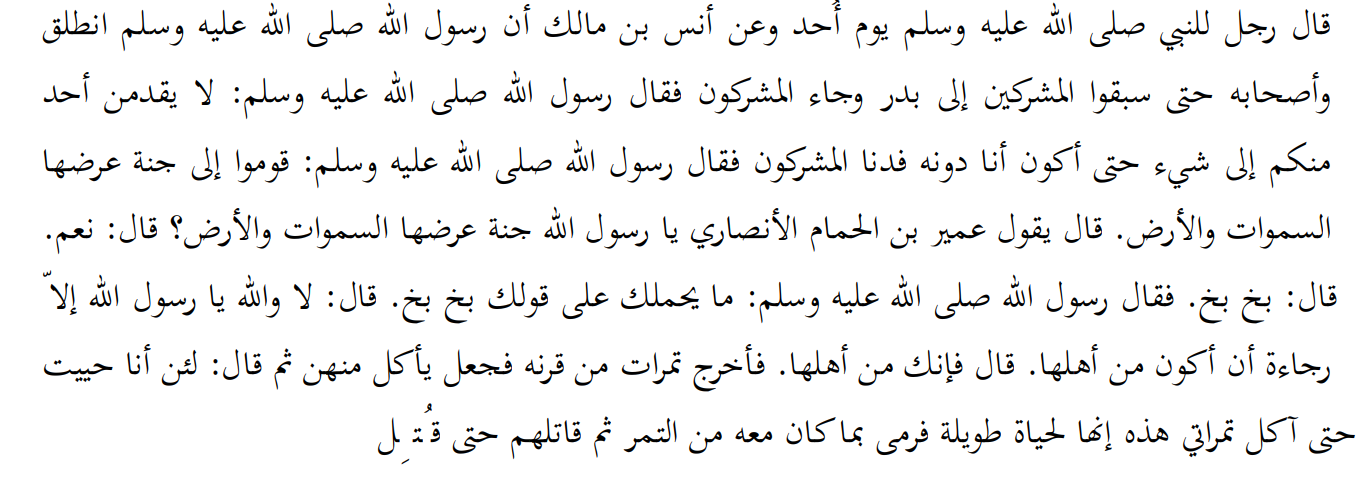
"Hech biringiz men bo'lmaguncha hech narsaga oldinga o'tmang." Mushriklar yaqinlashib kelgach, Allah elchisi ﷺ dedilar: "Kengligi osmonlar va yer kengligicha bo'lgan Jannatga qarab oldinga yuringlar." U zot aytdi: "Umayr ibn al-Hammam al-Ansariy dedi: Ey Allah elchisi, kengligi osmonlar va yer kengligicha bo'lgan Jannatmi? U zot aytdilar: (Baxx! Baxx!). Shunda Allah elchisi ﷺ dedilar: Sizni (Baxx! Baxx!) deb aytishga nima undadi? U aytdi: Allah haqqi, hech narsa emas, faqat uning ahlidan bo'lish umidi. U zot aytdilar: Albatta, siz uning ahlidansiz. U (qaran) dan xurmolarni olib, ulardan yeyishni boshladi. Keyin dedi: Agar bu xurmolarni yeguncha yashasam, bu uzoq umr bo'lar edi! U o'sha xurmolarni tashladi va ular bilan jang qildi, to shahid bo'lguncha." (Muslim rivoyat qilgan.)
“Let none of you precede to anything without my being. The polytheists came close so the Messenger of Allah (saw) said: Stand forth to a Paradise whose breadth is that of the heavens and the earth. He said: ‘Umayr bin al-Hammam al-Ansari said: O Messenger of Allah, a Paradise whose breadth is that of the heavens of the earth? He said: (Bakh! Bakh!). So the Messenger of Allah (saw) said: What carried you to your statement, (Bakh! Bakh!). He said: Nothing, by Allah, except the hope that I be one of its people. He said: Verily you are one of its people. He removed dates from his (qaran) and began eating from them. Then he said: If I were to live until I ate these dates, it would then be a long life! He threw the dates that had then fought them until he was killed” (Narrated by Muslim).
Demak, Alloh (SWT) va Alloh Elchisi ﷺ shahid uchun Jannatga guvohlik berdilar. Shahidning hayoti esa Qur'onning aniq matni bilan sobit bo'lgan. Alloh (SWT) aytdi:
So Allah (swt) and the Messenger of Allah (saw) have witnessed the Paradise for the shaheed. As for the life of the shaheed, it is established by the explicit text of the Qur’an. Allah (swt) said:
“Allohning yo‘lida o‘ldirilganlarni o‘lik deb o‘ylama, balki ular Robbilari huzurida rizqlanib tirikdirlar. Allohning fazlidan ularga berganidan xursand bo‘lib, ortlarida hali ularga qo‘shilmagan kishilar uchun ham xushxabar bo‘lib, ularga na qo‘rquv bor, na ular g‘amgin bo‘lurlar. Ular Allohdan ne’mat va fazl bilan xursandchilik xabarini oladilar va Alloh mo‘minlarning mukofotini zoye qilmasligini (bilib oladilar)” [TMQ 3:169].
“Do not think that those killed in the way of Allah are dead, rather (they are) alive with sustenance before their Lord. Pleased with what Allah gave them of His favours and with good tidings for those behind them who have not met them, that there is no fear for them nor do they grieve. They have glad tidings of blessings from Allah and His favour, and verily Allah does not cause the reward of the believers to be lost” [TMQ 3:169].
Shahidlarning bu hayoti ko‘rinmasdir, uni biz tushunmaymiz va abadiy maskanda bo‘lgani kabi idrok etmaymiz. Garchi biz bu yashirin hayotni tushunmasak va idrok etmasak ham, shunga qaramay uning mavjudligiga ishonamiz, lekin uning haqiqatini tushunmaymiz. Uning mavjudligiga bo‘lgan ishonchimiz muqarrar masaladir, chunki u aniq bir Qur’on matni bilan sobit qilingan. Alloh (SWT) aytadi:
This life for the shuhadaa is unseen which we do not understand nor perceive as it is in the eternal abode. Although we do not understand this hidden life nor perceive it, nevertheless we believe in its existence but do not understand its reality. Our conviction in its existence is an inevitable matter as it is established by a definite Qur’anic text. Allah (swt) said:
"Alloh yo'lida o'ldirilganlarni "o'lik" demanglar... Balki ular tirikdirlar, lekin siz sezmaysiz" [TMQ 2:154].
“Do not say of those killed in the way of Allah (are) ‘dead’... Rather they are alive but you do not know” [TMQ 2:154].
Shahidlarning hayoti ghayb masalalaridandir, ularga iymon keltirish vojibdir. Shahidlarning fazilatiga kelsak, bu teng keladigan narsasi yo‘q buyuk fazilatdir va Payg‘ambar ﷺ buni ko‘plab hadislarida bayon qilganlar. Imom al-Bухорий Qatoda’dan rivoyat qiladi, u aytadi: Men Anas ibn Molik (roziyallohu anhu)dan eshitdim, u Payg‘ambar ﷺdan rivoyat qilib aytdi:
The life of the shuhadaa is from the unseen (matters) in which iman is obliged. As for the virtue of the shuhadaa, it is a great virtue without an equivalent and he (saw) clarified it in numerous ahadith. Al-Bukhari narrated from Qatadah who said: I heard Anas bin Malik (ra) from the Prophet (saw) who said:
Jannatga kirgan hech kim, shahidlar bundan mustasno, dunyoda bor bo'lgan hamma narsaga ega bo'lish uchun dunyoga qaytishni xohlamaydi. Shahidlar esa, ulug'vorlikni (karamah) ko'rganlari sababli, o'n marta o'ldirilish uchun dunyoga qaytishni xohlashadi.
“No one who enters Paradise would like to return to the world to obtain all that is upon the world except the shuhadaa who would wish to return to the world to be killed ten times due to what he sees of the honour (karamah).”
Va Al-Buxoriyda:
And in Al-Bukhari:
Al-Mug‘iyra ibn Shu‘ba rivoyat qildi: “Bizning Payg‘ambarimiz ﷺ bizga Rabbimizning xabarini aytdilar: kimki bizdan o‘ldirilsa, u Jannatga boradi”. Umar ﷺ Payg‘ambarga ﷺ dedi: “Bizning o‘liklarimiz Jannatda emasmi, ularning o‘liklari esa Do‘zaxda emasmi?” U zot ﷺ dedilar: “Ha”.
“Al-Mughira bin Shu’bah said that our Prophet (saw) informed us of the message of our Lord that whoever is killed among us goes to Paradise and Umar said to the Prophet (saw): ‘Are not our dead in Paradise and their dead in the Fire. He said: Yes.”
Abdulloh ibn ‘Amr ibn al-‘Os (roziyallohu anhu) rivoyat qiladi: Allohning Elchisi ﷺ shunday dedilar:
And from Abdullah bin ‘Amru bin al-‘Aas that the Messenger of Allah (saw) said:
"Shahid qilingan kishining barcha gunohlari kechiriladi, faqat qarzidan tashqari" (Muslim rivoyat qilgan).
“All the shaheed’s sins are forgiven except the debt” (narrated by Muslim).
"Shahid qilingan kishining barcha gunohlari kechiriladi, faqat qarzidan tashqari" (Muslim rivoyat qilgan).
“All the shaheed’s sins are forgiven except the debt” (narrated by Muslim).
Allah yo‘lida o‘ldirilgan kishining barcha gunohlari, qarzidan tashqari, kechiriladi.
“The one killed in the way of Allah has all his sins wiped out except the debt.”
Abu Hurayra (roziyallohu anhu) rivoyat qilgan hadisda Payg'ambar ﷺ shunday degan, deb Al-Bukhoriy va Muslim naql qilganlar:
And Al-Bukhari and Muslim narrated from Abu Hurairah (ra) from the Prophet (saw) who said:
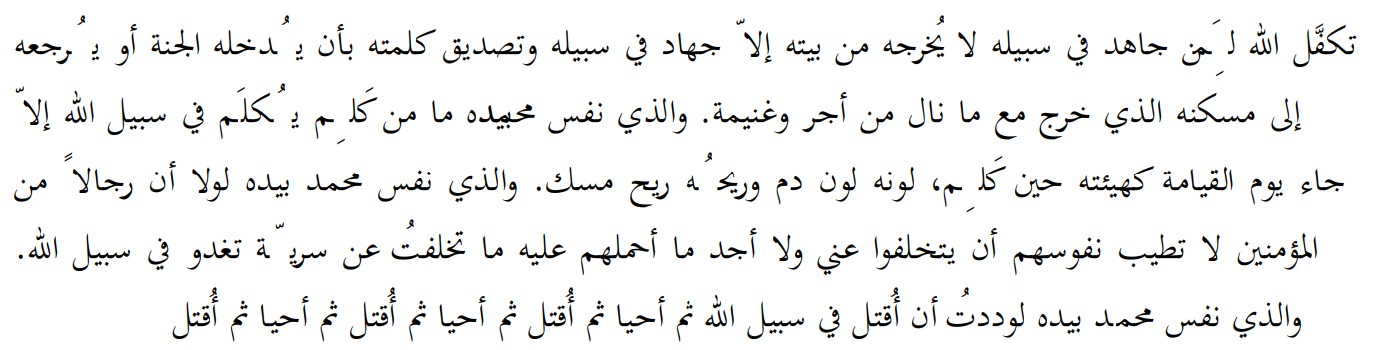
"Alloh o'z yo'lida jihod qilib halok bo'lgan kishiga kafolat beradi, uni uyidan faqat Uning yo'lidagi jihod va Uning so'zlariga ishonishdan boshqa sabab bilan chiqmagan bo'lsa, Uning Jannatiga kiritishini yoki qaytib ketgan joyiga, qanday ajr yoki o'ljaga erishgan bo'lsa, shular bilan birga qaytarishini. Muhammad ﷺ qo'li ostida bo'lgan Zot bilan qasam ichamanki, Alloh yo'lida yaralangan har bir kishi Qiyomat kunida yaralangan holatidagi shaklda keladi: uning rangi qon rangi, hidi esa mushk hidi bo'ladi. Muhammad ﷺ joni qo'lida bo'lgan Zot bilan qasam ichamanki, mo'minlar orasida mendan orqada qolishni xohlamaydigan odamlar bo'lmasa, va men ularni minib ketishga ulov topa olmasam, Alloh yo'lida tongda chiqadigan hech bir lashkardan orqada qolmagan bo'lardim. Muhammad ﷺ joni qo'lida bo'lgan Zot bilan qasam ichamanki, men Alloh yo'lida o'ldirilishni yaxshi ko'raman, so'ng tirilaman, so'ng o'ldirilaman, so'ng tirilaman, so'ng o'ldirilaman, so'ng tirilaman, so'ng o'ldirilaman."
“Allah guarantees security for the one who dies jihad in His way, not leaving his house for any other reason except jihad in His way and believing in His words, that He will enter him into Paradise or return him to his abode from which he left together with what he achieved of reward or booty. By the One in whose hand lies the should of Muhammad, whoever is wounded in the way of Allah will not come on the Day of Judgement except in his form when he was wounded, his colour the colour of blood and his odour the odour of musk. By the one in whose hand lies the soul of Muhammad, were it not that there were men among the believers whose souls are not pleased to stay behind me (when I go) nor do I find that could carry them upon, I would not stay behind any expedition that goes out in the way of Allah in the morning. By the One in whose hand lies the soul of Muhammad, I would love to die in the way of Allah then I am resurrected then killed, then resurrected then killed, then resurrected then killed.”