21.6 Favqulodda shartnomalar
21.6 Emergency Treaties
Musulmonlar ba'zan shunday og'ir vaziyatlarga tushib qolishlari mumkinki, ular ruxsat etilmagan ishlarga ham majbur bo'lib qoladilar, lekin zarurat shuni talab qiladi. Islomiy Davlat ichki yoki tashqi inqirozlarga duch kelishi mumkinki, bu uni to'g'ridan-to'g'ri da'vatni yetkazishga yoki Allah (SWT) yo'lida jihod qilishga olib kelmaydigan, lekin kelajakda da'vatni yetkazish uchun sharoit yaratadigan, da'vatni to'xtatish yomonligining oldini oladigan yoki musulmonlarning mavjudligini saqlab qoladigan shartnomalar tuzishga majbur qilishi mumkin. Zarurat bunday turdagi shartnomalarni tuzishni talab qiladi, shuning uchun Xalifaning ularni tuzishi joiz bo'ladi va ular musulmonlarga nisbatan amalga oshiriladi. Bunday shartnomalar fuqaholar aniq bayon qilgan ikki holatda yuz beradi, ular quyidagilardir:
Muslims can fall into severe situations which compel them to matters which are not allowed but the necessity obliges it. The Islamic State can fall into internal or external crises which compel it to contract treaties which do not lead directly to conveying the da’wah or fighting in the way of Allah (swt) but they facilitate creating conditions which will enable conveying it in the future or prevent the evil of stopping the da’wah or preserve the entity of the Muslims. Necessity compels these types of treaties to be contracted therefore it is allowed for the Khalifah to contract them and they are executed upon Muslims. These treaties occur in two situations which the jurisprudents (fuqaha) stated clearly, and they are:
Birinchi holat: Harbiy xalqdan bir guruh muayyan yillarga musulmonlardan sulh tuzishni so'rasa, bunda harbiy xalq har yili belgilangan miqdorda xiroj to'lashi va ularning yurtlarida Islom hukmlari joriy etilmasligi shartlari bilan, bu qilinmaydi, chunki bu kufrga rozilik bildirish hisoblanadi; ammo Davlat zulmning oldini ololmasa va bu sulhda musulmonlar uchun foyda ko'rsa, shu holda zaruriyat tufayli uni tuzish joizdir. Bunday holatda Islom Davlati ular uchun yordam yoki ko'mak bermaydi, chunki ular bu sulh orqali Islom hukmlariga bo'ysunmaydilar va Islom qoidalariga itoat qilmagan holda harbiy xalq bo'lib qolaveradilar. Shuning uchun ularga yordam ko'rsatish musulmonlarning zimmasiga yuklanmaydi. Allohning Elchisi ﷺ Shom chegaralarida, Tabuk yerida bo'lganlarida Yuhanna ibn Ruba bilan sulh tuzdilar. U zotni o'z hududida o'z dini bilan qoldirdilar va u musulmonlar bayrog'i va hukmronligi ostiga kirmadi. Muddatli bu sulh ushbu davlatning xavfsizligini Islom Davlati tomonidan kafolatlaydi. Musulmonlardan kim unga kirsa, u sulhning amniyati bilan kiradi, shaxsiy aman-omonlik bilan emas, va uning aholisiga qarshi chiqish unga joiz emas. Ushbu yurt fuqarolaridan kim musulmonlar yurtiga kirsa, u sulhning amniyati bilan kiradi va sulhdan boshqa yangi aman-omonlikka muhtoj bo'lmaydi, shuningdek musulmonlardan hech kimga uni to'xtatishga ruxsat berilmaydi. Savdogarlarning bu davlatga tovar olib borishiga, urush vositalari — qurollar, harbiy materiallar va ularga o'xshash narsalardan tashqari, to'sqinlik qilinmaydi, chunki ular harbiy xalq hisoblanadilar, musulmonlarning ular bilan sulh tuzgan bo'lsalarida ham.
The first situation: If some people of the people of war seek a treaty from the Muslims for specific years on condition that the people of war give kharaj every year for a specified amount and that the Islamic rules are not executed upon them in their lands; this is not done as it is consenting upon disbelief unless the State is not able to prevent oppression and sees in this treaty good for Muslims, then at this point it is allowed to contract it out of necessity. In this situation there is no assistance or support for them from the Islamic State because they are not compelled by this treaty with the Islamic rules and do not depart from being people of war when they do not obey the rules of Islam. So undertaking support for them is not obliged upon the Muslims. The Messenger of Allah (saw) made a treaty with Yuhanna bin Rub’ah while he was at Tabuk in the boundaries of Bilad AsSham. He left him in his zone upon his religion, and he did not enter under the banner of Muslims and their rule. This treaty of limited period makes the security of this State guaranteed by the Islamic State. Whoever enters it from the Muslims enters it with the security of the treaty and not an individual security, and it is not allowed for him to oppose its people. Whoever enters the Muslim lands from the citizens of this land enters with the security of the treaty and does not require a new security other than the treaty, nor is anyone from the Muslims allowed to oppose him. Traders are not prevented from carrying merchandise to this State except tools used in war like weapons and war materials and what is similar to this because they are people of war even if the Muslims have a treaty with them.
Ikkinchi holat: Bu birinchi holatga teskari bo'lib, unda musulmonlar o'z dushmaniga ularning sukutini saqlash evaziga pul to'laydilar. Fuqaholar aytganidek, agar dushman musulmonlarni qamal qilsa va ularga ma'lum yillarga sulh tuzishni talab qilsa, bunda musulmonlar har yili kofirlarga belgilangan miqdorda pul to'lashlari sharti bilan, xalifaning bunga rozi bo'lishi to'g'ri emas, chunki bunda musulmonlar uchun xorlik va tahqir bor, faqat zarurat yuzaga kelgandagina bundan mustasno. Bu esa musulmonlar o'zlari uchun qirilib ketishdan qo'rqqanda va xalifa bu sulhda foyda borligini ko'rganda sodir bo'ladi. Shunday paytda, rivoyat qilinganiga ko'ra, bunda hech qanday zarar yo'q.
The second situation: This is opposite to the first situation wherein the Muslims pay money to their enemy in return for their silence regarding them. The fuqaha mentioned that if the enemy sieges the Muslims and require a treaty for specified years on condition that the Muslims pay the disbelievers a specific amount every year, it is not correct for the Khalifah to comply to them upon that due to the contemptibility and humiliation therein for Muslims except under necessity. This is (when) the Muslims fear extermination for themselves, and the Khalifah views there is good in this truce. At this point, there is no harm in that due to what was narrated
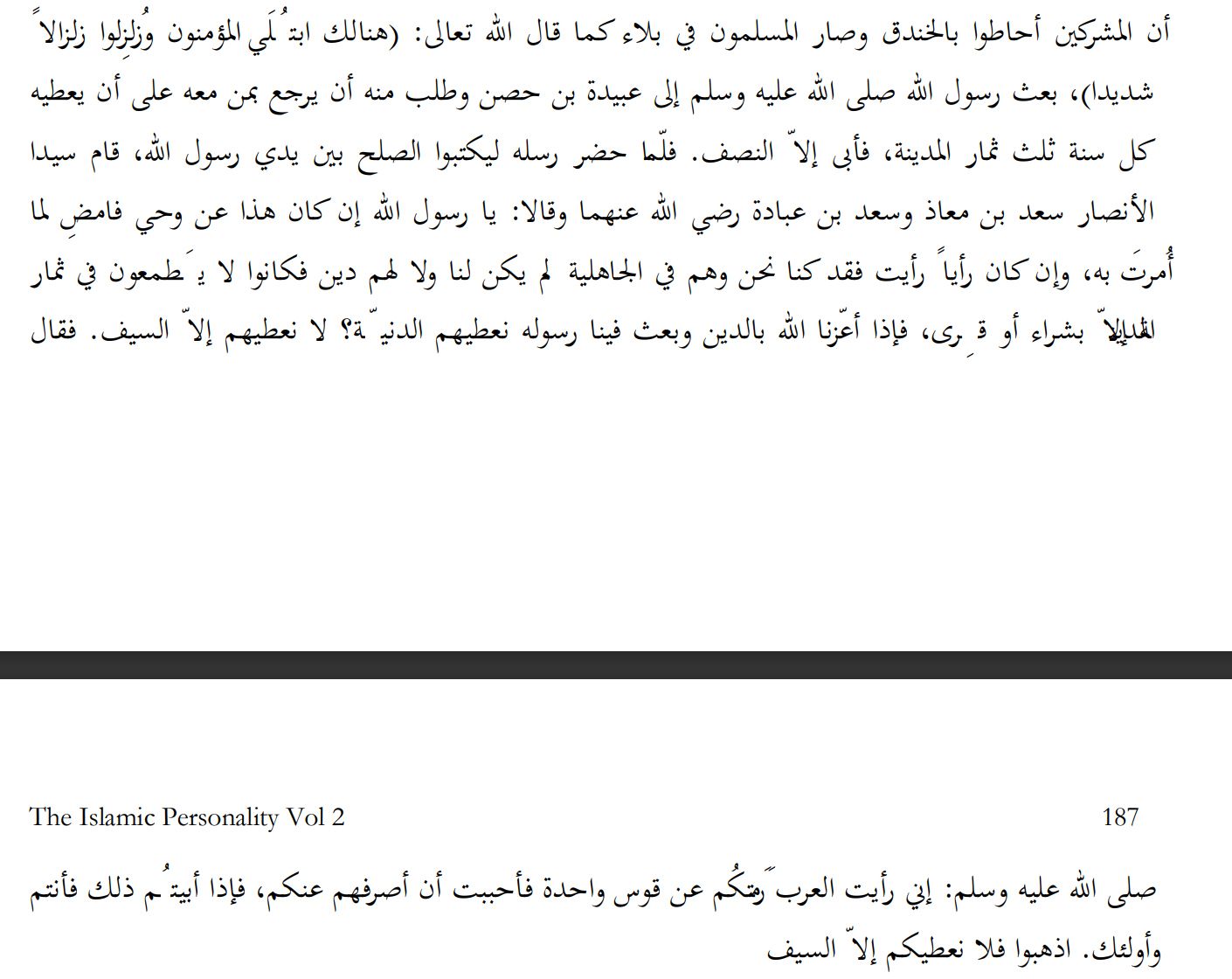
Mushriklar xandaqni o‘rab olganlarida va musulmonlar Alloh (subhanahu va taolo) aytganidek sinovga tushganlarida: «U yerda mo‘minlar sinovga solindi va qattiq larzaga keltirildi» [TMQ 33:11]. Allohning Elchisi ﷺ ‘Uyayna ibn Hasanga kishi yuborib, o‘zi bilan birga bo‘lganlar bilan qaytishini so‘radi, unga Madina mevalarining uchdan birini berishni taklif qildi. Lekin u yarmidan kamini qabul qilmadi. Uning elchilari Allohning Elchisi ﷺ huzurida sulh bitimini yozish uchun kelganlarida, Ansorning ikki sardori Sa’d ibn Ubada va Sa’d ibn Mu’oz (roziyallohu anhumo) o‘rnidan turib dedilar: «Ey Allohning Elchisi, agar bu vahiy bo‘lsa, unda buyurilganini bajaring. Agar bu sizning ijtihodingiz bo‘lsa, unda biz johiliyatda edik, na ular, na biz dinga ega emas edik. Ular Madina mevalaridan faqat sotib olish yoki mehmondorchilik orqali yeyishar edi. Shunday ekan, Alloh bizni din bilan sharaflab, Elchisini orasimizga yuborgach, biz ularga bu dunyoni, o‘zimiz xor bo‘lgan holda berarmidik? Yo‘q, biz ularga faqat qilichdan boshqasini bermaymiz». Shunda Nabiy ﷺ dedilar: «Men arablarning bir kamondan o‘q otayotganini ko‘rdim, shuning uchun ularni sizdan chalg‘itishni xohladim. Agar buni rad etsangiz, unda o‘zingiz va ular. Ketinglar, biz sizlarga faqat qilichdan boshqasini bermaymiz!»
“That the polytheists surrounded the trench and Muslims were in trial like Allah (swt) said: ‘Therein the believers were tested and shaken with a severe shaking’ [TMQ 33:11].The Messenger of Allah (saw) sent to ‘Uyaynah bin Hasan and requested that he return with those together with him upon giving him a third of the fruits of Madinah but he refused except a half. When his messengers appeared to write the truce in front of the Messenger of Allah, the two chiefs of the Ansar, S'aad bin ‘Ubadah and S'aad bin Mu’adh (ra) stood and they said: ‘O Messenger of Allah, if this is from revelation then execute what you are commanded with but if it is an opinion which you considered, then they and we were in jahiliyyah when neither they nor we had a religion yet they did not eat of the fruits of Madinah except through purchase or hospitality. So when Allah honoured us with the deen and sent His Messenger among us, should we give them this dunya while being contemptible? No, we will not give them except the sword. So he (saw) said: ‘I saw the Arabs shooting from one bow so I liked to divert them from you. If you reject that, then it is you and those. Go away for we will not give you except the sword!’”
Bu shuni ko'rsatadiki, Allah elchisi ﷺ musulmonlarning zaifligini sezgani sababli avvaliga sulhga moyil bo'ldi. Sa'd ibn Ubada va Sa'd ibn Mu'oz (roziyallohu anhuma) so'zlaridan so'ng musulmonlardagi kuchni ko'rgach, u bundan qaytdi. Bu esa, zarar yetish xavfi bo'lganda kofirlar bilan pul to'lash evaziga sulh tuzishda hech qanday zarar yo'qligini bildiradi. Chunki agar ular musulmonlarni yengsalar, butun boylikni va oilalarni asir (sabaya) qilib olishadi. Shuning uchun musulmonlarni, ularning oilalarini va mollarini himoya qilish uchun ozgina mol to'lash, ancha xo'rlikli va foydaliroqdir.
This indicates that the Messenger of Allah (saw) initially inclined to the truce due to what he sensed of the Muslims’ weakness. When he saw the strength in them due to what S'aad bin ‘Ubadah and S'aad bin Mu’adh (ra) said, he refrained from that which indicates that there is no harm from contracting a treaty with disbelievers paying them money when there is danger of harm. This is because if they conquered Muslims they would take all the wealth and the families as captives (sabaya), so paying some wealth to safeguard Muslims and their families and wealth is less contemptible and more beneficial.